

There is a category of everyday experience so ordinary that nobody thinks to ask about it, and this is a good example.
Something itches. You scratch. It stops, briefly, and then frequently returns worse. Everybody has done this thousands of times and almost nobody has wondered why any part of that sequence happens.
The answers are more interesting than the question suggests, and they were established comparatively recently. For most of the history of the subject, itch was assumed to be a variety of pain rather than a distinct sensation, and the identification of a separate system is a development of the past few decades.
Here is what is now understood, and where it stops.
Why the Old View Was Reasonable

The intensity theory held that the same nerve fibres carried both sensations, with weak stimulation producing itch and strong stimulation producing pain.
That was a sensible position given the available evidence. The two sensations occur in the same tissue, are triggered by overlapping stimuli, and behave as though they sit on a continuum — a mild irritation itches and a stronger one hurts.
It also explained the relationship between them economically. If they share a pathway, the interaction between them requires no additional machinery.
What defeated it was the accumulation of findings that a shared pathway could not accommodate. Certain substances produce intense itch and no pain at all. Certain conditions abolish pain while leaving itch intact. And the sensations produce opposite behaviour — pain causes withdrawal and itch causes approach, which is a strange thing for one system to do at two intensities.
That last point is the strongest. A signal saying stop touching and a signal saying touch this immediately are not plausibly the same signal at different volumes.
Like our content? Follow us for more.
What Itch Actually Is
The current picture involves dedicated machinery at several levels.
Specific receptors on nerve endings in the skin respond to itch-producing substances, and those receptors are distinct from the ones responding to damaging stimuli.
Specific signalling molecules are involved, some of which produce itch reliably when introduced and pain not at all.
And dedicated nerve fibres carry the signal, along a pathway that can be distinguished from the pain pathway in the spinal cord and above.
That is a complete parallel system rather than a variation on an existing one, which is what makes the discovery significant. It also means the two systems can be studied, and potentially addressed, separately.
There is a further complication worth noting: itch divides into more than one kind. Itch arising in the skin and itch arising from within the nervous system are not the same phenomenon and do not respond to the same things, which is part of why the subject took so long to untangle.
There is a practical consequence of the separate-pathway finding worth stating. Because the two systems are distinct, something that reduces one does not necessarily reduce the other, and treatments developed for pain do not reliably help with itch.
That was a real clinical problem while the two were assumed to be the same thing, and it is the clearest illustration of why the distinction matters beyond the laboratory.
Why Scratching Works

The relief has a mechanism, and it is not what people assume.
Scratching does not remove whatever is causing the itch. What it does is generate a competing signal — a mild pain and pressure input from the same region — and pain suppresses itch.
The two systems inhibit one another. Activity in the pain pathway reduces transmission in the itch pathway, which is why a mildly painful stimulus produces relief and why cold, heat and pressure can do the same thing.
That explains the specific quality of scratching relief. It is not the removal of a cause; it is the drowning out of a signal by a louder one on an adjacent channel.
It also explains why the relief is temporary. Nothing has been fixed. The suppression lasts while the competing input lasts, and when it stops the original signal is still there.
Why It Frequently Gets Worse
The unpleasant part follows directly, and it is the reason scratching is generally poor advice.
Scratching damages skin, and damaged skin releases substances that themselves provoke itch. So the relief is followed by an increase in the underlying signal.
That produces a cycle in which each round of scratching provides briefer relief and generates a stronger return, escalating over time.
Where this becomes a real clinical problem it is a matter for a doctor, and nothing in this article is advice about any skin condition, persistent itching, or anything that is not settling. Those require proper assessment and this is not it.
The general mechanism is worth understanding regardless, because it explains an experience everybody has had: that scratching an itch is frequently the thing that makes the next hour worse.
Why the Sensation Exists at All
The functional question is worth asking, because itch is unpleasant and evolution does not generally produce unpleasant sensations without a reason.
The standard account is that itch evolved as a defence against things on the skin rather than things damaging it. Pain reports injury and prompts withdrawal; itch reports something present on the surface and prompts removal.
That distinction explains the opposite behavioural responses neatly. An insect, a plant irritant, a parasite or anything else resting on the skin is best dealt with by directed contact, and a signal producing withdrawal would be exactly wrong.
It also explains the localisation. Itch is felt at a precise point and prompts action at that point, which is what a removal response requires and more than a general damage signal needs.
There is supporting evidence in where itch can be felt. It arises readily from skin and from surfaces exposed to the outside world, and not from internal organs – which is what would be expected of a system evolved to deal with things arriving on the outside.
That account is generally accepted in outline and leaves plenty unexplained, particularly the varieties of itch arising from within the nervous system rather than from anything on the skin, which the defensive story does not cover at all.
The Part That Is Genuinely Strange
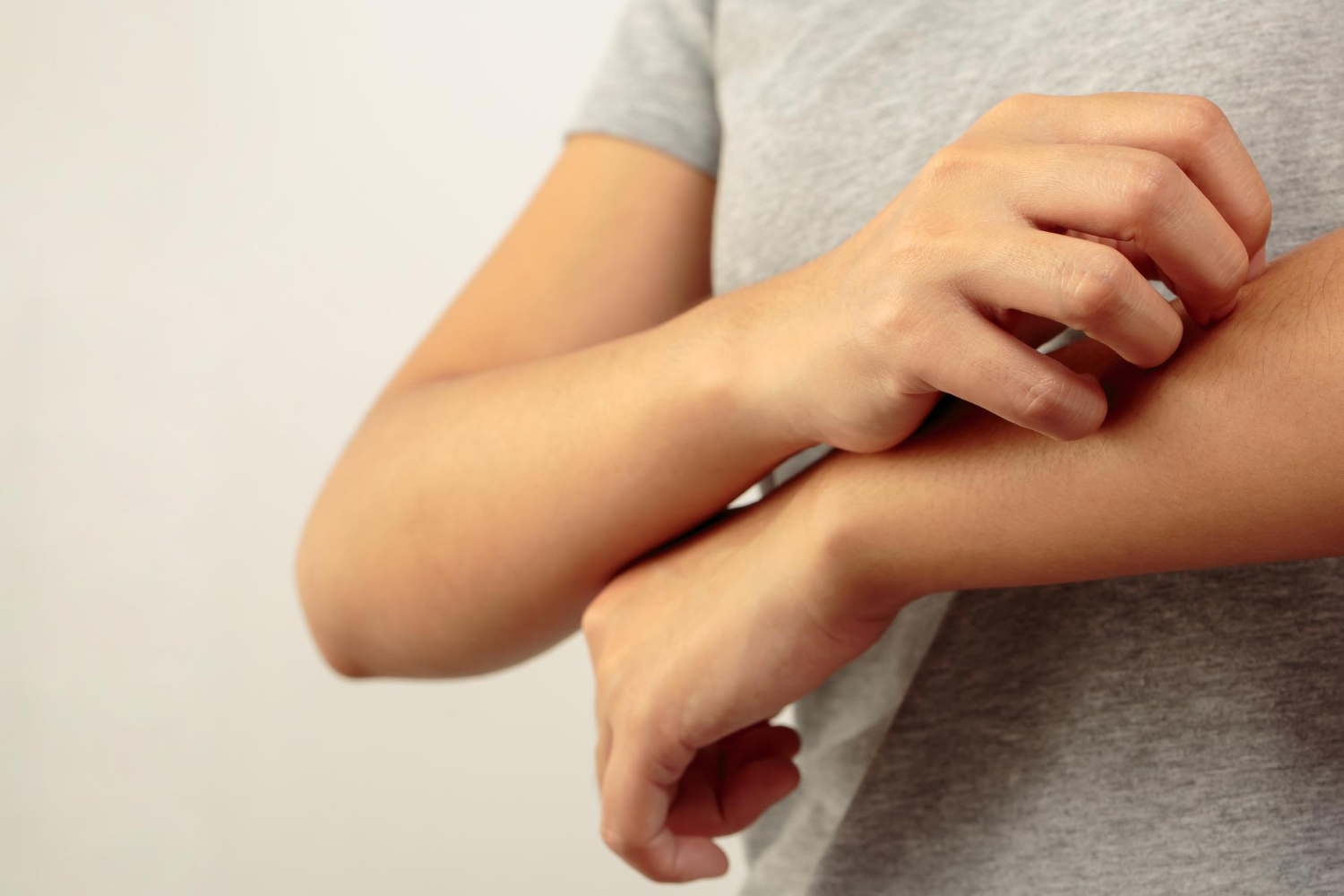
Itch is contagious, and this is well documented rather than anecdotal.
Watching somebody scratch, and in controlled settings merely reading or hearing about itching, produces measurable scratching behaviour in observers. Studies have demonstrated the effect under conditions where suggestion alone is the only input.
That places itch alongside yawning as a behaviour that transmits socially, and the mechanism is not established. Proposals involve the systems handling observed action, or something related to social signalling about parasites, and neither is demonstrated.
A reasonable number of people reading this paragraph will have scratched something while doing so, which is a demonstration available at no cost and is itself the phenomenon.
There is one more asymmetry between the two systems that is worth noting, because it is counterintuitive.
Pain can be produced almost anywhere in the body – in muscle, in bone, in organs, in joints. Itch is essentially confined to the skin and to the surfaces continuous with it.
Nobody reports an itching liver. That restriction is consistent with the defensive account and is another piece of evidence that the two systems are doing different jobs rather than one job at two intensities.
Why Anybody Should Care
Beyond the curiosity, the reason this matters is medical and it is worth stating plainly.
Chronic itch is a serious problem affecting a substantial number of people, arising from a wide range of causes, and for a long time it was poorly served because it was regarded as a minor variant of pain rather than as its own subject.
Establishing that it has separate machinery is what makes it addressable separately. A system with its own receptors, its own molecules and its own pathway offers points of intervention that a shared pathway would not.
That is the practical payoff of a piece of basic science that looks, from outside, like an academic distinction about a trivial sensation.
And it is a reasonable illustration of a general pattern. An assumption held for two centuries, entirely plausible, consistent with most of the available evidence, and wrong — corrected not by a single decisive experiment but by an accumulation of findings that the old framework could not absorb.
The sensation itself remains exactly as it always was: an urgent instruction to touch a specific point, arriving from a system that had been assumed for two hundred years to be doing something else.
Which is a reminder that the most ordinary experiences are not necessarily the best understood. Something everybody feels daily, that requires no equipment to observe, went two centuries with a confident and incorrect explanation – not for want of interest, but because the wrong answer fitted well enough that nobody had reason to look harder.
Like our content? Follow us for more.
