
The Fold Most People Assume Is a Mistake

Turn a pillowcase inside out at the open end and you will usually find an extra depth of fabric – a flap, sewn to the sides and open along one edge, running the full width of the case and extending perhaps fifteen to twenty centimetres inside.
An enormous number of people have never noticed it. Of those who have, most assume it is a seam allowance, a reinforcement, or a bit of untidiness in the making. It gets ignored, the pillow is pushed in, the open end is left open, and the pillow spends the night gradually emerging.
It is a closure. The term for it in the trade is an envelope closure, and the design is deliberate: you push the pillow all the way in, then tuck its end into the flap, which folds back over the pillow and holds it. The pillow is then enclosed on all four sides with nothing to work loose, no buttons to press into anybody’s head, and no zip to break or dig in.
Used as intended, a pillow stays where it is put. Used as most people use it, it does not.
Like our content? Follow us for more.
Why a Pillow Escapes in the First Place
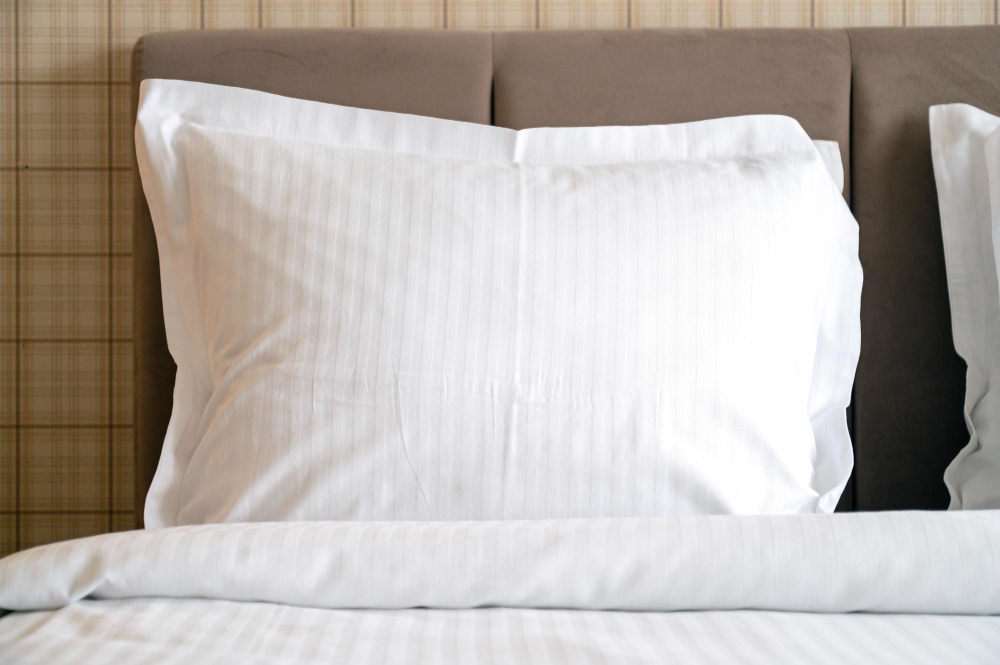
The reason this matters is that a pillow in an open-ended case is being worked on all night by forces that are quite well suited to pushing it out.
A sleeping person moves – estimates vary but most adults shift position dozens of times a night – and each movement compresses part of the pillow and releases it. A pillow is compressible and springy, so compression at one end pushes filling and air towards the other, and the open end is where it can go. Over several hours the pillow migrates towards the opening and a corner emerges, after which the rest follows quickly.
Add to that the fact that bedding is pulled, turned and dragged, and that the pillow is frequently gripped through the case and repositioned. Every one of those actions tends to move the pillow outward.
An envelope flap defeats all of it with no mechanism at all. The flap lies between the pillow and the opening, so the pillow is pushing against a doubled layer of fabric anchored to both side seams rather than against nothing. It cannot migrate past it.
The whole arrangement costs the manufacturer an extra piece of fabric and one more seam, which is why it has survived as a standard feature on better bedding for well over a century.
The Alternatives and Why Most of Them Lost

The envelope flap is not the only way to close a pillowcase, and the competitors are instructive.
Buttons were the traditional solution on good linen, and they work. The objection is that a button is a hard object positioned exactly where somebody’s head and ear will rest for eight hours, which is tolerable on a pillow large enough that the closure is well off to the side and uncomfortable on anything smaller.
Ties are gentler and solve the pressure problem, but they take time to fasten, come undone, and knot themselves in the wash.
Zips are the most positive closure available and are standard on protective covers and on many cushion covers. They are also hard, cold, prone to failure, awkward to iron over, and capable of catching skin and hair – which is why they are generally confined to a protector underneath rather than the case you actually sleep on.
The flap has none of those drawbacks. There is nothing hard in it, nothing to fasten, nothing to fail and nothing to catch. It adds no bulk you can feel, requires no action beyond tucking, and works identically for the whole life of the item.
Which is the usual reason a plain-looking solution beats a clever one: it has no failure mode.
How to Tell Which Kind You Have
Not every pillowcase has a flap, and it is worth knowing which of yours do.
The quick test is to put your hand into the open end and feel along the inside of the top layer. If there is a flap, your hand will find a second layer of fabric with an open edge running across it a hand’s span or more inside the opening, and you will be able to put your fingers into the pocket this forms.
A plain hemmed opening is the cheaper construction and is what you get on most inexpensive bedding and on a good deal of hotel-grade stock, where cases are changed constantly and the extra fabric is an expense repeated across thousands of items.
There is a second design worth recognising: the housewife or Oxford style case where the closure is on the end rather than the long side, and some of these have the flap, some have an overlap on the outside instead, and a few have both.
If yours is plain, there is nothing wrong with it and nothing to fix. But it explains why the pillow comes out, and it is the single most useful thing to check when buying new bedding, because it is not usually mentioned on the packaging and is obvious the moment you put a hand inside.
Using It Properly Takes About Three Seconds

The method, for anybody who has been ignoring a flap for years:
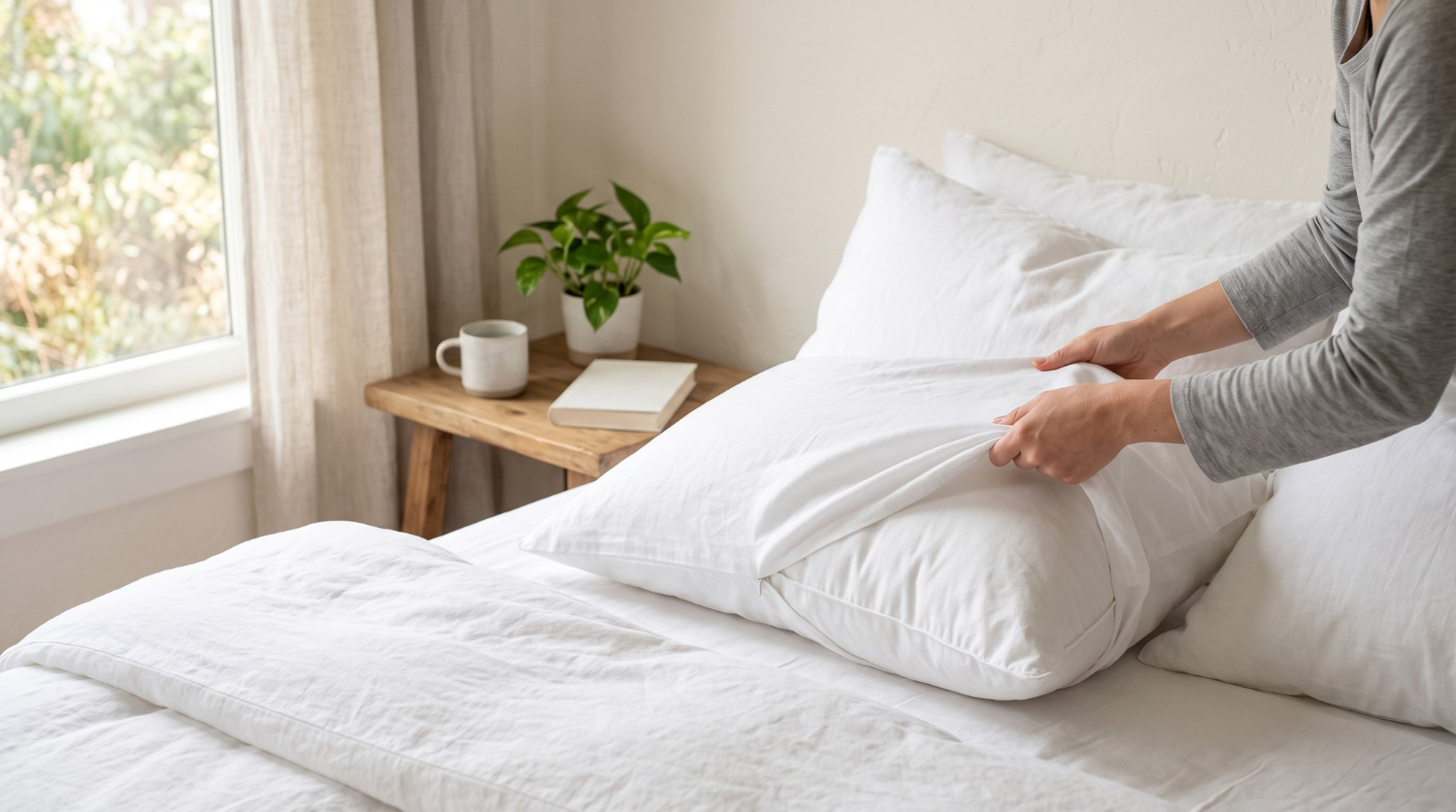
Push the pillow fully into the case, right to the closed end, and square the corners off so the pillow’s corners sit in the case’s corners rather than bunching. Then take the trailing end of the pillow, compress it slightly, and feed it into the pocket formed by the flap. Let the pillow expand again and the flap will lie flat across it, held in place by the pillow’s own springiness.
The common error is tucking the flap behind the pillow rather than putting the pillow inside the flap. That does nothing, because the flap is then on the outside of everything and holding nothing. If the flap is visible from outside when you have finished, it is the wrong way round.
The second common error is using a case that is too large for the pillow, in which case the pillow does not reach into the flap and cannot be held by it. Pillow and case sizes are nominally standardised but vary between makers, and a case a size too big will not stay neat whatever you do with the flap.
Done correctly, the finished pillow has a crisp squared end with no opening visible, which is also why hotels and the makers of magazine photographs favour cases with flaps.
The Flap Is Also the Part That Wears Out First
There is a practical consequence of the flap that nobody mentions, which is that it changes how the case ages.
The opening end of a pillowcase takes the most handling of any part of the bedding. It is gripped, stretched over the pillow, pulled off again, and put through the wash more often than anything else in the room. On a plain hemmed case that stress goes into a single hem, which eventually frays or pulls away from the side seams.
On a case with a flap, the stress is shared across two layers and the side seams are reinforced by the flap being stitched into them. That makes the opening stronger – but it also means the flap itself takes punishment, and the seam where the flap meets the side is the first place a case will fail. If a pillowcase is going to go, it will usually go there rather than in the middle.
It also affects drying and ironing. A doubled layer holds water, so a case with a flap takes noticeably longer to dry and will come out of a cycle damp at the opening when the rest is ready. If you iron bedding, the flap needs opening out and pressing separately, which is one of the quieter reasons high-turnover laundries prefer plain hems: every extra fold is a few more seconds multiplied by several thousand items a day.
None of that is a reason to avoid them. It is simply the trade-off: a closure that costs nothing to operate costs a little in laundering.
The Same Idea Turns Up All Over the House
Once you recognise the envelope closure, you start seeing it in other places where a hard fastening would be a nuisance.
Cushion covers use it constantly, with two panels overlapping at the back so the cushion can be removed for washing with no zip in the seam. Duvet covers use a version of it. Laundry bags, folding garment covers and a great many soft furnishings use the same geometry: an overlap held shut by the contents pressing against it.
The principle in all of them is that a filled object pressing outward can be used to hold its own cover closed, so the fastening is supplied free by whatever is inside. No mechanism is needed because the contents do the work.
That is a genuinely elegant piece of design, and it is almost entirely invisible, which is presumably why so many people spend years turning a flap inside out, deciding somebody at the factory was careless, and wondering why the pillow will not stay in.
It was doing its job all along. It just needed the pillow put inside it.
Like our content? Follow us for more.