

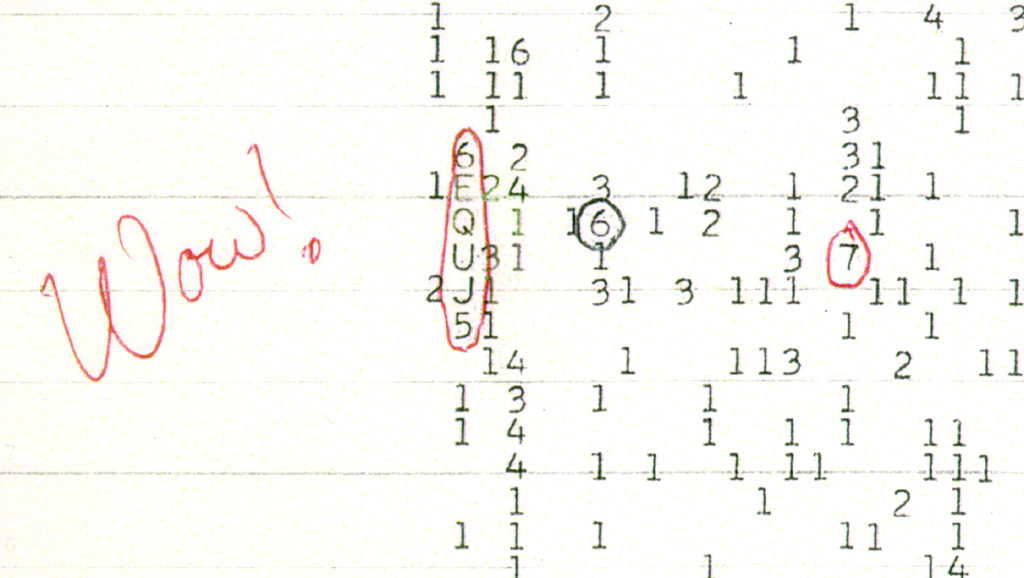
In 1977, an Ohio radio telescope detected a 72-second burst from deep space so strong and so anomalous that the astronomer who found it scrawled “Wow!” on the printout. For 47 years, no one could explain what it was. Now there are two serious scientific candidates.
On the night of August 15, 1977, the Big Ear radio telescope at Ohio State University was scanning the constellation Sagittarius as part of the longest-running search for extraterrestrial intelligence in scientific history. A few days later, volunteer astronomer Jerry R. Ehman was reviewing the night’s printout when he noticed something that stopped him cold. A 72-second signal, 30 times stronger than the surrounding background noise, on a frequency exactly where extraterrestrial intelligence researchers expected aliens might communicate. Ehman circled the alphanumeric code that recorded the signal’s intensity — “6EQUJ5” — and wrote a single word in the margin: “Wow!”
For the next 47 years, no one could explain what had produced it. The Wow! signal became one of the most discussed unsolved mysteries in modern astronomy, generating thousands of papers, theories, and arguments. As of 2026, two serious scientific explanations are now in active competition. Neither involves aliens. Both are extraordinary in their own way.
What made the signal so strange
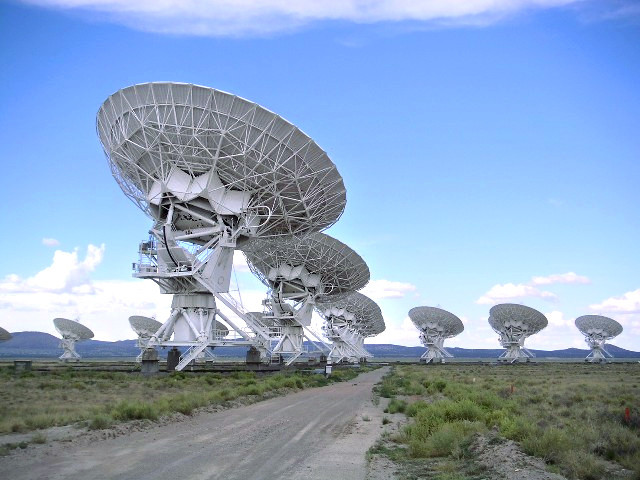
The reason the Wow! signal stood out wasn’t just its strength. Multiple specific characteristics matched what astronomers had hypothesized an artificial deep-space transmission would look like.
First, the frequency. The signal was detected at approximately 1,420.4556 MHz — known as the “hydrogen line,” because hydrogen atoms in space naturally emit at this frequency. In a famous 1959 paper, Cornell physicists Philip Morrison and Giuseppe Cocconi argued that any technological civilization attempting to communicate via radio would likely use exactly this frequency, since hydrogen is the most common element in the universe and its emission frequency would be familiar to all advanced astronomers, human or otherwise. This frequency is also held off-limits to human transmissions by international agreement, making it unusually quiet on Earth — which is exactly why SETI researchers had been searching it since the 1960s.
Second, the bandwidth. The Wow! signal was narrowband — it occupied a very small range of frequencies, the same way artificial radio transmissions do, and unlike most natural astronomical sources which spread across wide frequency ranges.
Third, the duration. The 72-second signal length matched exactly the time the Big Ear telescope’s beam would have swept across a fixed point in the sky. This was consistent with a stationary source rather than something moving rapidly through the telescope’s field of view.
Fourth, and perhaps most puzzling: the signal appeared in only one of the telescope’s two parallel feed horns. The Big Ear had two receivers offset slightly from each other, and any signal from a fixed point in the sky should have been detected first by one feed horn, then by the other roughly three minutes later. The Wow! signal appeared in one and not the other, even though Ehman and other astronomers spent the following months and years searching for its return.
It never came back.
The first 40 years of failed explanations
Numerous theories were proposed and rejected over the following decades. Reflections from satellites or space debris were checked and ruled out. Stellar scintillation was considered and dismissed as inconsistent with the signal’s specific properties. Various proposed natural astrophysical sources didn’t match the signal’s narrowband nature. Conspiracy theories — Soviet weapons tests, secret military communications, alien probes — proliferated in popular media but had no supporting evidence.
By the 2010s, the Wow! signal was widely treated by serious astronomers as an unsolvable case: a one-time event with no captured follow-up, occurring at a frequency where modern human transmissions had since become common (introducing more sources of confusion), at a sky location that was approximate at best.
Then in 2016, an astronomer at St. Petersburg College in Florida proposed an answer that hadn’t been seriously considered before.
The comet hypothesis
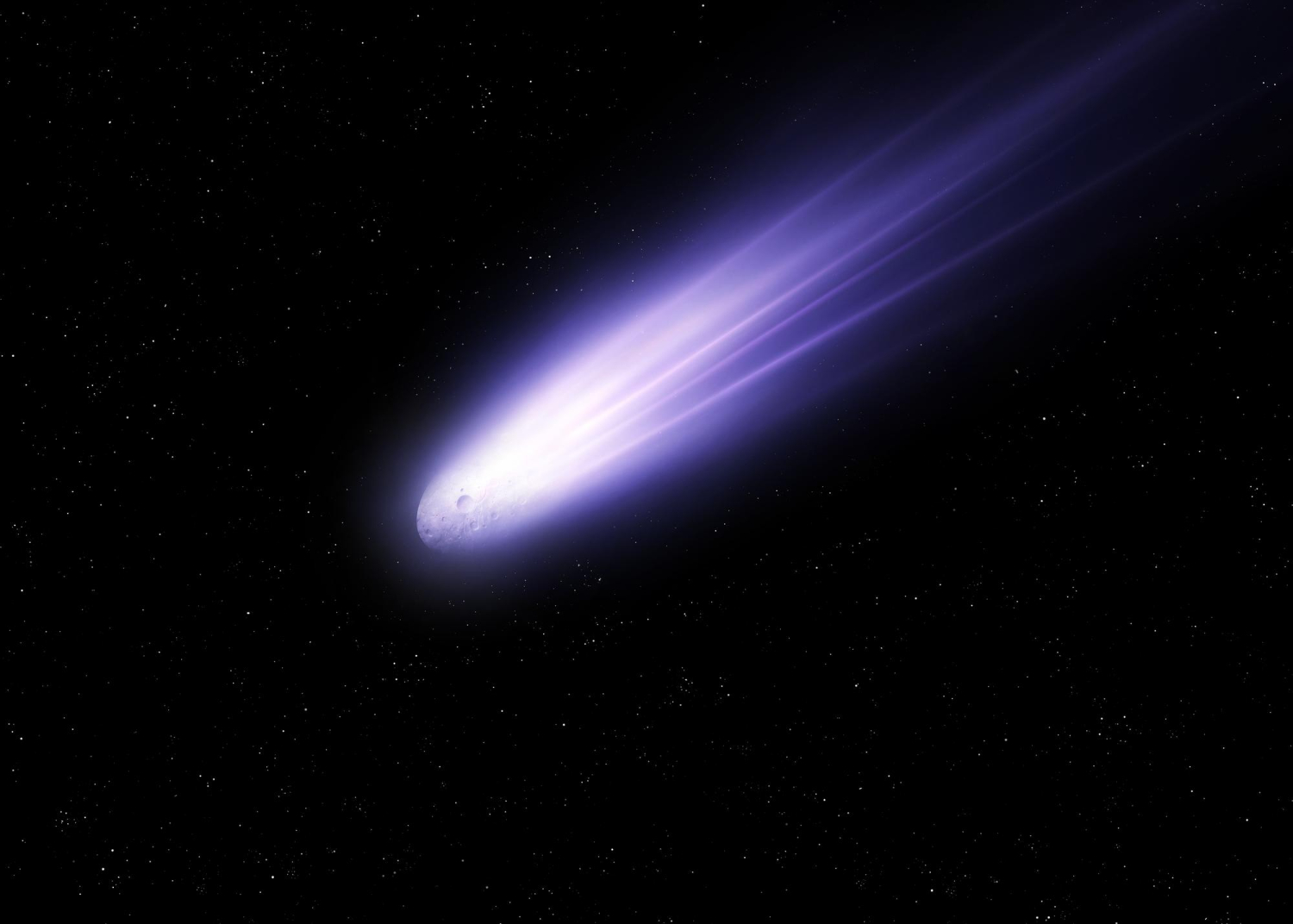
Antonio Paris, an assistant professor of astronomy at St. Petersburg College and Chief Scientist at the Center for Planetary Science, noticed something in his historical research: two comets — 266P/Christensen and P/2008 Y2 (Gibbs) — had passed through the same region of sky as the Wow! signal in August 1977, but were unknown to astronomers at the time. Both comets are surrounded by enormous clouds of hydrogen gas. Paris hypothesized that the hydrogen cloud around one of the comets could have produced a brief, narrow-band emission at exactly 1,420 MHz as the comet’s outgassing interacted with the surrounding interstellar medium.
The hypothesis had several attractive features. It explained why the signal was never detected again — the comet had moved on in its orbit. It explained the narrowband nature, since a hydrogen cloud emits at the hydrogen line. It explained why the signal came from the specific direction it did. And it didn’t require any new physics.
Between November 2016 and February 2017, Paris’s team built a 10-meter radio telescope and conducted over 200 observations of comet 266P/Christensen and three other comets selected randomly from the JPL Small Bodies database. The team’s published results in the Journal of the Washington Academy of Sciences in June 2017 showed that all four comets emitted radio signals at 1420 MHz — supporting the hypothesis that comets in the right configuration can produce hydrogen-line emissions.
But the comet explanation has not been universally accepted. Jerry Ehman himself — the astronomer who originally identified the Wow! signal — told Live Science in 2017: “We do not believe the two-comets theory can explain the Wow! signal.” Several specific objections have been raised: comets don’t typically emit strongly at 1,420 MHz, the cited comets weren’t in the precise correct position to match the signal’s recorded coordinates, and the issue of the signal appearing in only one of the Big Ear’s feed horns remained unexplained. Seth Shostak, senior astronomer at the SETI Institute, said in the same coverage: “I don’t think the idea that the Wow! signal was due to comets makes much sense.”
The magnetar/maser hypothesis
In 2024, a different explanation emerged — one that may now be the leading candidate.
Astrobiologist Abel Méndez, director of the Planetary Habitability Laboratory at the University of Puerto Rico at Arecibo, led a team that re-analyzed the original Big Ear data using modern signal analysis techniques. The work was conducted as part of the “Arecibo Wow!” project, which had been searching archival data from the now-collapsed Arecibo Observatory for similar signals. The team published their results in 2024.
Their analysis revealed several details the original 1977 investigators couldn’t see. A more precise location for the signal in the sky. A peak intensity of approximately 250 Janskys — four times stronger than previous estimates. And, critically, the team found in archival data multiple Wow!-like signals scattered across the sky in similar configurations.
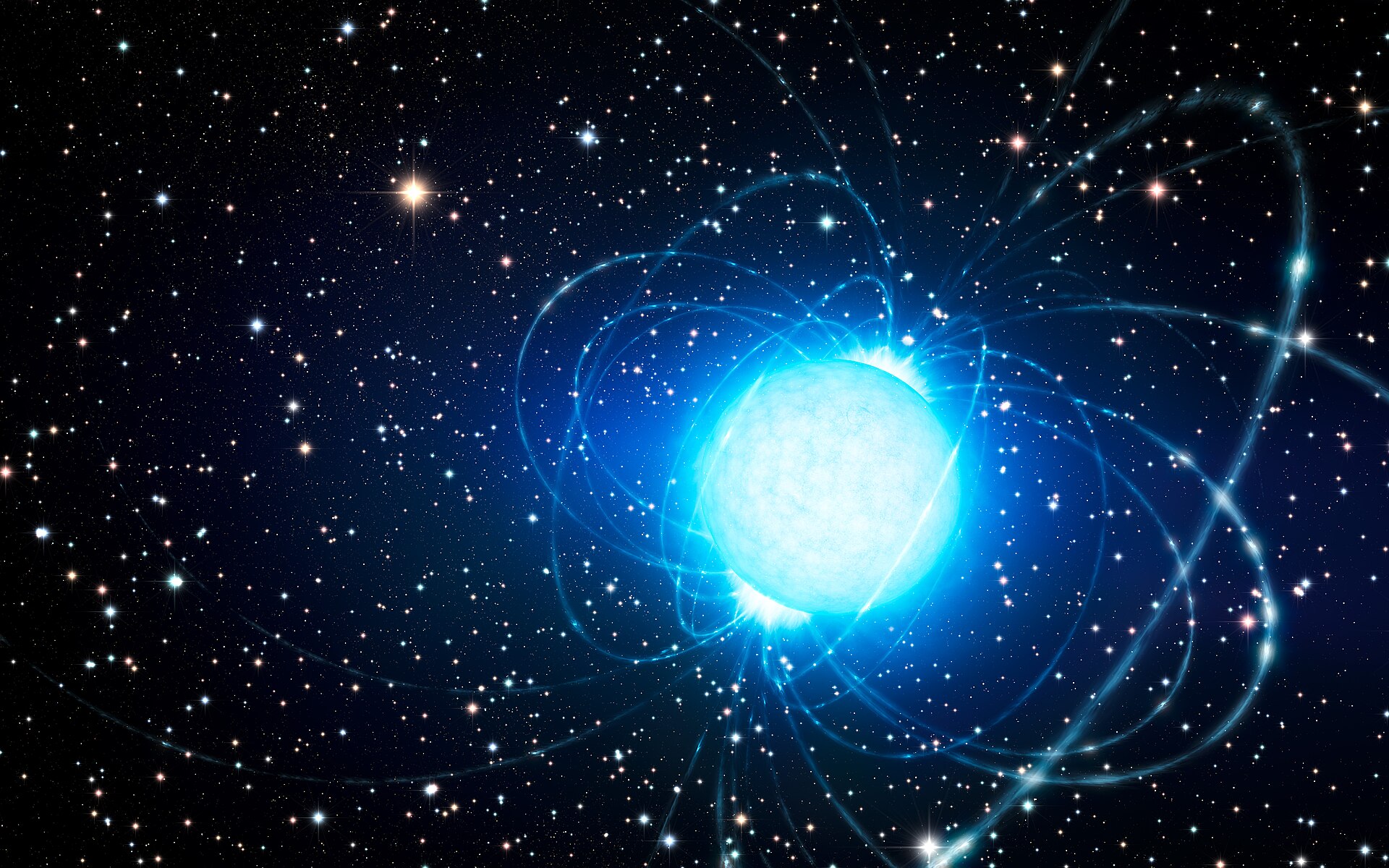
The conclusion they reached: the Wow! signal was likely produced by a “naturally occurring maser” — a phenomenon where a flare from a hypermagnetized, hyperdense star called a magnetar struck a cold interstellar cloud of hydrogen gas. The flare caused the hydrogen cloud to “incandesce” briefly in radio wavelengths at exactly 1,420 MHz. The emission was intense, narrowband, and short-lived because magnetar flares themselves are short-lived events.
Magnetars are an extreme class of neutron star with magnetic fields trillions of times stronger than Earth’s. They were only discovered as a distinct astrophysical object in 1992 — 15 years after the Wow! signal was detected. Méndez and his coauthors essentially argued that the 1977 Big Ear telescope had been pointed, by remarkable coincidence, at exactly the right hydrogen cloud at the moment a magnetar flare reached it.
The magnetar/maser hypothesis explains things the comet hypothesis doesn’t: the discovery of similar signals in archival Arecibo data (suggesting the underlying mechanism is not unique), the signal’s specific intensity profile (matching what models predict for hydrogen-line maser emission), and the precise frequency match.
It also doesn’t fully explain everything — particularly the feed horn anomaly — and remains under active scientific debate. But as of 2026, it is the most rigorous proposed explanation for what happened on August 15, 1977.
What we still don’t know
Both explanations — Paris’s comet hypothesis and Méndez’s magnetar/maser hypothesis — share a feature that’s worth noting: neither one was conceivable in 1977. The comet hypothesis required the discovery of comets 266P/Christensen and P/2008 Y2 (Gibbs), which weren’t cataloged for decades after the Wow! signal. The magnetar/maser hypothesis required the discovery of magnetars themselves, which weren’t a known object class until 1992, and required the kind of archival re-analysis that’s only become possible with modern computational tools.
In other words, the reason the Wow! signal stayed unexplained for 47 years isn’t because no one was looking. It’s because the actual explanation required science that didn’t yet exist. Even now, neither explanation is settled — and there’s no guarantee that the case won’t be revised again as new instruments and new physics become available.
What the Wow! signal demonstrates more than anything else is the actual texture of how astronomical mysteries get solved: not in a single dramatic breakthrough, but slowly, across decades, as the universe yields more information about what’s actually out there. The question of whether anyone is signaling Earth from elsewhere in the galaxy remains open. The Wow! signal, as best we can tell now, was almost certainly nature being weird in a way nobody in 1977 had the tools to recognize. That’s a more interesting answer than the alien hypothesis ever was — and unlike the alien hypothesis, it can keep being checked as we get better at listening.
