Antikythera, a remote Greek island with just 24 permanent residents, is trying to repopulate itself by paying families €500 a month for three years and providing free housing. The catch: there’s only space for five families, and the homes still aren’t built.
The Greek island of Antikythera sits between Crete and the Peloponnese, covering less than eight square miles in the Aegean Sea. It has 24 permanent residents in winter, rising to about 40 during the summer tourist season. Forty years ago, the island had a population of approximately 300. The decline followed the same pattern as countless other small Greek islands and rural communities across southern Europe — younger generations moved to Athens or abroad for work, and the population that remained slowly aged out.
In response, the local Greek Orthodox Church (the Metropolis of Kythira and Antikythera) and the local council launched an unusual repopulation initiative: pay new families to move to the island. The program has generated significant international media attention since it was announced and continues to attract interest in 2026. But the actual mechanics — and the catches — are more specific than the headlines often suggest.
What the program actually offers
According to multiple sources including statements from Antikythera president Andreas Charchalakis, the local Greek Orthodox Church, and 2026 reporting from Greek City Times and Travel Pirates, the program offers selected families:
- Free housing, in newly constructed homes that the program will provide and that families can live in for as long as they remain residents
- A monthly stipend of €500 (roughly $584 USD, £435 GBP) per household for the first three years
- Total financial support of approximately €18,000 over the three-year period
- A small plot of land alongside the housing
- Continued housing access at reduced rent (€225/month) after the initial three years, plus an additional €50 per month for each child between ages 4-18
The total package, including housing value and stipend, has been estimated at roughly $20,000 USD over three years, though the housing component has substantially more value than that.
The catches that aren’t always reported
The program is significantly more restrictive than international headlines suggest. According to local sources who have spoken with Greek relocation specialist Elxis (At Home in Greece) and other published interviews:
Only five families will be selected. This is not an open relocation program. The total program capacity is five households, total. The selection process involves interviews with prospective residents.
Families must have at least four children. The program is specifically designed to repopulate the island, particularly to ensure the local school can remain open. Solo applicants, couples without children, or families with one or two children are not the target demographic.
Specific skills are prioritized. The program is looking for people whose work supports island life: bakers, fishermen, builders, farmers, and other tradespeople who can sustain essential services. Remote workers and retirees are less likely to be selected.
The houses don’t exist yet. This is the most significant practical issue. As of recent reporting, the homes intended for the program are still in planning stages and have not been built. The construction has faced administrative delays. No families have actually moved in under the program. Despite ongoing media coverage, the program is essentially in pre-launch state.
Long-term commitment is expected. The program is designed to attract permanent residents, not short-term arrivals. Selected families are expected to commit to the island for the long term, raise their children there, and integrate into community life.
What life on Antikythera actually involves
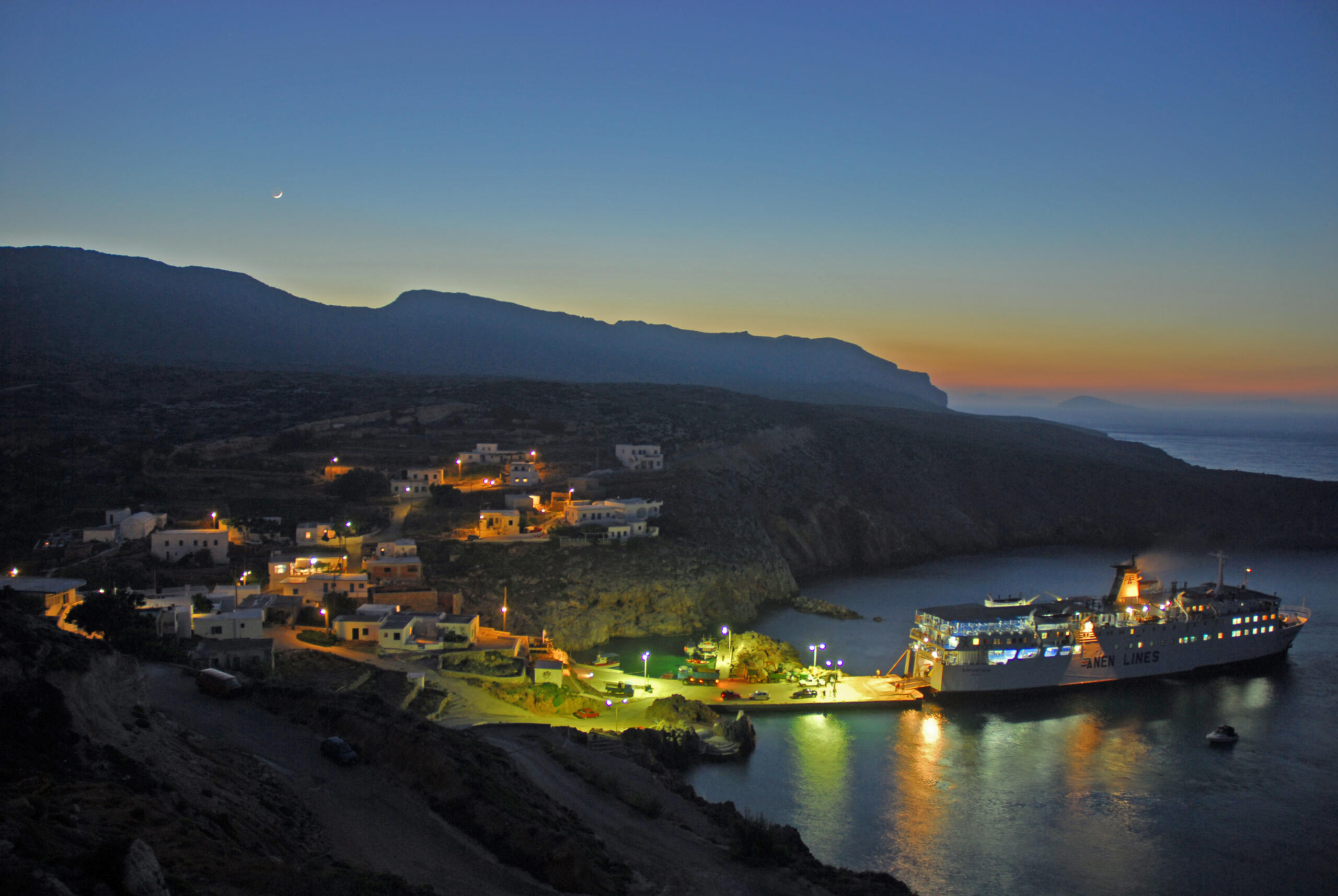
For families seriously considering this — or for travelers curious about visiting — Antikythera is genuinely remote. The island has:
- A single ferry connection to Kythera island, operating five times a week, with the journey taking 2-3 hours. Strong winds frequently cancel ferries.
- Less frequent boats to Crete (Kissamos) and Athens (Piraeus), which take longer and run irregularly.
- No airport. The nearest airport is on Kythera, which has flights to Athens taking about an hour. Reaching Athens from Antikythera typically requires the ferry to Kythera plus the flight.
- Minimal commercial services. No restaurants in the conventional sense. No supermarkets. The closest hospital is on Kythera; emergency medical evacuations require helicopter or boat transfer.
- Beautiful natural surroundings. The island has pristine beaches (Xeropotamos and Kamarila are the most accessible), low hills with hiking trails, ancient pirate fortifications still standing from the 3rd-1st centuries BC, country chapels, and one of the Mediterranean’s most important bird migration monitoring stations.
- Wild goats that outnumber the human residents. This is literally true and frequently mentioned in tourism descriptions of the island.
The island’s most famous historical artifact, the Antikythera Mechanism, was discovered in a shipwreck off the coast in 1901 and dates to approximately 150-100 BC. The mechanism is an ancient Greek analog computer used to predict astronomical positions and eclipses, and is now displayed at the National Archaeological Museum in Athens.
How to actually apply (and the realistic likelihood)
For genuinely interested families meeting the requirements (four+ children, useful skills, long-term commitment), applications go through the local council in Antikythera. The Municipality of Kythera, which administers Antikythera as a local community, provides a contact phone number for Antikythera’s office: 00302736033004.
The realistic likelihood of being selected depends on competition and the program’s actual launch timeline — which, as noted, has been delayed by housing construction issues. As of early 2026, no families have actually moved in under the program despite years of international coverage suggesting it was active.
The honest assessment from people familiar with the program is that interested families should treat this as a long-term possibility rather than an immediate option. The program will eventually launch — the local mayor and Greek Orthodox Church have invested significant credibility in it — but the timeline has been slower than initial reporting suggested.
Why programs like this exist
Antikythera’s program is part of a broader European pattern. Southern Europe’s rural depopulation crisis has prompted dozens of similar initiatives:
- Italy’s €1 house programs in Sicily, Sardinia, and Abruzzo (covered in detail in our recent feature on Mussomeli and Sambuca).
- Spain’s Ponga village offering €3,000 to young couples willing to relocate to the rural mountain village in Asturias for at least five years.
- A Xesta, a tiny northwest Spanish village, offering homes for €100/month rent.
- Switzerland’s Albinen, offering 25,000 Swiss Francs (roughly $31,679 USD) to adults under 45 willing to buy property worth over 200,000 Swiss Francs and stay for at least 10 years.
- Japan’s Regional Revitalization Program, offering up to ¥4,800,000 (roughly $30,364 USD) in funding for expats willing to relocate to rural Japanese areas.
The pattern across all these programs is consistent: rural communities facing population collapse are willing to provide significant financial incentives to attract long-term residents who will integrate into the community, contribute essential skills, and ideally have children to keep local schools open.
For most American families, none of these programs are likely to be practical — the relocation, the language barriers, the bureaucratic complexity, and the lifestyle change are substantial. But for a small number of genuinely qualifying families, particularly those with strong language skills and useful trades, programs like Antikythera’s offer a genuine path to a different kind of life. The fact that the program is so restrictive (only five families, specific requirements, slow rollout) is itself part of what makes it more credible than the click-bait coverage suggests. The Greek Orthodox Church and local council are looking for people who will actually stay, build community, and rebuild the island. They’re not running a tourism marketing campaign.
For travelers, even those not interested in relocation, Antikythera is increasingly being added to off-the-beaten-path Greek itineraries. The 2-3 hour ferry from Kythera makes it impractical for day trips, but a 3-4 day visit produces an experience of Greek island life that mass-tourism destinations like Mykonos and Santorini no longer offer.