

A modern car will park itself, watch the lane markings, brake on your behalf and tell you the tyre pressures.
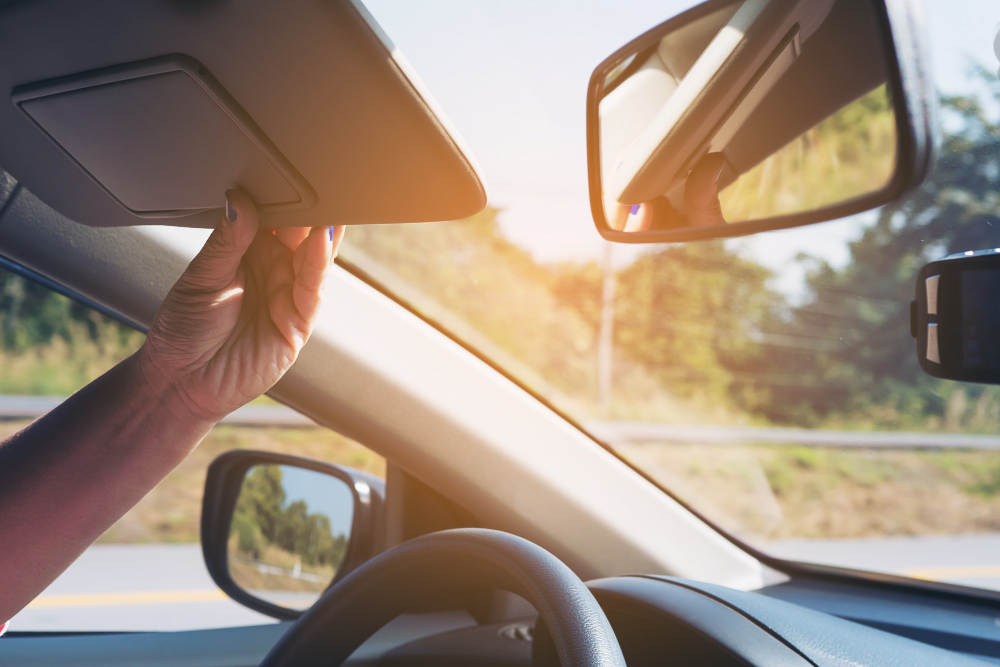
The thing it does about the sun is a flap on a hinge that you reach up and pull down with your hand. It has been that for roughly ninety years. It is one of the oldest unchanged ideas in the whole vehicle, and the reason is not neglect.
What the Visor Is Actually Doing
The problem a visor solves is narrower than it appears. It is not shading the cabin and it is not reducing overall brightness. It is blocking a small, bright, moving source of light from reaching your eyes, while leaving the rest of your field of view as clear as possible.
That is a demanding specification. Low sun sits at the worst possible angle – above the top edge of the windscreen glass from the driver’s eye position, which is precisely the region a fixed roofline cannot cover without making the windscreen uselessly shallow. The sun then moves, both because it moves and because the car turns, so whatever blocks it has to be repositionable continuously and immediately.
And the blocking has to be total. A partial reduction in brightness is worse than useless against direct sun, because the eye adapts to the average scene brightness and a dimmed sun is still far brighter than everything around it. The only thing that works is opacity.
So: a completely opaque object, adjustable instantly by a driver who must not look away from the road, positioned in the few inches between the top of the glass and the roof, which must get entirely out of the way when not needed and must not become a hazard in a collision.
Stated that way, a stiff hinged panel starts to look less like a leftover and more like a solution.
Like our content? Follow us for more.
What It Is Made Of Is Less Simple Than It Looks
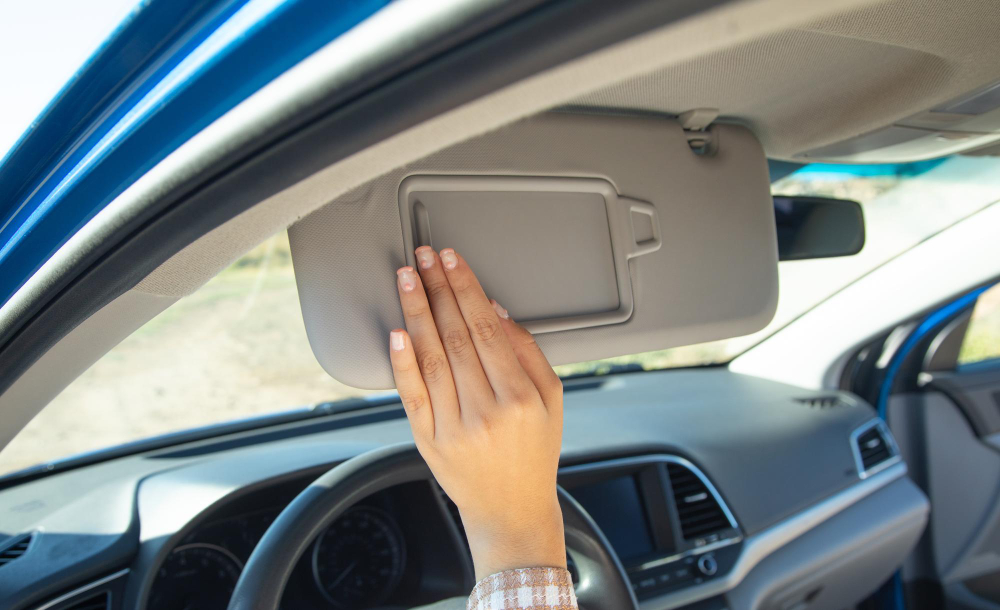
The visor in a modern car is not literally cardboard, though its ancestors essentially were, and the modern version is closer to it than most of the car.
A typical construction is a moulded core of rigid foam or a thermoplastic, sometimes with a wire frame, covered in fabric or vinyl to match the headlining. The core provides stiffness with almost no weight. The covering provides the finish and, importantly, a surface that does not reflect – a glossy visor would create its own glare problem from the side windows.
The hinge is the part that does the engineering. It has to hold any position against vibration for the life of the car, swing down and also rotate sideways on many designs, and do all of it with a friction mechanism that feels deliberate rather than loose. A visor that sags is one of the more annoying faults a car can develop, and it is annoying precisely because the component is otherwise so reliable that nobody expects it to fail.
Collision requirements shape it too. Anything mounted at head height in front of an occupant has to be soft enough or frangible enough not to cause injury, which rules out the rigid thin panel that would otherwise be ideal, and is part of why the modern visor is thicker and softer than the simple board of the 1950s.
Everything Clever Has Been Tried
The alternatives are a long list, and the list is instructive.
Tinted upper bands across the windscreen are standard and genuinely help with high sun, but they cannot be dark enough to handle direct low sun without compromising visibility, and low sun is the actual problem.
Photochromic and electrochromic glass that darkens on demand exists and works, and has appeared in roof panels, where there is no visibility requirement. Applied to a windscreen it faces the same fundamental objection: darkening the whole glass does not help against a point source, and darkening part of it requires knowing exactly where the driver’s eye and the sun are.
Systems that do know have been built. Cameras track the sun and the driver’s head, and a grid of liquid-crystal cells in the visor or the glass darkens only the few cells on the line between them. It works. It is also an expensive, power-consuming, failure-prone assembly to replace a component that costs very little, never breaks, needs no power, and is understood instantly by every driver who has ever sat in a car.
Extending the roofline, deeper dashboards, polarised glass, retractable fabric blinds – all tried, all either ineffective against the specific problem or worse on cost, weight, visibility or packaging.
This is the pattern. The visor is not surviving because nobody has thought about it. It is surviving because it has been attacked repeatedly by well-funded engineering departments and has won every time on the only basis that matters, which is doing the job adequately for almost no money and no complexity.
The Driver’s Side and the Passenger’s Side Are Not the Same
There is an asymmetry in visors that almost nobody notices.
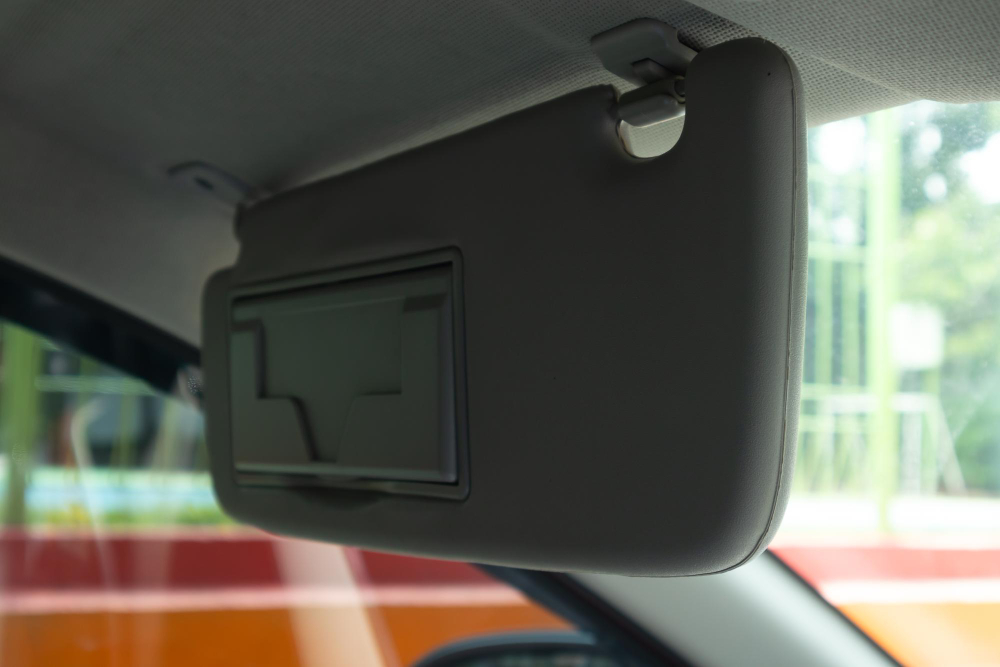
On most cars the driver’s visor swings down and also rotates outwards to the side, on a second axis, so it can be positioned against the door window rather than the windscreen. The passenger’s visor frequently does the same, but the driver’s is the one where it matters, because sun coming through the side window at a low angle while the driver is looking ahead is a problem the windscreen position cannot address.
That second axis is a genuine piece of mechanism – a rod that the visor slides and pivots on, held by friction at both joints, so that it can be swung through roughly ninety degrees and will stay where it is put while the car corners. It is the reason visor hinges are more complicated than they need to be for simple folding, and it is the single most common point of failure on the whole assembly.
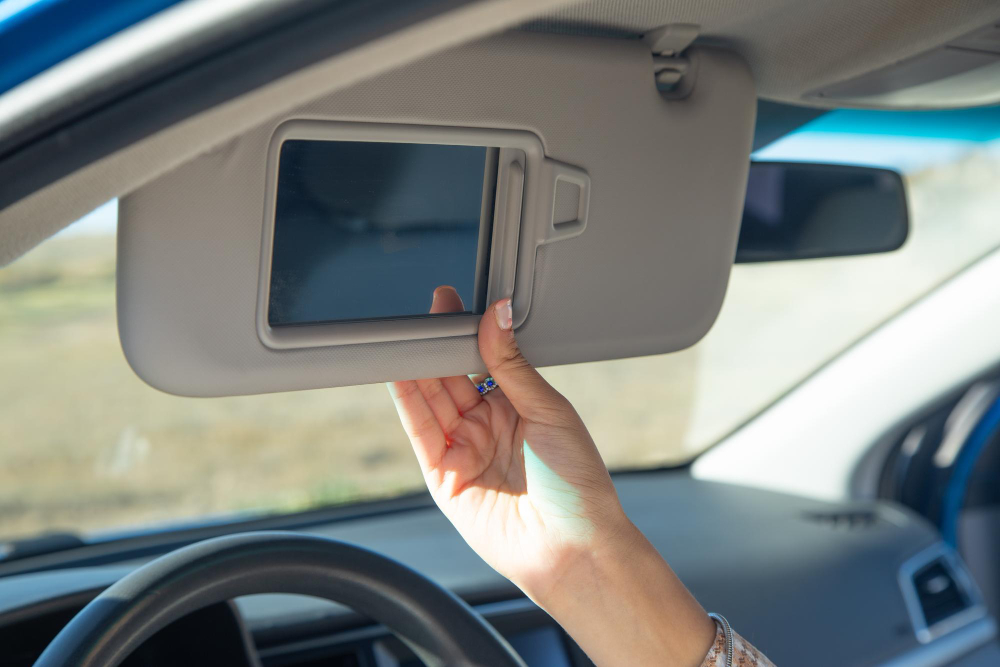
The asymmetry also shows up in what the two visors carry. The vanity mirror, when a car has only one, is traditionally on the passenger side, for reasons that belong to a period of motoring with assumptions about who was sitting where. Most cars now fit two and the question has quietly resolved itself.
And on a great many vehicles the driver’s visor carries printed warnings instead – about airbags, about child seats, about tyre pressures. The visor became the place for those because it is the one interior surface that is both permanently in the car and routinely in front of somebody’s face, which is exactly the property that made it useful for a mirror.
The Mirror Was the One Real Improvement
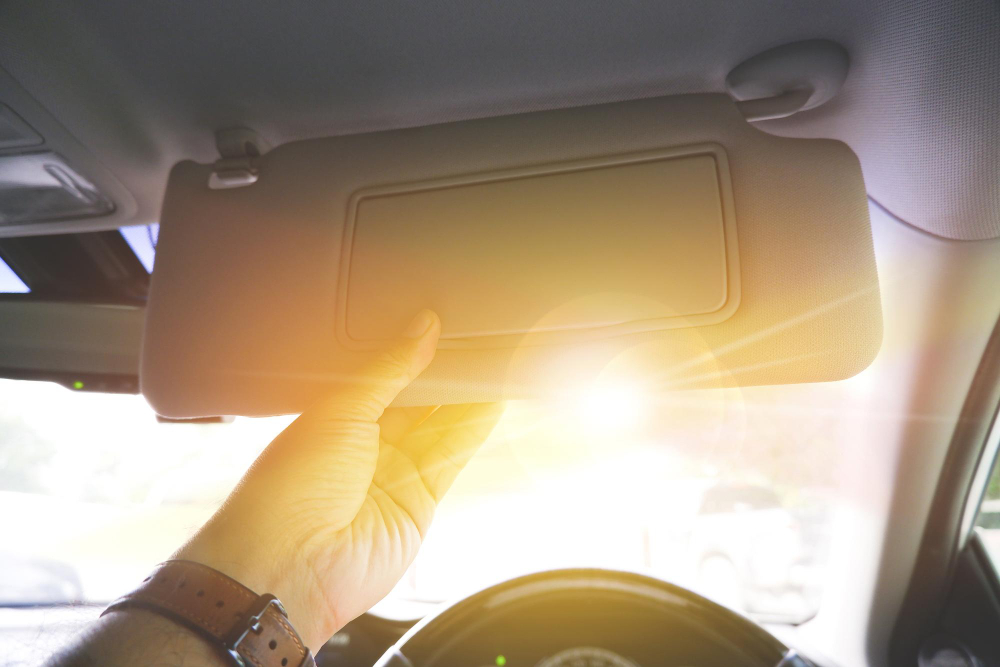
The one genuine addition to the visor in decades is the mirror on the back of it, usually with a cover and on many cars a light.
It is there because the visor is the only surface in the car that is already hinged to swing into a position directly in front of a seated occupant’s face, and because putting a mirror anywhere else in the cabin either obstructs the view or cannot be reached. The hinge that existed for the sun turned out to be exactly the mechanism a mirror needed.
That is a common kind of design outcome and a satisfying one: a component earns a second function not because it was designed for it but because its geometry happened to suit. The cover exists because an uncovered mirror at that position reflects light at the driver, which would reintroduce the glare the visor is there to prevent.
The lights that accompany it on many cars are the only part of the assembly that requires wiring, and consequently the only part that commonly fails.
Why This Matters Beyond Visors
The visor is a useful object to think about because it is a clear counterexample to the assumption that old equals obsolete.
A great many things in a car have been replaced by electronics and are better for it. Ignition timing, fuel metering, braking distribution, stability control – none of those should be mechanical and none of them are. The visor looks like it belongs on that list and does not, because the requirements that define it have not changed and the mechanical answer to them was close to optimal the first time.
The test is not how old a solution is. It is whether the problem has changed and whether anything else does the job better once everything is counted – cost, weight, reliability, power, repairability, and whether a driver can operate it in half a second without being taught.
On that test the hinged flap keeps winning, and it will probably still be there when the car is driving itself and nobody is looking out of the windscreen at all. At which point, finally, the problem will have changed.
Have a look at yours. Foam core, fabric cover, friction hinge, mirror on the back.
It is the simplest thing in the car and it has outlasted almost every clever idea aimed at it.
Like our content? Follow us for more.
