


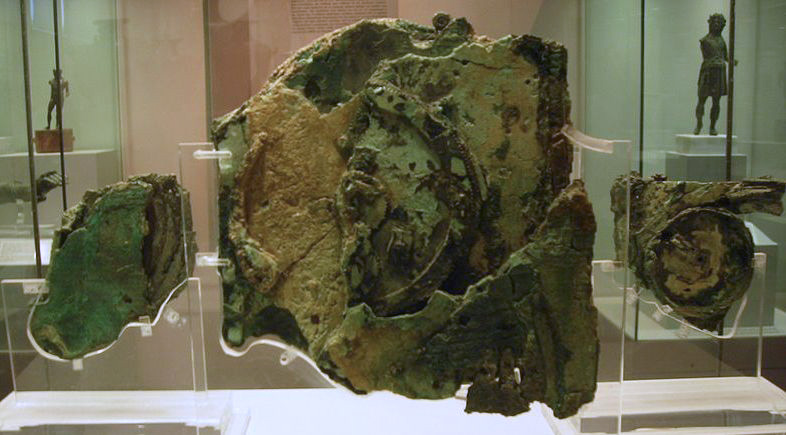
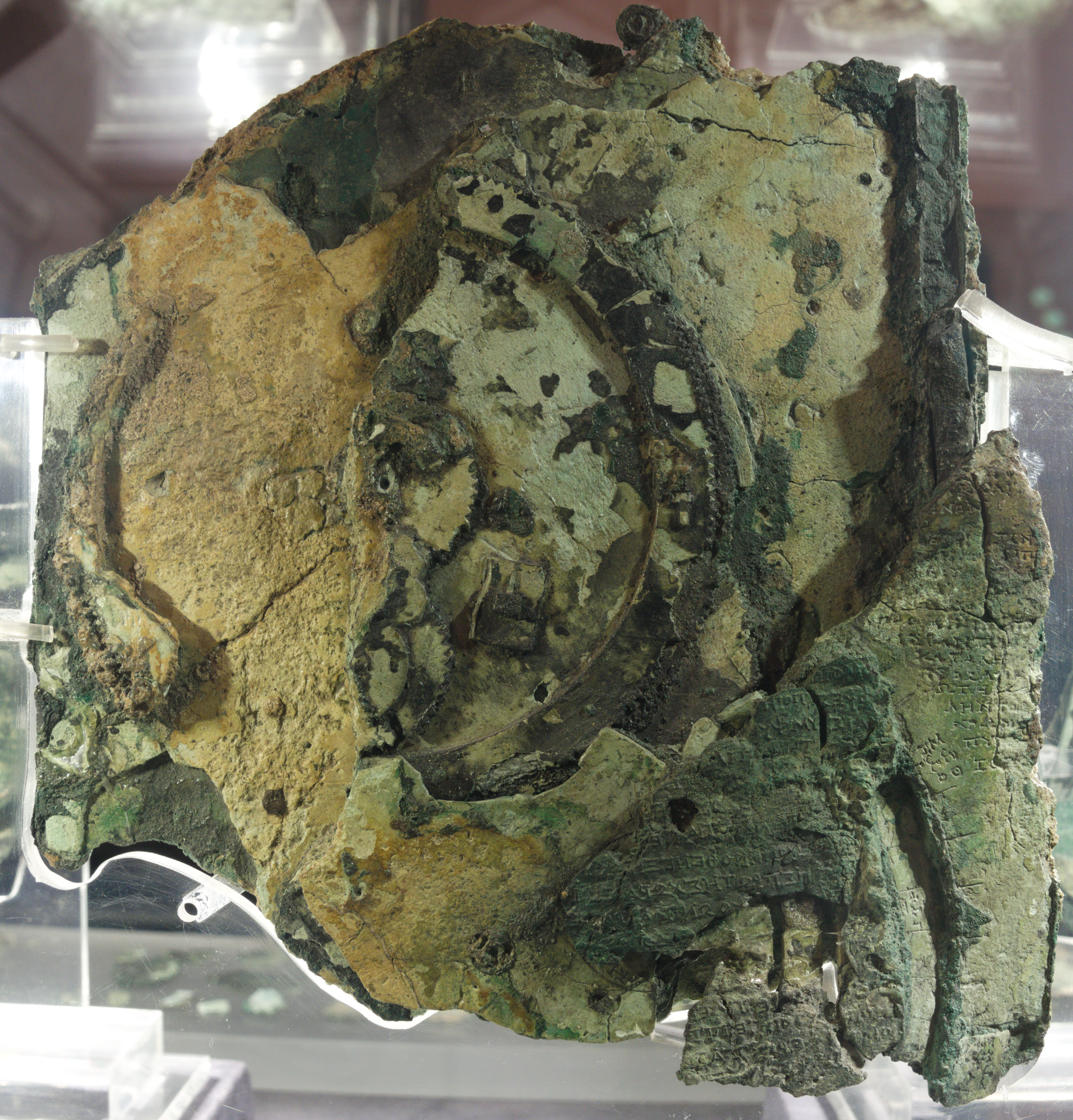
In a glass case in the National Archaeological Museum in Athens sits an object that should not exist. It looks unimpressive at first — a few flattened, blue-green fragments of corroded bronze, cracked and encrusted, the largest about the size of a paperback. Then you notice the teeth. Cut into the corrosion are the unmistakable outlines of gear wheels, dozens of them, machined by hand with a precision that belongs to the age of clockmaking. They are more than 2,000 years old.
The Antikythera mechanism is the single strangest artifact to survive from the ancient world. It is widely described as the oldest known analog computer: a hand-cranked device of interlocking bronze gears that modeled the movements of the sun and moon, tracked calendars, and predicted eclipses years in advance. It was recovered by accident, ignored for a year, misunderstood for decades, and only fully appreciated in the modern era of X-ray and CT imaging. And its existence poses a question that historians still can’t answer comfortably: if someone in the ancient Mediterranean could build this, what else could they build — and why does nothing like it survive again until medieval Europe?
A Storm, a Shipwreck, and a Heap of Statues
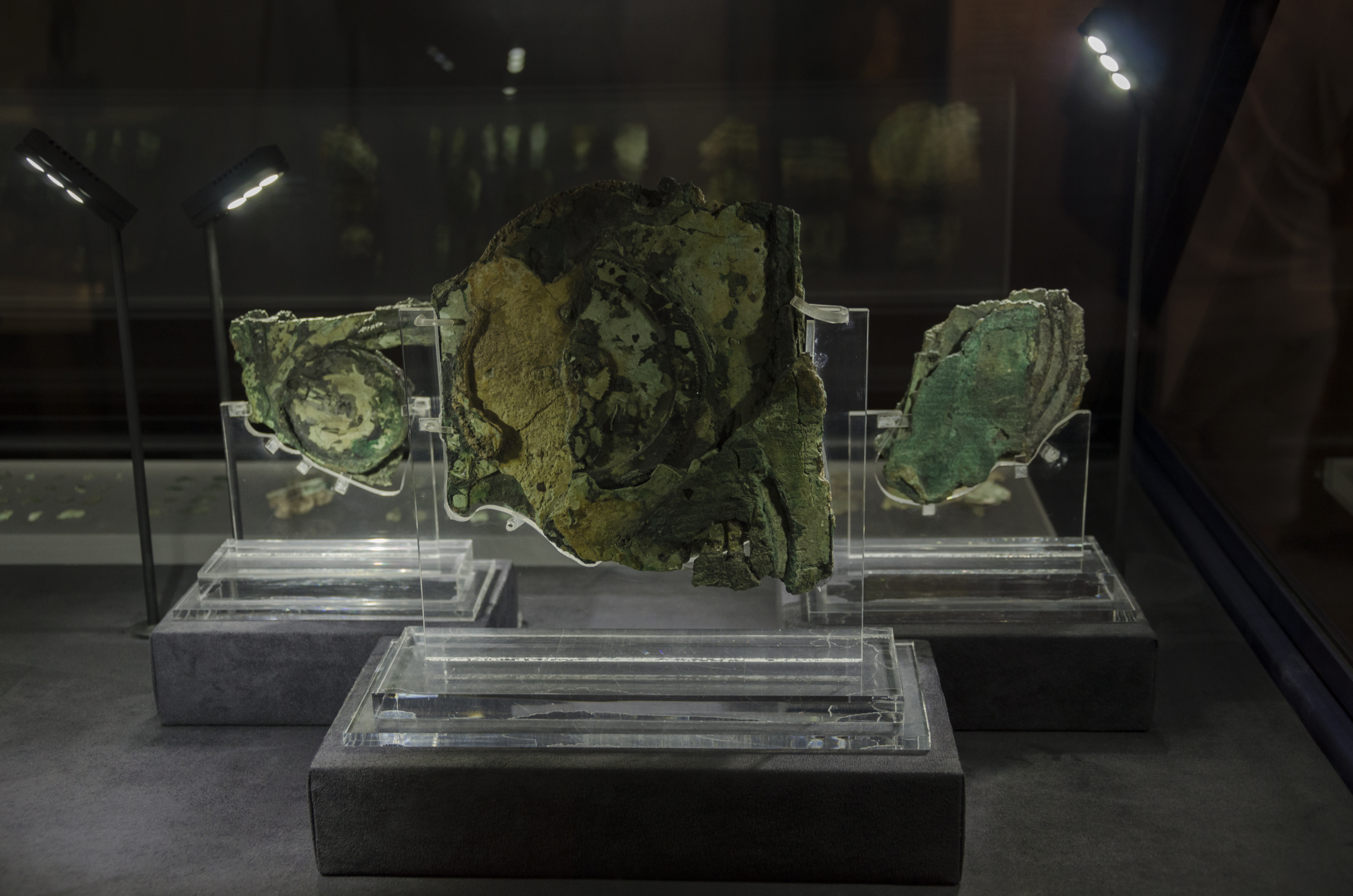
The story begins in 1900, when a crew of Greek sponge divers sailing toward North Africa took shelter from a storm near Antikythera, a small island lying between Crete and the Peloponnese. Diving for sponges in the sheltered water, one of them surfaced with an alarming report of bodies on the seabed — which turned out, on inspection, to be marble statues. They had found the wreck of an ancient merchant ship, resting far below the surface, packed with cargo.
The divers reported the find to the Greek authorities, who arranged an underwater excavation — an extraordinarily dangerous undertaking in the canvas suits and copper helmets of the era, at depths that pushed the limits of what was survivable. Over the following months, the wreck yielded a spectacular haul: bronze and marble statuary, glassware, jewelry, coins, and pottery, a floating treasury that appears to have been in transit when the ship went down. Coins and amphorae from the site have since dated the sinking to roughly the first half of the first century BC. Among the crates of recovered material was one lump of corroded bronze and wood that nobody paid much attention to at all.
Like our content? Follow us for more.
The Gear Nobody Noticed
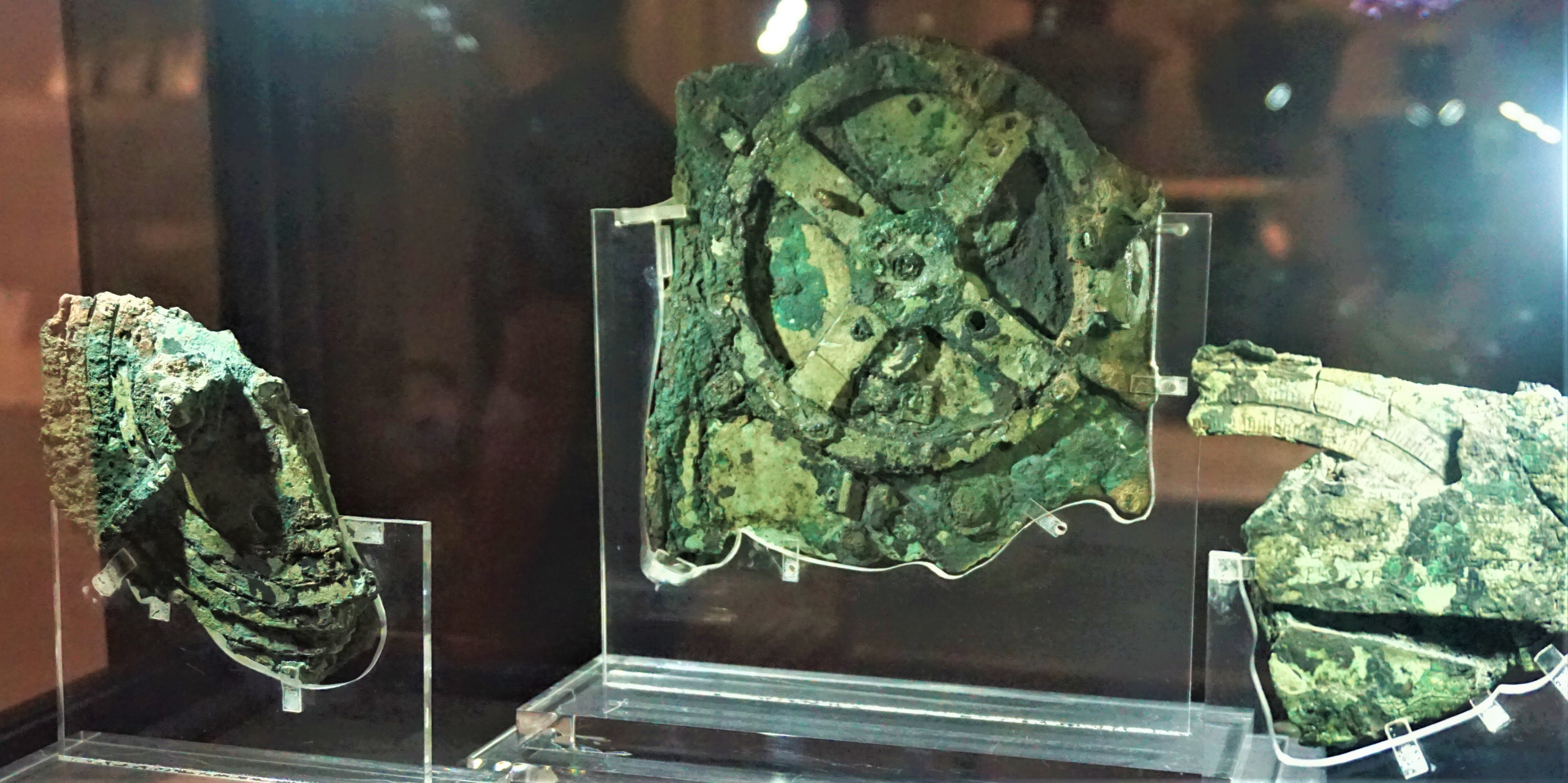
The lump sat in the museum in Athens along with everything else recovered from the wreck, and for months it attracted no interest. Then, in 1902, the Greek archaeologist Valerios Stais examined it and noticed something impossible in an object of that age: embedded in the corrosion was a gear wheel, along with traces of inscribed lettering.
The implication was so far outside what anyone believed about ancient technology that the find was met with real skepticism. The prevailing understanding held that the Greeks and Romans had produced only simple geared devices, nothing remotely like a precision gear train. Some suggested the object must be a later item that had somehow ended up mixed with the ancient cargo. It took decades of study — and, crucially, the arrival of imaging technology that could see through the corrosion without destroying the fragments — to establish what it actually was. Serious investigation only began in earnest in the mid-twentieth century, and radiographic imaging eventually revealed 30 gear wheels surviving in the fragments, with reconstructions suggesting the complete device held substantially more.
What the Machine Actually Did
The picture that has emerged from more than a century of study is remarkable in its specificity. The mechanism was originally housed in a wooden case roughly the size of a shoebox, with dials on the front and back and a hand crank on the side. Turning the crank drove a train of interlocking bronze wheels, and the dials updated to display the state of the heavens for the chosen date.
The front face showed the positions of the sun and moon against the zodiac, along with the phase of the moon — reproduced by a small rotating ball, half light and half dark. The back carried spiral dials tracking longer cycles: the 19-year Metonic cycle that reconciles lunar months with solar years, and the roughly 18-year Saros cycle after which eclipses repeat in a predictable pattern, allowing the device to forecast solar and lunar eclipses. Inscriptions on the mechanism functioned as a kind of user’s manual. There was even a dial tracking the four-year cycle of Panhellenic games, including the Olympics, which suggests it was meant to be socially useful as well as astronomically impressive. Researchers have concluded that the device also modeled planetary motion, and it did all of this mechanically — one input, and every astronomical variable updated at once, without a single calculation performed by the user.
The engineering behind that is the astonishing part. It required hand-cutting dozens of gears with precise tooth counts to encode astronomical ratios, nesting them in a compact multi-layer assembly, and getting the mathematics right. The people who built it understood both the astronomy of their era — much of it inherited from Babylonian observation — and how to render that knowledge in bronze.
The Question Nobody Can Answer
Here is where the Antikythera mechanism stops being an impressive artifact and becomes a real historical problem. Nothing of comparable mechanical complexity is known from the ancient world, and nothing similar survives again until the geared astronomical clocks of medieval Europe, roughly a millennium later. A device this sophisticated is almost certainly not a first attempt; the consensus among researchers is that it must represent a mature tradition, the product of a workshop with prior prototypes and accumulated expertise.
So where is the rest of it? The most likely answer is simply that bronze was valuable and got melted down, wood rotted, and the odds of any single object surviving 2,000 years are vanishingly small — this one survived only because it sank in the sea and stayed there. That means the mechanism may be less an anomaly than a lone survivor of an engineering tradition that has otherwise vanished from the record entirely, leaving us to guess at its extent from a single waterlogged example. It’s a sobering thought about how much of the ancient world we’ve simply lost, and it raises the tantalizing possibility that comparable devices are still sitting unrecognized in other wrecks or under modern cities.
As for who made it, ancient sources describe astronomical instruments associated with figures such as Archimedes and Posidonius of Rhodes, and researchers have speculated about a connection. But no inscription names a maker, and careful scholars decline to assign authorship on the available evidence. The builder of the most sophisticated machine to survive from antiquity is, so far, anonymous.
Seeing It Yourself
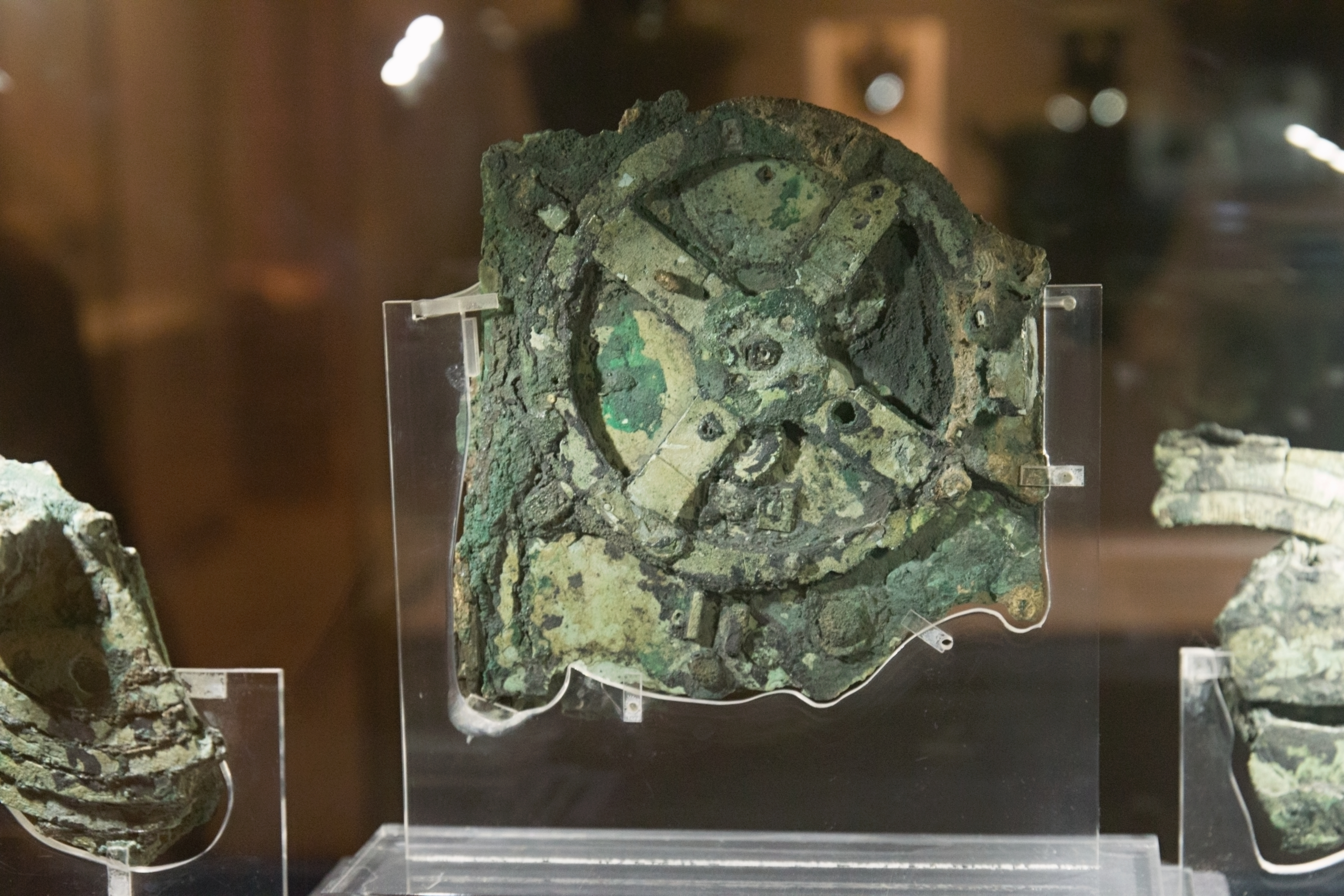
For travelers, the mechanism is one of the best reasons to build an afternoon into an Athens itinerary. It’s displayed at the National Archaeological Museum, which also holds much of the rest of the Antikythera shipwreck haul — the bronze and marble statuary recovered alongside it, which is spectacular in its own right and provides context for just how rich the sunken cargo was. Modern reconstructions are typically displayed nearby, showing what the complete device would have looked like and how the gearing worked, which helps enormously; the fragments themselves are cryptic without the model beside them.
It’s worth going in with the story in your head, because the object does not announce itself. Visitors who wander past without knowing see a few corroded scraps in a case. Visitors who know are looking at the oldest surviving evidence that someone, 2,000 years ago, built a machine to model the sky — and got it right. The museum sits a manageable distance from the Acropolis and central Athens, making it easy to pair the ancient monuments everyone comes for with the one small case that steadily upends the usual story about what the ancient world could do.
A Machine Out of Time
The Antikythera mechanism endures because it breaks the narrative we tell ourselves about technological progress as a steady upward line. Here is a device that models eclipses with bronze gears, built before the Roman Empire reached its height, lost at sea, and then not equaled for a thousand years. Progress, it turns out, is not a ratchet. Knowledge can be built, refined, and then simply lost when the workshops close, the experts die, and nobody writes it down in a form that survives.
That’s the thought worth carrying out of the museum. Some sponge divers sheltering from a storm happened to find a wreck; a lump of corroded metal happened to survive; an archaeologist happened to notice a gear. Change any one of those accidents and the ancient world’s greatest machine would still be on the seabed, and we would still be confidently teaching that the Greeks never built anything of the kind. Whatever else it calculated, the Antikythera mechanism is a permanent reminder of how much history is decided by chance — and how much of it we’ve almost certainly lost.
Like our content? Follow us for more.

