


Most people know their blood type, treat it as a fixed personal fact like eye colour, and have never wondered what it is.
It is a molecule. Specifically, blood type describes which of several possible structures sit on the surface of your red blood cells, and whether your immune system regards other versions of that structure as foreign.
The medical importance is enormous and entirely settled. The biological purpose is not settled at all, which is a truly unusual situation for something discovered in 1900, studied continuously ever since, and present in every human being.
Here is what is known, what is not, and why the gap has proved so stubborn.
What a Blood Type Physically Is
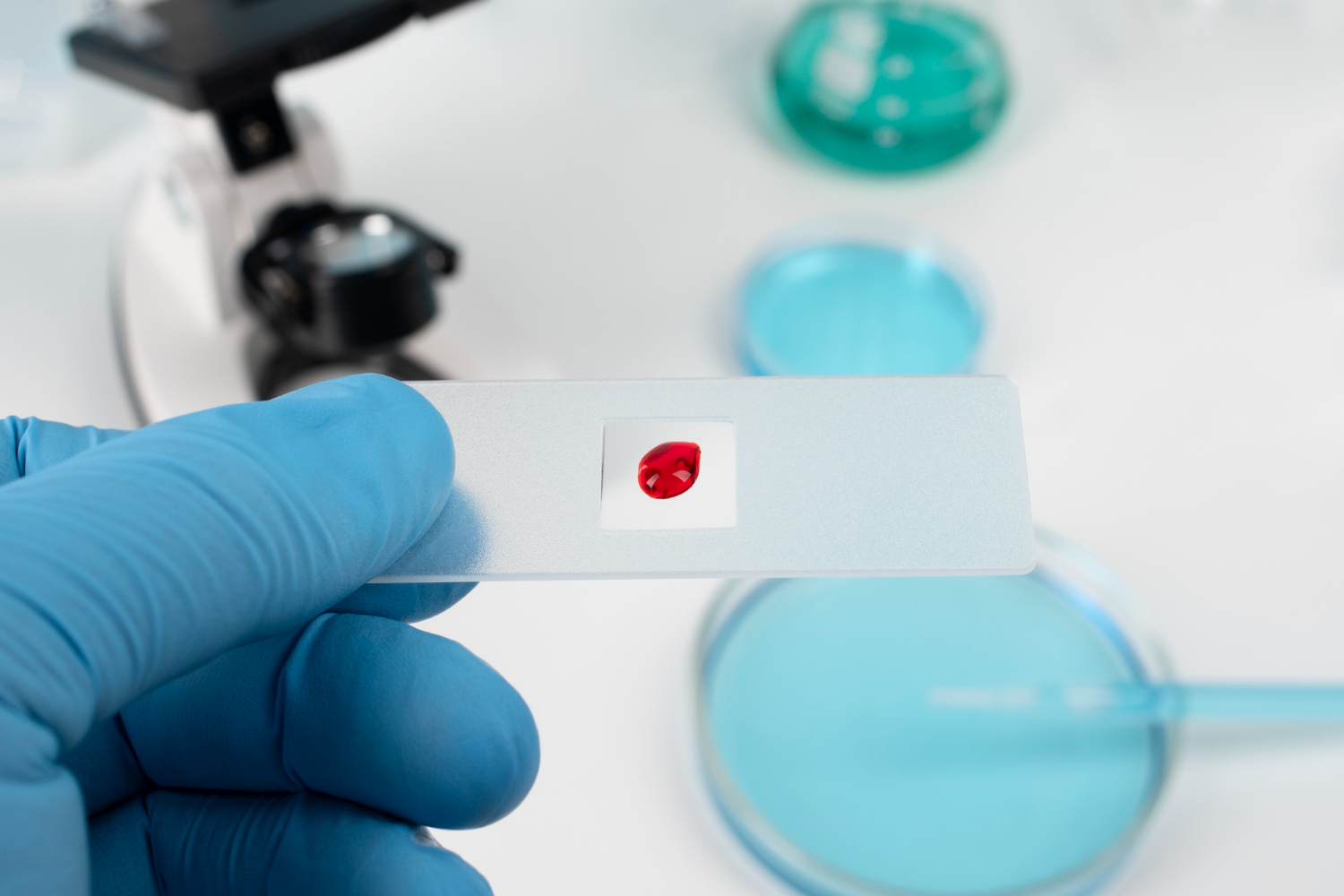
The surface of a red blood cell is not smooth. It carries a large number of molecular structures, and some of them vary between people.
In the ABO system, the relevant structures are chains of sugars attached to the cell surface. Everyone has a basic version of this chain. What differs is whether an additional sugar is attached to the end of it, and which one.
Attach one type and you have the A antigen. Attach a different one and you have B. Attach both, on different chains, and you have AB. Attach neither and the chain is left in its base form, which is type O.
The genetics follow directly: the gene involved codes for an enzyme that attaches the extra sugar, and different versions of the gene produce enzymes that attach different sugars or none at all.
The numbers involved are substantial. Each red blood cell carries on the order of two million of these antigens.
They are not confined to blood, either. The same structures appear on other cell types, and in most people a soluble form is present in saliva and other bodily fluids — a detail that matters for the disease theories discussed below.
The Rh system is separate and works differently, describing the presence or absence of another antigen entirely, which is what the positive or negative in a blood type refers to.
Like our content? Follow us for more.
Why Mixing Them Matters

The medical consequence follows from what the immune system does with these structures.
If you lack the A antigen, your immune system treats it as foreign and you carry antibodies against it. If you lack B, likewise. So a person with type O, having neither, carries antibodies to both, while a person with AB carries neither antibody.
That produces the familiar compatibility pattern, including the concepts of universal donor and universal recipient, which are more complicated in practice than the shorthand suggests and are handled by clinical protocols rather than by rules of thumb.
Before this was understood, transfusion was unpredictable and frequently harmful, because compatibility was a matter of chance. Identifying the system converted it into a routine procedure — which is why the discovery carried a Nobel Prize and remains one of the most consequential findings in medicine.
None of that explains why the variation exists. Compatibility is a consequence of the differences, not a reason for them, and evolution does not maintain variation in a population so that transfusion medicine can be interesting.
The Leading Explanation

The most widely supported theory concerns infectious disease, and the logic is straightforward.
Many pathogens gain entry to cells by attaching to specific molecular structures on the cell surface. If the structures vary between individuals, then some people present a convenient docking point for a given pathogen and others do not.
On this account, different blood group antigens change how particular microbes attach to and invade host cells. Some organisms exploit specific antigens; others are obstructed by them.
That produces a situation where no single blood type is best everywhere. A type conferring resistance to one disease may confer vulnerability to another, and which trade-off is advantageous depends entirely on which pathogens are present in a given place at a given time.
That would explain the most striking feature of the global data: blood type proportions vary markedly between populations and regions, in patterns consistent with local selection pressure rather than random distribution.
A number of associations between blood group and disease susceptibility have been reported in the research literature, covering infectious and non-infectious conditions.
Those associations should be read with considerable care. They are population-level statistical patterns, frequently modest in size, sometimes inconsistent between studies, and emphatically not a basis on which any individual should draw conclusions about their own health. The mechanisms behind most of them are not established, and reviews of the field are explicit that further work is needed at the molecular level.
Why It Remains Unresolved

The obvious question is why a century of work has not settled this, and the reasons are instructive.
Establishing that a trait was selected for is far harder than establishing that it exists. It requires showing not just an association but a mechanism, and then demonstrating that the mechanism produced enough of a survival difference over enough generations to shape the population.
Disease environments also change. A selection pressure that mattered enormously two thousand years ago may have vanished entirely, leaving a distribution that records a history nobody can now observe directly.
There is also the possibility, which researchers take seriously, that the answer is less tidy than the question assumes. Not every genetic variation has a purpose. Some persist because they were never costly enough to remove, and a search for the function of blood types may be looking for something that is not there in the form expected.
What the evidence does support is that the variation is ancient and has been maintained rather than drifting away, which is generally an indication that something is preserving it. Comparable systems exist in other primates, suggesting the variation predates modern humans substantially.
So the position is: old, maintained, probably related to pathogens, mechanism largely unestablished.
What This Is Not

A note is necessary here, because this subject attracts a great deal of material that is not supported by evidence.
Claims that blood type determines personality are not supported. Claims that people should eat particular diets according to blood type are not supported by the research literature. Both are widely circulated, and neither follows from anything in the science.
The real findings are substantially more modest and substantially more interesting: statistical associations between blood group and susceptibility to certain conditions, of uncertain mechanism, at population level.
Anything about an individual’s health, diet or medical care belongs with a doctor rather than with an article about evolutionary biology, and nothing here should be read as guidance of any kind.
More Than Four Types

One further correction is worth making, because the familiar four-letter scheme is a simplification of a substantially larger picture.
ABO is the most important system for transfusion, and Rh is the second. Neither is the whole story. A substantial number of additional blood group systems have been identified, each based on different antigens on the red cell surface, and new ones continue to be characterised.
For most people most of the time, ABO and Rh are sufficient, which is why they are what appears on a donor card. But for patients requiring repeated transfusion, or in pregnancies where incompatibility can arise, the other systems become clinically significant and are tested for accordingly.
Some of these systems are extremely rare, to the point where a handful of individuals worldwide are known to have a particular configuration, which creates real difficulties if they ever need blood.
There is a further wrinkle that surprises people. A person’s apparent ABO type is not entirely fixed under all circumstances — certain illnesses can alter how the antigens present, and there are documented situations in which a phenotype appears to change temporarily.
None of which affects how the system is used day to day. It does mean that describing someone as having one of four blood types is roughly comparable to describing a language as having a handful of words: true as far as it goes, and a considerable distance from the actual inventory.
An Honest Gap
There is something worth appreciating in a question this old remaining open.
Blood types are not obscure. They are present in every person, tested routinely, taught in schools, and central to a branch of medicine that saves an enormous number of lives. The classification is over a century old and thoroughly characterised at the molecular level.
And the question of why the variation exists at all is truly unresolved, with the leading explanation supported by suggestive distribution data rather than by demonstrated mechanism.
That is not a failure. It is a reminder that describing something completely and explaining it are different achievements, and that biology contains a great many features which are well documented and poorly understood.
The sugars on the surface of your red blood cells have been there your entire life, are inherited from your parents, differ from those of a substantial proportion of the people around you, and nobody can tell you with confidence what they are for.
Like our content? Follow us for more.

