

The Problem It Was Invented to Solve
White paint on a road is nearly useless at night. A headlight beam strikes a painted line at a very shallow angle and most of the light scatters away in every direction, with only a tiny fraction returning towards the car. In rain the problem becomes acute, because a film of water over the paint acts as a mirror angled away from the driver and the line disappears altogether.
This mattered enormously once cars became fast enough that a driver needed to know where the road went some distance ahead rather than immediately in front. Unlit roads with bends were lethal, and the available solutions were all expensive: lighting the entire road, building kerbs everywhere, or widening until mistakes were survivable.
The device that solved it was patented in the 1930s and the traditional account of its origin involves the inventor seeing the eyes of a cat reflecting his headlights on a dark road. That story is repeated everywhere and is not verifiable; it may well be a later tidying-up of a more ordinary process of invention. What is certain is that the principle it works on is exactly the one that makes an animal’s eyes shine, and that the common name for the device comes from the comparison.
The insight was not to make the marker brighter. It was to make it send light back where it came from.
Like our content? Follow us for more.
Retroreflection Is Not the Same as Reflection
An ordinary mirror sends light off at an angle equal and opposite to the angle it arrived at. Point a torch at a mirror from the side and the beam goes off to the other side, not back at you. A white surface does something different again: it scatters light more or less evenly in all directions, so a little comes back to you and most does not.
Retroreflection is a third behaviour. A retroreflector returns light towards its source regardless of the angle it arrived from, within limits. Shine a torch at one from anywhere in a wide arc and the light comes back at the torch.
There are two ways to build one. The first uses three flat mirrors arranged in the corner of a cube, at right angles to each other. Light entering that corner bounces off all three faces and leaves parallel to the way it came in, reversed. This is the principle behind the reflectors left on the moon and behind a bicycle reflector’s moulded plastic back face.
The second uses a transparent sphere or a curved lens with a mirrored back. Light entering the curved front is bent towards a focus, strikes the mirror behind, and is bent again on the way out so that it leaves roughly parallel to its arrival path. This is how an animal’s eye does it, using the lens that focuses the image and a reflective layer behind the retina, and it is how the road stud does it too.
The practical consequence is the one every driver has noticed without articulating it. The studs ahead of you are bright. The studs ahead of the car in the next lane are bright for that driver and not for you. Each vehicle is being shown its own private line of light, generated from its own headlamps, and nobody is sharing.
The Self-Cleaning Trick
A retroreflector on a road surface has one fatal weakness: it works only while the lens is clean, and a road is one of the dirtiest environments there is. Grit, oil, rubber and road film would coat a fixed lens within days and reduce it to a slightly shiny lump.
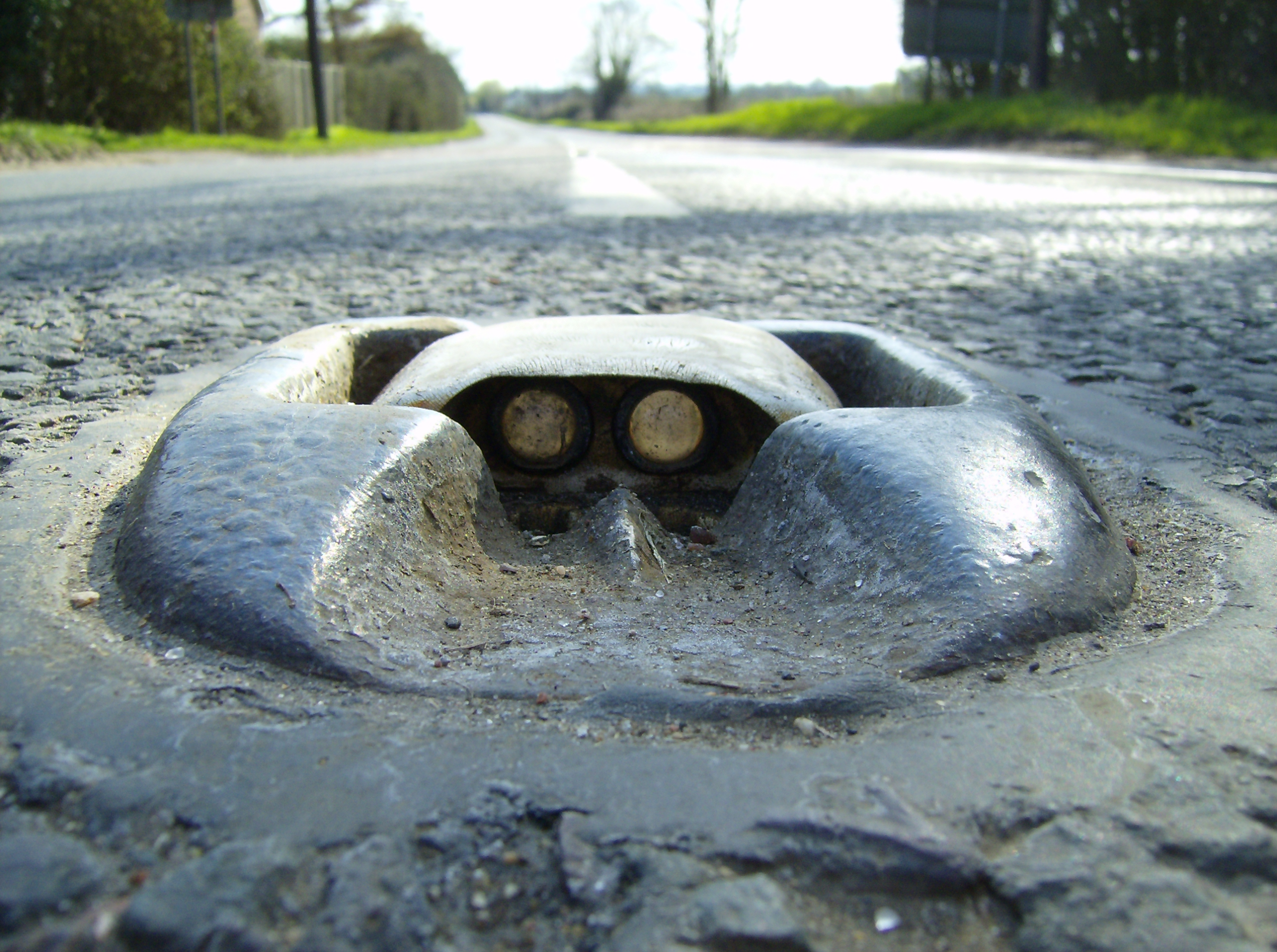
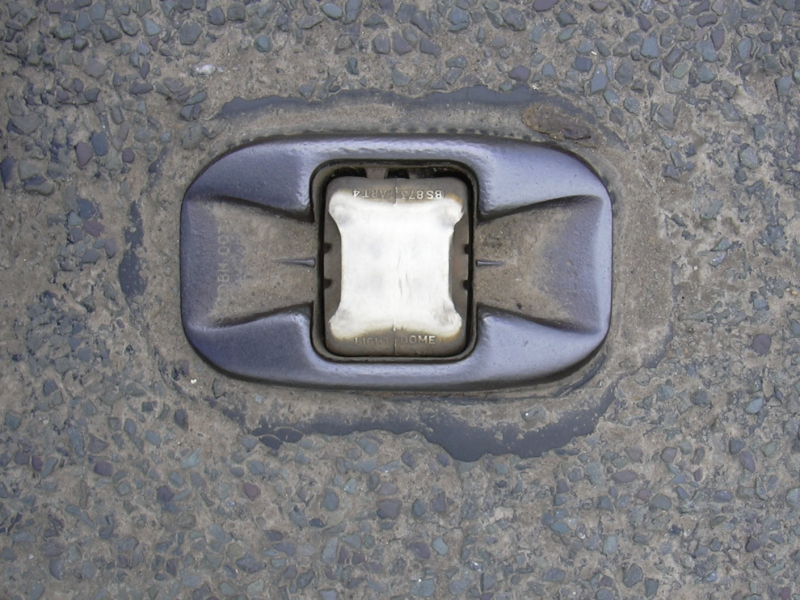
The solution is the part that makes the device properly clever. The reflective unit is not fixed to the road. It sits in a flexible rubber housing, set into a cast metal shoe that is embedded in the surface. When a tyre passes over it, the weight pushes the whole rubber unit downward into the shoe. When the wheel has gone, the rubber’s own elasticity pushes it back up.
In the bottom of the shoe, below the reflector, there is a small reservoir. Rain collects there and stays, because the shoe is a sealed cup rather than a drain. As the unit is pushed down, the face of the lens is dragged past the rim of that reservoir and wiped through the water sitting in it. The lens surfaces are washed and squeezed clean, and the unit rises back into position.
So every vehicle that runs over a stud performs a service on it. Busy roads, which dirty the studs fastest, also clean them most often. The maintenance rate is automatically matched to the contamination rate, with no mechanism, no power and nobody’s attention required.
It is one of the few pieces of road furniture that is actively improved by being driven over, and the first thing most people say when they learn this is that they had assumed the stud was simply a lump of glass glued down.
Why Being Run Over Does Not Destroy It
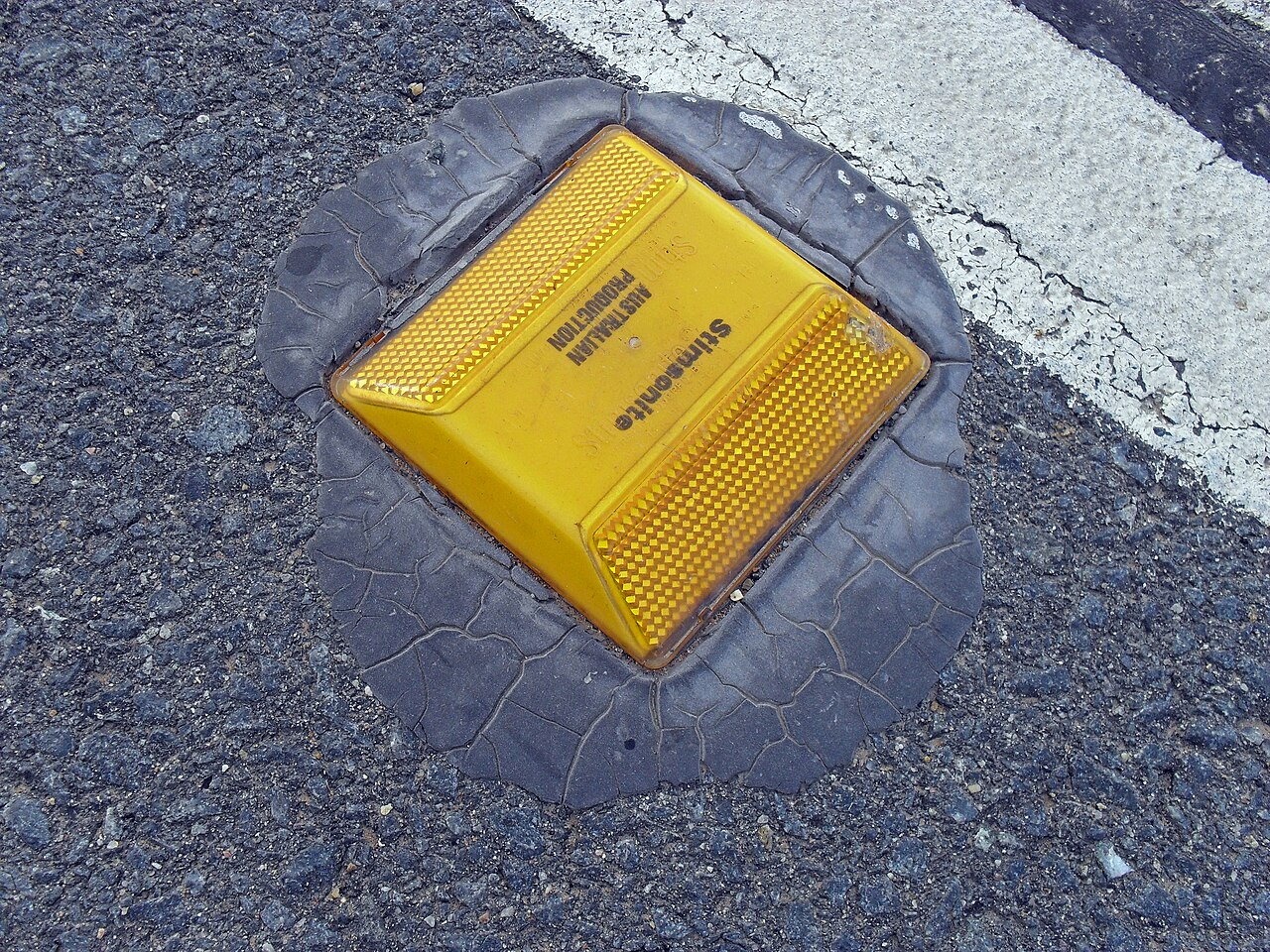
The same flexibility that provides the cleaning also provides the survival. A rigid object standing proud of a road surface and struck repeatedly by tyres at speed would be torn out or shattered.
Because the unit depresses, the wheel never meets a hard obstacle. The load is taken by the rubber in compression and spread into the metal shoe, which is in turn held by the road around and beneath it. The stud gives way, lets the wheel over, and comes back.
That also explains why they produce the particular sound and feel they do. Driving over a line of them generates a rhythmic series of soft thuds rather than sharp impacts, and that rhythm is doing a second job that was not necessarily designed in but matters a great deal. A driver drifting out of lane receives an unmistakable audible and physical warning. The marker that tells you where the lane is at night also tells you when you have left it, without being looked at.
That principle was later developed deliberately in the form of grooved and ribbed surfaces along the edges of roads, which exist purely to make noise and have no optical function at all. The stud got there first by accident.
The Colours Are a Language
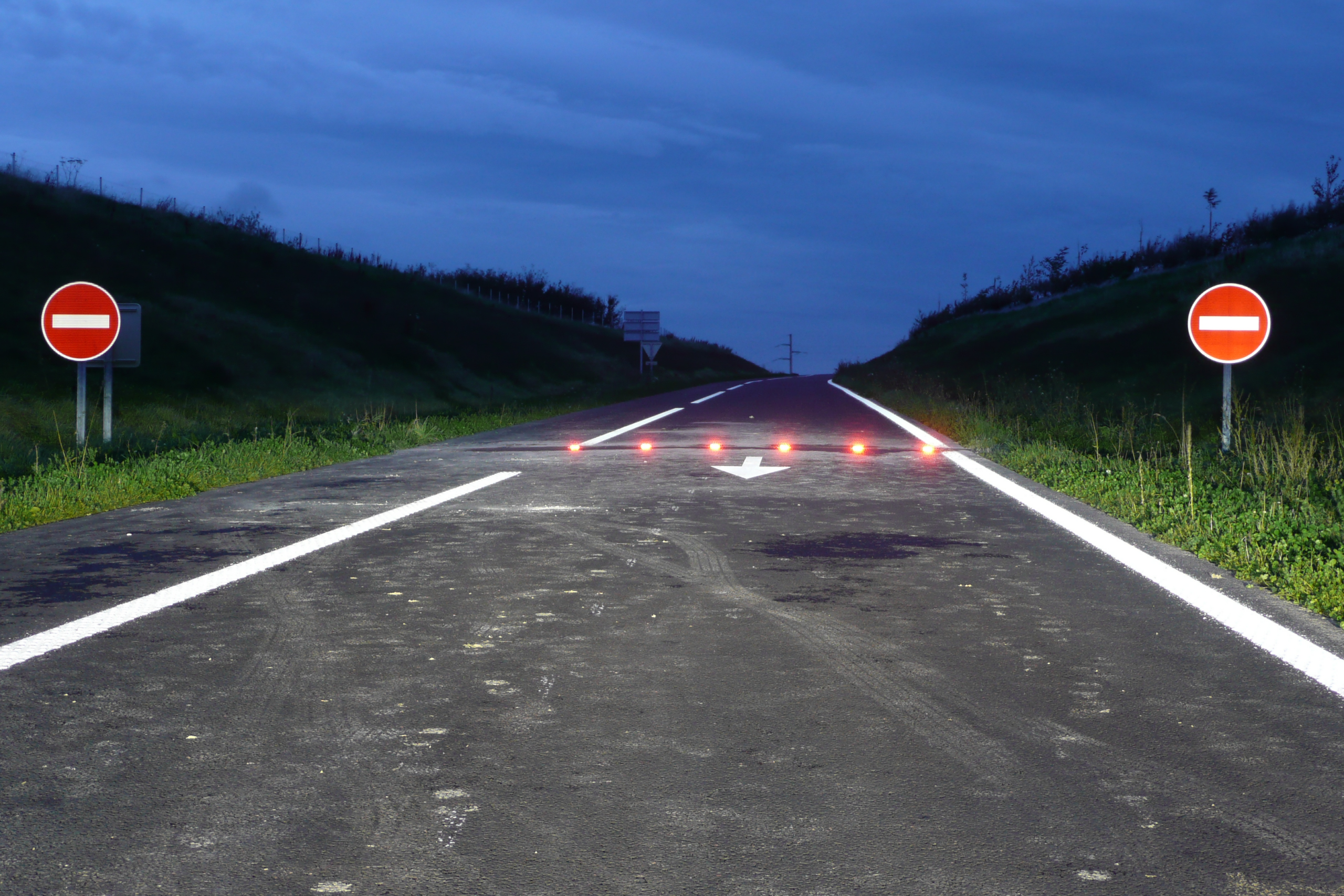
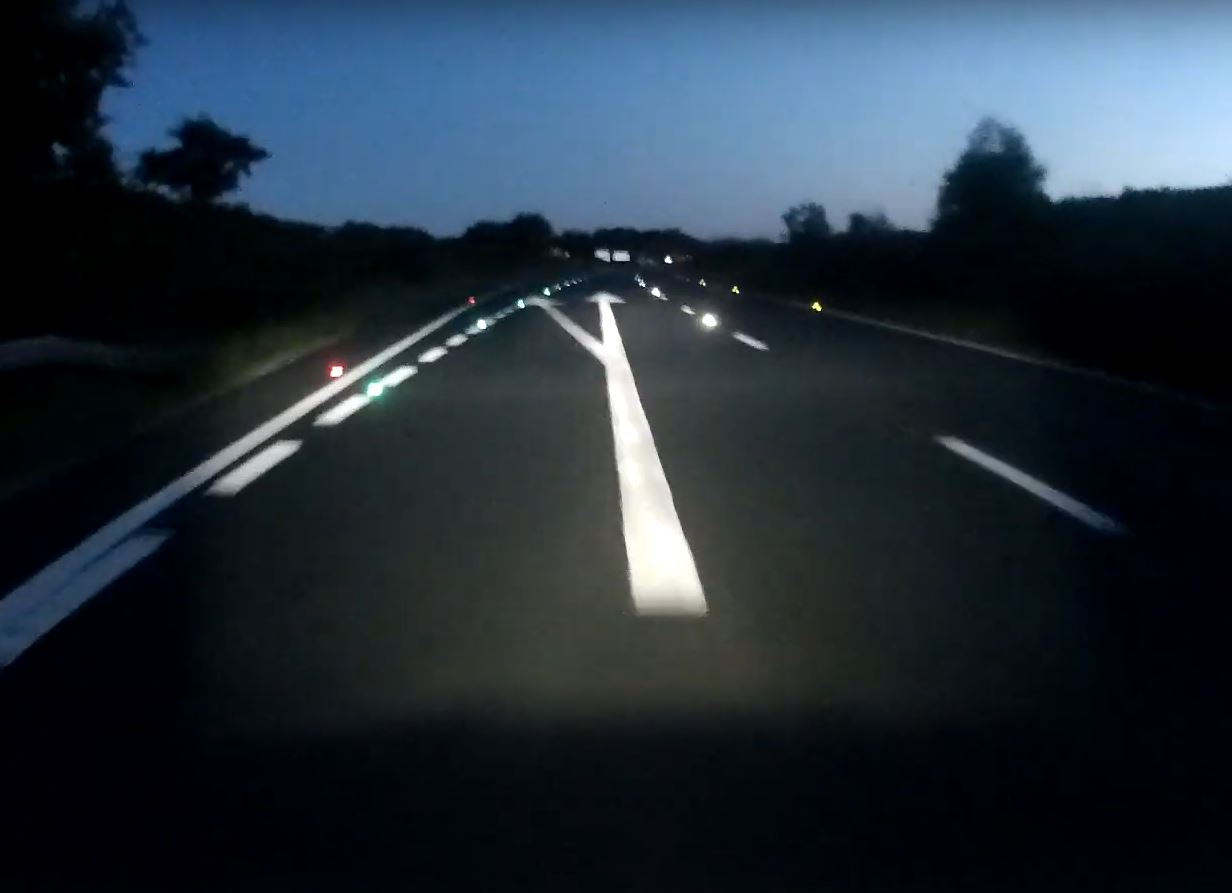
Where studs are used in quantity, their colours are not decorative. They encode which line you are looking at, which is information a driver needs instantly and cannot obtain from a white line in the dark.
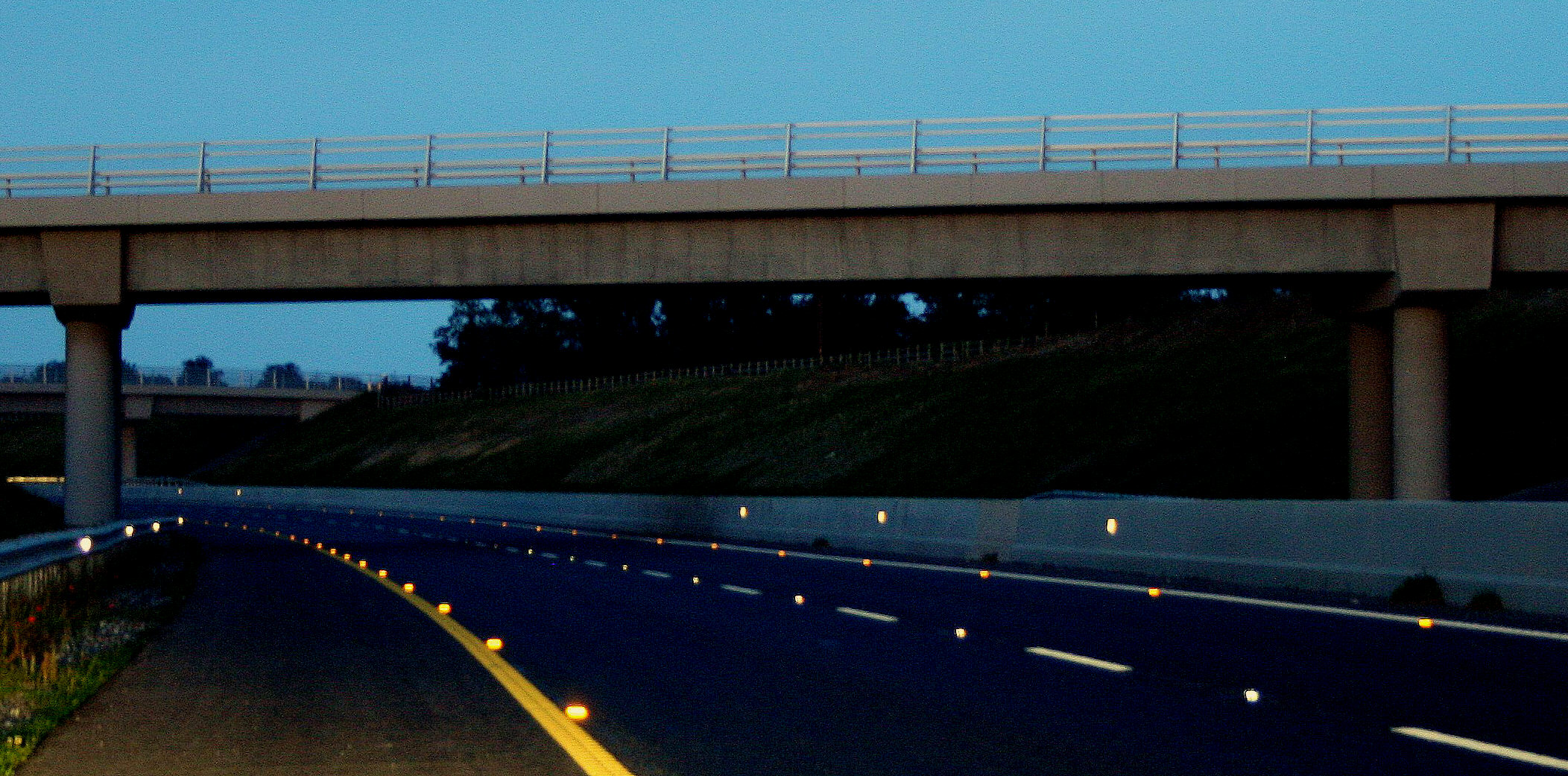
The systems differ between countries, so the specific correspondences cannot be stated generally, but the underlying logic is consistent. One colour marks the centre or lane divisions, another marks the edge of the carriageway on one side, another the edge on the other side, and a distinct colour marks something a driver must not cross or a hazard such as a slip road or a temporary layout.
The effect is that a driver on an unlit road at night is reading a coloured map of the road’s geometry, assembled from their own headlights, extending further ahead than the beam itself usefully illuminates. The information arrives before the road does.
Unidirectional reflectors add another layer. A stud can be built to return light only to traffic approaching from one direction, which means a driver travelling the wrong way along a one-way road sees nothing where they expect to see a line. The absence is the signal.
All of this is lost on anybody who has only driven on lit roads, which is part of why the device is so poorly known relative to how much work it does.
Why the Spacing Varies
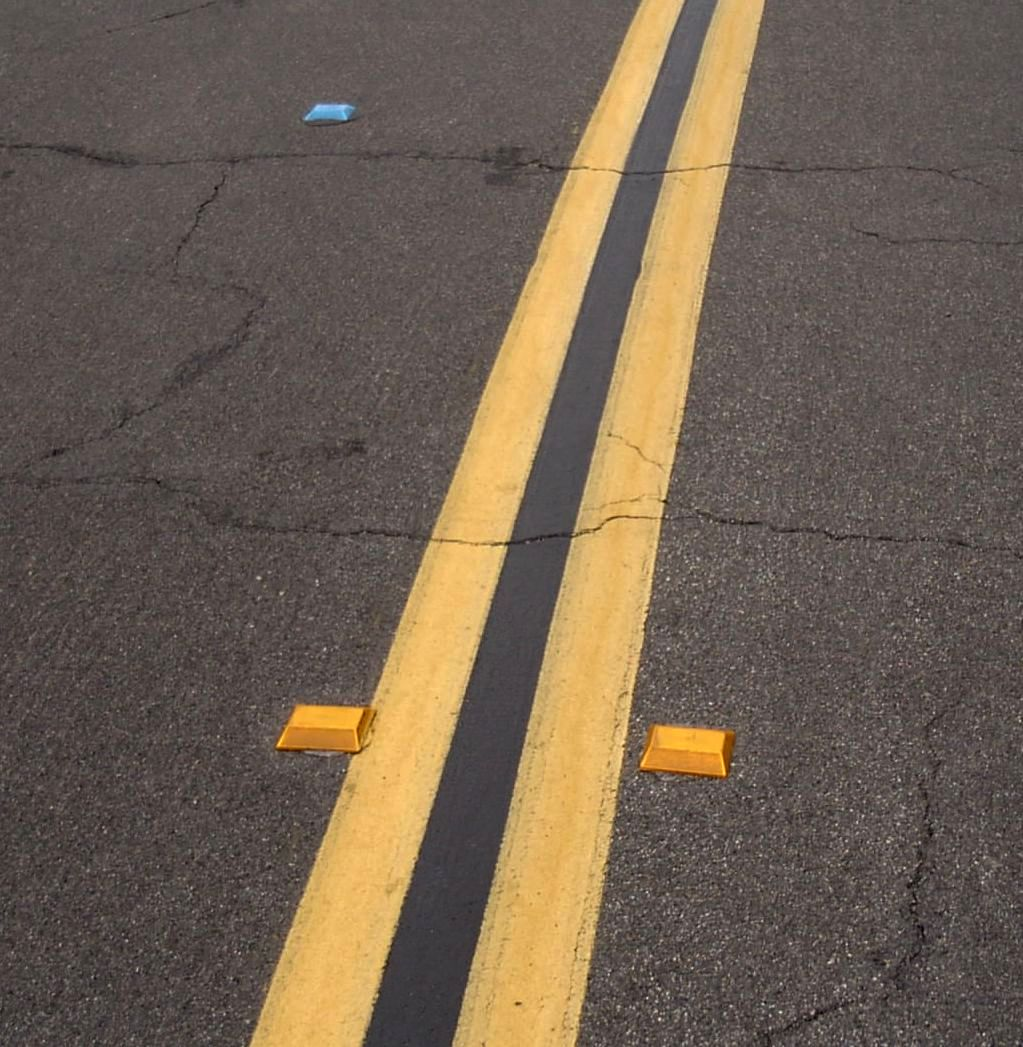
Studs are not laid at a constant interval. The spacing changes, and once you know that, it becomes readable.
On a straight section they are relatively far apart, because a driver needs only confirmation of a line that is doing nothing surprising. Through a bend they are placed closer together, because the eye needs more points to resolve a curve and because the information has to arrive sooner relative to the speed at which the geometry is changing.
Close spacing is therefore a warning in itself. A sudden tightening of the interval ahead means the road is about to do something, and an experienced driver reads it without consciously noticing. The same applies to the way studs are used to mark the taper of a merge or the division at a junction, where the pattern of the line does the explaining rather than any sign.
It is a signalling system with no text, no symbols and no power supply, which conveys lane position, lane type, road geometry, direction of travel and the approach of a change, to every vehicle independently, using light the vehicle brought with it.
The Modern Versions and What They Fixed
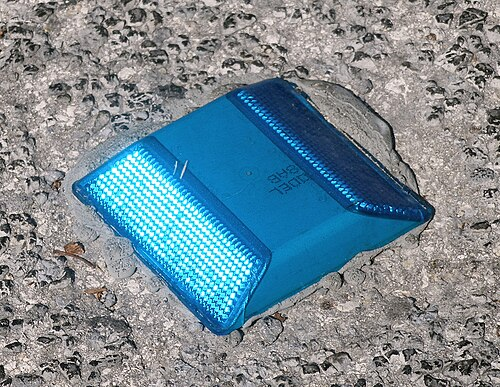
The original lens-and-mirror arrangement has been joined by several alternatives, each solving a specific shortcoming.
Moulded plastic retroreflectors using the cube-corner principle are cheaper to make in quantity and can be shaped into larger faces, so they return more light. They are commonly used where studs are bonded to the surface rather than set into a shoe.
Glass beads, broadcast into wet paint while it is being laid, turn an ordinary painted line into a weakly retroreflective one. Each bead is a tiny sphere doing the same job as a lens. This is why a fresh road marking is far brighter in headlights than an old one, and why the brightness fades as the beads are worn away or buried, long before the paint itself looks worn.
Solar-powered studs containing light-emitting diodes are a different proposition entirely, because they emit rather than return light. They can be seen from much further away, can be made to flash, and can be switched or sequenced to indicate a closure or a diversion. They need a charge and they fail individually, which the passive kind does not.
The passive stud’s advantage remains what it always was. It has no power source to fail, no electronics to corrode, no schedule, and it is cleaned by the traffic it serves.
What It Cannot Do
The limitation follows directly from the mechanism, and it is worth stating because the device is sometimes credited with more than it delivers.
A retroreflector needs light arriving from near the observer’s own position. It therefore does nothing for a pedestrian with no light, nothing in daylight, and very little in fog, because fog scatters the outgoing beam before it reaches the stud and scatters the returning light before it reaches the eye. Fog defeats the whole principle regardless of how good the reflector is.
Standing water defeats it differently. A stud submerged under a film of water loses most of its return, because light is refracted at the water surface and the geometry that makes retroreflection work is disrupted. Heavy rain is precisely the condition in which markings are most needed and in which they perform worst, which is why the raised profile matters: a stud that stands slightly above the surface stays clear of a film that would swamp a painted line.
And a reflector cannot indicate anything that is not geometric. It can tell you where the lane is and that something is changing. It cannot tell you what.
Within those limits it is one of the highest-returning pieces of engineering on any road: a small lump of glass, rubber and cast metal, with no power and no moving parts to speak of, which marks out a route in the dark for every vehicle separately and gets washed by each one in passing.
Like our content? Follow us for more.
