


On the back of a tie, a few inches up from the narrow end, there is a small loop of fabric stitched across it.
It is called a keeper, or a loop, and the narrow end of the tie is supposed to pass through it after the knot is tied, which holds the back blade flat against the front one.
A substantial proportion of people who wear ties have never used it, have assumed it is the brand label, or have used the label itself for the purpose – which is a different thing, is not designed to take the load, and tears out.
What It Is Actually Holding
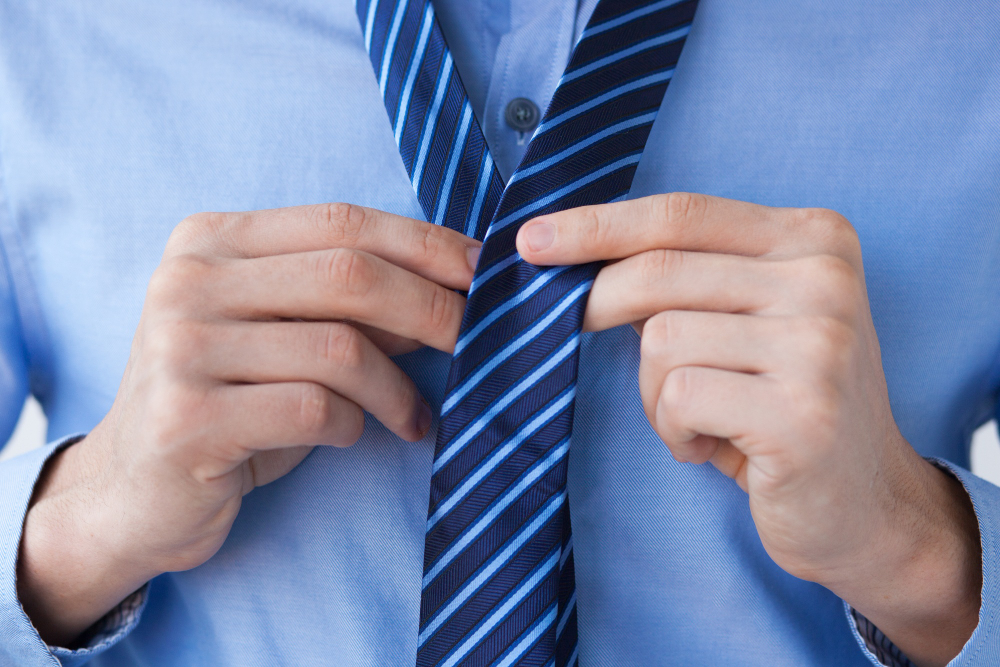
A tie is two blades of fabric of different widths joined at the neck. The wide one hangs in front and the narrow one hangs behind it, and the narrow one is not attached to anything below the knot.
So it swings. It drifts sideways, appears from behind the front blade, and in any kind of movement or wind ends up visible, which is the single commonest way a tie looks wrong on somebody who has otherwise dressed carefully.
The keeper solves it by giving the narrow blade somewhere to be. Threaded through, it is held centred and flat, and the two blades move together as one object instead of independently.
That is the whole function, and it also keeps the back blade from flapping into things, which matters more than it sounds for anybody eating, working at a desk or leaning over anything.
The alternative solution, a tie clip or bar fastening both blades to the shirt front, does the same job plus one more – it stops the whole tie swinging forward. The keeper and the clip are not alternatives so much as two different amounts of the same idea, and the clip went out of fashion while the keeper, being invisible, did not.
Like our content? Follow us for more.
The Label Is Not a Keeper and the Difference Matters

Most ties have both – a keeper loop and, separately, the maker’s label stitched across the back, which is also a loop and is in roughly the same place.
The label is sewn through the outer fabric only, with a few stitches, for appearance. The keeper is constructed to be pulled on, anchored into the seam or the interlining, and positioned where the geometry works.
Putting the narrow blade through the label works for a while and then pulls the stitching out, leaving a torn label, a hole, and in some cases a mark on the face of the tie where the thread has dragged through.
Which is worth knowing because it is one of the commonest small ways a decent tie is ruined, and the correct loop is frequently sitting an inch away.
Some makers have given up and now stitch the label as a proper anchored loop so that it can take the load, having presumably concluded that people will use it regardless of what it was for. That is a sensible response to observed behaviour and it is also an admission that the original arrangement was never communicated to anybody.
The Tie Is Cut on the Bias and That Is the Whole Construction

Since the tie is turned over, the construction is worth understanding because it explains everything about how a tie behaves.
A tie is cut diagonally across the weave of the fabric rather than along it. That bias cut is what allows the knot to be tied, to compress, and then to recover its shape rather than staying crushed – a tie cut along the grain would not knot properly and would not spring back.
It also means the tie wants to twist. Fabric on the bias stretches unevenly, and a tie that has been pulled hard or hung badly develops a permanent spiral that cannot be pressed out, because the distortion is in the weave rather than in a crease.
Inside there is an interlining – a separate layer of woven material whose weight determines how the tie knots and how it hangs. And the whole thing is held together along the back by a single thread running the length of it in a loose slip stitch, which allows the tie to flex and recover.
That single thread is why you should never pull a tie straight by yanking the blades apart. It is the one component holding the construction together, and it will break – and a tie with a broken slip stitch goes baggy and cannot be repaired without opening the whole thing up.
How Ties Are Supposed to Be Looked After
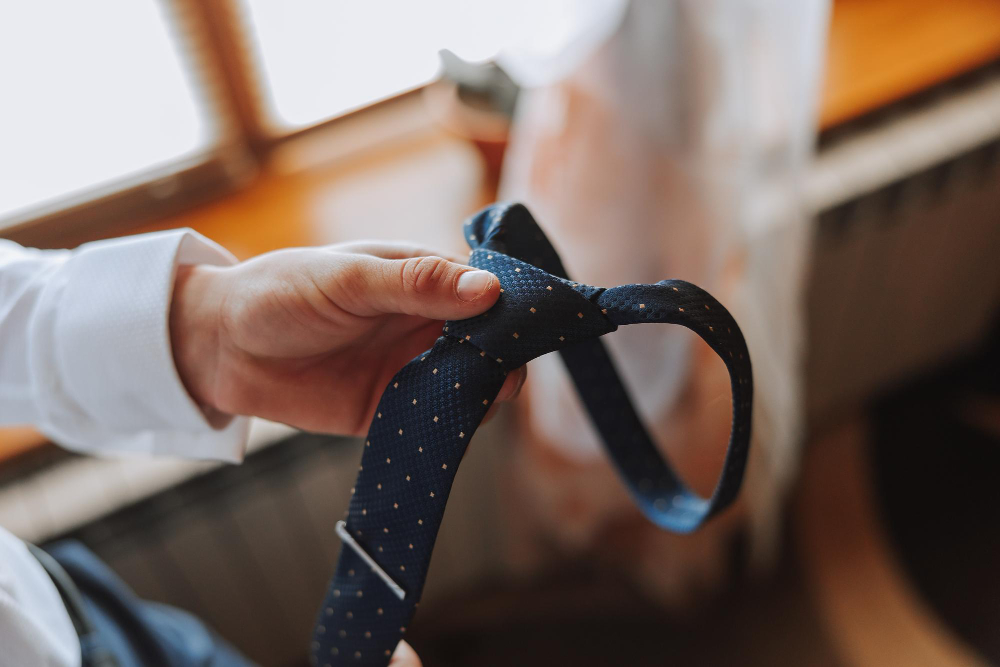
All of that construction has direct consequences for care, and the consequences are not intuitive.
Untie it rather than pulling the knot out. Pulling the narrow blade through a tightened knot drags fabric against fabric under pressure, which is what wears the point where the knot sits and is why old ties are worn out in exactly one place.
Hang it or roll it rather than folding it. The bias cut means a fold becomes a permanent distortion, and rolling loosely lets the fabric recover.
Do not press it flat with an iron. A tie has a rolled edge, and flattening it produces a hard pressed line along both sides that no amount of subsequent care removes – which is the quickest way to make a good tie look cheap.
And give it a day between wearings, because the fabric and interlining recover their shape slowly after being knotted.
None of that is fussy. It is the difference between a tie lasting years and a tie developing a permanent twist and a worn patch within a few months.
The Knot Decides How the Whole Thing Sits
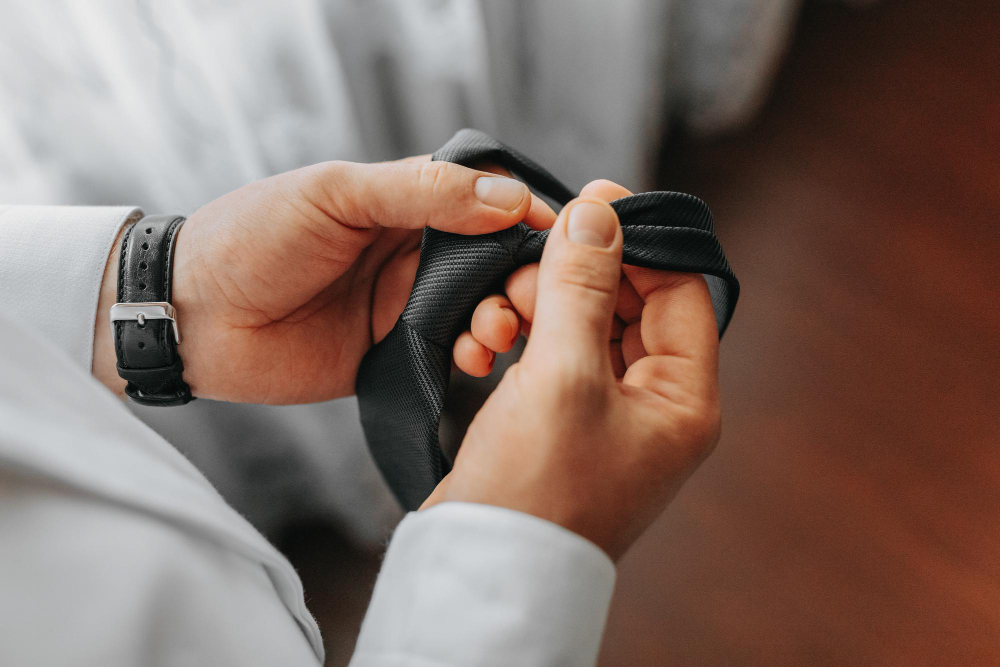
The keeper holds the back blade and the knot determines everything in front of it, which is worth covering because the two interact.
A knot’s bulk has to match the collar it sits in. A small knot in a wide spread collar leaves a visible gap on either side and looks lost; a large knot in a narrow collar forces the collar points apart and distorts them. The knot is the adjustable part, so the collar sets which knot is appropriate rather than the other way round.
The knots differ mainly in how many turns the wide blade makes, which is what controls bulk – and also in whether they are symmetrical, which is why a tie with a strong diagonal pattern sits differently in a symmetrical knot than in an asymmetrical one.
The dimple below the knot, the small vertical crease people either cultivate or have never noticed, is made by pinching the fabric as the knot is tightened. It serves no function at all. It exists because it makes the blade hang with a slight curve rather than flat, which catches the light and reads as deliberate.
And the length is a convention rather than a rule: the point of the wide blade finishing around the waistband. Getting that right is a matter of where the knot starts, which means a tall person and a short person cannot wear the same tie the same way, and ties are made in extra lengths for exactly that reason.
Why the Keeper Is Losing Its Function Anyway
There is an argument that the keeper is becoming vestigial in the same way as everything else in this category, and it is worth stating.
Tie wearing has declined sharply, which means a far higher proportion of the ties being worn are being worn occasionally, by people who are not practised, for a few hours at a time – and a keeper’s benefit accumulates over a long day of movement.
The fashion for narrower ties also reduced the difference between the two blades, and on some modern ties the narrow end is nearly as wide as the front, which makes the back blade both more conspicuous and harder to thread.
And some makers now fit a loop on each side, or omit it, or substitute a small clip.
So the keeper may well follow the sleeve button and the lash tab into being a thing that is present because it has always been present. For the moment it still works perfectly, costs the maker a few pence, and is used by roughly half the people who own one – which makes it the most functional and least used detail in this whole series.
The comparison worth drawing is with the cuff button, which has no function at all and is used by nobody, and which nobody would dream of removing. The keeper does something real, costs the same nothing, and is quietly disappearing – which suggests that what keeps a detail alive is not whether it works but whether its absence would be noticed.
Turn a tie over and find the keeper, then find the label, and note which one is anchored properly.
The narrow end goes through the keeper, not the label.
And if the label on one of your ties is already torn out at one end, that is what happened to it – which is a reasonably common discovery and not a manufacturing fault.
Like our content? Follow us for more.
