In August 1986, a crater lake in northwestern Cameroon released a cloud of carbon dioxide that suffocated entire villages in their sleep. Scientists are still working to make sure it can never happen again.
On the night of August 21, 1986, in a remote volcanic region of northwestern Cameroon, something happened that scientists at the time had no name for. A column of carbon dioxide gas — between 100,000 and 300,000 tons of it, according to the seminal 1987 Science journal paper by George Kling and colleagues — burst out of Lake Nyos, a crater lake in the Oku Volcanic Field. The gas cloud was 50 to 100 meters thick. It moved downhill at 20 to 50 kilometers per hour, hugging the ground because carbon dioxide is denser than air. Within minutes, it had reached the villages of Lower Nyos, Kam, Cha, and Subum.
By morning, 1,746 people were dead, along with about 3,500 cattle and uncountable smaller animals. Most had died in their sleep. The bodies showed no signs of trauma or struggle. They had simply stopped breathing.
It remains the only confirmed case in modern history of a natural disaster killing thousands of people through gas asphyxiation alone. And it might not have been the last, except that scientists figured out exactly what had happened — and how to prevent it from happening again.
What is a “limnic eruption”?
The phenomenon that struck Lake Nyos is now called a limnic eruption, and it’s one of the rarest and least-understood natural disasters on Earth. Only three have ever been confirmed: at Lake Monoun in Cameroon in 1984 (37 deaths), at Lake Nyos in 1986 (1,746 deaths), and indirectly at Lake Kivu on the border of Rwanda and the Democratic Republic of Congo, where similar conditions exist on a much larger scale and where scientists worry about an eruption affecting millions of people.
Here’s the mechanism, simplified:
Lake Nyos sits in a volcanic crater. Underneath it, deep in the earth, is magma releasing carbon dioxide gas. That gas rises through the rock and dissolves into the water at the bottom of the lake — where the high water pressure and cold temperature allow huge quantities of CO2 to remain dissolved, much like the carbonation in a sealed soda bottle.
Most lakes “turn over” annually, with cold surface water sinking and bringing deep water up, which would normally release accumulated gases gradually. Lake Nyos, due to its tropical location and the geometry of its crater, doesn’t turn over. The dissolved CO2 just kept accumulating, year after year, for centuries.
What triggered the 1986 eruption is still debated. The most accepted theory involves a rockslide on August 21, which disturbed the deep water enough to bring some of it toward the surface. As that water rose, the pressure dropped, and dissolved CO2 began coming out of solution — exactly like opening a soda bottle. The first bubbles rising disturbed more water, releasing more gas, in a chain reaction that emptied an enormous portion of the lake’s stored CO2 in a matter of minutes.
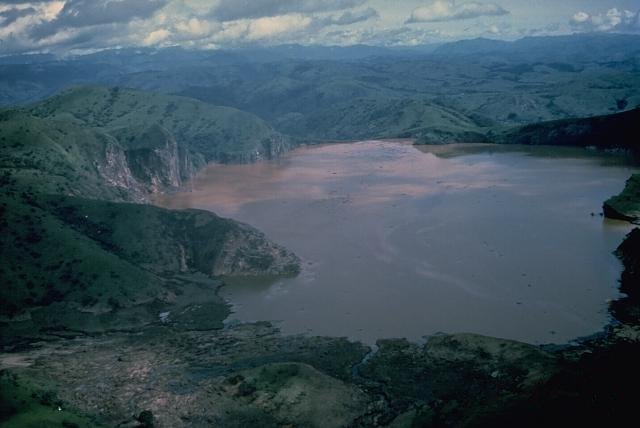
After the disaster, scientists measured the lake level had dropped by approximately four feet. The water surface had turned a strange reddish-brown from iron-rich deep water that had been brought to the surface.
What survivors experienced
Around 4,000 people survived in the broader region, mostly because they lived on higher ground above the gas cloud’s path. Their accounts, collected by medical investigators in the months that followed, were consistent and harrowing.
Most survivors reported losing consciousness suddenly, with no warning. They woke hours later — comas ranged from six to 36 hours — to find that family members, neighbors, and livestock around them had not woken up. There was no smell, no warning. Insects had stopped making sounds. The air had gone completely still.
A medical study published in the British Medical Journal in 1989, examining 845 survivors who reached hospitals, documented the clinical signature of mass CO2 poisoning. About 19% of survivors had skin lesions and burns initially attributed to acidic gas exposure but later determined to be associated with prolonged unconsciousness in the gas cloud. Many survivors developed lasting respiratory problems, paralysis, and neurological damage.
The villages of Lower Nyos were essentially eliminated. Of the 1,200 people who had lived there before the disaster, only two — a woman and a child — survived.
How they’re defusing the lake
The most remarkable part of the Lake Nyos story isn’t the disaster itself — it’s what happened afterward.
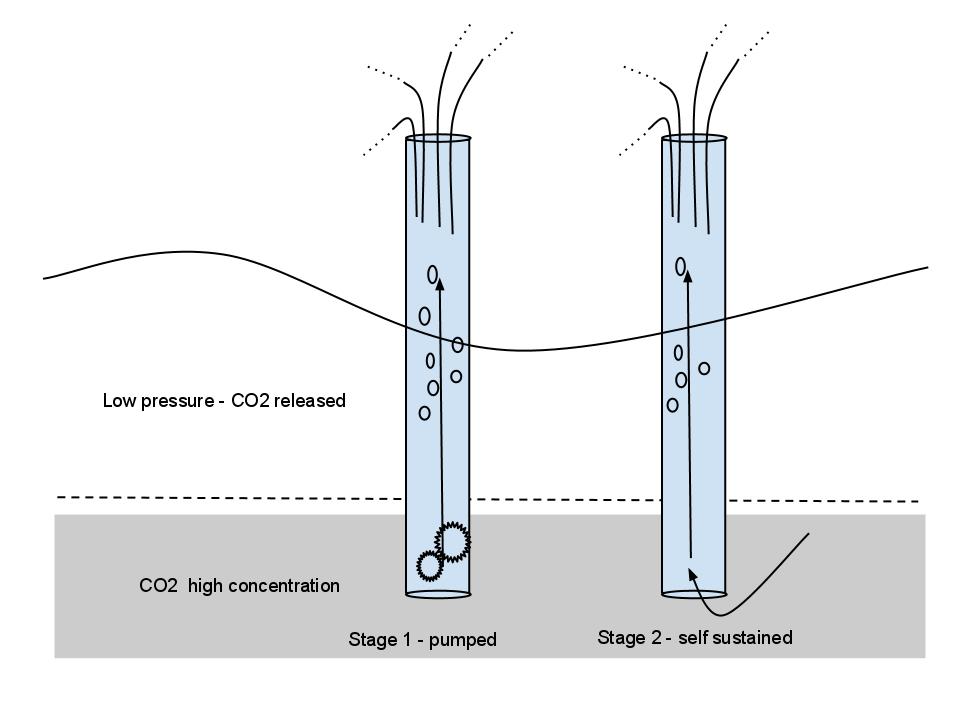
Within a year of the eruption, an international team of scientists led by French researcher Michel Halbwachs proposed an audacious solution: install pipes running from the deep, gas-saturated water at the bottom of the lake to the surface. Once started — initially with a pump — the gas-rich water rising through the pipe would naturally continue flowing, because the dissolved CO2 would expand as pressure decreased on the way up, propelling the water like a giant straw. The gas would harmlessly release at the surface in a controlled fountain rather than a catastrophic eruption.
The first prototype pipe was installed in 1995. The first permanent degassing pipe began operation in 2001, shooting a 50-meter-tall fountain of gas-laden water continuously into the air. Two more pipes were added in 2011. According to research presented at the IAVCEI Commission on Volcanic Lakes workshop in Yaoundé in 2016, the degassing operation has successfully reduced the dissolved CO2 in Lake Nyos to roughly half of pre-eruption levels.
The system isn’t perfect. The original natural gas barrier in the lake — the temperature and chemistry gradient that kept the deep water trapped — has been disturbed by the pipes themselves. Scientists continue to monitor whether new equilibria might create different risks. But the catastrophic risk that existed in 1986 has been substantially reduced.
A separate, much more dangerous degassing operation continues at Lake Kivu, on the border of Rwanda and the DRC. Lake Kivu contains an estimated 300 cubic kilometers of dissolved CO2 and 60 cubic kilometers of methane — orders of magnitude more than Lake Nyos. An eruption there could affect roughly two million people living along its shores. International efforts to safely extract methane from Lake Kivu (which is being used to generate electricity for Rwanda) are also gradually reducing the disaster risk, though the work is expected to take decades.
What’s left in the affected region
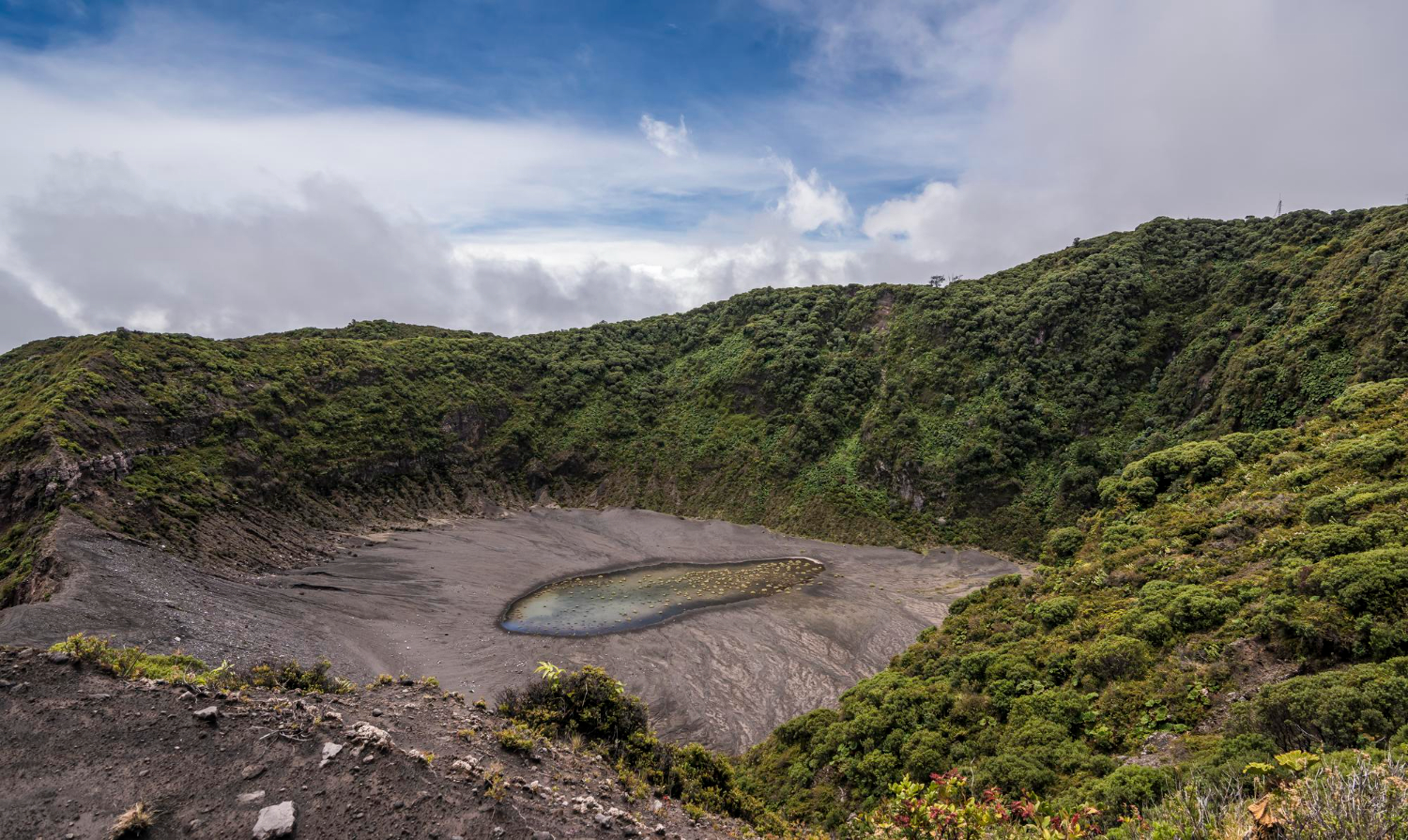
The villages directly hit by the 1986 cloud were never resettled. The Cameroonian government declared the immediate area a no-return zone, and survivors were relocated to other communities. Lake Nyos itself is now monitored by Cameroonian and international scientific teams as part of an ongoing volcanic hazard assessment.
For visitors today — and the area does receive a small number of researchers, journalists, and adventure travelers — Lake Nyos is reachable by 4WD from the regional capital of Bamenda after a long drive over rough roads. The fountain of degassing water is visible from the lake shore, an ongoing engineering response to a disaster that scientists once didn’t believe was possible.
The deepest legacy of the Lake Nyos disaster, beyond the human cost, is what it taught the field of volcanology and limnology. Crater lakes around the world that had previously been considered geologically inert are now classified, monitored, and in some cases actively degassed. The International Working Group on Crater Lakes was founded at a 1987 conference in Yaoundé in direct response to what happened at Nyos. The lakes that scientists now know are dangerous — and the engineering solutions to make them safer — exist because 1,746 people went to sleep in their villages on a calm August night and didn’t wake up.