

From Mall Madness to Crossfire to Dream Phone, several iconic board games defined sleepovers and birthday parties for an entire generation. Most are now out of production. The reasons range from electronic component obsolescence to changing social attitudes to corporate licensing decisions that fans never really understood.
If you grew up in the United States during the 1980s or 1990s, your family probably owned at least three or four of the games on this list. They sat in closets and on rec room shelves, came out at sleepovers and birthday parties, and produced specific sensory memories — the rattle of plastic pieces, the dramatic voiceover prompts, the satisfying click of mechanical components. They were everywhere, and then, gradually, they disappeared.
Most of these games are no longer in production at all. A few have been brought back in updated forms but lack the original electronic components, packaging, or design that made them memorable. The reasons each one disappeared vary, but the broader pattern reflects how dramatically the toy industry has changed since the 1990s.
Here are 8 of the most-missed, with the actual stories behind each one’s discontinuation.
1. Mall Madness — discontinued, then reissued in a different form
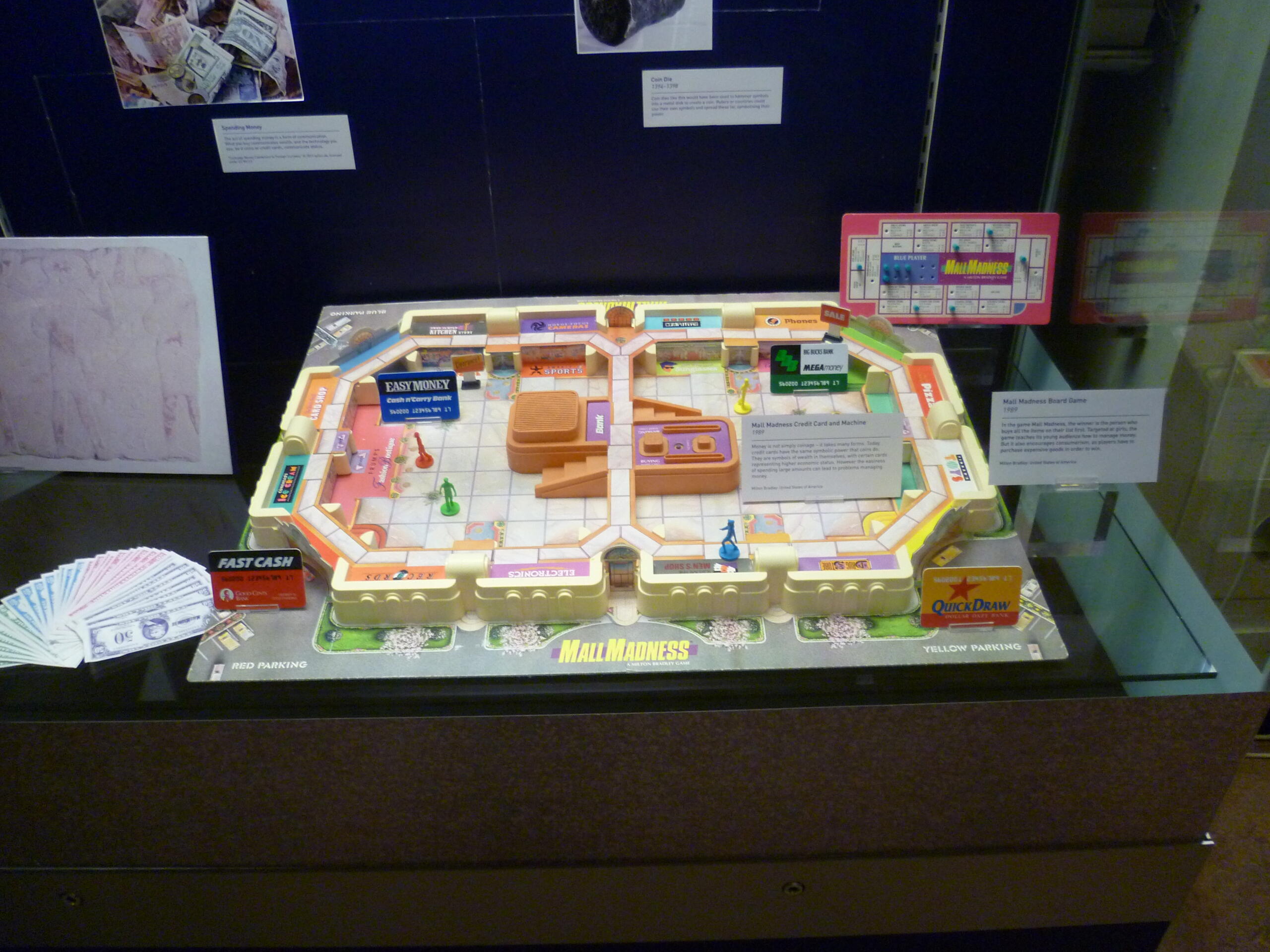
Mall Madness was released by Milton Bradley in 1988 as a battery-powered electronic board game where players raced around a fictional shopping mall, used a plastic ATM card to buy items from a shopping list, and tried to be the first to complete their list and reach the parking lot. The game’s electronic voice — featuring the famous prompt “There’s a sale at the shoe store!” — was the defining feature.
The original Mall Madness was discontinued in the late 1990s. Hasbro (which acquired Milton Bradley) released updated versions in 2004 and again more recently, but fans consistently report that the modern versions don’t quite capture the original’s electronic voice quality, board design, or specific 1980s shopping references. The current 2020s version exists but lacks the elaborate electronic mall structure of the original.
The deeper reason for the original’s discontinuation: the electronic components became expensive to manufacture as the technology aged, and the cultural reference (mall shopping as an aspirational activity) became less resonant as malls themselves began declining.
2. Dream Phone — discontinued, never satisfactorily replaced
Dream Phone, released by Milton Bradley in 1991, was a deduction game where players used an oversized pink toy phone to “call” a series of dreamy boys and decode clues to determine which boy had a secret crush on the player. The pre-recorded voice prompts (“He’s not wearing a hat!” or “He’s not at the beach!”) delivered clues that players used to narrow down suspects.
The original Dream Phone was discontinued in the mid-1990s. A “Modern Edition” was released in 2017 but with significant differences — different artwork, updated photos of “modern” crushes, different voice prompts. The original 1991 version is now a collector’s item, with sealed copies selling for $200+ on eBay.
The reason for the discontinuation included shifting attitudes about gendered marketing and the dating-stereotypes-as-game-mechanic premise. Modern toy industry sensibilities have moved away from games that explicitly cast players as girls and require them to wait for boys to “like” them. The 2017 reissue softened the premise but never recaptured the original’s cultural impact.
3. Crossfire — discontinued in the 1990s
Crossfire was released by Milton Bradley in 1972 and reached peak popularity in the late 1980s and early 1990s after a memorable TV commercial featuring the song that became iconic (“Crossfire! You’ll get caught up in the Crossfire!”). The game featured two players using launchers to fire metal ball bearings at puck-shaped targets, attempting to push them into the opposing player’s goal.
The original Crossfire was discontinued in the late 1990s. Milton Bradley released a “Crossfire 2” version in 1995, then various subsequent updates that gradually lost the original’s metal-ball-bearing intensity. The modern versions use plastic balls and are significantly tamer than the original.
The discontinuation was driven primarily by safety concerns. The high-velocity metal ball bearings could cause genuine injury — to the players, to younger siblings, to pets, to walls and furniture. Multiple injury reports through the 1990s led to product liability concerns. The reformulated plastic versions are safer but lack the original’s chaotic appeal.
4. Mouse Trap — original mechanism discontinued, modern version is much simpler
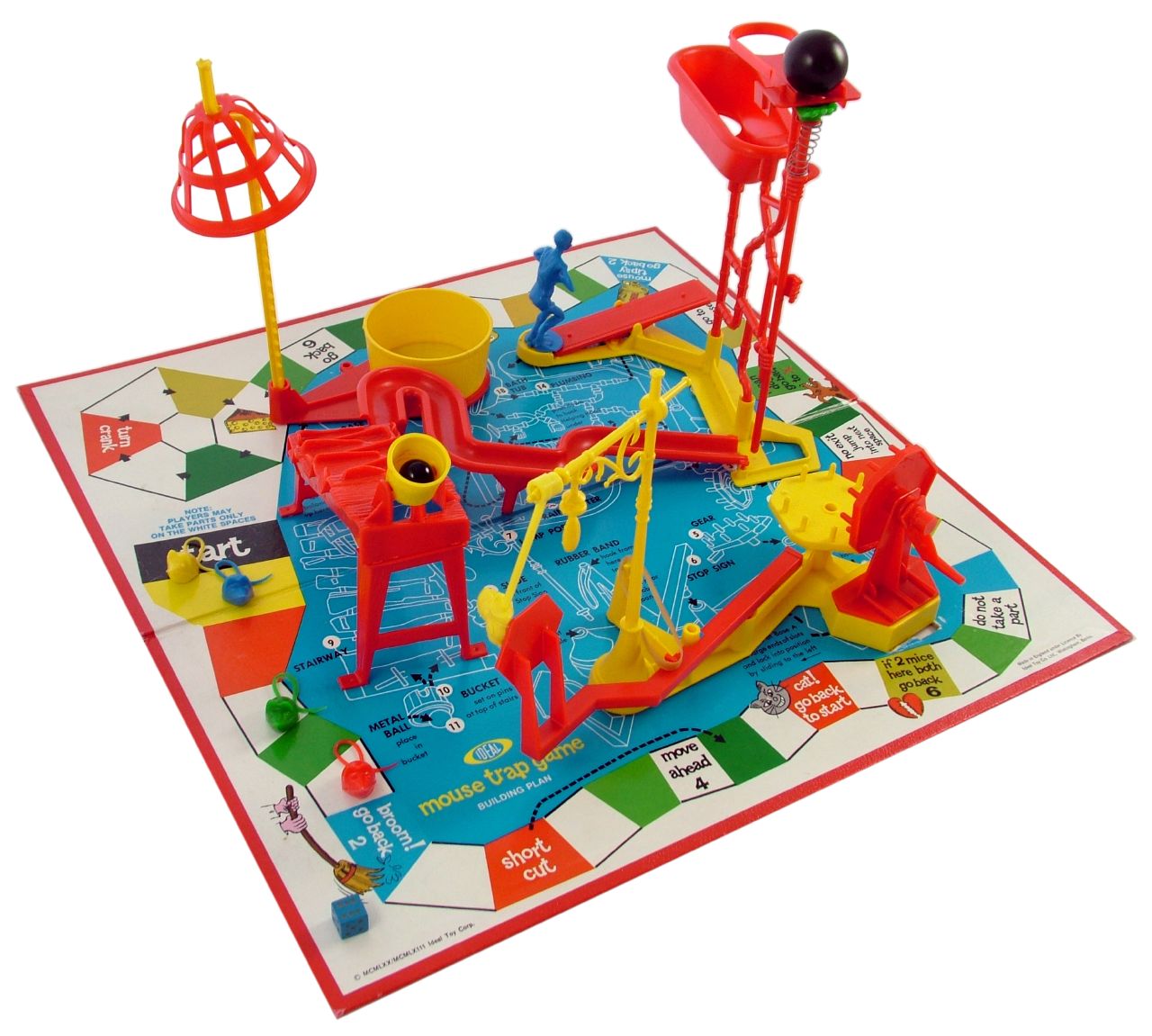
Mouse Trap was released by Ideal Toy Company in 1963 and remained a staple of American childhoods through the 1990s. The game’s defining feature was the elaborate Rube Goldberg-style machine that players assembled during gameplay — a chain reaction involving a crank, a gear, a kicking boot, a rolling ball, a diving man, and a falling cage that captured a plastic mouse.
The original elaborate Mouse Trap mechanism was simplified significantly starting in 2004, when Hasbro released a streamlined version that eliminated several Rube Goldberg components and made the trap much easier to set up. Subsequent versions have continued to simplify the mechanism. The modern Mouse Trap (still in production) bears little physical resemblance to the elaborate original.
The discontinuation of the original mechanism was driven by manufacturing cost. The original Mouse Trap had numerous small plastic components that broke easily, were expensive to mold, and required complex assembly during gameplay — gameplay that often failed because pieces were lost or broken. Hasbro’s calculation was that a simpler, more reliable game would have better long-term sales than the elaborate but fragile original.
5. Don’t Wake Daddy — discontinued, brief revival, current status uncertain
Don’t Wake Daddy was released by Parker Brothers in 1992. The game featured a plastic “Daddy” figure asleep in bed and a series of paths leading to the kitchen. Players moved their pieces toward the kitchen to grab a midnight snack, but stepping on certain spaces required pushing a button that sometimes — randomly — caused Daddy to bolt awake with a startled “What’s that?!” sound effect.
The original Don’t Wake Daddy was discontinued in the early 2000s. A reissue was released around 2005 but with different artwork, different game mechanics, and different voice prompts. The current status of the game is unclear; sporadic reissues have appeared but none have become a sustained product line.
The reason for the original’s discontinuation was a combination of changing cultural attitudes and the difficulty of replicating the specific voice acting and design that made the original distinctive. Some critics also noted that the premise — sneaking food past a sleeping father who would react with anger if awoken — felt increasingly culturally tone-deaf in modern parenting contexts.
6. Hungry Hungry Hippos — original metal-ball version discontinued
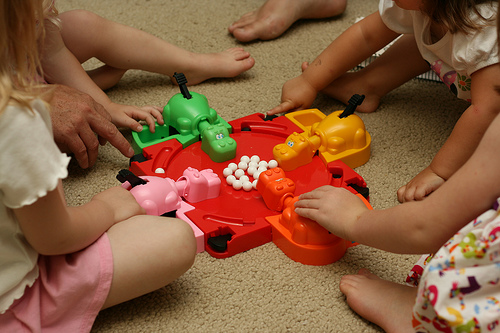
Hungry Hungry Hippos was released by Hasbro in 1978 and reached peak popularity through the 1980s and 1990s. The original game featured four hippos clustered around a central platform; players slammed levers behind their hippos to extend the hippo’s neck and “eat” plastic marbles in the center.
The original metal-ball version was discontinued in the late 1980s, replaced with the plastic-ball version. The ostensible reason: choking hazard for younger players. The actual reason was the same as Mouse Trap — the metal balls were more expensive to manufacture, and the plastic balls were cheaper.
The plastic-ball Hungry Hungry Hippos is still in production and remains popular. Original metal-ball versions from the late 1970s and early 1980s are now collector’s items.
7. Pictionary — discontinued in original Mattel release, now Hasbro
Pictionary was originally released by Pictionary Inc. in 1985 and quickly became one of the defining party games of the late 1980s and 1990s. The game itself — drawing words for teammates to guess — has remained popular, but the specific Pictionary product line went through multiple corporate transitions that effectively discontinued the original version.
Mattel acquired Pictionary in 1994. The Mattel-era Pictionary editions (1994-2017) introduced various special-edition variants and modified gameplay. In 2017, Mattel sold Pictionary back to Pictionary Inc., which then licensed it to Hasbro. The current Hasbro Pictionary (2018-present) uses different artwork, different word lists, different scoring rules, and a different overall product design from any of the previous versions.
The discontinuation pattern reflects broader corporate consolidation in the toy industry. Pictionary survived as a brand but the specific product that 1980s and 1990s families remember — the original Pictionary Inc. version with its specific yellow box and category cards — is no longer in production.
8. Operation — original mechanism still in production but significantly different
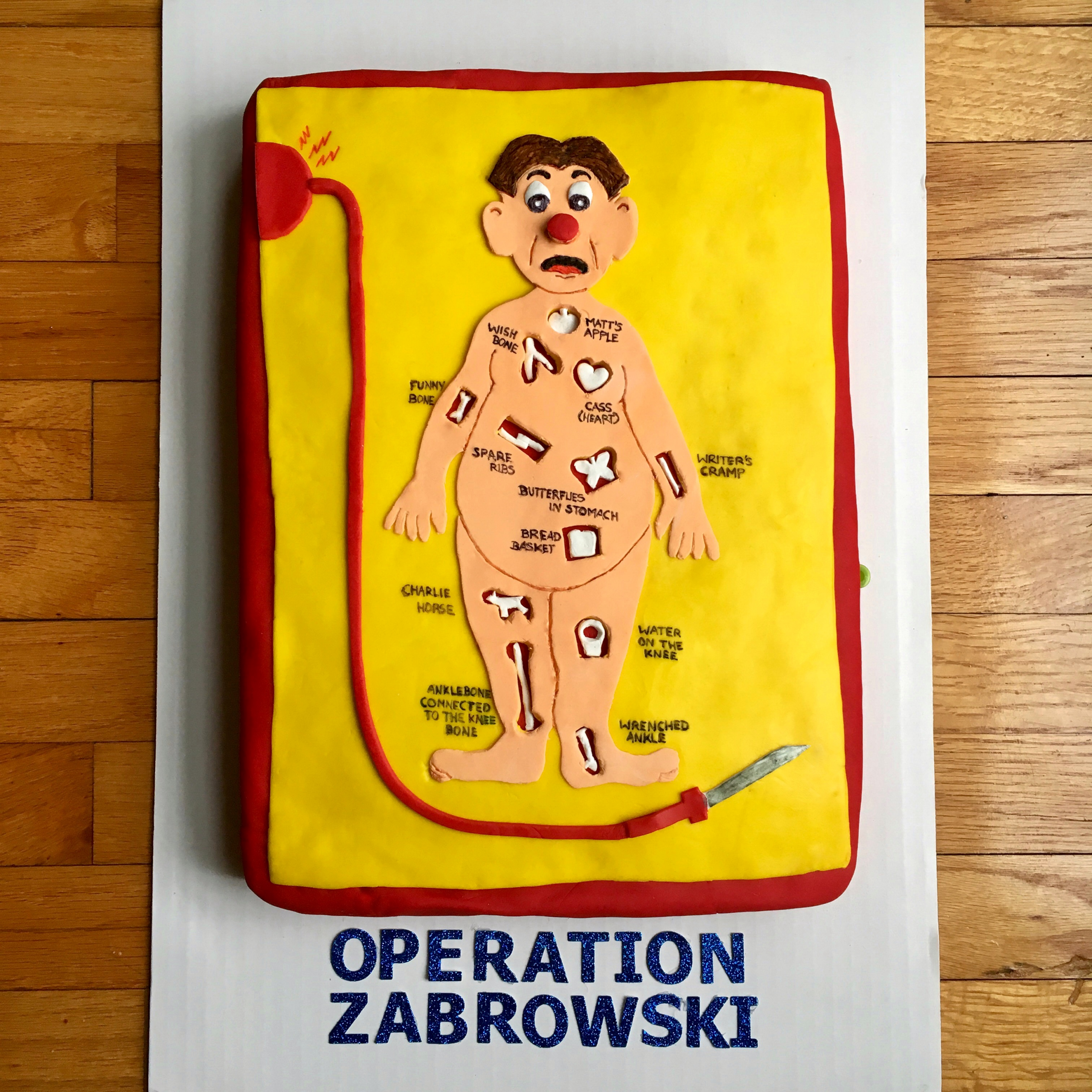
Operation has been in continuous production by Milton Bradley/Hasbro since 1965, but the version most 80s and 90s kids remember has been substantially modified over the decades. The original game’s plastic body cavity, plastic tweezers, and battery-powered buzzer when players touched the metal sides remain — but the artwork, the specific organs and ailments, and the gameplay rules have changed multiple times.
The “Cavity Sam” character that defined the original game (the patient on the operating table) was redrawn in the 1980s, again in the 1990s, and again in the 2000s. The “Funny Bone,” “Charlie Horse,” “Wishbone,” and other body parts that made the original memorable have been replaced or supplemented with newer versions. The game still exists, but the specific 1985-era Operation that 80s kids played is no longer available.
The continuous modification has been driven by Hasbro’s marketing strategy of refreshing the game every few years to maintain appeal for new generations. The result is that you can still buy “Operation,” but you can’t buy the specific Operation you remember.
Why this generation of board games is disappearing
The pattern across all eight games reflects specific industry dynamics that have changed since the 1990s:
Electronic components are expensive to maintain. Many of the most memorable games (Mall Madness, Dream Phone, Don’t Wake Daddy, Operation, Battleship) relied on specific electronic voice components, batteries, or mechanical effects. As manufacturing has shifted increasingly to lower-cost overseas production, the specific electronic components used in 1980s and 1990s games have become economically unviable.
Safety standards have tightened. Crossfire’s metal ball bearings, Mouse Trap’s small plastic parts, Hungry Hungry Hippos’ metal marbles, various other games’ choking hazards or impact risks — modern toy safety standards have effectively prohibited continuing to sell the original versions of many of these games. Reformulated versions exist but are typically less satisfying than the originals.
Cultural attitudes have shifted. Dream Phone’s gendered dating premise, Don’t Wake Daddy’s domestic dynamic, Mall Madness’s consumerist celebration — these games reflected specific cultural moments that don’t translate as easily to 2026 sensibilities. Reissues either soften the original premise (losing what made it distinctive) or fail to find audiences.
Corporate consolidation has eliminated competing toy companies. In the 1980s, Milton Bradley, Parker Brothers, Tonka, Mattel, Ideal, Selchow & Righter, and many others all produced board games. By the 2020s, virtually all major American board game brands are owned by either Hasbro or Mattel. Corporate consolidation has reduced product variety and accelerated discontinuation of less-profitable lines.
Video games have replaced board games for many household entertainment occasions. The cultural role that board games played in 1980s and 1990s households (family entertainment on weekend nights, the default sleepover activity) has been substantially replaced by video games, streaming entertainment, and digital social platforms. The total board game market has shrunk in real terms over decades.
For collectors interested in original versions, the secondary market through eBay, Mercari, Facebook Marketplace, and dedicated retro toy stores can produce most of these games in playable condition. Original Mall Madness games sell for $50-$150 in good condition. Original Dream Phone goes for $150-$300. Original Crossfire (the metal-ball version) goes for $200-$400.
For the families that owned these games during their original peak, the loss is genuinely cultural rather than economic. The specific memories tied to specific games — the particular voice of the Mall Madness narrator, the elaborate Rube Goldberg of original Mouse Trap, the chaotic intensity of original Crossfire — are sensory experiences that can’t be replicated by modern toys. Those memories will continue to fade as the 1980s and 1990s recede further into history. The games will continue to exist on eBay and in basements until the components stop working and the boxes finally fall apart.
