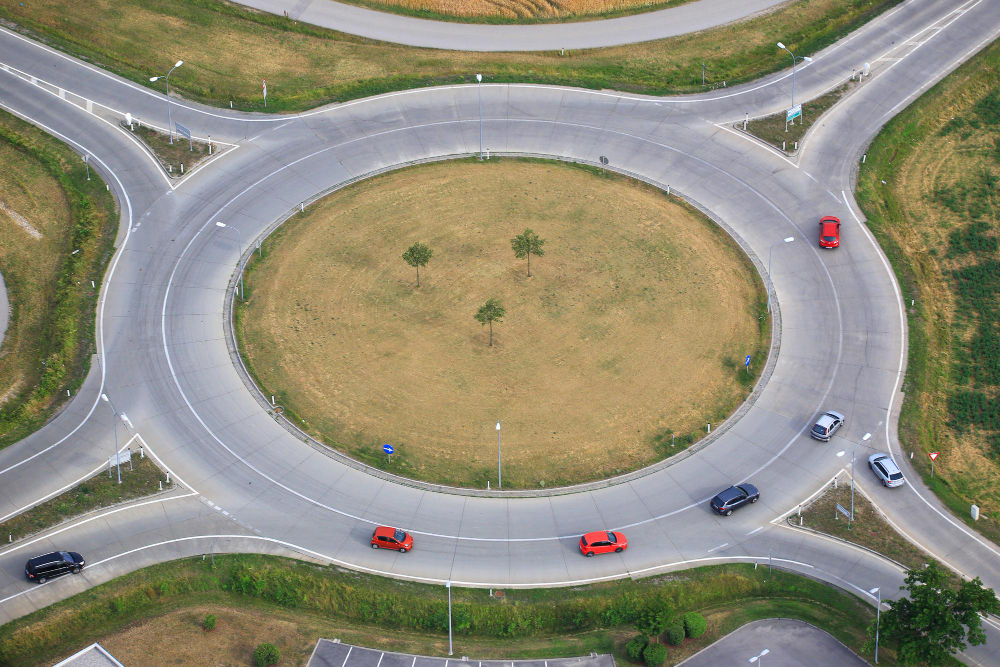
There is a way of analysing junctions that makes their differences obvious, and it is not the one most people use.
The usual way is to think about rules — who goes first, what the signals mean, who has priority. That is how a junction is experienced and it is not how one is designed.
The design method is to count conflict points: every location within the junction where the paths of two vehicles could occupy the same space, classified by the angle at which they meet.
That count, and the type of conflicts it contains, determines almost everything about how a junction performs — and it explains why a circulatory arrangement behaves so differently from a crossroads despite carrying the same traffic.
Counting the Conflicts
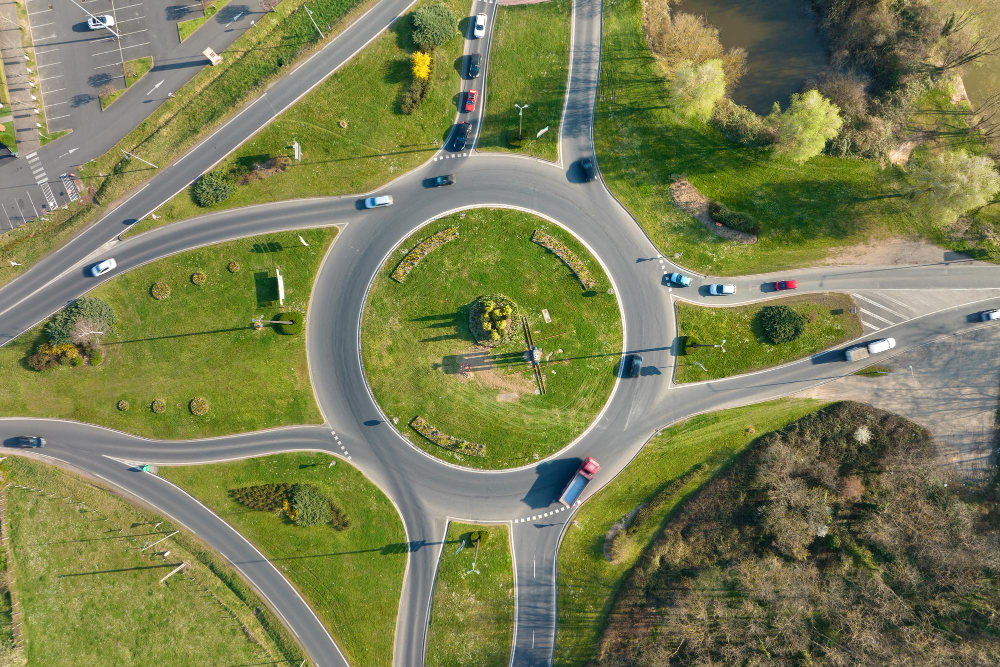
The analysis is straightforward and the numbers are the point.
At a standard four-arm crossroads with turns permitted, paths conflict in three ways.
Merging conflicts occur where two streams join, at a shallow angle, with both vehicles travelling in similar directions.
Diverging conflicts occur where a stream splits, which are the least hazardous of the three.
Crossing conflicts occur where one path passes directly through another, at a substantial angle, with the vehicles travelling in different directions.
A four-arm crossroads has thirty-two conflict points in total, of which sixteen are crossings.
A four-arm circulatory junction has eight, and none of them is a crossing. Every movement is either joining the circulating stream or leaving it.
That is the entire argument, and everything else follows from it.
Like our content? Follow us for more.
Why Crossing Conflicts Are Different
The distinction is not merely that there are fewer of them.
A merging conflict between vehicles travelling in similar directions involves a low relative speed, because the difference between two vehicles going roughly the same way is small even if both are moving quickly.
A crossing conflict involves vehicles travelling in substantially different directions, so the relative speed is high — and the consequences of a failure scale with relative speed rather than with road speed.
The geometry also matters. A vehicle struck from the side has far less structure between the impact and the occupants than one struck from the front or behind.
So a junction that eliminates crossing conflicts has removed the category of conflict where failure is most consequential, which is a more useful change than simply reducing the number.
There is a visibility point worth adding. Approaches are designed so that a driver can see the circulating traffic early enough to judge a gap, and deliberately NOT so far that they can see enough to arrive at speed intending to cross without slowing.
That balance – enough sight to decide and not enough to commit early – is a real design parameter rather than an accident of layout.
The Geometry Does the Work

The physical design is where the effect is actually produced, and it is frequently misunderstood as decoration.
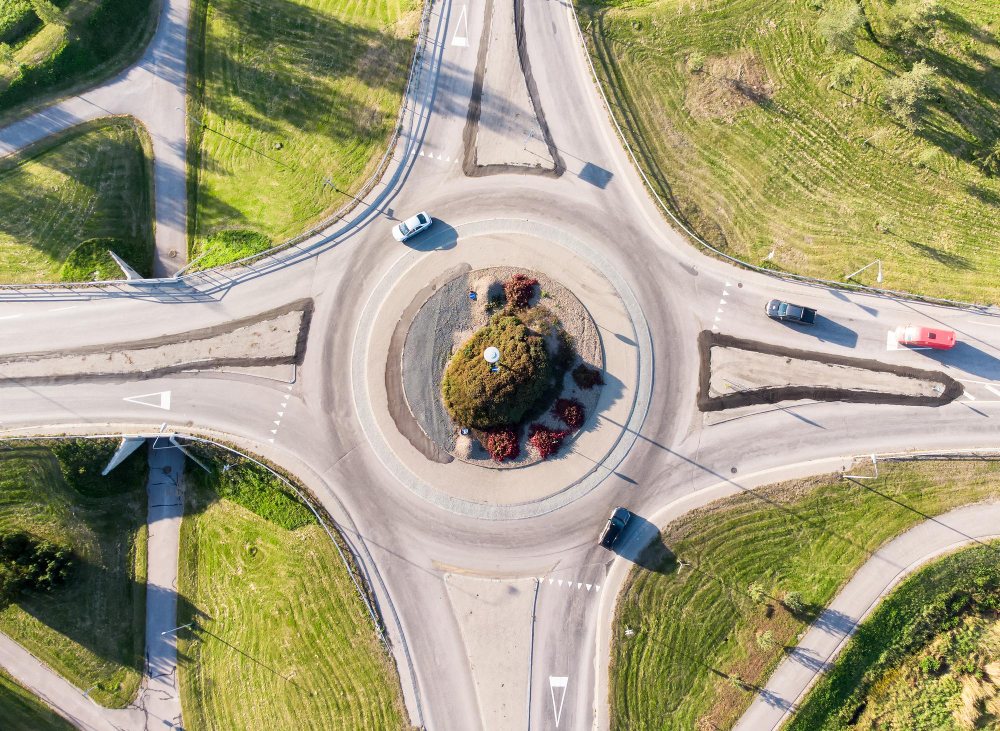
The central island forces a deviation. A vehicle cannot travel straight through, which means it must steer — and steering at speed is uncomfortable, so drivers slow down without being instructed to.
That is the key mechanism. Speed reduction is produced by the shape rather than by a sign, a limit or a signal, which means it does not depend on anybody choosing to comply.
The entry angle is designed so that a driver joining the circulating stream is looking in the direction the traffic is coming from, which makes the gap judgement natural rather than requiring a difficult head movement.
Deflection on entry is deliberate for the same reason as the island — a straight entry permits a fast one.
And the diameter is a substantial design variable. Too small and large vehicles cannot pass; too large and the deviation is insufficient to slow anybody.
There is a capacity detail worth adding. Throughput depends heavily on how many lanes the circulating carriageway has and on the width of the entries, since a wider entry allows more than one vehicle to take the same gap.
Those dimensions are adjusted independently for each arm according to its flow, which is why the entries around a single junction are frequently different widths.
What It Costs
The trade-offs are real and are the reason the arrangement is not universal.
Capacity is not always better. A circulatory junction outperforms a signalled one where flows on the arms are balanced, and performs worse where one arm carries a dominant flow — because circulating traffic has priority and a dominant stream can prevent others entering at all.
Space is a real constraint. The arrangement requires more land than a crossroads, and in a built-up area that land may not exist.
Pedestrian provision is harder. A signalled junction can stop traffic completely, and a circulatory one has no natural point at which everything halts, which means crossings must be placed on the approaches and are less convenient.
That applies more acutely to anybody with impaired vision or mobility, for whom judging a gap in continuously moving traffic is substantially more demanding than waiting for a signal — and this is a documented criticism rather than a theoretical one.
And cyclists are in a difficult position, travelling more slowly than the circulating stream on a path that requires crossing entries and exits, which is why separate provision is generally preferred where it can be afforded.
Why the Small Ones Exist
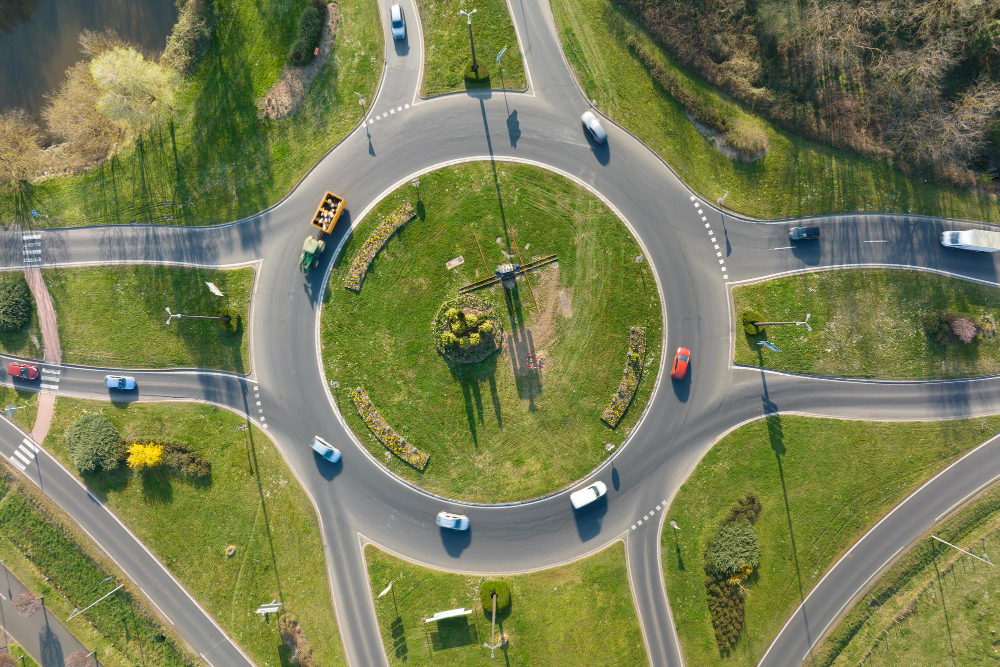
The compact versions deserve their own explanation because they look like a compromise and are a different device.
Where space does not permit a proper island, a marked or slightly raised circle can be used, which drivers pass over rather than around.
Those do not achieve the deflection that produces speed reduction, so they rely much more on the priority rule and much less on geometry.
They are cheap, fit into existing junctions, and improve on an uncontrolled crossroads without approaching what a full-size arrangement achieves.
Arrangements combining several of them around a larger circle exist, permit movement in both directions, and are notoriously confusing to anybody encountering one for the first time — while performing well, because they reduce every movement to a series of very small decisions.
Why They Keep Moving

One behaviour of these junctions is worth explaining because it is counterintuitive.
Circulatory junctions generally produce lower delay than signals at moderate flows, and the reason is that nobody stops unnecessarily.
A signalled junction allocates time in fixed blocks. If an arm has a green phase and no traffic on it, that time is wasted, and everybody else waits through it — which means the junction is idle for part of every cycle regardless of demand.
A circulatory junction allocates space rather than time. A driver waits only for an actual gap, and takes it as soon as it appears, which means capacity is used continuously rather than in allocated periods.
At low and moderate flows that is substantially more efficient, and it is why such junctions are frequently installed where a signalled arrangement produced queues on empty roads.
The advantage reverses under heavy flow. Once the circulating stream is continuous, gaps stop appearing, and a driver on a minor arm may wait indefinitely — whereas a signal guarantees a phase eventually regardless of how busy the main road is.
That is the real trade. Signals provide fairness and guaranteed access at the cost of wasted time; circulation provides efficiency at the cost of no guarantee — and which is preferable depends entirely on the flow pattern rather than on anything about the design.
Which is why the two coexist, and why converting one to the other is a decision about traffic rather than about engineering.
Why the Rule Matters More Than the Shape
The final point is the one that is easiest to miss.
The arrangement only works because circulating traffic has priority. A junction where entering traffic has priority fills up and locks solid, because vehicles enter until the circulating space is full and then nobody can leave.
That priority rule was not original to the design, was adopted some decades after circulatory junctions first appeared, and is what converted them from an unreliable arrangement into a dependable one.
Before it, such junctions worked adequately at low flows and failed completely at high ones, which gave them a poor reputation that took a long time to shed.
So the thing that makes it work is a rule about who yields, and the island, the deflection and the geometry are all there to make complying with that rule easy and slow enough to be safe.
Which is a reasonable summary of a great deal of traffic engineering. The rule does the work, the geometry makes the rule easy to follow, and the design succeeds to the extent that the two agree with each other.
And that is the part that transfers. A rule everybody must follow works best when the physical arrangement makes following it the natural thing to do – which is a cheaper and more reliable approach than asking people to comply with something the layout is fighting.
Like our content? Follow us for more.