Pick up a die. Look at the top face and the bottom face together. They add to seven.
Turn it. Any pair of opposite faces adds to seven – one against six, two against five, three against four. There are no exceptions on a standard die, and you can check it on any die in the house in about ten seconds.
The arrangement is called the seven rule, it is at least two and a half thousand years old, and almost nobody notices it despite handling dice their whole lives.
Why Seven

A six-sided die carries the numbers one to six, which add to twenty-one. Pair the faces into three opposite pairs and the only way to make all three pairs equal is to make each pair total seven.
That is the arithmetic, and it explains why seven rather than some other number. It does not explain why anybody wanted the pairs to be equal in the first place.
The usual answer is balance, in two senses. There is a crude physical argument – that distributing the pips so opposite faces carry the same total keeps the mass distribution more even, since a pip is a small amount of material removed from the face. The effect on a modern die is negligible and would not have been the original reason.
The better answer is that it is a self-checking design. An arrangement in which every opposite pair sums to seven is immediately verifiable: anybody can pick up a die and confirm in seconds that it is made correctly. A die with a mistake in it, or a deliberately altered one, fails the check. In a game played for money with somebody else’s equipment, that matters a great deal.
Like our content? Follow us for more.
There Are Two Mirror-Image Versions and They Both Exist
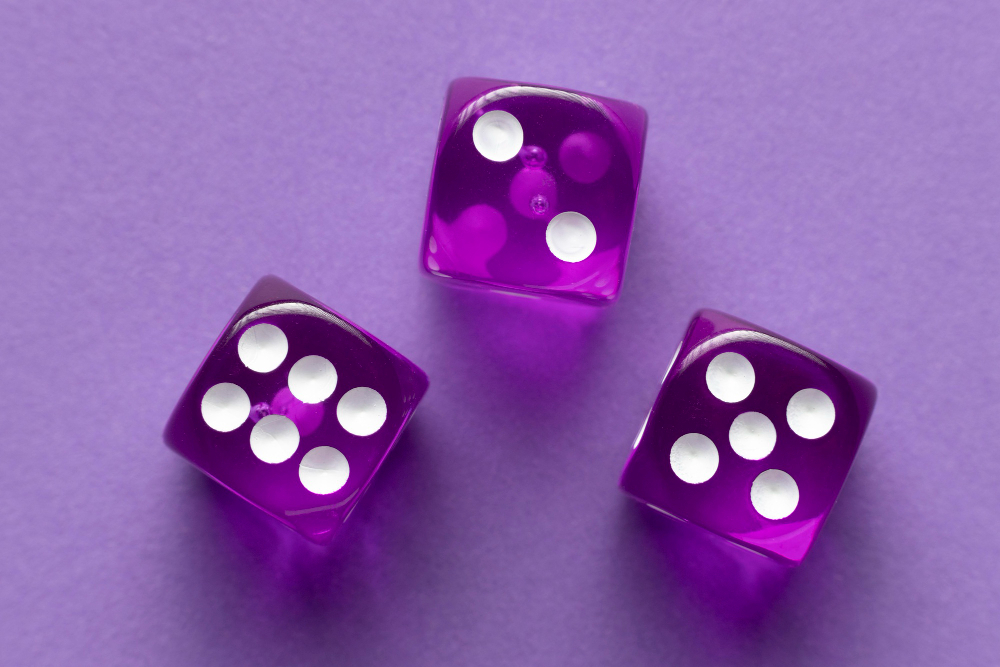
The seven rule does not fully determine a die. Once one, two and three are placed around a corner, they can run clockwise or anticlockwise, and those two arrangements are mirror images of each other. They cannot be rotated into one another.
The two forms are called right-handed and left-handed. Hold a die so that one, two and three all meet at a corner facing you: if they read anticlockwise it is right-handed, and if clockwise, left-handed.
Western dice are overwhelmingly right-handed and have been for a very long time. Chinese and Japanese dice are commonly the other form. Both have been found in archaeological contexts and both are entirely valid – the handedness makes no difference whatever to the probabilities, and no game depends on it.
It is a genuinely satisfying thing to check. Collect a few dice from different sources and a surprising number of people find they own both kinds without ever having noticed.
Not Every Die Follows the Rule, and the Exceptions Say Something

A few categories break it, and each exception is informative.
Casino dice follow the rule strictly and are manufactured to tolerances that ordinary dice are not. They are transparent so that nothing can be concealed inside, the pips are drilled and then filled flush with material of the same density so the mass distribution is not altered, the edges are square rather than rounded so they do not favour any face, and each one is serialised and inspected. A rounded, opaque, hollow-pipped die from a board game is not a precision instrument and does not pretend to be.
Novelty, promotional and some very old dice frequently do not follow the rule, which is one of the quick ways to spot that an object is decorative rather than a playing piece.
And dice with other numbers of faces – the four, eight, ten, twelve and twenty-sided dice used in role-playing games – follow their own arrangements. On most of them opposite faces sum to one more than the highest number, which is the same principle generalised.
Loaded Dice Are an Old Problem With an Old Answer
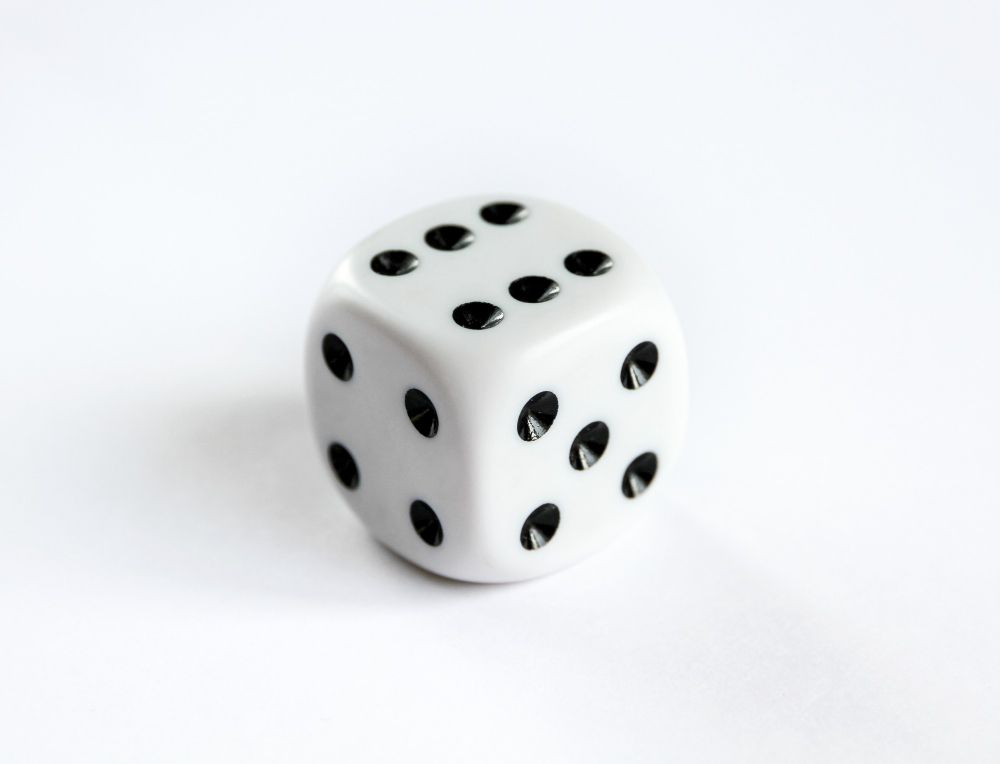
Dice have been cheated with for as long as they have existed, and loaded examples have been recovered from Roman sites, which tells you how early the problem was understood.
The methods are simple and ancient: weight concealed inside, faces shaved so the die is not a true cube, edges rounded unevenly so it rolls further on some axes, or a set substituted for another.
The countermeasures are equally old and are the reason casino dice look the way they do. Transparency removes concealment. Flush pips remove mass bias. Sharp edges and precise dimensions remove shape bias. Serial numbers and inspection remove substitution. A casino die is a solution to four separate cheating methods, each of which was in use long before anybody wrote the rules down.
The simplest home test is a salt water float: dissolve enough salt in water for a die to float, then spin it repeatedly. A fair die comes to rest showing different faces at random; a weighted one keeps showing the same face upward. It is not conclusive and it will not detect a shaved die, but it is a real test that works and costs nothing.
The Pip Pattern Itself Is Standardised

The arrangement of the pips is as fixed as the numbering. One is a single centre pip. Two and three run on a diagonal. Four and six are in columns. Five is four with a centre pip.
That pattern is recognisable to essentially everybody in the world and is read instantly without counting, which is the whole point – a player glancing at a tableful of dice is pattern-matching, not adding up. The arrangements were chosen to be distinguishable at a glance and at an angle.
The diagonal on the two and the three is the one with the most variation historically. Some traditions run it the other way, and on Japanese dice the single pip is frequently larger and red, which is a decorative convention with no effect on play.
It is worth noticing how much work the pattern is doing. A set of arabic numerals on the faces would be unambiguous and would be far slower to read, which is why dice have never adopted them despite numerals being available for the whole of the relevant period.
A Fair Die Is Harder to Make Than It Looks
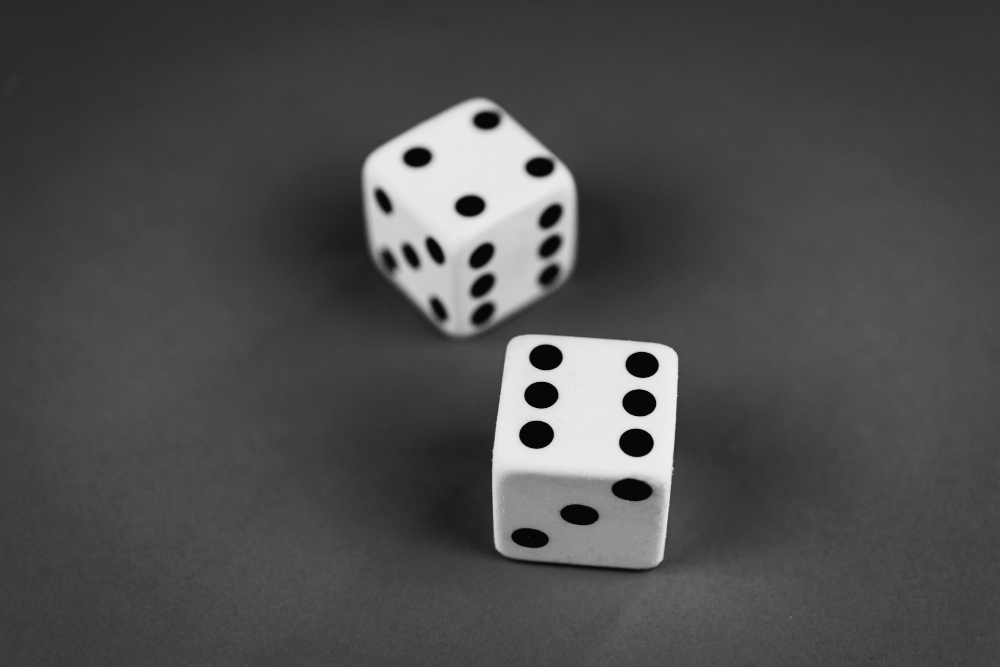
The seven rule is about the numbering. Fairness is about the shape, and the shape is where ordinary dice fall short.
A die is fair if each face has an equal chance, which requires the solid to be a true cube with identical faces, uniform density and no bias in how it comes to rest. Every one of those is compromised in a mass-produced die.
The pips are the first problem. A pip is material removed from the face, so a face with six pips is marginally lighter than a face with one, which biases the die very slightly towards landing with the six downward and the one up. On a cheap die with deep pips this is measurable, though it is far too small to matter in any ordinary game.
The edges are the second. Rounded corners make a die roll further and settle more readily, and if the rounding is uneven – which it is on an injection-moulded die with a mould seam – some axes are favoured over others.
And the material is the third. An injection-moulded die has a sprue mark where the plastic entered and can contain voids, neither of which is distributed symmetrically.
None of this makes a board game unfair in practice, because the biases are tiny and both players use the same dice. It is why anybody playing for serious money uses equipment built to a completely different standard, and why the difference between a casino die and a games-cupboard die is not fussiness.
Where Dice Came From

Dice are among the oldest manufactured game objects anywhere. Six-sided dice with the familiar arrangement have been excavated from sites across the ancient Near East, the Indus valley, Egypt, Greece and Rome, and they were already standardised in antiquity in a way that most objects of that age were not.
Their ancestors are frequently taken to be knucklebones – the astragalus bone of a sheep or goat, which lands on four distinguishable faces with unequal probabilities and was used for games and for divination across an enormous range of cultures.
The step from a bone that lands four ways unevenly to a cut cube that lands six ways evenly is a conceptual one, and it is close to the beginning of the idea of a fair random device. Everything from a lottery to a statistical sample traces its logic back to somebody deciding that a thing should land each way equally often and then shaping an object until it did.
The Thing Worth Taking Away
The seven rule is a tiny piece of design that nobody teaches, almost nobody notices, and everybody carries around in a cupboard.
It is a verification mechanism hidden inside an ordinary object – a way of letting a stranger confirm, in two seconds, without tools or expertise, that the equipment they are about to gamble with has been made correctly. That is a remarkable thing to have built into a toy, and it has survived unchanged through two and a half thousand years of manufacturing because the problem it solves has not changed.
Go and check the dice in your house. Confirm the seven rule, which will hold. Then find the corner where one, two and three meet and work out whether yours are right-handed or left-handed.
Most households with games bought over several decades turn out to contain both, and once you have seen it you will check every die you pick up for the rest of your life.
Like our content? Follow us for more.