

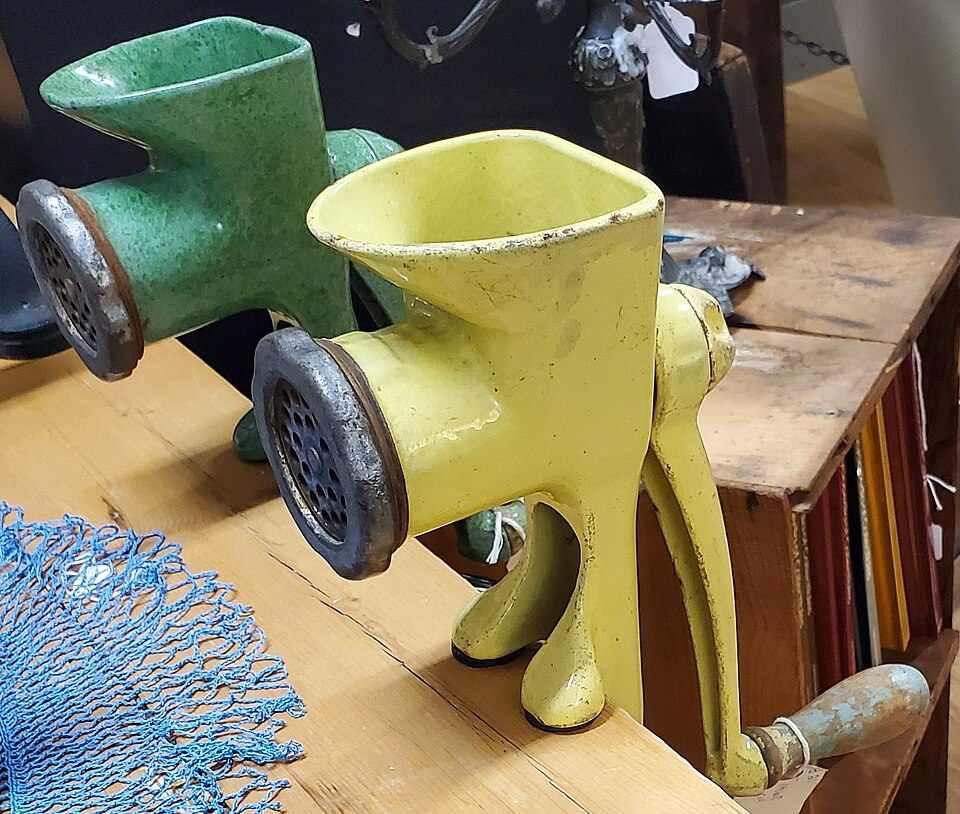
It is the cast iron thing with the crank and the clamp screw, in the back of a kitchen cupboard or on a shelf in a barn, usually with a couple of round perforated discs rattling around inside it and a wooden handle somebody has lost.
Modern cooks look at it and assume meat grinder, and in households where that was the main use the assumption is fair. But the machine was sold and used as a general-purpose food chopper, and the list of what went through it in an ordinary American kitchen is considerably longer and more interesting than people expect.
It is also a better machine than it looks, for a reason that is purely mechanical: it cuts rather than crushes.
Cutting and Crushing Are Not the Same Thing
This is the distinction that makes the object worth understanding.
A mortar and pestle crushes. A blender smashes. Both reduce food by breaking the cell walls indiscriminately, which releases water and turns a lot of ingredients into a wet pulp whether you wanted that or not.
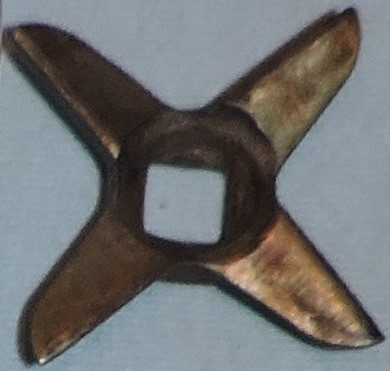
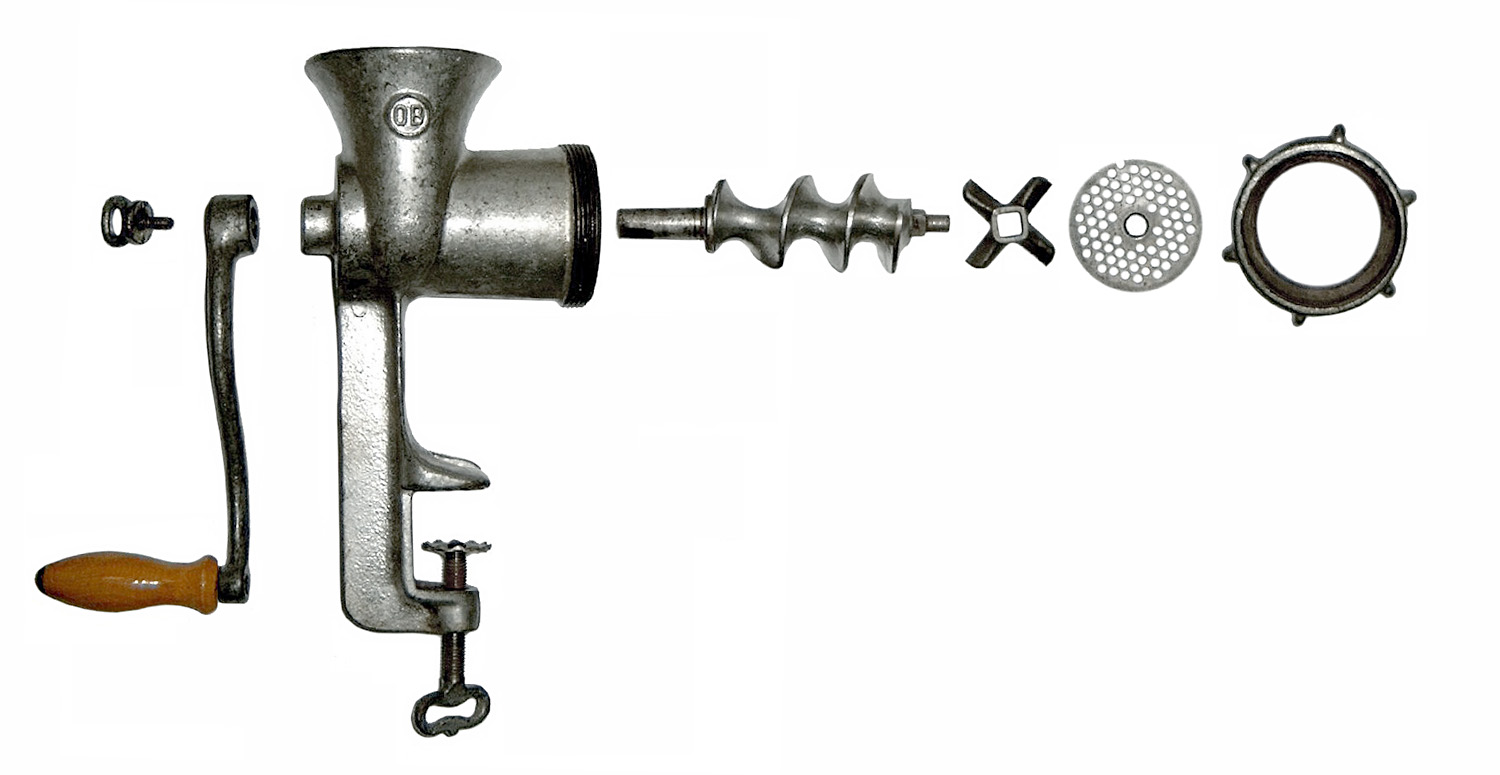
A chopper works differently. Inside the body is a helical screw – an auger – which pulls food forward and compresses it against the inside face of a perforated plate at the far end. A rotating knife with several blades turns against that plate. The food is forced into the holes and the knife shears across them, cutting off a piece at each pass.
So every particle leaving the machine has been cut to the size of the hole it came through. Change the plate and you change the output: a coarse plate gives a rough chop, a fine one gives something close to a paste.
That is a sizing operation rather than a destruction, and it is why the results hold their texture. Cabbage out of a chopper is chopped cabbage; cabbage out of a blender is wet.
Like our content? Follow us for more.
The Clamp Is Doing Real Work
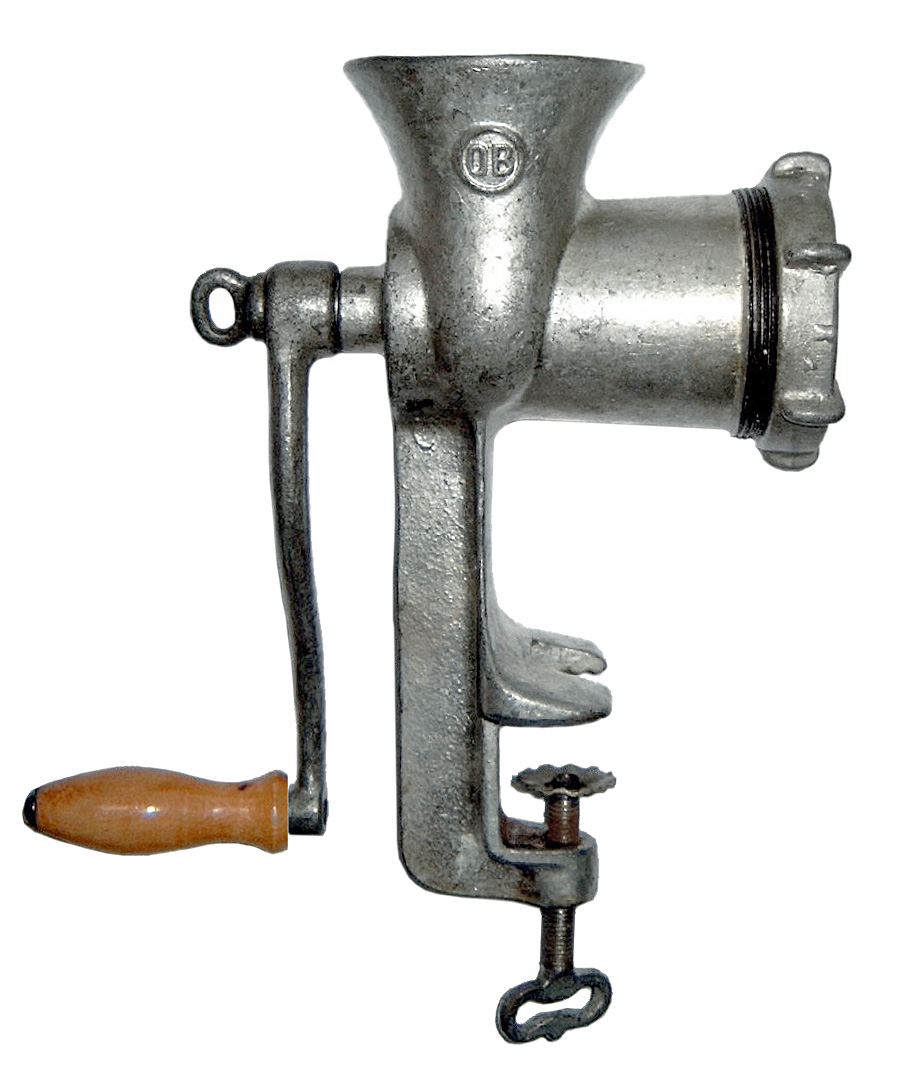
The thumbscrew clamp that fixes it to a table edge is not a convenience. It is structural.
The forces inside are substantial – an auger compressing food against a plate and a knife shearing it generates real resistance at the crank, and the whole machine wants to rotate away from you as you turn it. Without a clamp, you need a second person to hold it, which is exactly the problem that the lap mill and the unanchored coffee mill had.
So the clamp made it a one-person machine, and it also made it portable. The chopper lived in a cupboard and came out onto whatever table was free, which is a different proposition from a fixed appliance.
The trade-off is the table. A century of chopper clamps has left a particular kind of crushed dent on the edge of a great many American kitchen tables, and the better households put a block of wood or a folded cloth under the clamp foot to spare the wood.
The List of What Went Through It
This is the part that surprises people, and it is why the thing was worth owning.
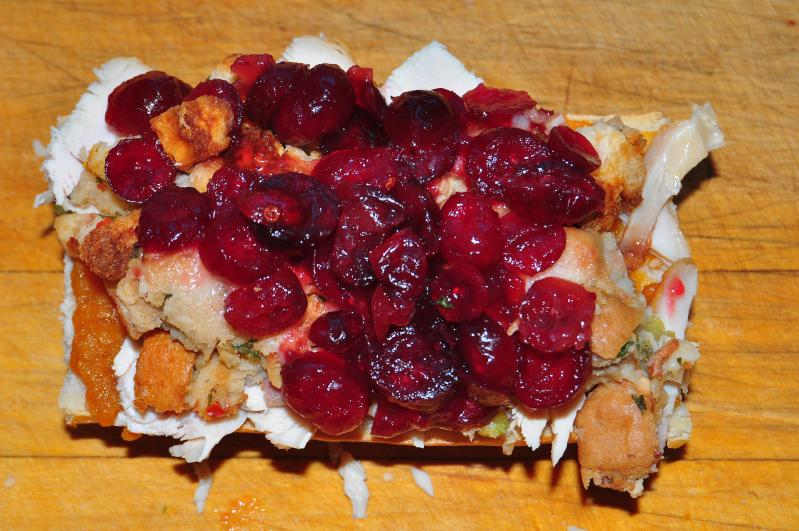
Vegetables for relish, pickle and slaw. Cooked vegetables for croquettes and patties. Dried bread for crumbs. Nuts for baking. Dried fruit, which is otherwise extremely awkward to cut. Apples for sauce and butter. Cranberries. Onions in quantity, which is the job everybody remembers because of what it does to a room. Cheese. Boiled eggs. Cooked potatoes for hash. Leftovers of any kind, turned into something else.
Suet and cold fat for pastry and mincemeat. Horseradish root, which was done outdoors by anybody with sense.
And soap – hard soap was run through a chopper to reduce it for laundry, which is a use nobody expects and which tells you the machine was regarded as a general reduction device rather than a food appliance.
The pattern across that list is that these are all jobs where a knife works but takes a long time, and where a knife on a cutting board produces uneven results. A chopper is faster and more uniform, and uniformity matters when something has to cook evenly.
It Made Leftovers Into a System
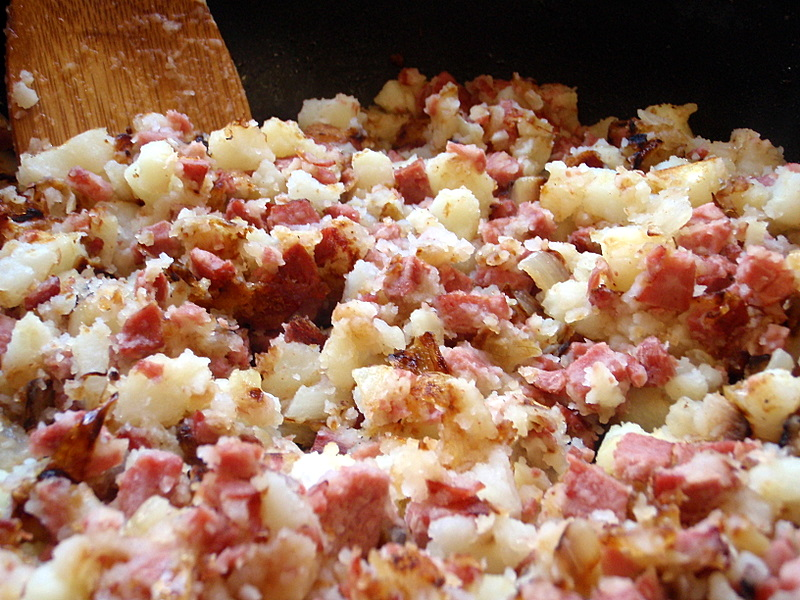
The function worth drawing out is what it did to household economy.
A kitchen with no refrigeration and no spare money cannot throw food away, which means yesterday’s cooked food has to become today’s dish. The difficulty is that cooked food in recognisable pieces is unappealing the second time, and the standard solution across American cooking of the period is to chop it and rebuild it – into hash, croquettes, patties, loaves, fillings, salads and spreads.
Every one of those requires the same operation: reduce the ingredients to a uniform small size and bind them. The chopper is the machine that performs that operation, and it performs it fast enough to do it daily.
So an entire category of cooking exists because this device was on the table. The recipes are not a preference for chopped food. They are the available way of serving something twice.
Taking It Apart Was the Price
Honesty requires this, because it is the thing everybody who used one complains about.
A chopper has to be dismantled and washed after every use, and it has a lot of parts that trap food – the auger in the barrel, the knife, the plate, the retaining ring and the threads. Anything left in it goes off, and a chopper that has had onion through it will put onion into whatever comes next unless it has been properly cleaned.
It also has to be dried immediately, because cast iron rusts and a rusty plate ruins both the machine and the food.
And it is awkward to wash. The barrel is a tube, the auger is a screw, and the knife is sharp – which means the cleaning takes a meaningful fraction of the time the machine saved.
That is a real cost and it is a large part of why the thing lost when something easier appeared.
It Was Sold as a Labour-Saving Device for Women
The marketing is worth a look, because it tells you how the thing was understood at the time.
These were advertised hard, in women’s magazines and catalogues, and the pitch was almost always the same: hours saved, less fatigue, no more standing at a board with a knife. The copy frequently gave a comparison – what a job took by hand against what it took with the machine – and the numbers, whether or not they were honest, were the whole argument.
That places the chopper in a specific category of object. It is one of the first wave of mechanical household appliances sold on the explicit promise of reducing a woman’s labour, decades before anything in a kitchen was electrified. The treadle sewing machine, the washing machine with a hand lever, the cream separator and the apple parer all belong to the same wave, and they all made the same claim.
Whether the claim held up is a fair question. A machine that saves twenty minutes of chopping and then takes eight minutes to dismantle and wash has saved twelve, which is real but considerably less than advertised – and the washing fell to the same person either way.
What the chopper genuinely did deliver was not time so much as scale. It made it possible to do a large quantity of something, uniformly, which a knife cannot match at all.
Then Electricity Took the Crank Away
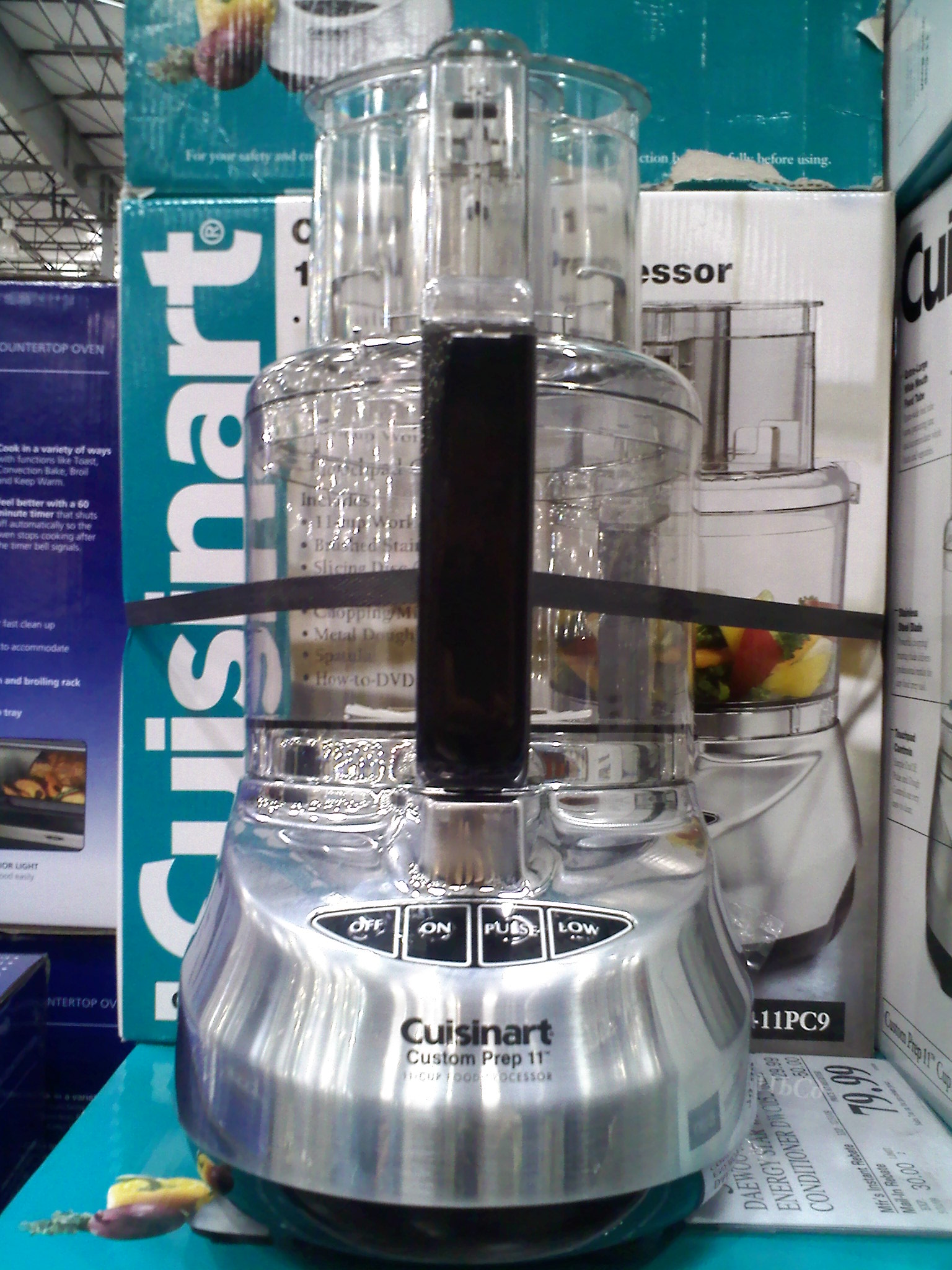
The electric food grinder and then the food processor did the same job without the arm, and that is most of the story.
Worth being precise about the two, though, because they are different machines. An electric grinder is the same mechanism – auger, knife, plate – with a motor instead of a crank, and it produces the same cut. A food processor is a different principle entirely: a blade spinning in a bowl, which chops by repeated impact rather than by shearing through a plate.
The processor is faster and vastly easier to clean, and for most jobs the difference in result does not matter. For some it does, which is why the plate-and-knife mechanism survived in grinders and attachments rather than disappearing.
But the decisive advantage was never the result. It was that a processor is one bowl, one blade and one lid, and that the whole thing goes in water.
Then the Shop Did the Chopping
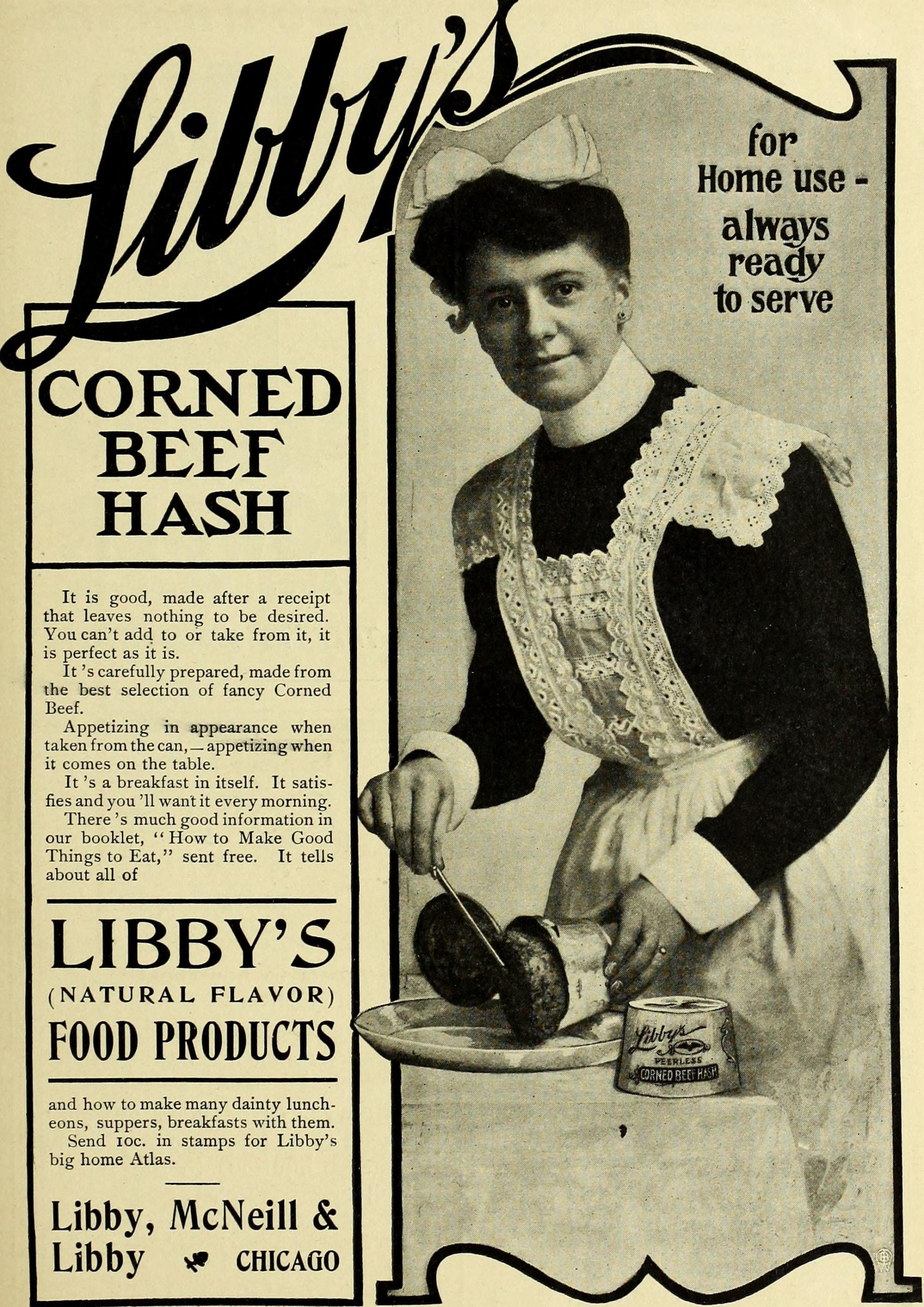
The larger change is that the household stopped needing to reduce things at all.
Breadcrumbs come in a carton. Nuts come chopped. Dried fruit comes diced. Relish, pickle and slaw come in jars. Potato products arrive ready for a pan. Cheese comes shredded. And the whole category of cooking built around rebuilding yesterday’s food lost its purpose once a refrigerator kept leftovers properly and a freezer kept them indefinitely.
So the chopper did not merely lose to a better machine. The jobs went out of the kitchen one at a time, bought ready-done, until there was nothing left for it to do.
Which is why the surviving ones are generally complete but unused. Nobody wore them out.
The Plates in the Bottom of the Box
If you find one, look at the plates rather than the machine, because the plates are the interesting part.
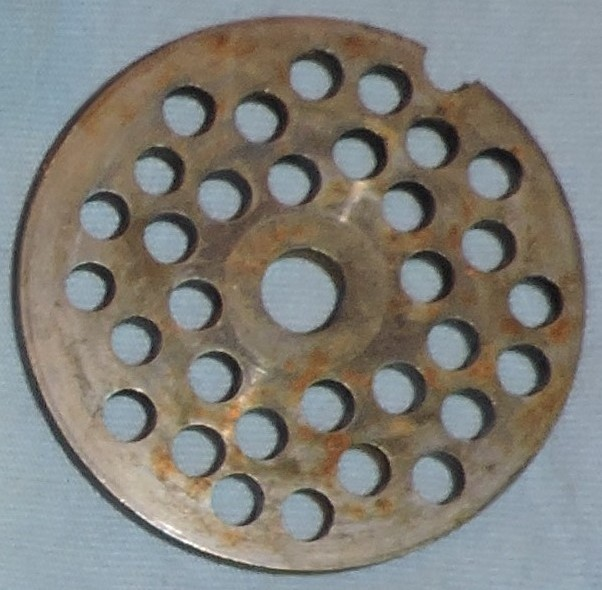
A chopper came with two or three, and the holes are different sizes – and that set of discs is the whole adjustability of the device. One for coarse work, one for fine, sometimes one in between, and a household that had lost the fine plate had lost half the machine’s range.
They are also usually the part that survives, because they are solid discs of steel with nothing to break. The wooden handle rots, the clamp screw seizes, the knife dulls, and the plates sit in the bottom of the box indefinitely.
Which means a drawer with two perforated steel discs in it and no machine is reasonably common – and almost nobody who finds them can say what they were for.
Like our content? Follow us for more.

