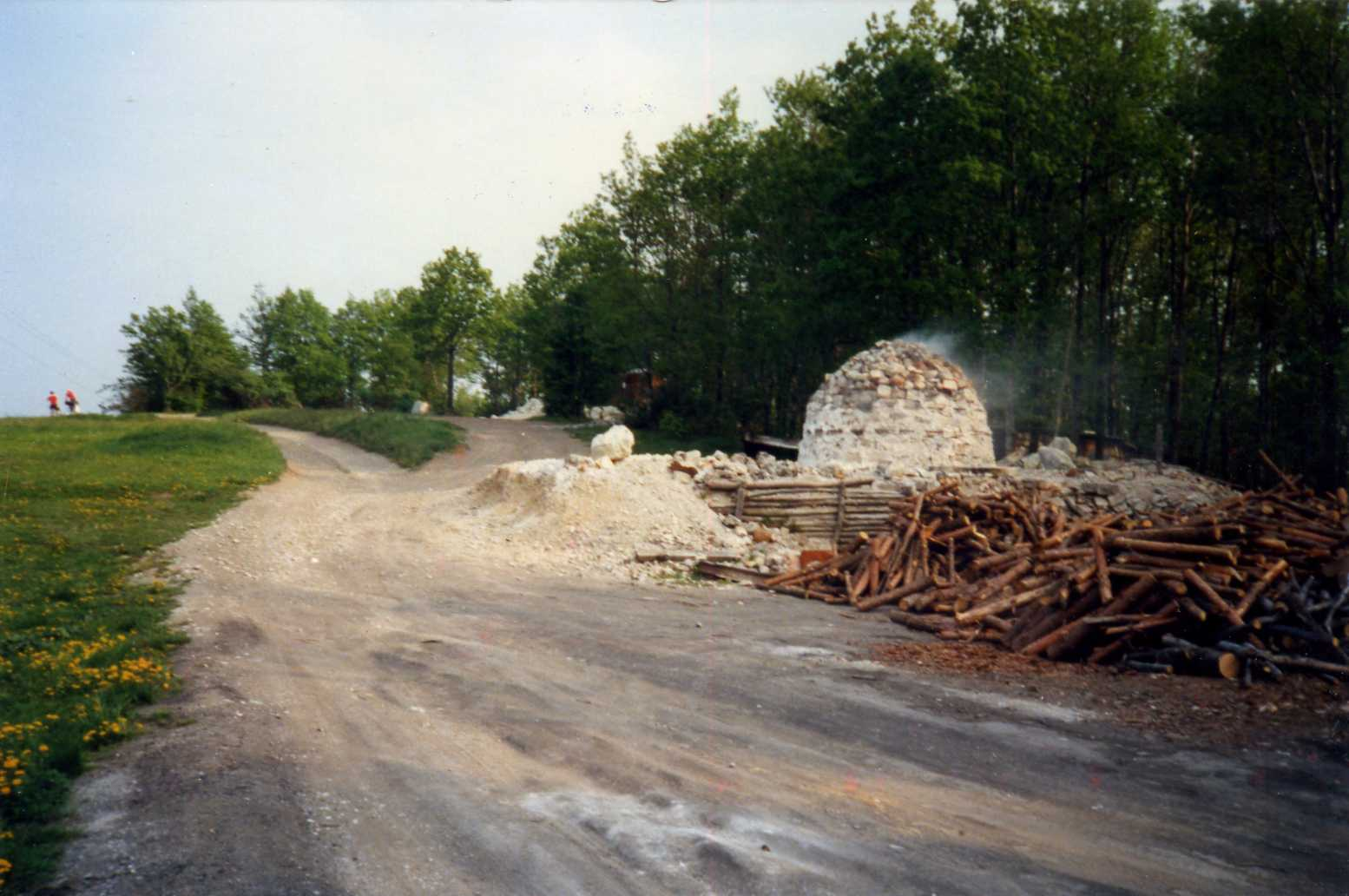
A lime kiln is a shaft lined with firebrick that is loaded from the top and emptied from a hole at the bottom while it is still burning. The limeburner’s job was to keep it burning evenly, to judge by eye and feel when the stone at the base had cooked through, and to draw it out without letting the fire above collapse into the gap.
By 1960 the small field kilns that had dotted limestone country for centuries were nearly all cold, but the trade had not quite gone. Men still worked kilns, still handled quicklime with a shovel, and still stood in the heat and the dust of an operation that had changed very little since the eighteenth century.
What burning lime actually does
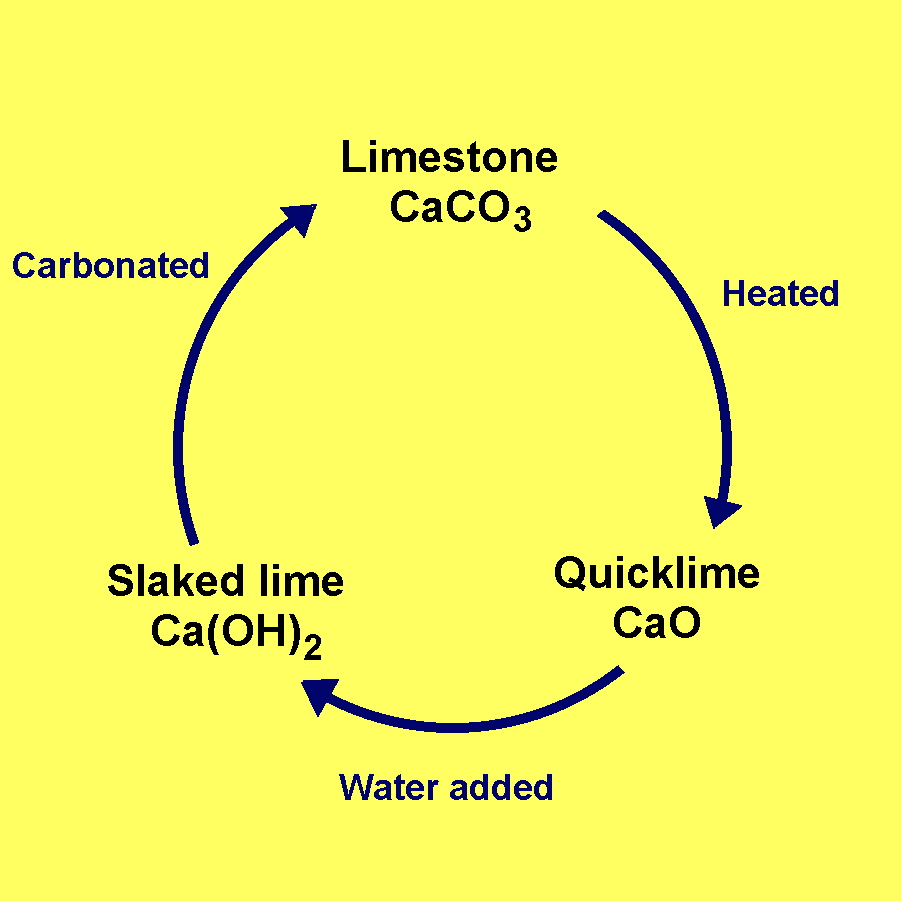
Limestone is calcium carbonate. Heat it hard enough, above roughly nine hundred degrees Celsius, and it gives up carbon dioxide and becomes calcium oxide, which is quicklime.
Quicklime is not a stable, inert product. Add water and it reacts, generating a great deal of heat, and becomes calcium hydroxide, which is slaked lime. Leave it exposed to the air for long enough and it slowly absorbs carbon dioxide again and returns toward calcium carbonate.
That last step is the whole basis of lime mortar and lime plaster. A lime mortar does not set like cement; it carbonates, gradually turning back into a form of the rock it came from, which is why old lime-mortared walls behave the way they do.
So the trade is a chemical cycle performed with a shovel: rock in at the top, carbon dioxide driven off by fire, product drawn out at the bottom, water added somewhere else, and carbon dioxide reabsorbed over the following years in a wall.
Understanding that cycle was the limeburner’s actual expertise, even though almost none of them would have described it in those terms.
Like our content? Follow us for more.
The kiln, and how it was worked
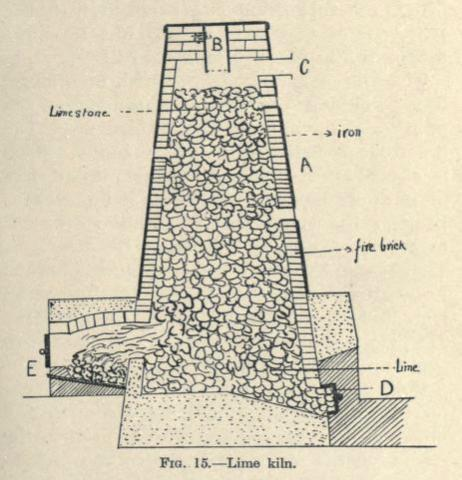
The older intermittent kilns were loaded, fired, allowed to cool and emptied in cycles, which wasted heat and time. The continuous draw kiln, which is what most surviving structures are, was the improvement.
A draw kiln is charged from a platform at the top with alternating layers of broken limestone and fuel, usually coal or coke. The fire burns in the middle of the column, the finished lime works its way down as material is drawn from the eye at the base, and fresh charge is added above. Once lit, it runs for weeks or months.
The skill was in the layering and the drawing. Too much fuel wasted it and overburned the stone into a hard glassy mass; too little and the core of each lump came out unburned. Draw too fast and the burning zone descended into the drawing area; too slow and the kiln choked.
The limeburner judged all of it from the colour of the fire through the charge holes, the feel of the drawn lime, and the behaviour of the gases at the top.
It is genuinely difficult, and the proof is that it was a recognised occupation rather than labouring. A kiln with a poor man on it produced poor lime, and everybody downstream knew.
Quicklime, which is the part that should worry you
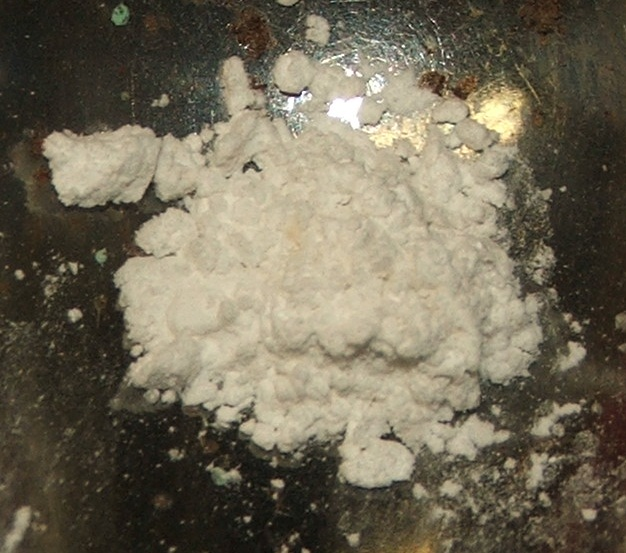
Quicklime is caustic. It reacts with moisture, and skin, eyes and the lining of the airways are all moist, which is the entire explanation of the hazard.
In 1960 it was handled with a shovel and a barrow by men in ordinary clothes, boots and often no gloves, in an atmosphere of fine dust. Sweat on a forearm and lime dust on it is a reaction taking place on a person.
The modern controls are the obvious ones that were absent: sealed handling and conveying wherever possible, eye protection as a non-negotiable because the eye is the organ at real risk, gloves and covered skin, respiratory protection against the dust, and washing facilities immediately available.
The rule that governs modern lime handling, and that is the one worth carrying away, is that water and stored quicklime are kept apart. The reaction generates serious heat, and a quantity of quicklime that gets wet in a confined space is a genuine industrial hazard rather than a theoretical one.
Nothing here describes an injury and nothing here should be read as first aid. The point is that a material which looks like grey gravel is chemically active, and that the trade handled it for two centuries before anybody provided so much as goggles.
The other hazard, at the bottom of the kiln

Burning fuel in a shaft produces combustion gases, and a kiln eye is a low opening into the base of a column of them. Carbon monoxide is the specific concern with a solid-fuel fire, because it is produced by incomplete combustion and gives no warning of any kind.
This is a different mechanism from the heavier-than-air gas that collects in a cellar, and it is worth separating the two. Carbon monoxide does not pool at floor level in the same way; the problem at a kiln is that the drawing position sits in the draught of gases leaving a fire that is burning in restricted air.
The modern treatment is to classify kiln openings, flues and any below-ground drawing arrangement as a confined space, with an entry procedure, atmospheric testing, forced ventilation and a person stationed outside.
And the correct response, then as now, if somebody is overcome at such an opening, is to call the emergency services rather than to go in after them. More than one person has been lost that way, which is why that instruction is given first in every modern procedure.
In 1960 the arrangement was a man, a shovel and no monitoring of anything.
What lime was for
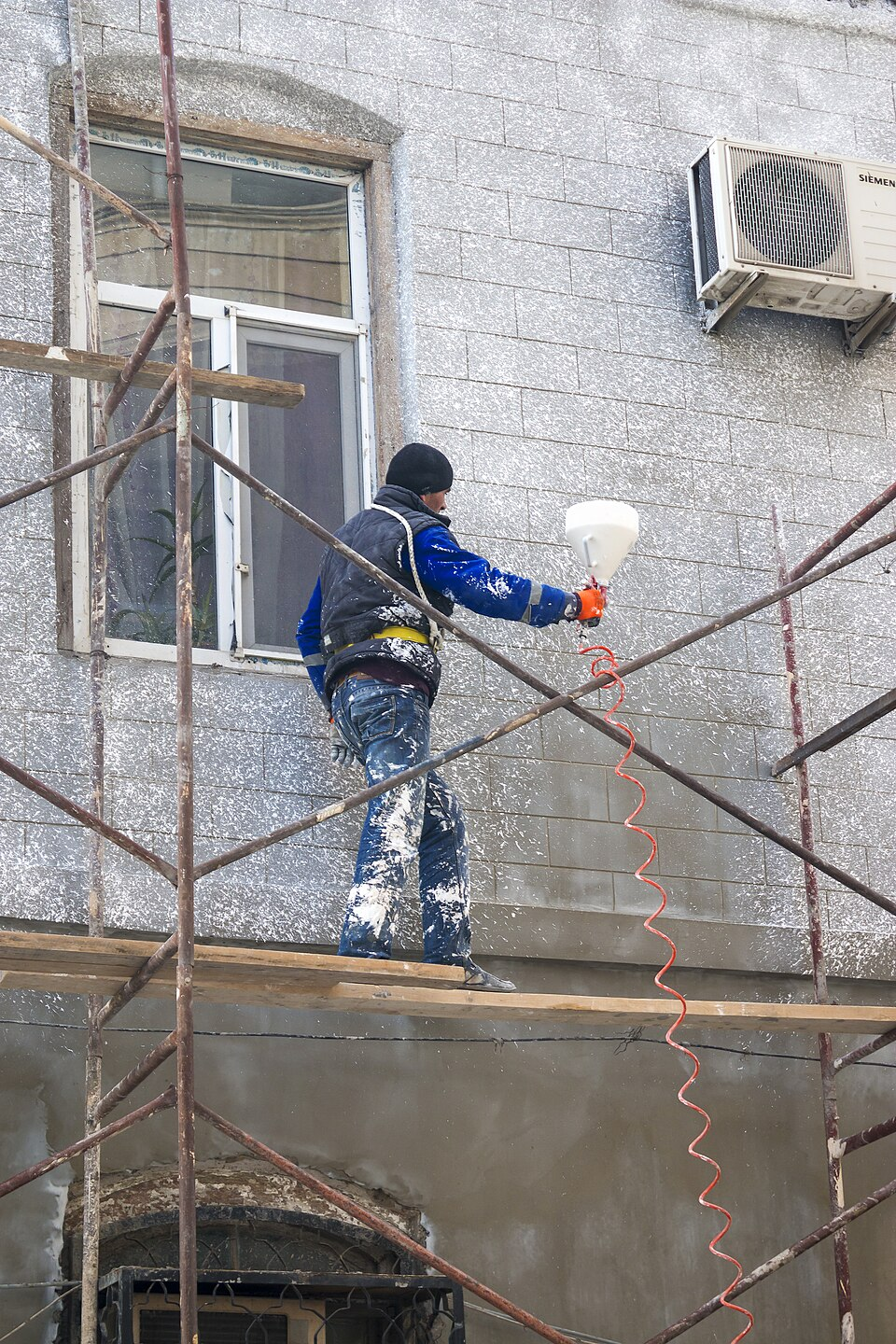
A great deal more than mortar. Agricultural liming, spread on acid soil to raise its pH, was the largest single use in many regions and the reason small kilns existed on farms at all.
Industrially, lime is used in steelmaking to remove impurities, in sugar refining to purify juice, in water and effluent treatment, in paper making, in glass, and as the starting point for a long list of chemicals. It is one of the genuinely essential industrial materials and almost nobody outside the industries concerned has heard of it.
In building, lime was the binder for mortar, plaster and limewash until Portland cement displaced it through the first half of the twentieth century. Limewash on a wall is simply slaked lime and water.
That displacement was not entirely an improvement, which the conservation world worked out later. Cement mortar is stronger and less permeable than many old masonry materials, and a hard cement repair on a soft old wall can concentrate stress and trap moisture in the stone instead of letting it evaporate from the joint.
The result is a real modern revival. Lime putty, lime mortars and limewash are specified routinely on historic buildings, and the people making them had to go back to the old literature to do it.
How the trade ended
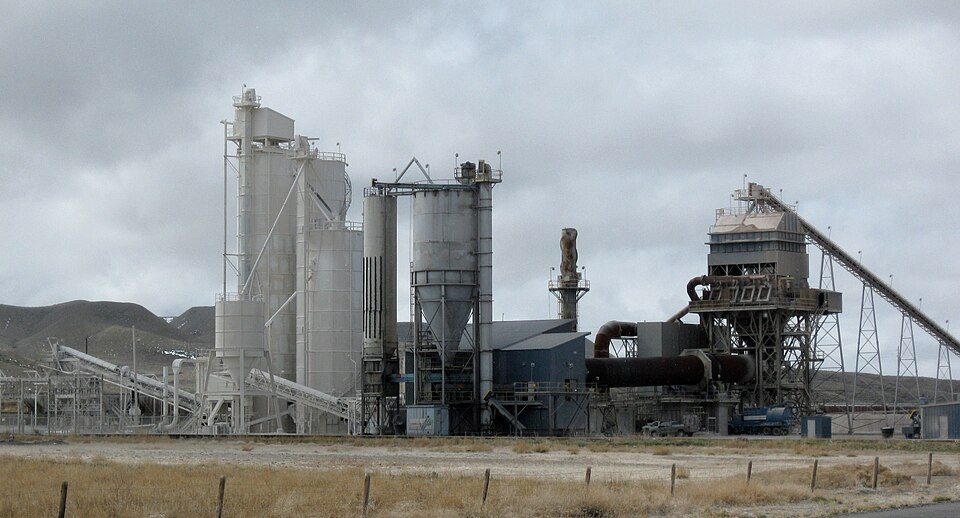
Scale. The small kiln burning local stone with local coal for local farms could not compete once transport made it possible to bring lime in from a large plant, and the large plants were vastly more efficient.
The technology also moved on. Modern production uses rotary and large shaft kilns with controlled fuel and air, instrumentation, continuous monitoring and mechanical handling throughout, producing lime of consistent and specified quality rather than lime that was as good as the burner was.
Agricultural practice changed too, with ground limestone often spread directly instead of burnt lime, which removed the need to calcine it at all for that market.
So the kilns went cold, and because they were built of stone and built into hillsides, an extraordinary number of them are still standing. Most people who walk past one assume it is a folly or an old well.
The trade’s own end was quiet. There was no closure announcement, just a last firing, and in most places nobody wrote down when it was.
What is left to see
A great many kilns survive as structures, typically a stone block built against a slope with one or more arched openings at the base and a funnel-shaped bowl at the top, now usually filled with earth and brambles.
If you find one, the diagnostic features are the arch at the bottom with a smaller square draw hole inside it, vitrified or discoloured brick in the throat where the fire sat, and a level loading area above reached by a track or a tramway bed. There is frequently a quarry face within a hundred yards, because stone was never carried further than it had to be.
They are also dangerous in the way all old industrial ruins are: open shafts, unstable masonry and occasional accumulated material. The sensible treatment is as a thing to look at from outside rather than to climb into.
The honest summary: burning lime drives carbon dioxide out of limestone to make quicklime, which reacts with water to make slaked lime and slowly reabsorbs carbon dioxide to become a form of rock again, which is why lime mortar carbonates rather than setting; a continuous draw kiln was charged from the top in alternating layers of stone and fuel and drawn from the eye at the base while burning, and the layering and the drawing rate were the skill; quicklime is caustic because it reacts with the moisture in skin, eyes and airways, so modern practice uses sealed handling, mandatory eye protection, covered skin, respiratory protection and immediate washing facilities, and keeps water away from stored quicklime; carbon monoxide at a kiln eye is a distinct hazard from gas pooling in a cellar, and kiln openings are now treated as confined spaces; and the trade ended through scale and instrumentation rather than through any single decision.
Like our content? Follow us for more.