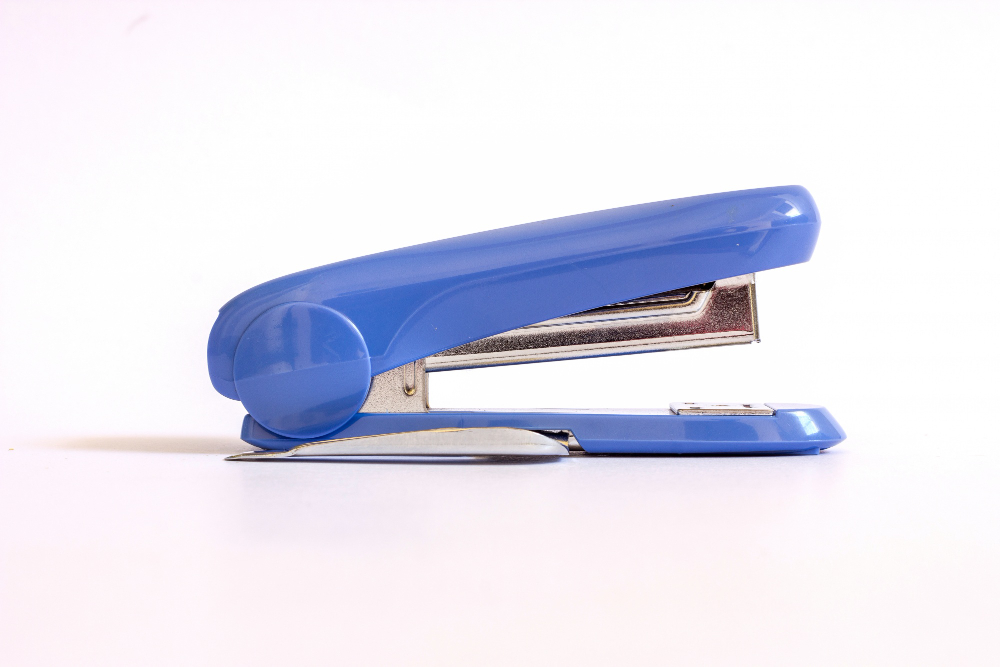
The small metal plate at the base of a stapler, the one the staple legs hit, is called the anvil, and on most staplers it rotates.
Turn it and the grooves move to a different position, and the staple that comes out is folded in a different direction. One setting makes a permanent fastening. The other makes one designed to be removed.
It has been on staplers for decades, it is on most of the ones currently sold, and almost nobody has ever turned it.
What the Two Settings Actually Do
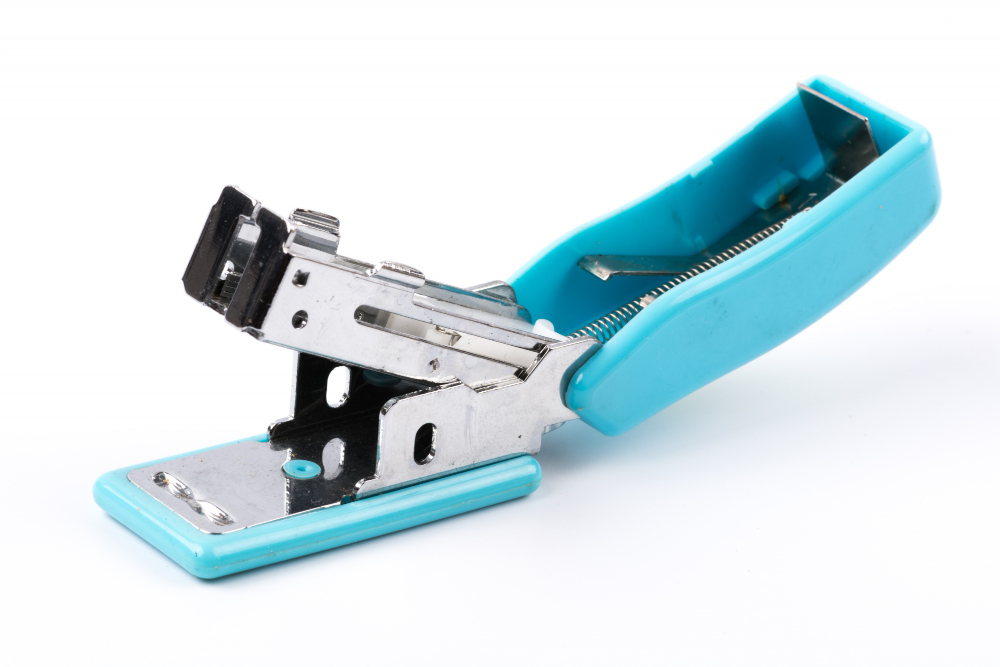
A staple works by punching two legs through the paper and then bending them over on the far side, and the anvil is what bends them.
The grooves in the anvil are curved channels. In the standard position they curve inwards, so each leg is deflected towards the other and the two fold inward across the back of the stack, crossing underneath. That grips firmly, lies flat, and is what everybody thinks of as a staple.
Rotate the anvil and the grooves present a different profile that bends the legs outward instead. The staple still holds, and the legs splay away from each other rather than clenching inward.
An outward-bent staple is much easier to remove. The legs can be lifted and straightened without the crossing underneath to fight against, so the staple comes out with far less tearing of the paper around the holes.
That is the whole feature. Permanent, or temporary.
Some staplers mark the two positions and most do not. Where there is a marking it is usually a tiny pictogram of the two staple shapes moulded into the plate, which is exactly the kind of symbol that is unreadable without already knowing what it means.
Like our content? Follow us for more.
When You Would Actually Want the Other One
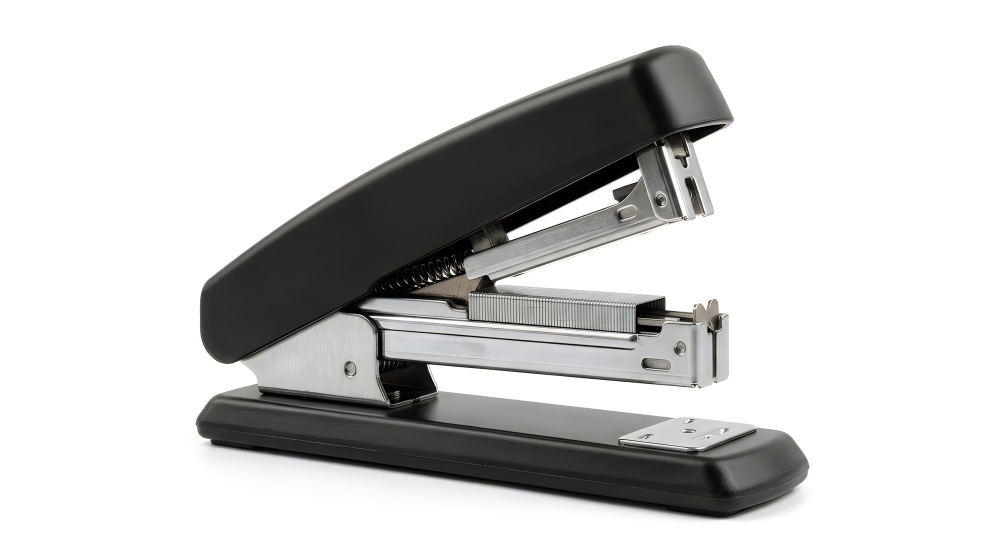
The temporary setting is genuinely useful in a narrower set of situations than the permanent one, which is part of why it has gone unnoticed.
It is for documents that will be taken apart. Anything going to be photocopied or scanned page by page. Drafts that will be reordered. Sets being collated now and bound properly later. Papers that have to be stapled for handling and then separated for filing.
In each case the alternative is a permanent staple that then has to be prised out with a remover, which tears the corner, leaves two ragged holes and sometimes takes a piece of the page.
That damage matters more than it sounds when the document is going through a sheet feeder afterwards, because a torn corner is the commonest cause of a misfeed, and a jammed scanner costs considerably more time than choosing the correct setting would have.
For everything else – things being filed, sent, submitted or kept – the standard inward clinch is correct, which is why it is the default and why the other setting sits unused.
The Stapler Does Several Other Things Nobody Knows About
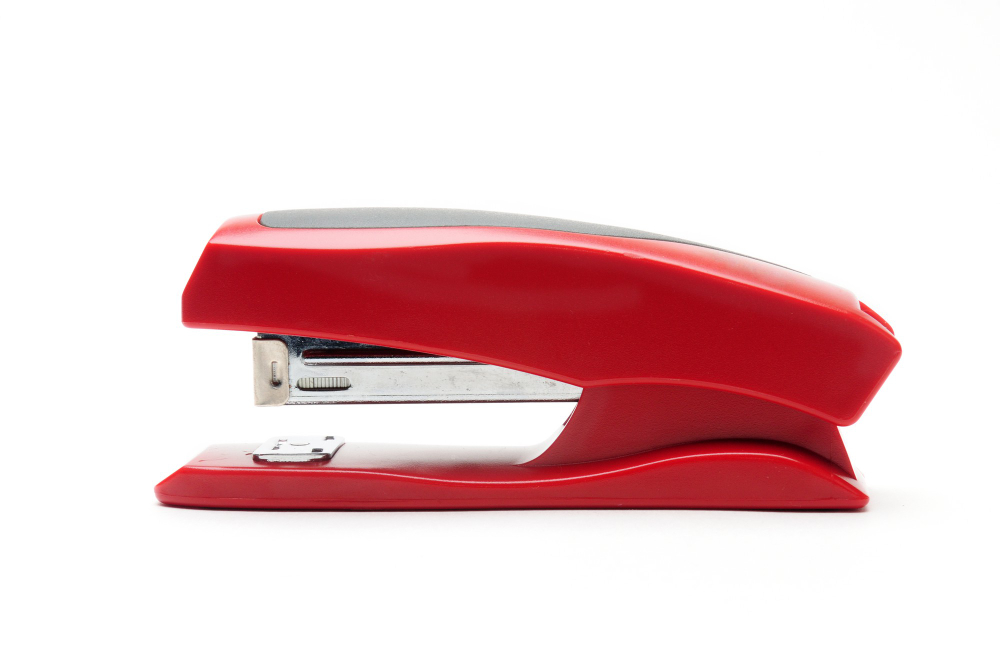
The anvil is one of three or four hidden functions on an ordinary office stapler.
Most staplers open flat. Swing the whole top back until the body lies in a straight line and the anvil is out of the way, and the stapler drives a staple straight through into whatever is underneath without bending it at all – which is how you staple into a noticeboard, a partition wall or a cardboard box. It is a tacker, and the hinge was designed to allow it.
Many have a depth guide at the back – a flap or an adjustable stop – so that a stack can be placed against it and the staple lands the same distance from the edge every time, which matters when you are doing a hundred of them.
And the base frequently releases separately from the arm, which is how a jam is cleared properly rather than by poking at it. A jammed stapler is almost always a bent staple wedged in the channel, and reaching it means opening the magazine fully rather than attacking it from the front, which is how most of them get bent further and turned into a permanent obstruction.
There is usually a sprung pusher in the magazine too, which has to be retracted fully before a new strip goes in. Loading against a partly retracted pusher is the commonest reason a freshly filled stapler fires nothing at all, and the user concludes the stapler is broken.
None of this is marked on the product. It is in the instructions that came with a stapler, which nobody has ever read, for an object that is passed between desks for twenty years and outlives everybody who was there when it was bought.
Why the Features Are Invisible
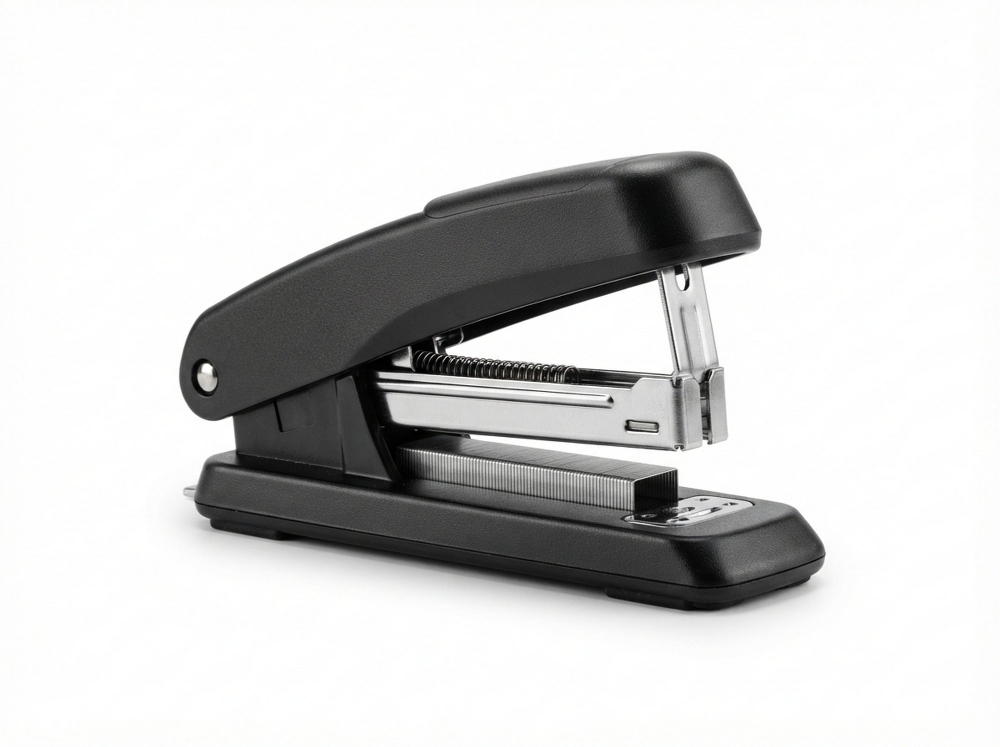
There is a reason this particular object accumulates unused functions, and it is instructive.
A stapler is cheap, it is bought by somebody who is not going to use it, it is not read about, it has no screen to explain itself, and it works adequately out of the box for the one thing everybody wants. There is no moment at which anybody is motivated to find out more.
Compare an object with a learning curve – a camera, a sewing machine, a power tool – where the user expects to have to understand it and goes looking. The features get found because the user arrives expecting to be taught.
A stapler arrives expecting nothing. It presents as a solved problem, and anything it can do beyond the obvious is therefore invisible by default, however useful and however prominently it is physically presented.
That gap – between what an object can do and what its owner knows it can do – is one of the larger inefficiencies in everyday life, and it is almost entirely a communication failure rather than a design one. Somebody did the work of putting a rotating anvil in there. The information simply never reached the desk.
Removing a Staple Is Its Own Small Problem
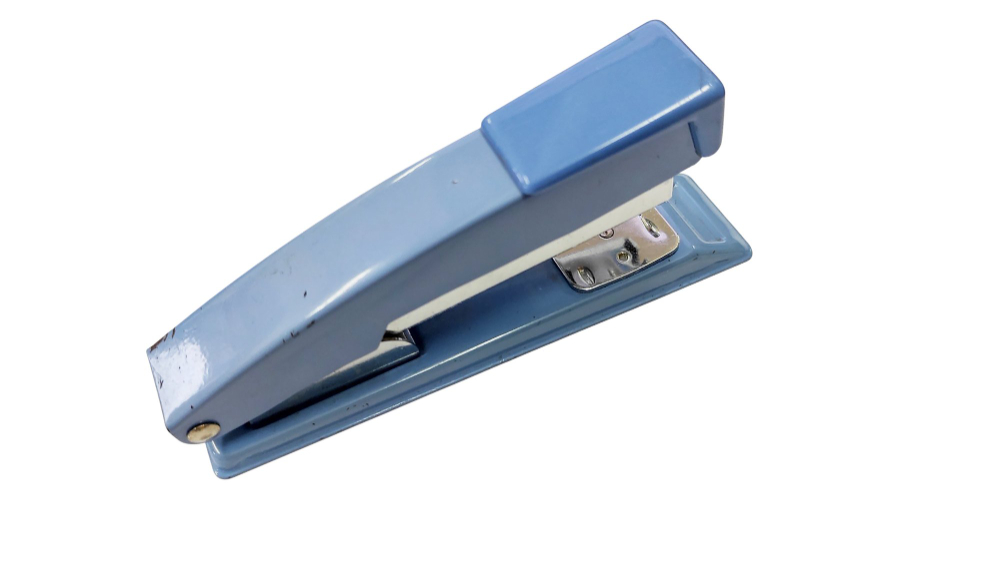
Since the whole point of the second setting is removal, it is worth saying what happens when a permanent staple has to come out, because the standard tool is poorly suited to it.
The jawed remover that everybody has works by forcing itself under the crossed legs and levering the staple upward. It is fast and it is violent – it pulls the legs through the paper backwards, enlarging the holes, and on the top sheet it frequently takes a crescent of paper with it.
The gentler method is to lift each bent leg individually, straighten it, and then push the staple back out from the front rather than pulling it through from the back. It takes several seconds rather than one, and it leaves two clean holes and an intact page.
For a single staple on something that matters – a certificate, an original document, anything going into an archive or a scanner – the slower method is worth the time, and the flat-bladed removers made for the purpose do exactly this.
Which puts the rotating anvil in context. All of this difficulty exists because the staple was clinched inward when it did not need to be, and the setting that would have avoided it was on the stapler the whole time.
The Staple Itself Is a Better Fastener Than It Looks
Worth ending on the consumable, because it is unusually well designed for something costing a fraction of a penny.
Staples come in strips held together by a thin adhesive that is strong enough to keep the strip rigid in the magazine and weak enough to release a single staple cleanly under the driver, thousands of times, without jamming. Getting that adhesive balance right is the whole difference between a stapler that works and one that does not, which is why cheap staples jam machines that handle good ones perfectly.
The wire is galvanised or coated so it does not rust in paper that may be stored for decades, and it is soft enough to bend reliably at the anvil while being stiff enough to punch through a stack without buckling – which is a narrow specification, because those two requirements are opposed.
And the standard sizes are genuinely standard across manufacturers, which is unusual and quietly valuable: a stapler bought in one decade takes staples bought in another, from anybody.
A disposable item, made to a tight specification, interchangeable worldwide, that reliably performs a mechanical operation for a hundredth of a penny. There are not many objects that do their job that well, and essentially none of them that have been doing it unchanged for as long with so little attention paid to them.
Open your stapler and look at the plate at the base. If it has a tab on it, it turns.
Turn it and staple something, then try pulling the staple out.
Then turn it back, because for almost everything you staple the permanent setting is the one you want – which is the reason the feature is unknown, and not a reason it is useless. A tool with one setting you use constantly and one you need four times a year is doing exactly what it should; the only failure is that nobody ever told you the second one existed.
Like our content? Follow us for more.