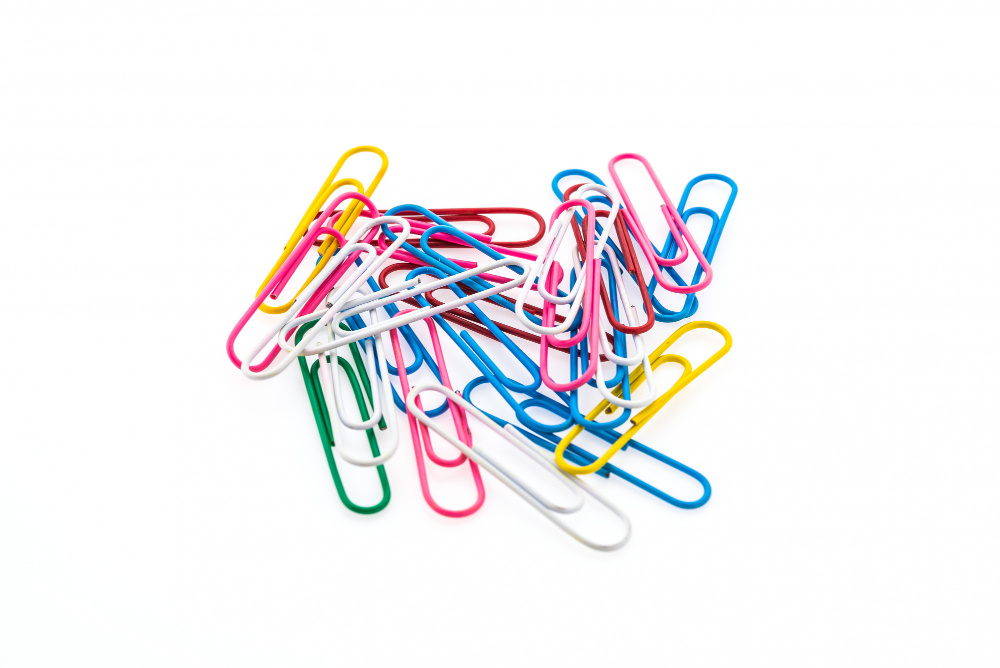
The paper clip is one of the few objects in daily use that is genuinely anonymous. The shape everybody pictures – the double oval of bent wire – is called the Gem, and nobody knows who designed it.
There is a widely told story that it was invented by a Norwegian named Johan Vaaler, and that the clip became a symbol of resistance during the occupation of Norway. Parts of that are true and the central claim is not, which makes it a good example of how a national story can attach itself to an object after the fact.
What Vaaler Actually Patented
Johan Vaaler was a Norwegian who in 1899 patented, in Germany, a wire clip for holding papers. He later obtained an American patent for it as well, because Norway had no patent law at the time.
His design is not the clip in your drawer. It was a rectangular wire form with a single loop, lacking the double-oval return that is the whole mechanism of the modern clip. It does not grip in the same way, it was never manufactured in quantity, and there is no evidence it was ever commercially produced at all.
The Gem design – the one everybody uses – was already in circulation by then. It was being made in Britain and was being sold and advertised before Vaaler filed, and it takes its name from a company associated with it rather than from any inventor. Nobody patented it, which is why nobody is credited with it.
So Vaaler patented a paper clip. He did not patent the paper clip, and the distinction is the whole of the matter.
Like our content? Follow us for more.
How the Story Took Hold
The attribution appears to have grown in Norway during the twentieth century, gathering strength through encyclopaedia entries and then through repetition, and it became genuinely established as a point of national pride.
The occupation-era part is real and is the thing worth preserving. Norwegians did wear paper clips on their lapels during the German occupation as a quiet sign of solidarity and resistance – a small, deniable, universally available object that said something without saying it. That happened and it mattered to the people who did it.
What is not supported is the idea that the clip was worn because it was a Norwegian invention. The contemporary accounts suggest the symbolism was simply about binding together – holding things in unity – rather than about national claim, and the invention story appears to have attached itself afterwards.
Norwegian historical and patent authorities have since been fairly direct about correcting the attribution, which is unusual and creditable: a country publicly unpicking one of its own pleasant national stories because it does not hold up.
The Shape Is Doing More Than It Looks
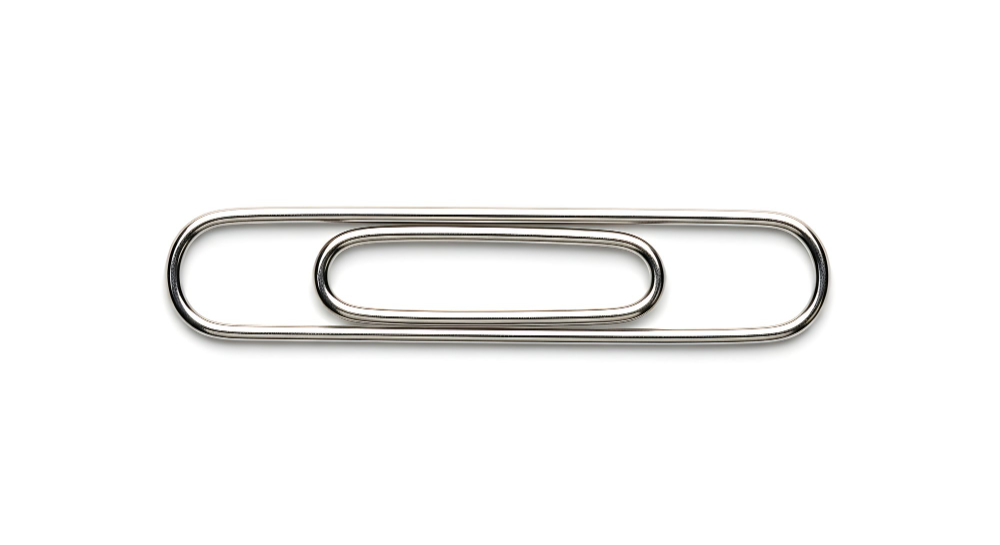
Whoever designed it got a surprising amount right, and the proof is that it has not changed.
The clip works as a spring. Sliding it onto a sheaf forces the two loops apart slightly, and the elasticity of the wire pulls them back together, clamping the paper. It is a spring made from one piece of wire with no joints, no moving parts and nothing to fail.
The outer loop extends past the inner one and is turned so that the end does not catch, which is what lets it be pushed on without tearing. The inner loop’s free end sits inside the clip where it cannot snag. Both free ends face inward and slightly away from the paper.
The whole thing is made by a single machine that feeds wire, bends it through a series of formed dies and cuts it, at an enormous rate, from a continuous reel. It requires no assembly because it is one piece, and that is the real reason it costs almost nothing.
Dozens of improved designs have been patented – clips with gripping teeth, plastic clips, triangular clips, clips that will not tangle. None has displaced it, and the main reason is that the Gem is cheap and good enough, which is a combination that is very hard to beat.
It Tangles Because of the Same Geometry That Makes It Work
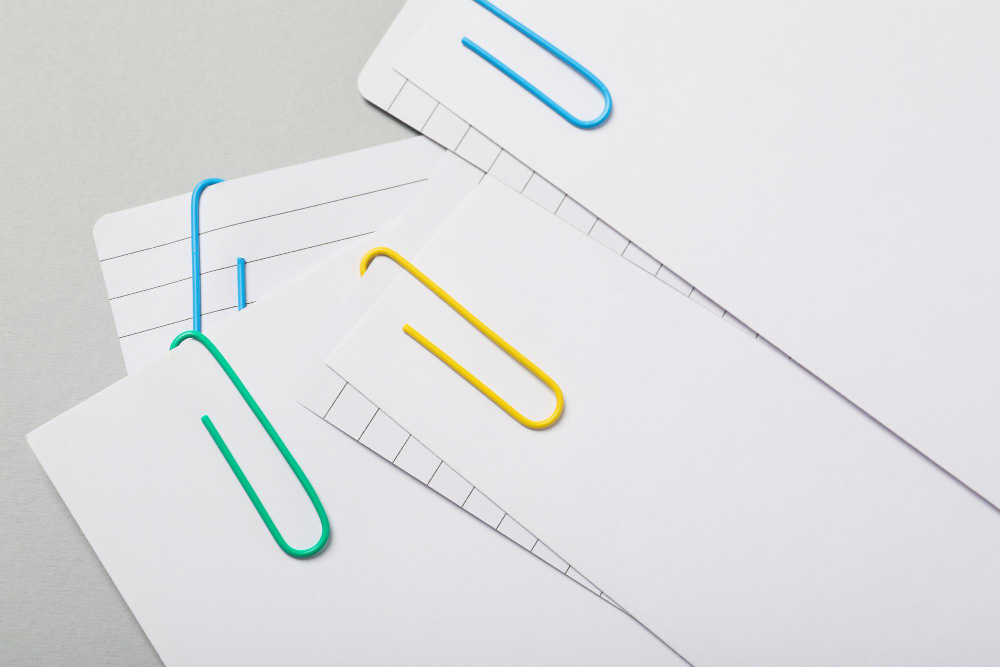
The one genuine flaw is that a box of them comes out in a chain, and the cause is the feature that makes the clip function.
The outer loop stands slightly proud of the inner one so that it can be pushed onto paper. That same raised loop catches on the loop of the next clip. Any design that stops the tangling by closing the gap also stops the clip sliding onto a sheaf.
Several solutions exist. Triangular and square clips tangle less because the geometry gives fewer hooking opportunities. Plastic-coated clips tangle more, because the coating adds friction. Clips supplied in a dispenser with a magnet avoid the problem rather than solving it.
The tangle is therefore not a defect to be designed out so much as a direct consequence of the thing working, which is a surprisingly common relationship in simple objects.
Before the Clip, Paper Was Fastened Permanently
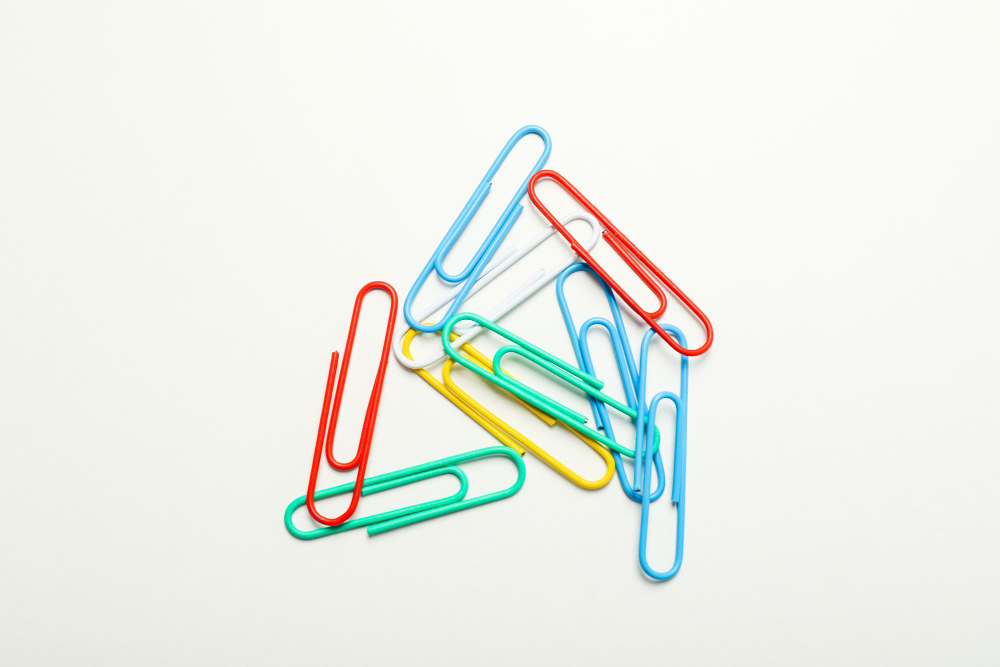
The paper clip only became possible at a particular moment, and the reason is the wire rather than the idea.
Holding sheets together before it meant doing something irreversible. Documents were sewn with thread through punched holes, which is why old legal and official papers are stitched at the corner. They were fastened with ribbon and sealing wax. They were held with straight pins, which rusted, marked the paper and pricked the reader. Or they were simply folded together and docketed on the outside.
What changed was industrial steel wire. Cheap, uniform, springy wire drawn in continuous lengths arrived in quantity in the second half of the nineteenth century, along with machinery that could feed and bend it automatically. Before that, a clip would have had to be made by hand from material that was not consistently elastic, and it would have cost more than the document was worth.
So the paper clip is one of a family of objects that all appeared within a few decades of each other for the same underlying reason – the safety pin, the hairpin, the spring clothes peg, the wire coat hanger, the staple. Each is a small spring made from one piece of drawn wire, and none of them was practical until the wire was.
That is the actual invention. The shapes were found quickly once the material existed, which is probably why nobody managed to own the best one.
The Office It Was Made For Barely Exists
The paper clip belongs to a document system that has largely gone.
Its advantage over a staple is that it is reversible and leaves no mark, which mattered enormously when papers were circulated, read, separated, recombined and filed repeatedly, and when putting a hole in a document could matter.
That workflow has moved. Documents are circulated as files, versions are managed in software, and the physical sheaf passing between desks is now a minor part of most offices. Paper clip consumption has fallen accordingly, and the clip now mostly holds things together for a short period on one desk rather than travelling.
It survives for the same reason a great many simple objects survive: it costs so little that nobody is motivated to stop buying it, and it does several unrelated jobs adequately – holding paper, marking a page, replacing a missing zip pull, resetting a device through a pinhole, and functioning as the universal emergency tool for anything requiring a thin stiff wire.
The Pinhole Use Is Almost Its Main Job Now
It is worth noticing that the paper clip has quietly become part of the design of consumer electronics.
Devices with sealed cases need a way to be reset, or to have a tray ejected, without a button that can be pressed accidentally. The standard answer is a small hole requiring a thin stiff probe, and the probe the manufacturer assumes you have is a straightened paper clip.
That is a genuine design dependency. A product shipped worldwide relies on the fact that an object of a particular diameter and stiffness is available in essentially every home and office on earth, without the manufacturer having to supply one – and in the cases where they do supply one, it is a small piece of bent wire in the box that most people lose immediately and then replace with a paper clip.
Which is a reasonable epitaph for the thing. Nobody knows who designed it, nobody ever patented it, it has been unchanged for more than a century, it is being used less and less for the job it was made for, and it has become a standard tool that device manufacturers quietly build their products around.
There is one last thing worth saying about the Norwegian story, because correcting it is not the same as dismissing it.
The people who pinned a paper clip to a coat during the occupation were not making a claim about patents. They were using the most ordinary object available to say something that could not be said out loud, in a way that could be denied if challenged, and that anybody who understood would understand. That is a real act and the fact that the invention story turned out to be wrong does not touch it.
If anything the truth is better. The clip was chosen because it was unremarkable and because it holds things together, and both of those are more to the point than where it was designed. A symbol that works because it is beneath notice is a more interesting thing than a symbol that works because of a patent filing – and it is the only version of the story that is actually true.
Like our content? Follow us for more.