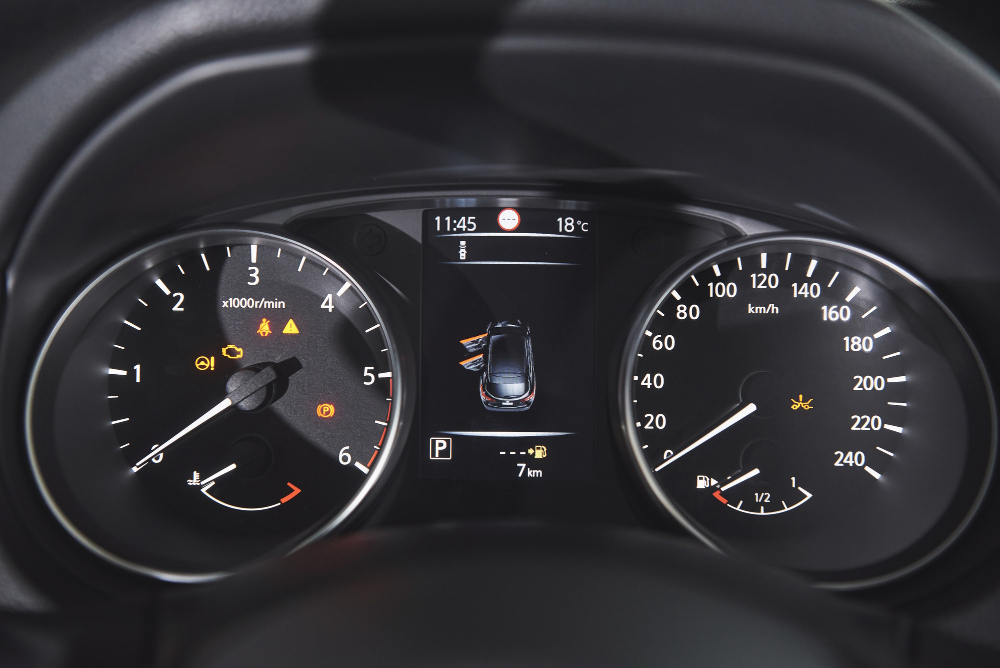
Look at the fuel gauge on most cars built in the last fifteen years or so. Beside the little petrol pump symbol there is usually a small solid triangle, pointing left or right.
It is pointing at the side of the car the filler cap is on. That is the entire feature, and almost nobody is told about it. On some cars the hint is built into the pump icon instead – the hose and nozzle hang off one side, and that side is the side you need.
Why Nobody Told You

There is no warning light for it, no chime, no line in the delivery handover at the dealership, and in a great many owner’s manuals it is either buried in a diagram caption or absent entirely.
Part of the reason is that it was never a safety feature, so it did not have to be documented the way a warning lamp does. Part of it is that a dashboard is a crowded piece of design with a long list of legally mandated symbols competing for space, and a helpful triangle is near the bottom of anyone’s priority list. And part of it is that the people who design instrument clusters have generally assumed the marking is self-explanatory, which it is – but only once somebody has pointed it out, which is the condition for almost all self-explanatory things.
The feature became widely known in the 2010s, when it circulated online and a very large number of drivers discovered it on cars they had owned for years. A Ford designer is usually credited in those accounts with having added it to a model around the end of the 2000s. The marking predates that by some margin – examples turn up on cars from the 1980s and 1990s – but the attribution stuck because that was the point at which it became common enough for people to start noticing.
Like our content? Follow us for more.
Why the Side Is Not Standardised in the First Place

The obvious question is why manufacturers do not simply agree. There is no regulation anywhere that specifies which side a fuel filler goes on, and the reasons it varies are mostly to do with what else is competing for the space.
A fuel tank sits ahead of or above the rear axle, and the filler neck has to run from the tank to the body skin without crossing the exhaust system, the rear suspension, the spare wheel well, or the rear seat floor pan. Where the exhaust runs down a particular car determines which side is clear, and the exhaust routing is determined by the engine’s exhaust manifold, which is determined by whether the engine sits transversely or longitudinally. By the time a designer gets to the filler neck, the decision has largely been made for them several steps upstream.
Two further considerations apply. A filler on the side away from the exhaust is preferred, because hot pipework near a fuel neck is an avoidable risk. And in countries that drive on the right, a filler on the passenger side puts the driver on the kerb side of the car when refuelling at the roadside, which some manufacturers consider safer and others do not weigh at all.
Hybrid and electric vehicles reshuffled the question again, because a battery pack under the floor occupies the space the tank used to have, and a charging port can be placed almost anywhere – which is why the port on an electric car is as likely to be at the front wing or the nose as at the rear.
The Explanation That Gets Repeated, and Whether It Holds Up

There is a widely circulated claim that manufacturers deliberately alternate the side so that cars do not all queue for the same pump, spreading the load across a forecourt.
It sounds plausible and it is almost certainly not a design policy. No manufacturer has published such a rationale, no regulator has requested it, and the engineering constraints above comfortably account for the variation on their own. A carmaker designing a vehicle for a global market is not optimising the queueing behaviour of filling stations.
What is true is that the resulting mixture has that effect. Because filler sides are effectively randomised across the vehicle fleet, a forecourt does get used from both sides, and a pump island with hoses on both faces works well. That is a consequence rather than an intention, and the distinction matters because the story is usually told the other way round.
The other thing worth knowing is that the hose on a modern pump will generally reach around the back of a small car to the far side. It is not recommended, it strains the hose and the nozzle, and on a long vehicle it will not reach – but the reason forecourt attendants used to object to it was less about safety than about blocking the island.
What Happens When You Get It Wrong

Putting a car on the wrong side of the pump is a small event with a surprising number of consequences, which is why the marking is worth more than it looks.
On a busy forecourt the usual outcome is a reverse manoeuvre with a car waiting behind you, performed under observation, with a hose on the ground on at least one side. On a motorway service area at a holiday weekend it can mean leaving the queue entirely and rejoining it.
The worse version happens at unattended pumps, which are now the majority. A great many have a short hose on a fixed swivel with limited travel, and a vehicle parked with its filler on the far side simply cannot be fuelled from that position – there is no stretching it. Some forecourts are laid out one-way, so correcting the mistake means driving the full circuit again.
For anybody towing, the calculation changes completely. A car with a caravan or trailer behind it cannot reverse out of a pump lane in any practical sense, and getting the approach wrong at a filling station with a trailer attached is a genuine problem rather than an inconvenience. Which is why drivers who tow habitually check the filler side of any unfamiliar vehicle before they set off, and why the triangle is the first thing an experienced one looks for on a hire car dashboard.
The Other Markings You Have Never Read

The fuel arrow is one of a set of small instructions hiding on most cars in plain sight.
The tyre placard, usually on the driver’s door jamb or inside the fuel flap, gives the manufacturer’s cold inflation pressures for that specific vehicle with its specific wheels. The number moulded into the tyre sidewall is the tyre’s maximum, not a recommendation, and inflating to it is a common and avoidable mistake.
The windscreen washer symbol, the coolant symbol and the oil symbol are each drawn to a standard that distinguishes them by outline rather than by colour, for the same reason stop signs are octagons – a driver glancing at a cluster in bright sunlight is reading shapes.
The arrows moulded into a windscreen wiper blade’s rubber indicate the direction of travel for fitting. The dot or triangle on a tyre sidewall marks the lightest point for balancing. The small arrow on a seatbelt webbing label shows which way up it mounts. The number stamped on the inside of a hubcap tells a fitter the torque sequence.
And the single most useful one, which is not a marking at all: your door mirror shows you the fuel flap on that side of the car. If there is no triangle on your gauge, two seconds with the mirror settles it permanently.
The Real Problem It Solves
Knowing which side your own car fills from is not a problem anybody has. You have done it a thousand times, and the knowledge is in your hands rather than your head.
The triangle exists for the other situations. A hire car at an airport, collected in the dark, to be returned full in ninety minutes. A courtesy car from a garage. A friend’s car, a van hired for an afternoon, a vehicle borrowed in another country where you are already managing the wrong side of the road and an unfamiliar gearbox.
In all of those, the information arrives at precisely the wrong moment – as you pull onto a crowded forecourt and commit to an approach angle. The alternative is getting out, looking, getting back in and reversing out of a queue, which is the specific small humiliation the arrow was drawn to prevent.
It is a good piece of design for a reason that has nothing to do with cleverness. It puts the answer where the question gets asked, costs nothing to manufacture, and needs no instructions – once, as with so much good design, somebody has told you it is there.
If your own car has no triangle, the fix takes one minute and lasts for as long as you own it. Walk to the filler flap, look at which side it is on, and then sit in the driver’s seat and find the mirror that shows it. Do that once and the information is attached to a view you already check every time you move the car, rather than to a fact you have to remember.
And if you are collecting an unfamiliar vehicle, the sequence is: triangle on the gauge first, nozzle direction on the pump symbol second, door mirror third. One of those three will answer it before you reach the forecourt.
Like our content? Follow us for more.