

The Voynich manuscript is the most stubborn document in the world. It is a real, physical object — roughly 240 surviving pages of vellum, bound, densely handwritten, and lavishly illustrated in faded colors — held at Yale University’s Beinecke Rare Book and Manuscript Library, where anyone can view high-resolution scans of every page online. There is no dispute about its existence, its age, or its physical composition. The dispute is about literally everything else, starting with what it says.
The text runs to tens of thousands of characters in an unknown script, written fluently and confidently in what appears to be a consistent system. It has been studied by some of the most capable codebreakers of the twentieth century, including people who broke real wartime ciphers for a living, and by generations of linguists, medievalists, and computational researchers with access to tools those earlier investigators could only dream about. Claimed solutions appear regularly and are, without exception so far, rejected by specialists. It remains, by a comfortable margin, the most famous undeciphered text on the planet.
What’s Actually in It
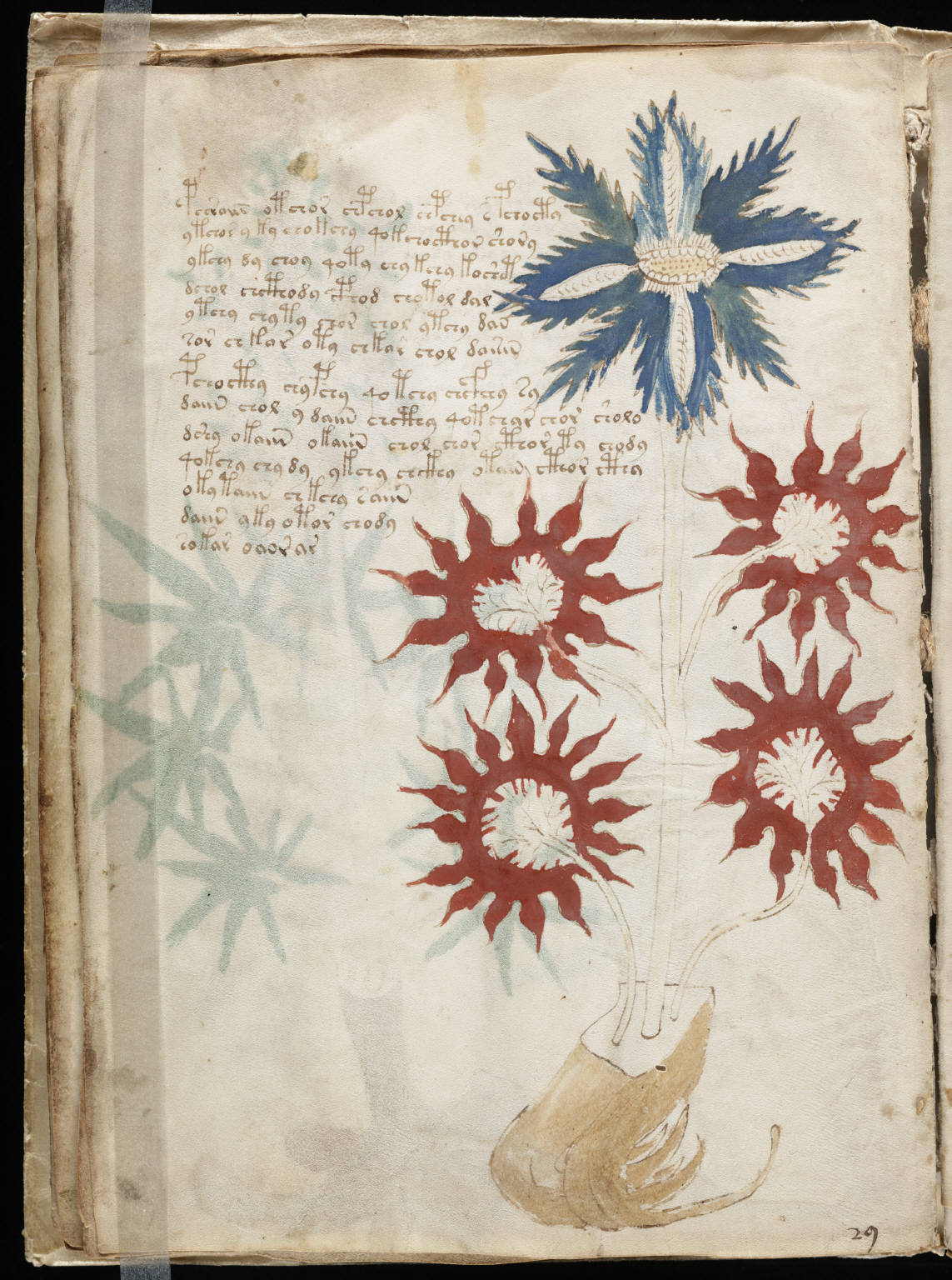
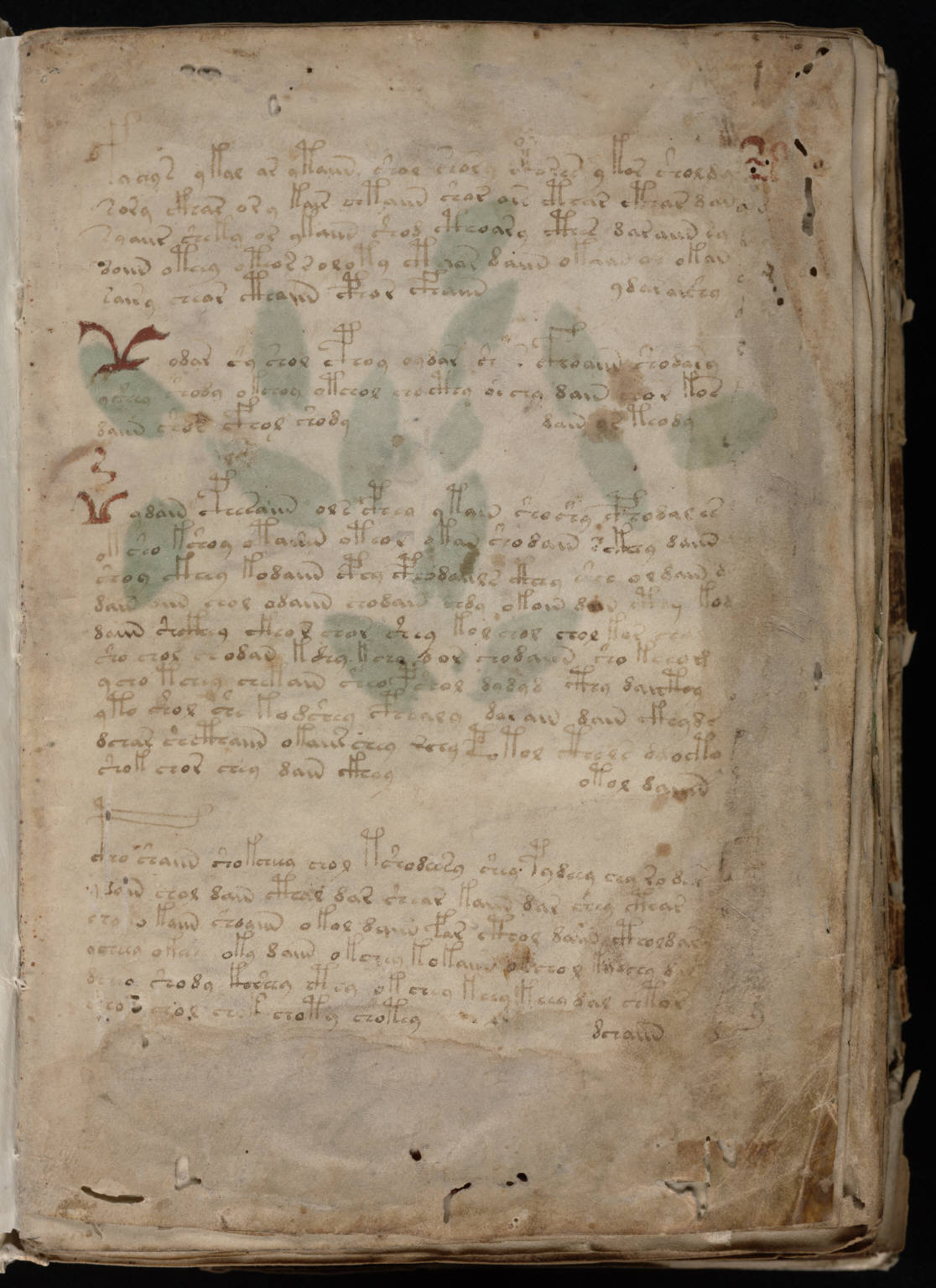
The manuscript is organized into sections that scholars have named by their illustrations, since nobody can read the headings. The largest is botanical: page after page of large, colored plant drawings surrounded by text. The plants are the first hint that something is odd, because most of them do not correspond to any known species. A handful bear a passing resemblance to real plants, but the majority appear to be composites or inventions — roots, leaves, and flowers assembled into things that have never grown anywhere.
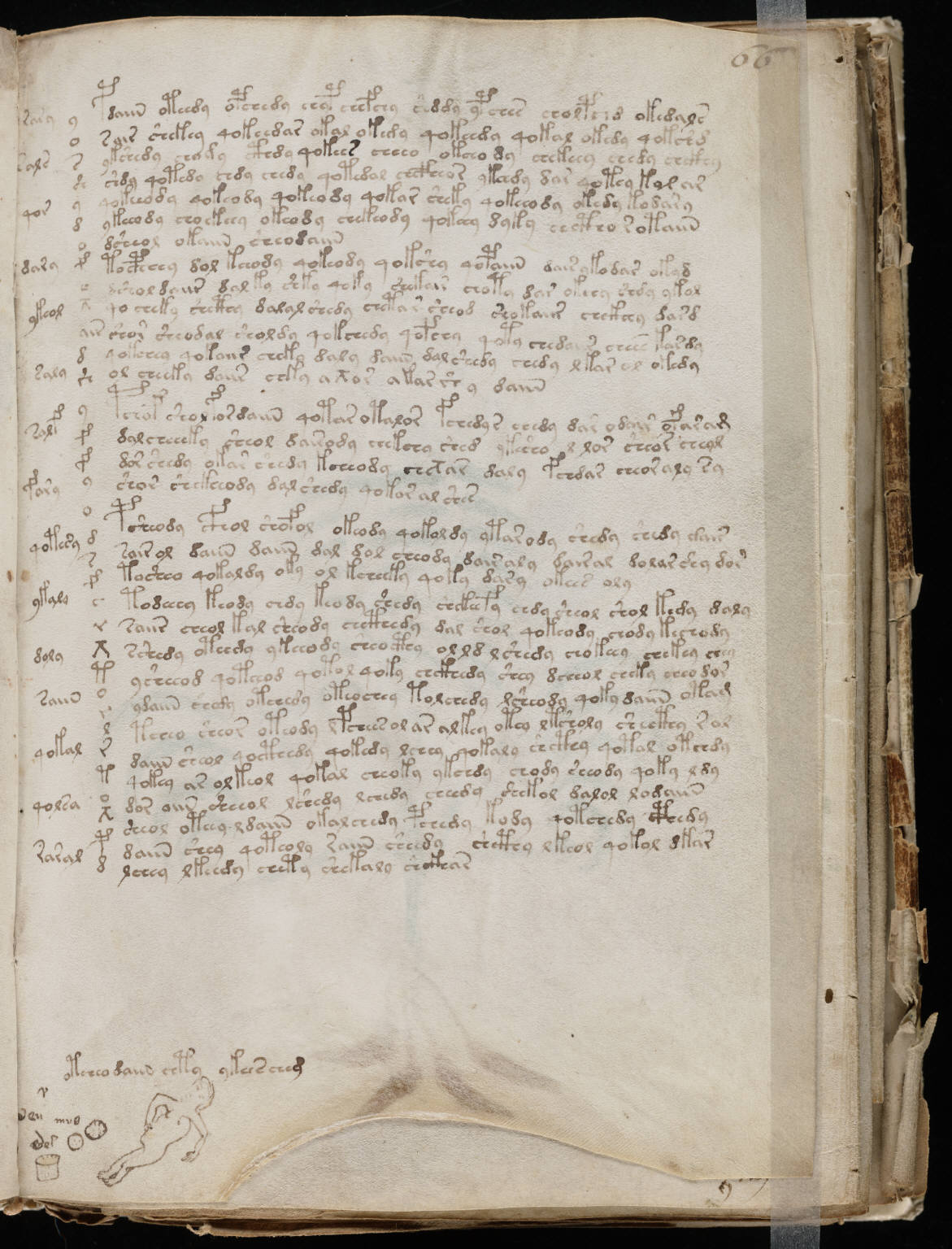
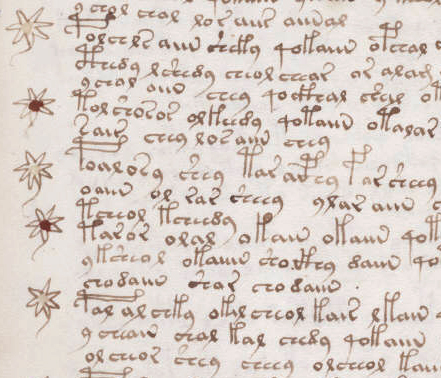
Another section is astronomical or astrological, filled with circular diagrams, star-like patterns, and what appear to be zodiac symbols, some accompanied by small human figures arranged around the rings. A further section is the strangest of all: it depicts numerous small female figures, often in what look like pools, tubs, or interconnected systems of tubes and vessels, in arrangements that have been interpreted as everything from medical practice to bathing ritual to biological allegory. There is a section of dense text with star-shaped marks in the margins, resembling a list of short entries, and pages that look like pharmaceutical preparations with drawings of containers and plant parts.
Taken as a whole, the layout resembles the general shape of a late-medieval or early-modern reference work — a herbal, an astronomical text, a medical compendium — assembled by someone who understood the conventions of such books. It looks, in other words, exactly like a serious book about something. It simply cannot be read.
Like our content? Follow us for more.
What We Know for Certain
The verified facts are few and hard-won. Radiocarbon dating carried out on samples of the vellum places the material in the first half of the fifteenth century, with the commonly cited range falling in the early 1400s. That single result was enormously important, because it ruled out a large class of theories holding that the manuscript was a nineteenth- or twentieth-century forgery. The parchment is truly that old.
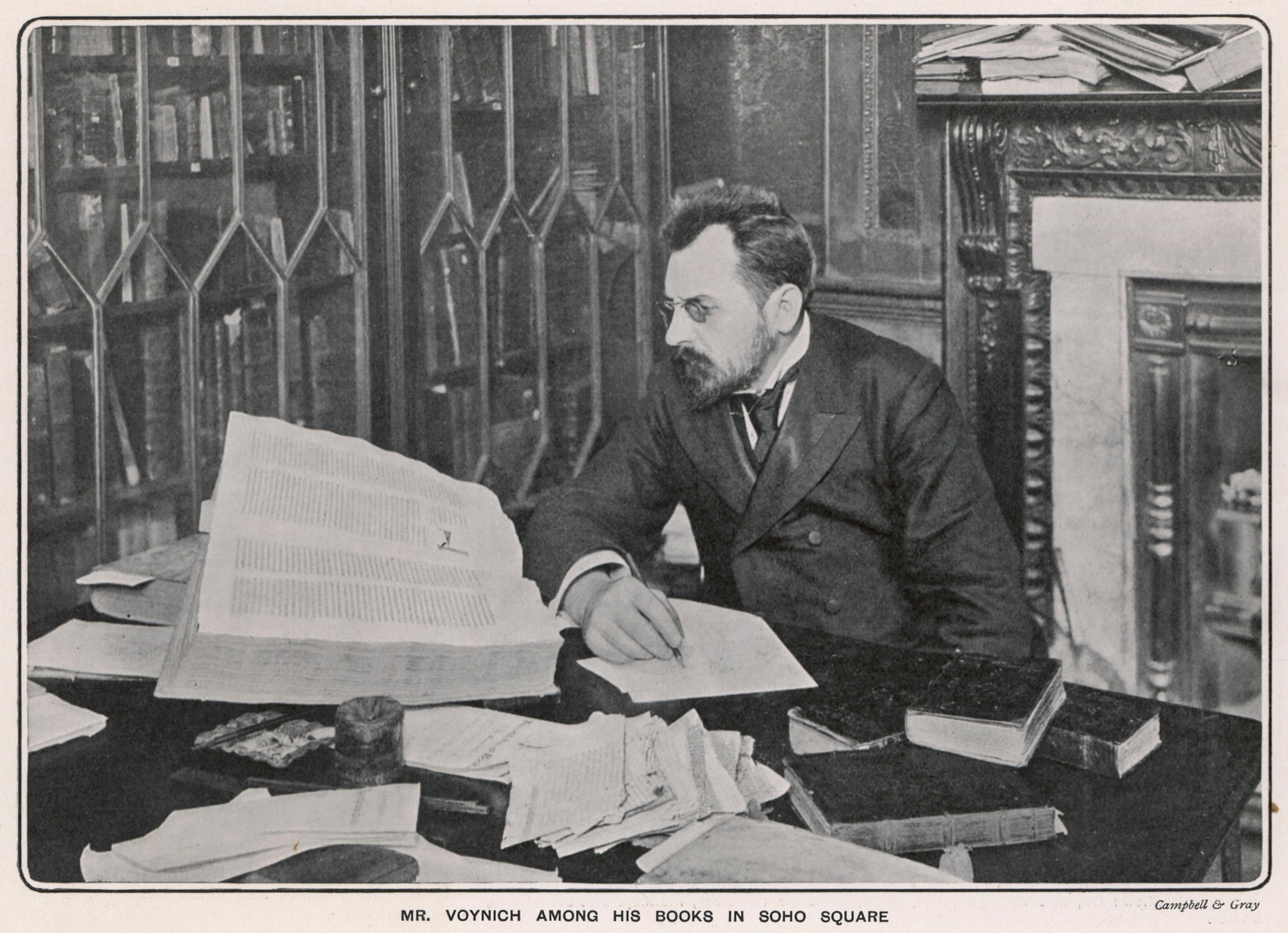
Analysis of the inks and pigments has found them consistent with materials in use in that period, which further undercuts the modern-forgery hypothesis — though it does not, on its own, prove that the writing was done at the same time as the parchment was made. The manuscript’s documented ownership history stretches back several centuries in Europe, with references and correspondence connecting it to collectors and scholars, and it acquired its modern name from Wilfrid Voynich, a book dealer who acquired it in the early twentieth century and worked energetically to publicize it. It eventually came to Yale, where it has been since the 1960s.
Statistical analysis of the text has produced the most tantalizing findings. The writing behaves, in several measurable ways, like language: the character and word frequencies follow patterns broadly similar to those found in real languages, words repeat in structured ways, and certain characters cluster in particular positions within words. That is a serious problem for the simplest explanation — that it’s meaningless gibberish — because producing tens of thousands of characters of convincing pseudo-language by hand, consistently, without a system, is truly difficult. At the same time, the text has features that no known language shares, including an unusual amount of repetition, with the same or nearly the same word sometimes appearing several times in a row.
The Theories, and Why They All Struggle
Broadly, the explanations fall into four camps, and each has a serious weakness.
The first holds that it’s an enciphered text in a known language — that some cipher, once identified, will render it into Latin or another tongue. The difficulty is that the world’s best cryptanalysts have thrown a century of effort at it, including teams who broke far more sophisticated systems under wartime pressure, and none of them cracked it. It is also unclear why a fifteenth-century writer would apply a cipher of such durability to what appears to be a herbal.
The second holds that it’s written in an unknown or lost language, or in a constructed one, using an invented script. This is possible, but every specific proposal — and there have been many, spanning obscure European dialects, Asian languages, and invented tongues — has failed to convince specialists when the proposed reading is applied consistently across the whole manuscript rather than a few cherry-picked lines.
The third holds that it’s an elaborate hoax containing no meaning at all, produced to be sold to a wealthy collector — a plausible motive, since credulous buyers for exotic manuscripts certainly existed. The obstacle is the statistical structure: the text is more language-like than a fraudster’s random scribbling should be, and generating it would have taken enormous, sustained effort for a document that would be worth exactly as much if the writing were sloppier.
The fourth, and perhaps the most interesting, holds that it’s a personal system — a private shorthand, a mnemonic scheme, or an idiosyncratic notation devised by one person for their own use, encoding real content in a way that made sense only to its creator. If that’s true, the manuscript may be permanently unreadable, not because it’s too well encrypted but because the key was never written down and died with whoever invented it.
Why the “Solutions” Keep Failing
Every year or two, a new decipherment makes headlines, usually accompanied by confident claims that the mystery is finally solved. They have so far all foundered on the same test, which is the only test that matters: does the proposed system, applied mechanically and consistently across the entire manuscript, produce coherent text throughout?
Proposed solutions typically work on a handful of words or a single page, chosen by the proposer, and then dissolve into nonsense when extended. Some rely on so much interpretive flexibility — allowing characters to stand for multiple letters, permitting rearrangement, tolerating heavy guesswork about missing vowels — that they could be used to extract almost any desired meaning from almost any text. Specialists in the field have grown correspondingly cautious, and the standing expectation is that a real decipherment will announce itself by working, at length, without special pleading.
The Book at Yale
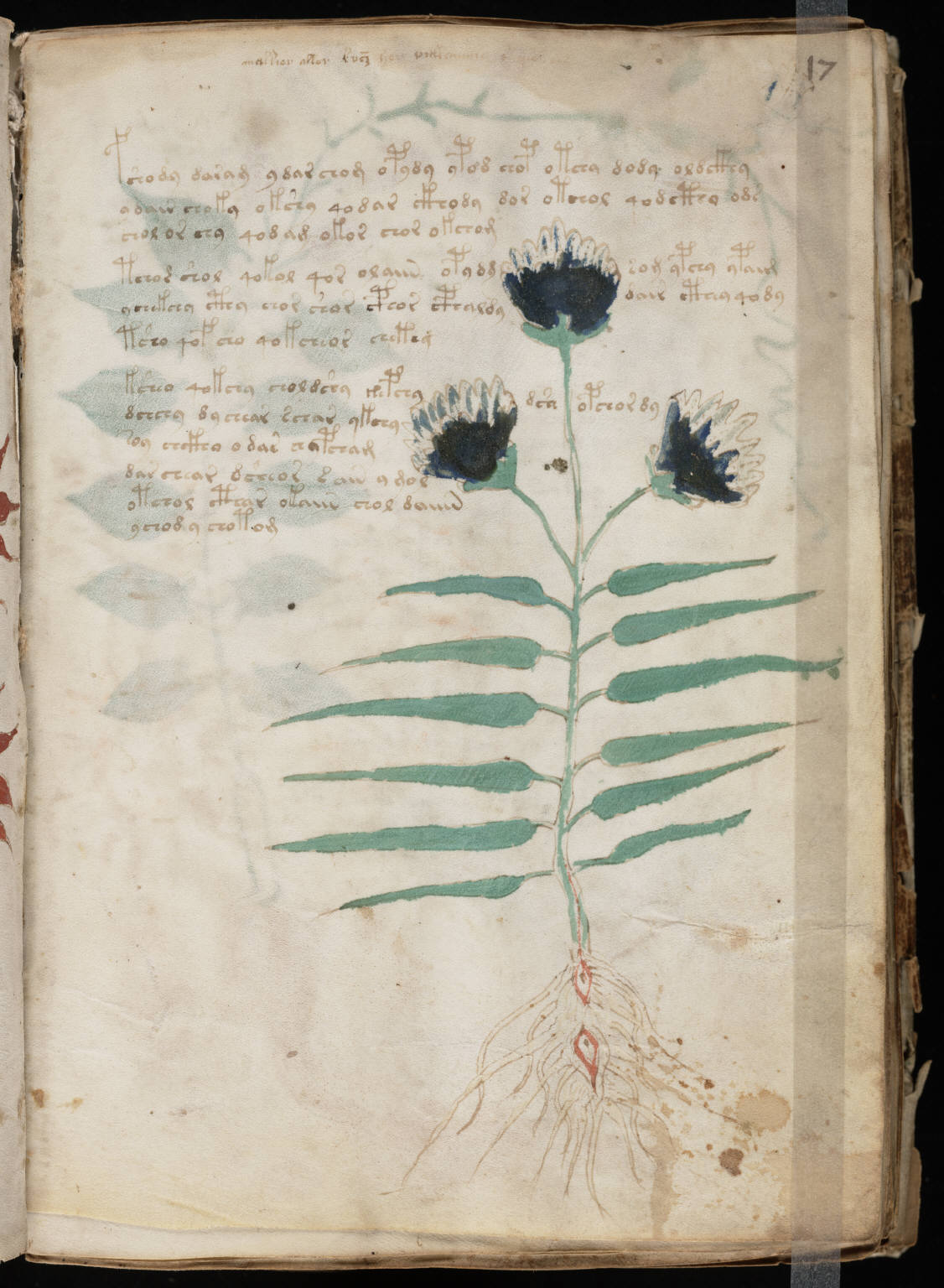
For anyone drawn to unsolved things, the manuscript is unusually accessible for a treasure of this stature. The Beinecke Library has digitized it completely and made the images freely available, which means anyone with an internet connection can page through the actual object in high resolution — the odd plants, the circular diagrams, the crowded script — and try their own hand at it. A substantial amateur community does exactly that, alongside the professionals.
New Haven itself makes a worthwhile stop for anyone in that part of Connecticut, and the Beinecke’s building is a destination in its own right: a modernist structure whose walls are made of thin translucent marble that glows amber when the sun comes through, sheltering a central glass tower of books. The manuscript is not permanently on public display, and viewing the physical object requires the library’s research procedures, but the building and its rotating exhibitions are open to visitors.
Six Hundred Years of Silence
What makes the Voynich manuscript so compelling is not that it’s mysterious in a vague, atmospheric way. It’s that the mystery is precise. Here is a specific object, of known age, made of known materials, sitting in a known building, covered in tens of thousands of characters written by a real human hand with evident care and fluency. Somebody made this. It took a very long time. They were doing something.
And after six centuries, with every analytical tool modernity can bring to bear, we cannot say what. The plants have no names because they may have no referents. The diagrams chart something unidentifiable. The women in their pools are doing something nobody can explain. The most likely outcome, on current evidence, is that the manuscript is not hiding a great secret at all — that it’s a herbal, or a medical text, or one person’s private notebook, and that its content would be modestly interesting if we could read it. But we can’t. And the small, persistent scandal of that fact is why a book nobody can read remains one of the most studied objects in the world.
Like our content? Follow us for more.

