

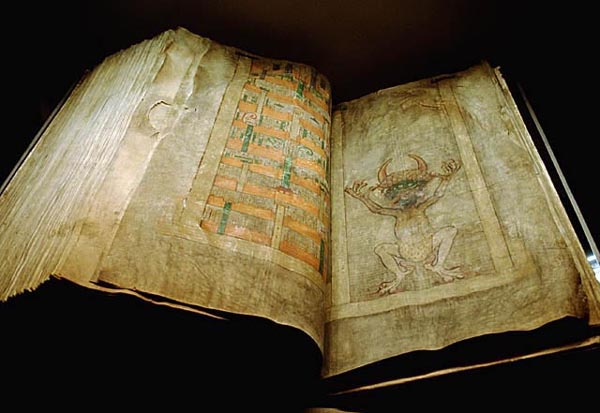
There is a book in the National Library of Sweden that is unlike any other on Earth. It is called the Codex Gigas — Latin for “giant book” — and it lives up to the name completely. Standing about three feet tall and weighing a staggering 165 pounds, it is the largest surviving medieval manuscript in the world, so massive that two people are needed simply to move it. Its pages, hundreds of them, are made from treated animal skin, requiring the hides of an estimated 160 animals. And bound within this enormous volume, alongside the complete text of the Bible, is a single, arresting, full-page illustration: a large and striking portrait of the Devil.
It is this image, and the legend attached to it, that has given the Codex Gigas its far more famous nickname: the Devil’s Bible. According to a tale that has clung to the manuscript for centuries, it was written not through years of patient labor but in a single night, by a desperate monk who made a pact with the Devil to complete an impossible task. The truth, as revealed by modern scholarship, is different but scarcely less remarkable. Here is the story of the giant book, its demonic portrait, and the mystery of how one person could produce a work of such staggering, superhuman consistency.
A Book Like No Other
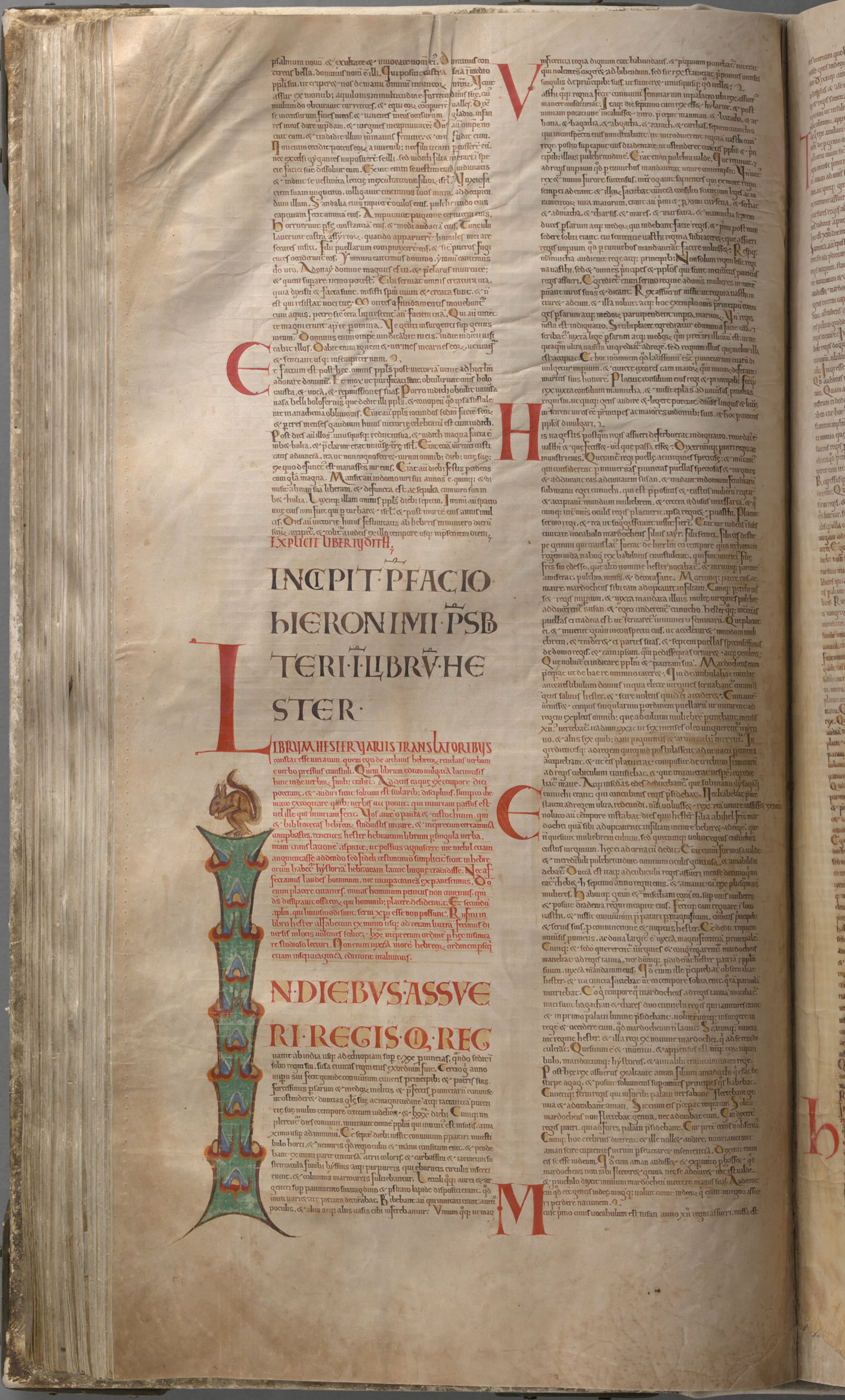
Everything about the Codex Gigas is outsized. It measures roughly a full yard in height, some twenty inches wide, and nearly nine inches thick, and its weight of about 165 pounds makes it one of the heaviest books in existence. Creating it required an enormous quantity of vellum — fine writing material made from prepared animal skin — with estimates suggesting the hides of around 160 animals went into its hundreds of large pages. Simply assembling the raw materials for such a book would have been a major undertaking in the medieval world.
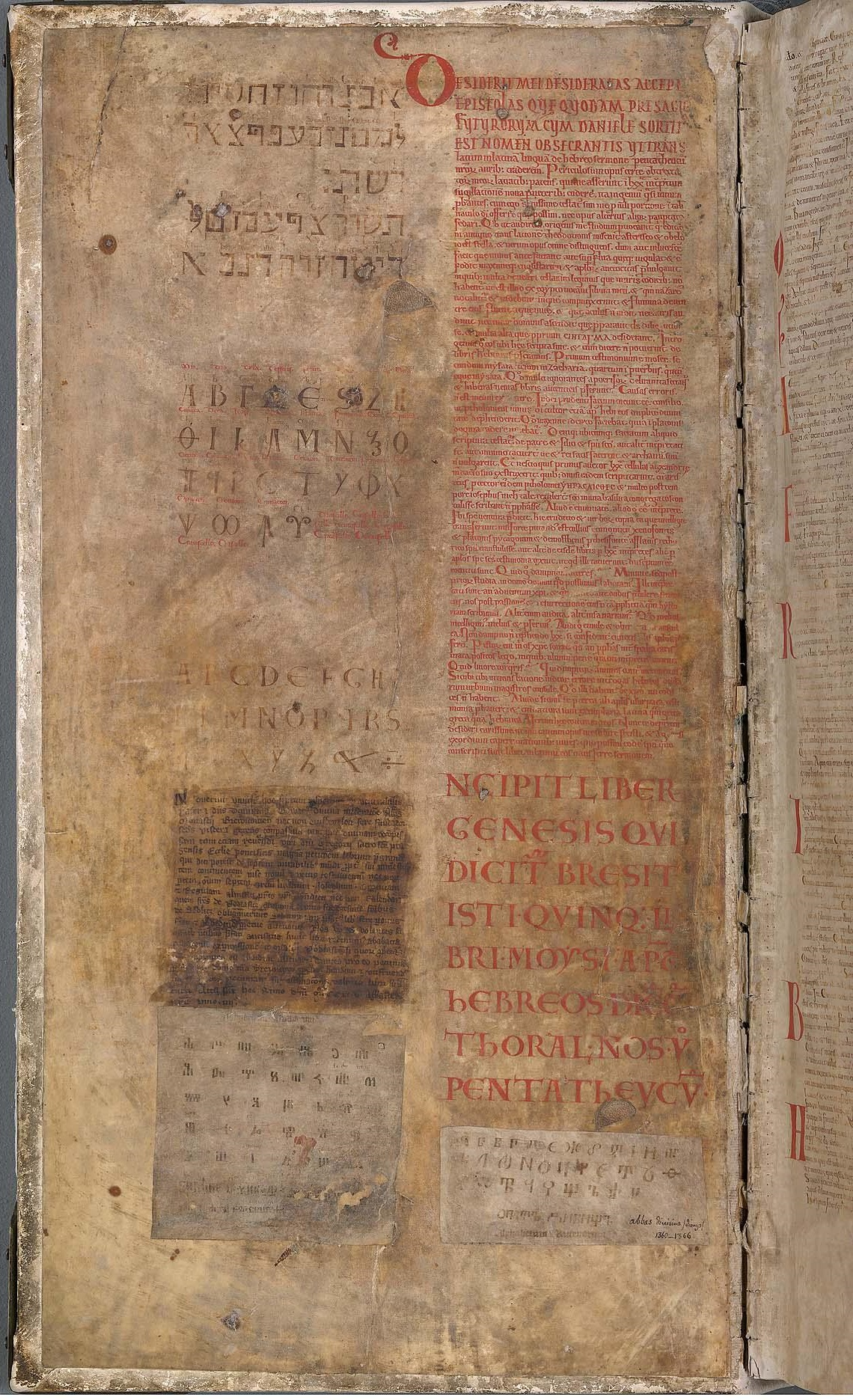
The manuscript was created in the early thirteenth century, most likely in a Benedictine monastery in Bohemia, in what is now the Czech Republic. And its contents are as sprawling as its dimensions. It contains the complete text of the Old and New Testaments in Latin, making it a full Bible, but it is far more than that. Bound into the same volume is an eclectic library of other works: historical chronicles, a medical text, encyclopedic writings, magical formulas and incantations including exorcism spells, a calendar, and more. It was, in effect, an attempt to gather a vast body of knowledge into a single monumental book — a complete library compressed between two covers. This strange combination of sacred scripture, practical knowledge, and occult material, all in one giant volume, gives the Codex Gigas an air of encyclopedic ambition and mystery that has fascinated scholars for centuries.
Like our content? Follow us for more.
The Portrait of the Devil
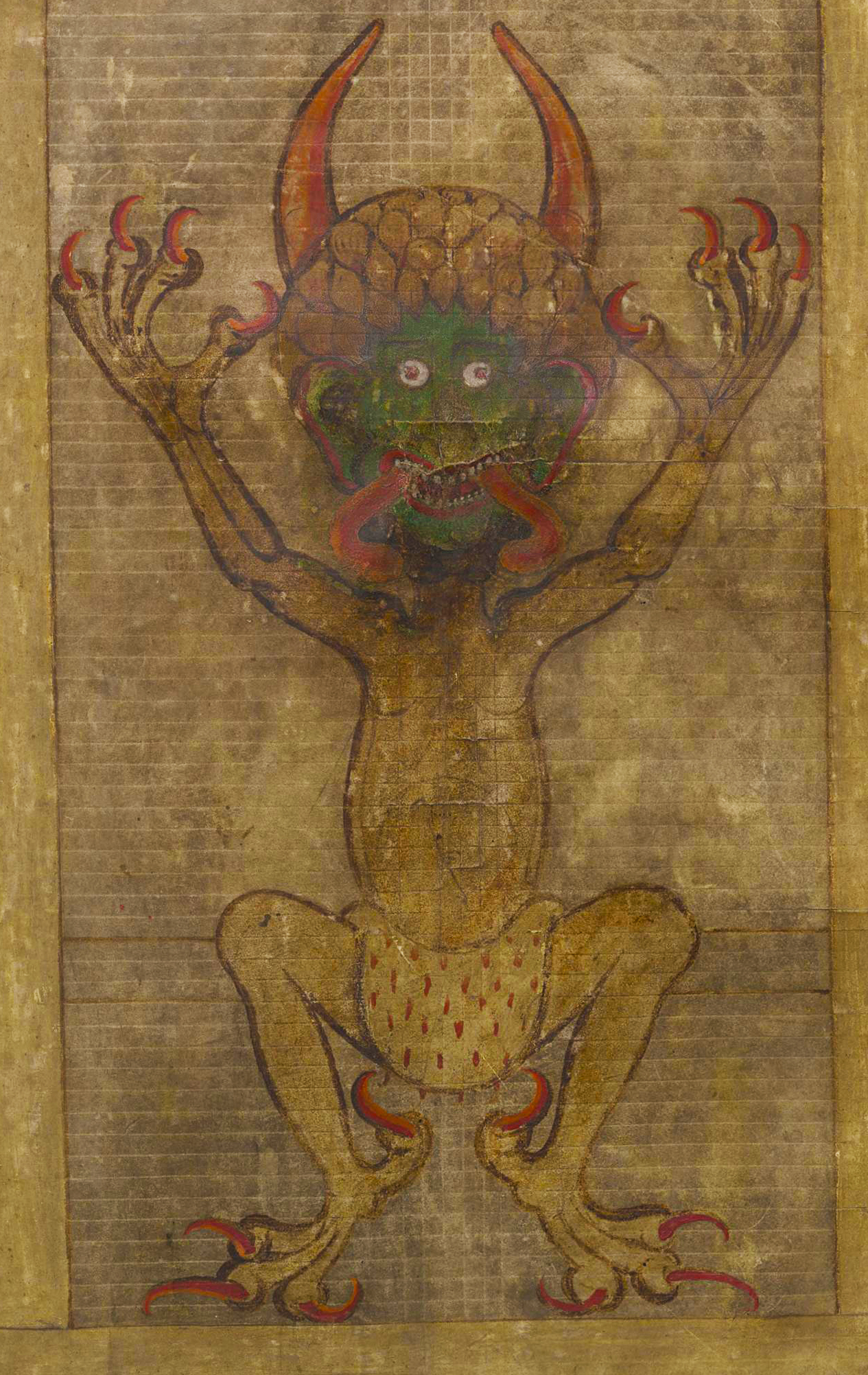
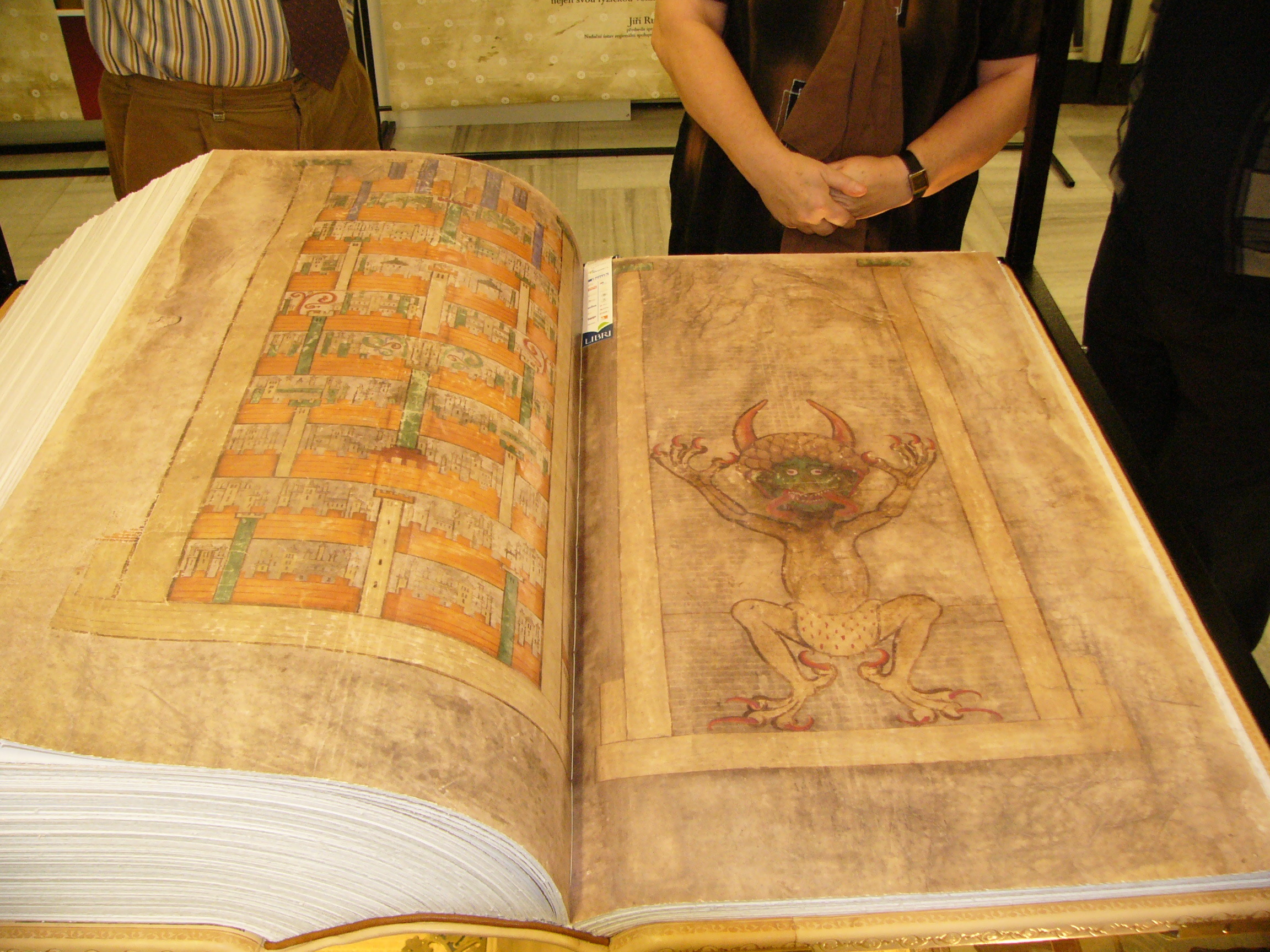
For all its size and scope, the single feature that made the Codex Gigas legendary is one particular page. Deep in the manuscript, occupying an entire page nearly two feet tall, is a large illustration of the Devil — depicted alone, crouching, with a green head, red horns and eyes, clawed hands and feet, and two long, forked red tongues, wearing what appears to be an ermine loincloth, a detail associated with royalty.
This is believed to be the largest surviving depiction of the Devil in any medieval manuscript, and it is truly striking, rendered in a cruder, darker style than the manuscript’s otherwise elegant script and decoration. Adding to its eeriness, the pages immediately surrounding the Devil illustration are noticeably darkened and gloomy in character compared to the rest of the book. The image faces a depiction of the Heavenly City — heaven and hell set opposite one another — which some scholars interpret as a deliberate moral statement about the choice between salvation and damnation. Whatever its intended meaning, this full-page Devil is what transformed the Codex Gigas from a merely enormous manuscript into an object of dread and legend, and it is the direct source of its nickname, the Devil’s Bible. Visitors and readers over the centuries, confronted with this large image of Satan staring out from an ancient religious book, could hardly help but weave dark stories around it.
The Legend of the Midnight Pact
And weave stories they did. The most enduring legend of the Codex Gigas is a tale of desperation, damnation, and a deadline. According to the story, the book was written by a monk — sometimes named Herman the Recluse — who had committed some grave breach of his monastic vows. His punishment was among the most terrible imaginable: he was to be walled up alive, sealed into a confined space and left to die, a medieval penalty known as immurement.
Facing this horrific fate, the monk struck a bargain with the monastery to save himself. He promised that, in exchange for his life, he would create a single night a book so magnificent that it would glorify the monastery forever and contain all human knowledge — an utterly impossible task to complete in the time given. The monk set to work, but as the night wore on toward its end, he realized he could never finish such an enormous undertaking alone. In his desperation, the legend says, he called upon the Devil, offering his soul in exchange for help completing the book. Satan agreed, finished the manuscript, and, as a mark of the dark bargain, the monk added the great portrait of the Devil to the book in acknowledgment. Thus, according to legend, the largest book in the medieval world was completed in a single night through a pact with the Devil himself, and forever bore his image and his name.
What Really Happened
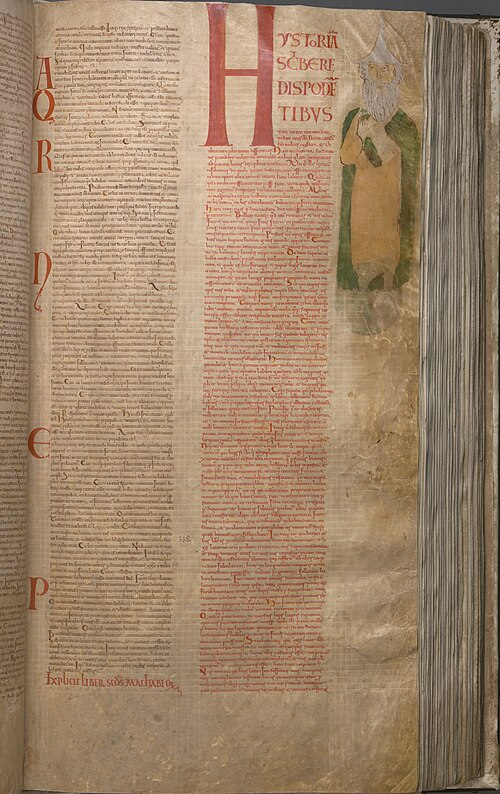
The legend is a wonderful story, but it is, of course, a legend. Modern scholarly analysis has pieced together a more grounded, though still remarkable, account of how the Codex Gigas was actually made, and the reality turns out to be fascinating in its own right. Researchers who have studied the manuscript closely conclude that it was, in all likelihood, written by a single scribe — one person, working alone — but over a very long period of time, not a single night.
Estimates for how long the work took vary, but experts suggest it would have required something on the order of two to three decades of dedicated labor for one person to complete the enormous text, and possibly longer to add all the decoration. Here, though, is the detail that connects the reality back to the legend: the handwriting throughout the entire massive manuscript is astonishingly uniform and consistent from beginning to end. There is no visible variation in the script — no sign of the writer aging, tiring, falling ill, or changing mood across what should have been decades of work. This near-superhuman consistency is so striking that it may well be the very origin of the legend. To medieval eyes, and even to later observers, a book of such size written in such an unwaveringly perfect and identical hand seemed impossible to have been produced slowly by an ordinary human, which naturally suggested that it must have been written impossibly fast, by supernatural means. The perfection of the work, in other words, birthed the myth of the Devil’s help. In reality, that perfection is a testament to the extraordinary discipline, skill, and devotion of one anonymous medieval scribe who gave, quite possibly, the better part of his life to a single book.
A Journey Through History
The Codex Gigas has had an eventful existence in the eight centuries since its creation, passing through many hands and surviving real peril. From its origins in a Bohemian monastery, the manuscript changed ownership over the centuries, eventually coming into the possession of the Holy Roman Emperor Rudolf II, a famous collector of curiosities and the occult, who took it to Prague near the end of the sixteenth century.
Its most dramatic moment came during the chaos of the Thirty Years’ War in the seventeenth century. When Swedish forces captured Prague, they looted the city’s treasures, and the enormous manuscript was carried off as war booty to Sweden, which is how this Czech-made book came to reside in Stockholm, where it remains to this day. The book also survived a serious fire at one point in its history, reportedly rescued from a burning royal library by being thrown out of a window — a fall that damaged its binding and cost it some pages but saved it from the flames. After centuries in Sweden, the manuscript made a brief, celebrated return visit to Prague in the twenty-first century, drawing enormous crowds eager to see the legendary Devil’s Bible in the land of its birth. Today it rests, carefully preserved, in the National Library of Sweden, still enormous, still bearing its portrait of the Devil, still the largest medieval book in the world.
The Book That Outlived Its Legend
The Codex Gigas endures as one of the most compelling objects to survive from the Middle Ages precisely because it sits at the meeting point of the real and the legendary. Strip away the supernatural tale, and you are left with an achievement that is arguably more impressive than the myth: a single human being, name lost to history, laboring for decades in a medieval monastery to produce the largest and one of the most comprehensive books of the age, in a hand of such flawless consistency that it seemed to later minds to defy human capability.
The legend of the midnight pact is a marvelous story, and the great portrait of the Devil is truly unsettling to behold. But the deeper marvel of the Codex Gigas is the human one. It is a monument to the patience and skill of anonymous medieval scribes, to the sheer determination it took to create books by hand before printing existed, and to the way a single extraordinary object can accumulate centuries of story, fear, and fascination around itself. It survived war, fire, looting, and eight hundred years of history to arrive, intact, on a library shelf in Stockholm, where it waits for anyone curious enough to seek out the giant book that legend says the Devil helped write — and that one remarkable, forgotten human being almost certainly wrote alone.
Like our content? Follow us for more.
