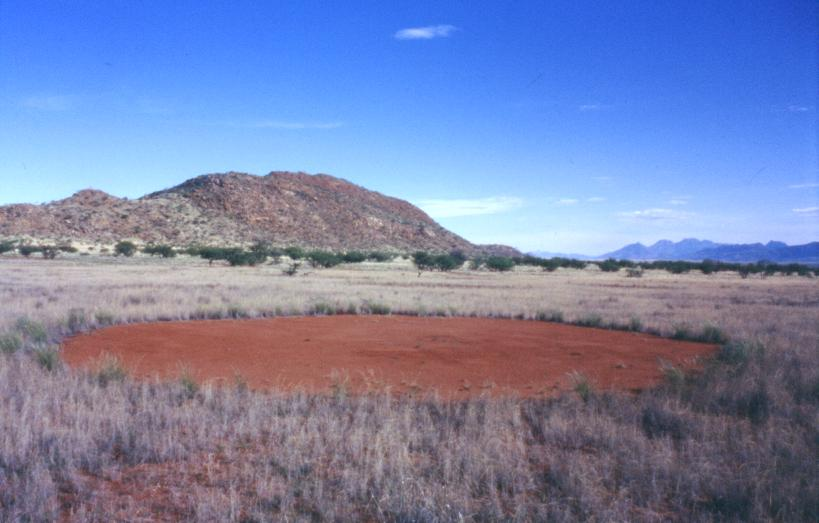
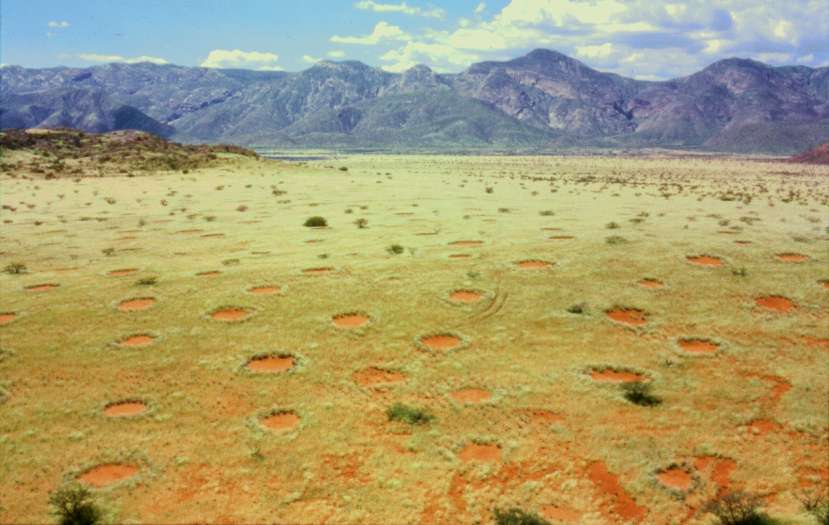
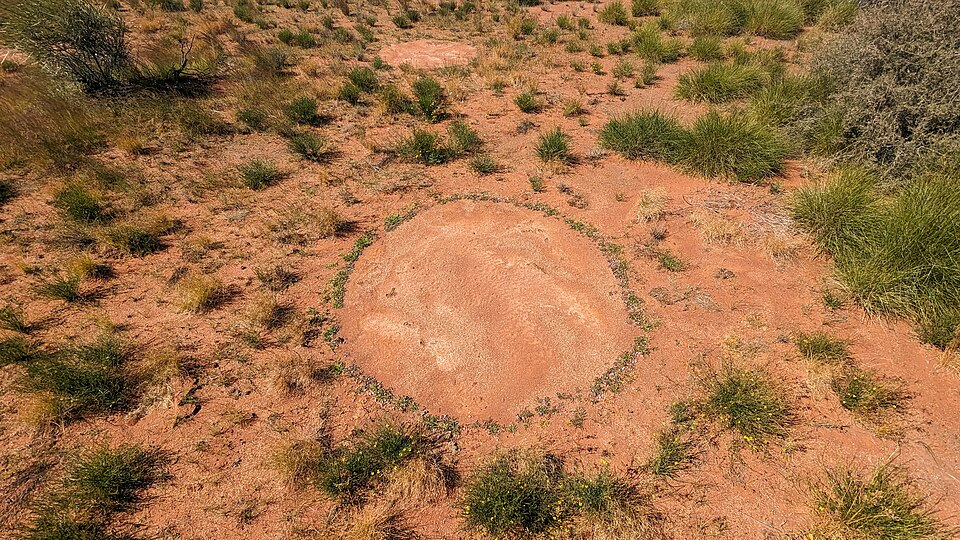
From ground level they are odd but unremarkable: bare, roughly circular patches of soil in dry grassland, each one somewhere between two and fifteen meters across, fringed by a ring of grass noticeably taller than the grass around it.
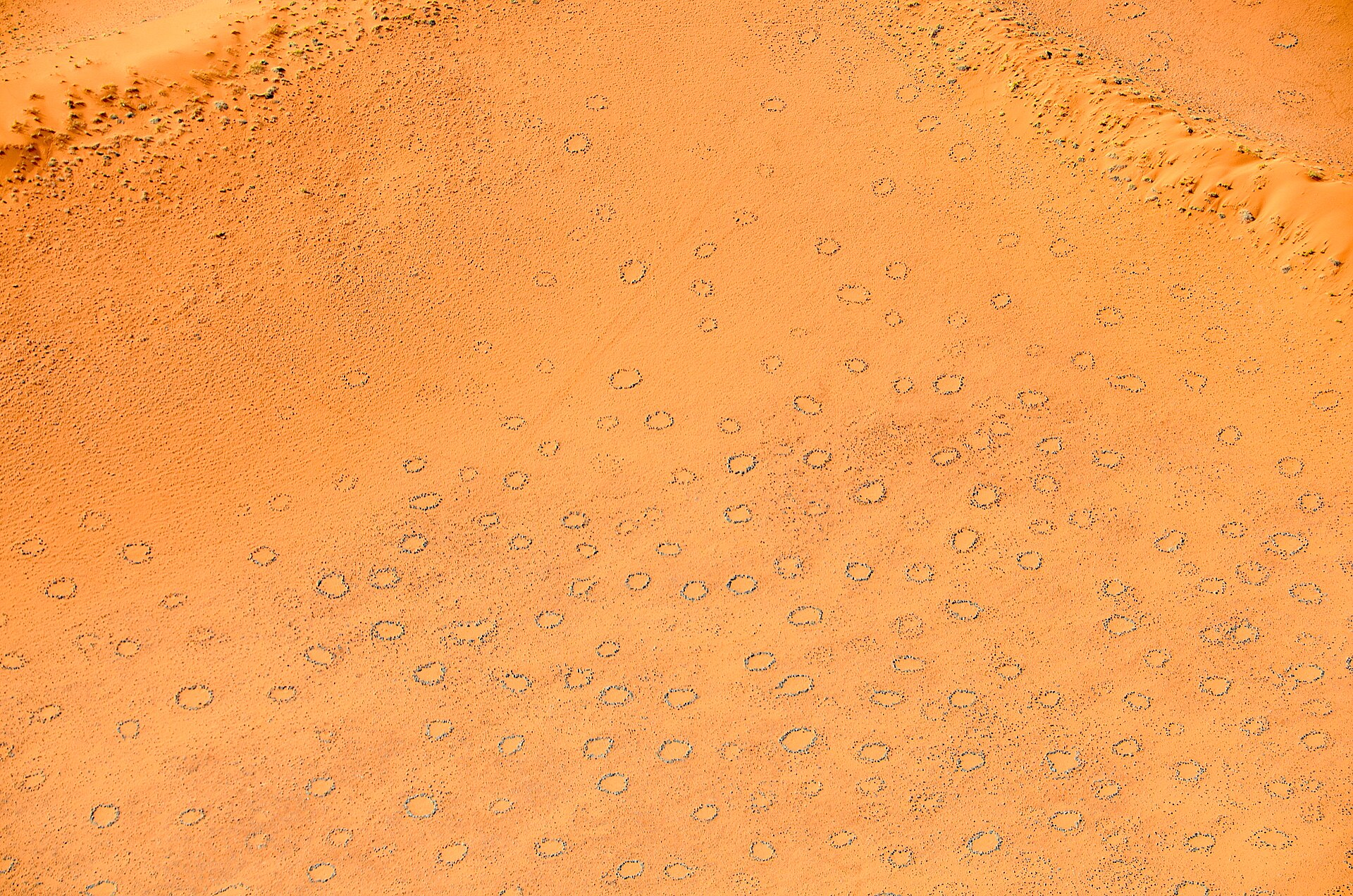
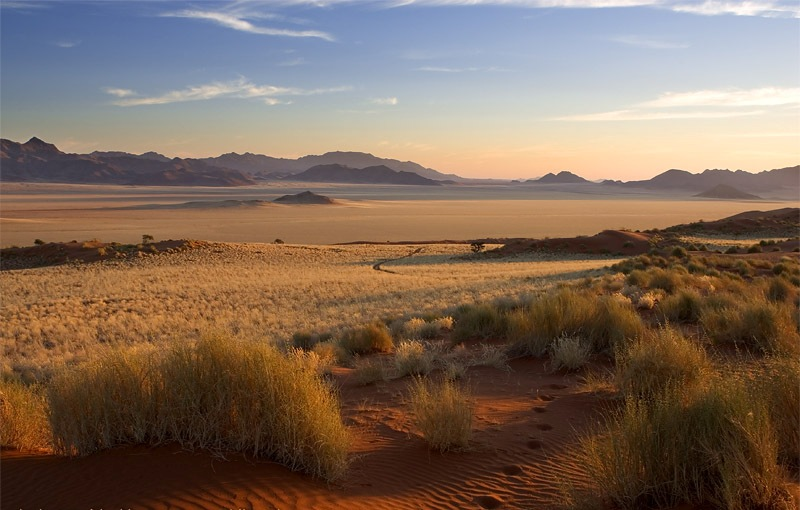
From the air they are astonishing. The circles cover thousands of square kilometers of arid grassland along the edge of the Namib Desert, and they are not scattered randomly. They are spaced with striking regularity, roughly five to ten meters apart at the edges, and where they are dense they arrange themselves into a nearly hexagonal pattern, like an enormous honeycomb laid across the landscape. Local traditions attributed them to spirits or gods, which seems entirely reasonable given how deliberate they look.
Science has been at them since the 1970s. In that time researchers have proposed gases, ants, poisonous plants, termites, and self-organizing vegetation, and two of those explanations have hardened into rival camps whose disagreement has run for decades and produced published papers that respond to each other by name. Here is what is actually known about the fairy circles, and why one of the most visually striking natural phenomena on Earth still lacks an agreed explanation.
What They Actually Are
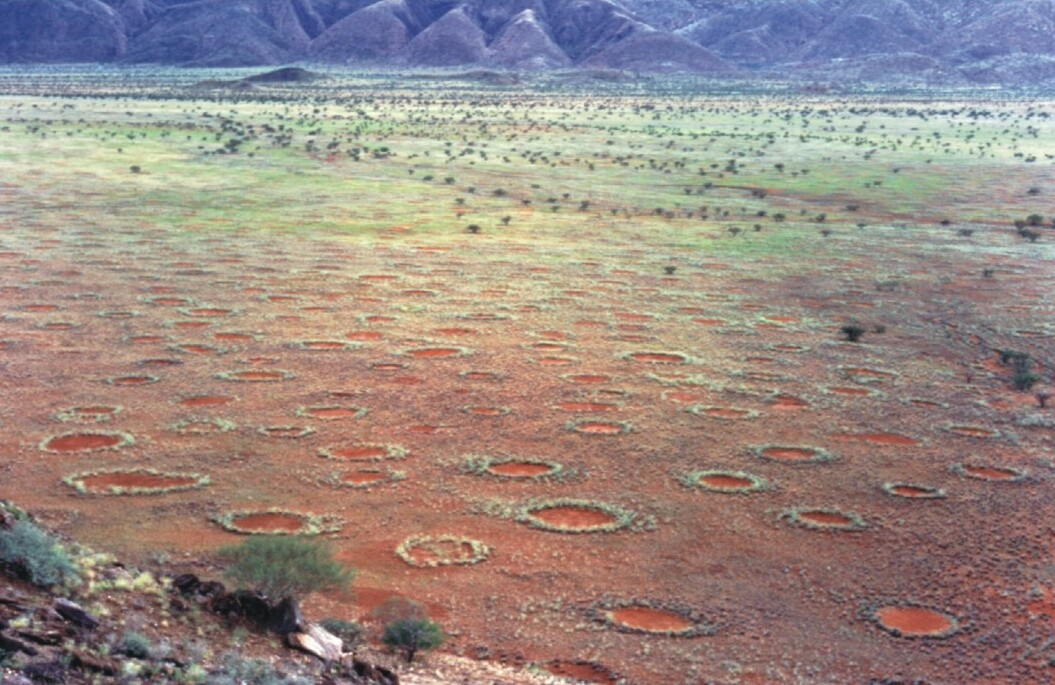
The physical description is well established. The circles appear in hyper-arid grassland, typically dominated by tufts of perennial Stipagrostis grass, which forms the distinctive taller ring around each bare patch. Between the circles is what researchers call the matrix, filled with annual or perennial grasses.
The bare interiors are truly bare, and the regularity of the spacing is the feature that demands explanation. Random processes do not produce evenly spaced patterns; they produce clumps and gaps. Something is enforcing the distance between circles, in the same way that something enforces the spacing of trees in certain forests or the pattern of vegetation in other arid landscapes worldwide, where similar regular patterning is known.
The circles are also dynamic rather than static. They are born as small new patches, grow over time, and eventually die by filling in with vegetation. Individual circles can persist for decades. That lifespan raises a complication: research has found that the grasses forming a single circle’s ring are genetically distinct from one another rather than clones, which means the circle outlives the individual plants composing it, and any explanation has to account for that.
Similar formations have since been identified in other parts of the world, which has broadened the question beyond Namibia.
Like our content? Follow us for more.
Camp One: It’s the Termites
The termite explanation had its major moment in 2013, when a biologist at a German university published a paper in a leading journal arguing that sand termites were responsible.
The evidence was substantial. Across more than 40 field expeditions, he found a particular species of sand termite present at nearly every circle he examined. He also documented something striking about the soil: without grasses drawing water out of it, the ground beneath the bare circles retained moisture down to about a meter depth all year, even through prolonged drought.
That observation drove the hypothesis. The termites, on this account, clear the vegetation in a patch by feeding on the roots, and in doing so engineer a permanent underground reservoir of moisture that allows the colony to survive in an environment that would otherwise be too dry. The bare circle is not a side effect; it is infrastructure. The headlines at the time announced the mystery solved.
The same researcher and a soil scientist colleague have continued to defend and develop the position in subsequent papers, publishing a direct response to their critics that reasserts sand termite herbivory as the cause and argues that the termites gain a substantial survival advantage through the moisture storage.
Camp Two: The Plants Organize Themselves
The rival explanation involves no animals at all. It holds that the pattern emerges from competition between the plants themselves, through a mechanism ecologists call self-organization.
The logic runs like this. In an environment where water is the limiting resource, grasses compete fiercely for soil moisture. Established plants with developed root systems can draw water from a radius around themselves, depleting the soil nearby and preventing new seedlings from establishing in that zone. Run that process across a landscape and it can produce regular, evenly spaced gaps without any coordinating agent, purely from each plant responding to local conditions. Mathematical models of this process successfully reproduce fairy-circle-like patterns.
The strongest field evidence for this arrived from work conducted during two exceptionally good rainfall seasons in the Namib, published in 2022 by a team from a German university. Timing was the key: after rain, the new grasses complete their life cycle within weeks, so the fieldwork had to catch them at exactly the right moment. What the researchers found was that grasses inside the circles germinated after rainfall and then died, and crucially, when they excavated those dying plants, the roots were undamaged. That is difficult to reconcile with termites eating them.
Continuous soil-moisture measurements pointed to the alternative cause: the established grasses in the matrix surrounding each circle were rapidly depleting the water from within the circle, leaving the seedlings inside to fail from water stress. The researchers described the surrounding grasses as having an overwhelming competitive advantage over freshly germinated seedlings in the circle. On this view, termites are present because they feed on dead plant material, which the failing seedlings conveniently provide, meaning the termite correlation is a consequence rather than a cause.
The Correlation Trap
That last point is the intellectual heart of the whole dispute, and it is worth stating plainly because it generalizes far beyond Namibian grassland.
Several early hypotheses were built on correlation: researchers noticed that termites, or ants, or particular euphorbia plants were found in or near the circles, and reasoned backward to causation. But correlation does not establish cause. A team working on the problem has been explicit about this, noting that observations and correlation provide a starting point for developing a hypothesis but do not provide final answers, and that the euphorbia hypothesis in particular was ruled out as coincidence once tested properly.
The termite camp faces this objection directly: termites are present at nearly every circle, but presence is not proof of agency. The self-organization camp faces its own version, since their models successfully reproduce the pattern but a model matching reality does not prove the model captured the actual mechanism.
Toward a Combined Answer
A third position has emerged that treats the two camps as describing parts of one system rather than competing outright.
A 2017 paper in a leading journal proposed that the interaction between termite engineering and vegetation self-organization could be jointly responsible, with each reinforcing the other and facilitating mutual survival. One prominent researcher in the self-organization camp has framed his own position in compatible terms, suggesting that plant self-organization primarily catalyzes the formation of the circles and that termites may then secondarily reinforce them. He has also been candid that scientists may yet arrive at a different model altogether, remarking that researchers always work with what they have.
More recent work has added further layers. Studies of soil nematodes have found conditions inside the circles to be notably hostile, with fewer species and different community assemblages than outside, attributed to the dryness and low organic content. Whether that underground biology is a cause, a consequence, or a reinforcing factor is a live question.
The honest summary as of now is that plant self-organization driven by competition for water is the leading working hypothesis among many researchers in the field, that the termite explanation retains serious and actively published defenders, that a combined mechanism is plausible, and that no single explanation has achieved consensus.
Why an Unsolved Question Is Worth Having
It would be easy to find this unsatisfying. Fifty years, dozens of papers, competing research groups, and no agreed answer to a question you can see from an airplane window.
But the fairy circles are a truly useful case study in how science handles a hard problem. The phenomenon is remote, it responds to rainfall that is patchy and unpredictable across a thousand kilometers of desert, the relevant biological events unfold within a few weeks of rain, and the circles themselves change over decades. Those constraints make controlled study extremely difficult, and researchers have been open about the limitations of their own work.
What the dispute has produced, beyond the specific question, is a body of knowledge about how patterns emerge in stressed ecosystems, how plants compete for scarce water, and how to distinguish correlation from causation in field ecology. Similar patterning has now been documented in other arid regions worldwide, and the Namibian circles have become the reference case for understanding it.
For a traveler, they remain one of the more remarkable things to see from the air in southern Africa: a landscape that looks patterned by intention, produced by processes that are still being argued over in the journals. There is something appealing about a natural wonder that has held onto its explanation this long, in plain sight, at a scale visible from orbit, while some of the best field ecologists in the world work out which of them is right.
Like our content? Follow us for more.