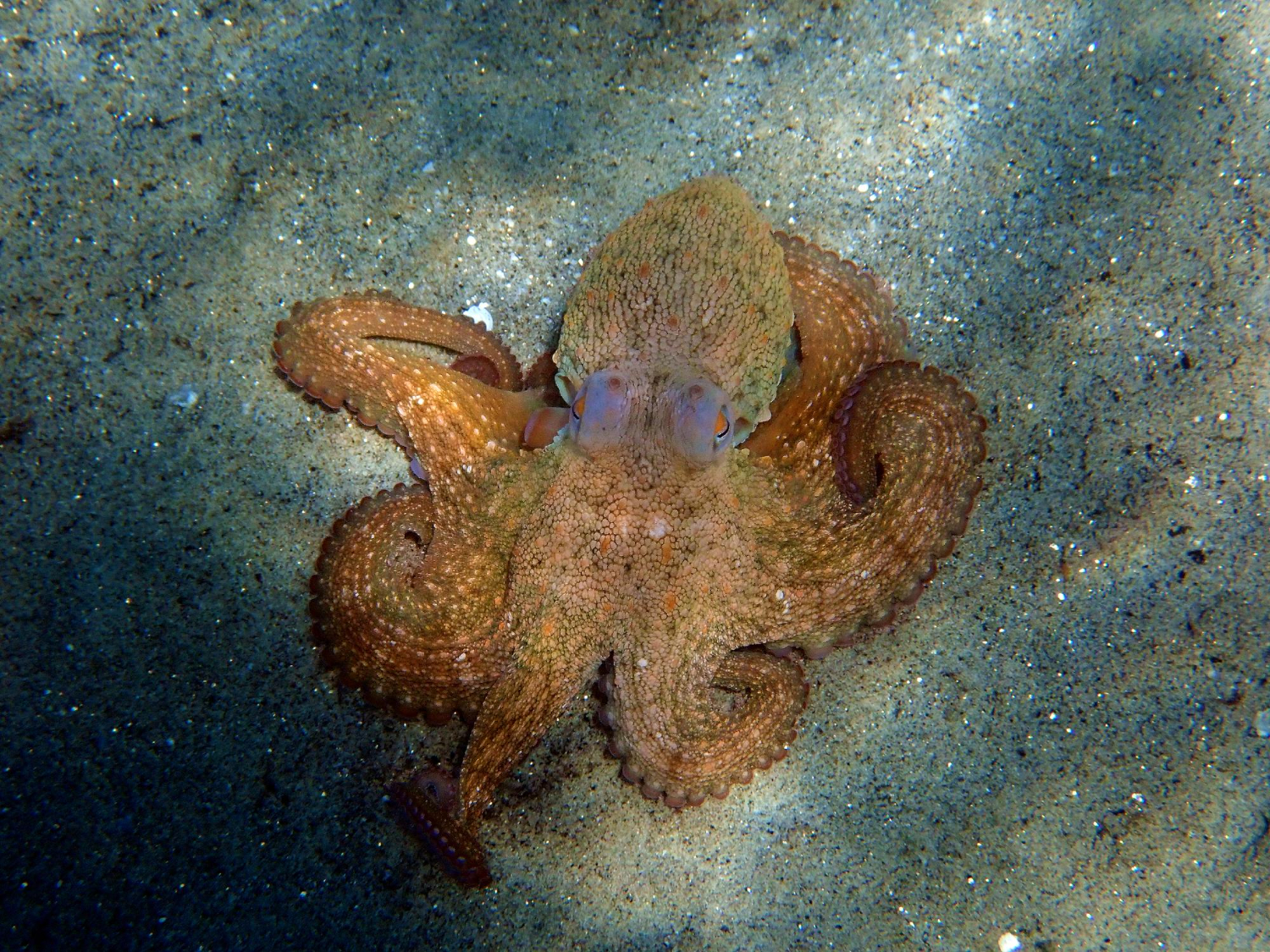
There is an assumption embedded in how nervous systems are usually described, and it comes from studying animals built like us.
The assumption is that a nervous system has a centre. Information arrives at a brain, is processed there, and instructions go out to the body — which is a hierarchy with the thinking in one place and the doing in another.
That is a reasonable description of vertebrates. It is a poor description of a cephalopod, and the difference is not a matter of degree.
An octopus distributes most of its processing into its limbs. The central brain issues something closer to a general instruction than a detailed command, and the arms work out the execution locally.
That is a different architecture for controlling a body, and it appears to work at least as well.
There is a further oddity worth registering before the anatomy. These animals have three hearts and blood that carries oxygen using copper rather than iron, which is why it is blue rather than red – and that system is markedly less efficient at oxygen transport than the vertebrate arrangement.
An animal running a large nervous system on comparatively poor oxygen delivery is an unusual combination, and it is part of why they are restricted to cool oxygen-rich water.
The Distribution
The numbers are worth stating because they are the whole point.
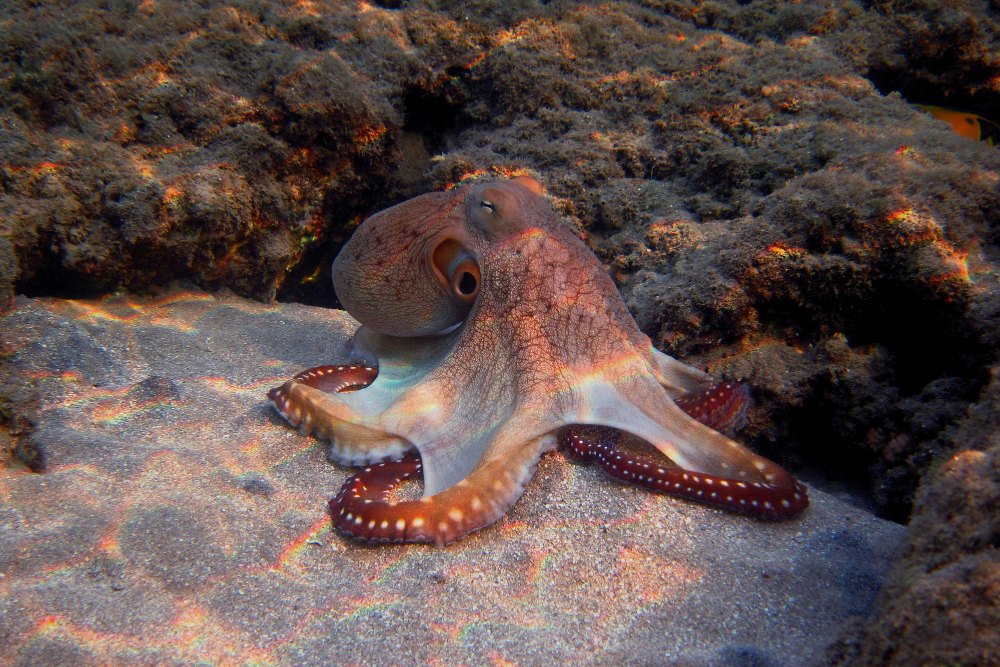
An octopus has neurons in the region of half a billion, which places it well above most invertebrates and in the general range of some small vertebrates.
Approximately two thirds of those are located in the arms, distributed along nerve cords running their length, with concentrations associated with each sucker.
The central brain holds the remainder, and is itself organised into many distinct lobes with a structure entirely unlike a vertebrate brain.
So the majority of the nervous system is peripheral by vertebrate standards, and calling it peripheral is already importing an assumption — it is peripheral only if you have decided in advance that the middle is where the thinking happens.
Like our content? Follow us for more.
What the Arms Do on Their Own
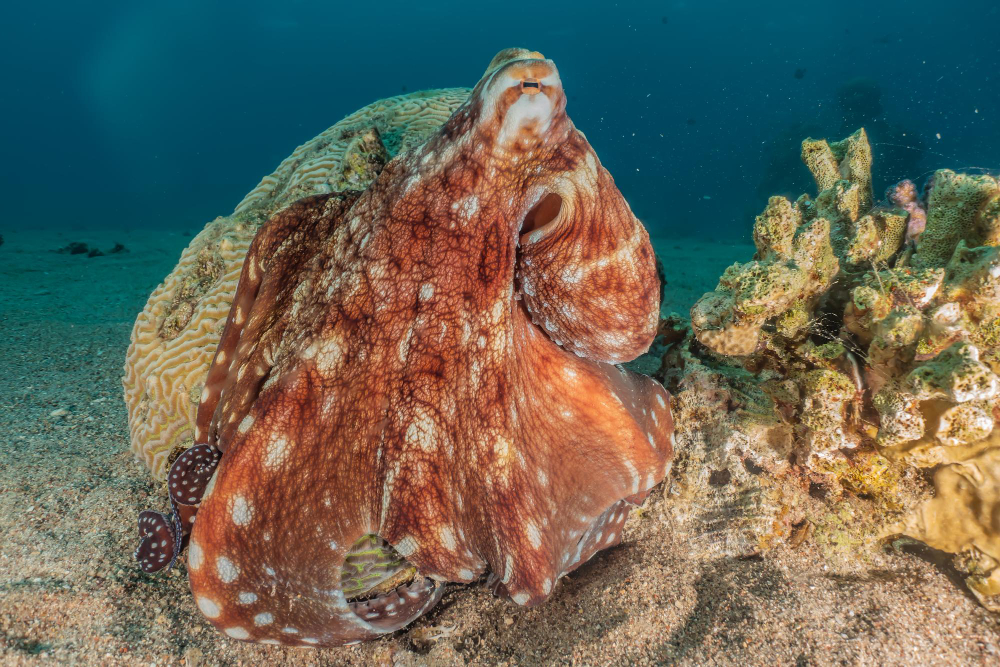
The behavioural evidence indicates substantial local autonomy.
An arm can perform coordinated reaching, grasping and retrieving movements without instruction from the central brain, generating the sequence locally in response to what it encounters.
Suckers respond individually to what they touch, gripping or releasing according to local information, without any central decision about each one.
Arms explore independently, moving into spaces and around obstacles, and the animal appears to receive results rather than to be directing each movement.
And a separated arm continues to respond to stimuli in ways that look purposeful for a period afterwards, which is unsettling to watch and is a direct consequence of the processing being located there.
The relationship is frequently described as the brain deciding what and the arms deciding how, which is a simplification and is broadly the shape of it.
The Problem This Creates
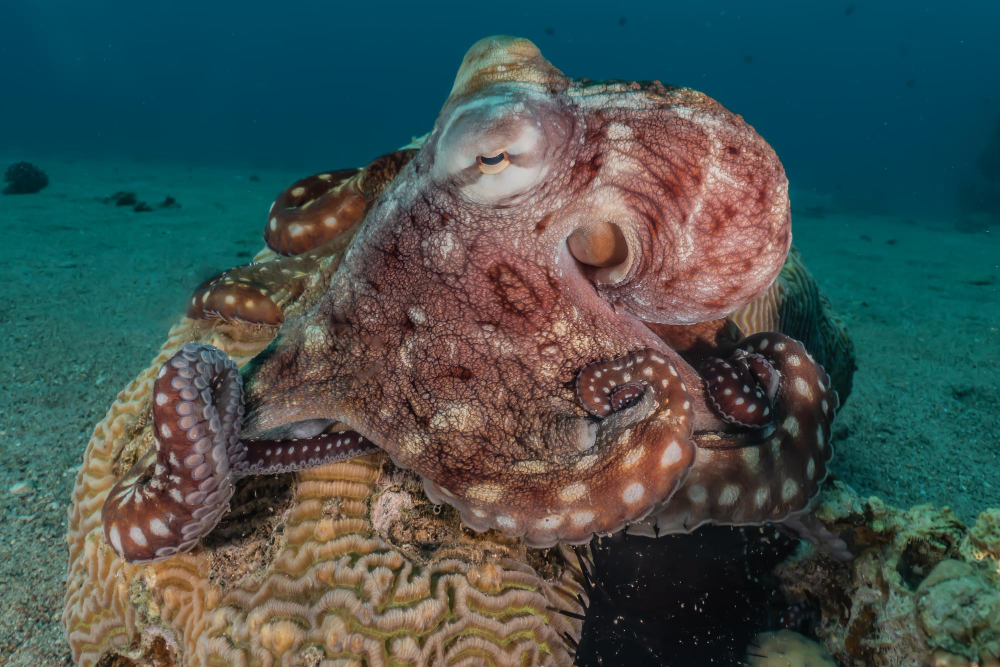
If the arms are doing that much, an obvious question follows about what the animal knows.
Evidence suggests the central brain does not receive detailed positional information about where each arm is. A vertebrate maintains a continuous internal model of its own body position; an octopus, with eight flexible limbs capable of bending anywhere, may not.
That would be a sensible economy. Tracking the exact configuration of eight arms with no joints would require enormous representational effort for limited benefit, and delegating the problem locally avoids it.
It also means the animal may not have a unified sense of its own body in the way a vertebrate does, which is truly difficult to think about and should be stated as a proposal rather than a finding.
There is a related puzzle about the skin. Octopuses change colour and texture with extraordinary precision for camouflage, and they appear to be colour-blind by the usual measures — which means the mechanism by which they match a background they may not see in colour is not established, with several proposals and no consensus.
It is worth noting how difficult these animals are to study. They are solitary, largely nocturnal, capable of escaping most enclosures, and short-lived, which limits sample sizes and long-term work substantially.
A great deal of what is known comes from a small number of species that tolerate laboratory conditions, which is a narrow base from which to generalise across a large and varied group.
What They Demonstrably Do
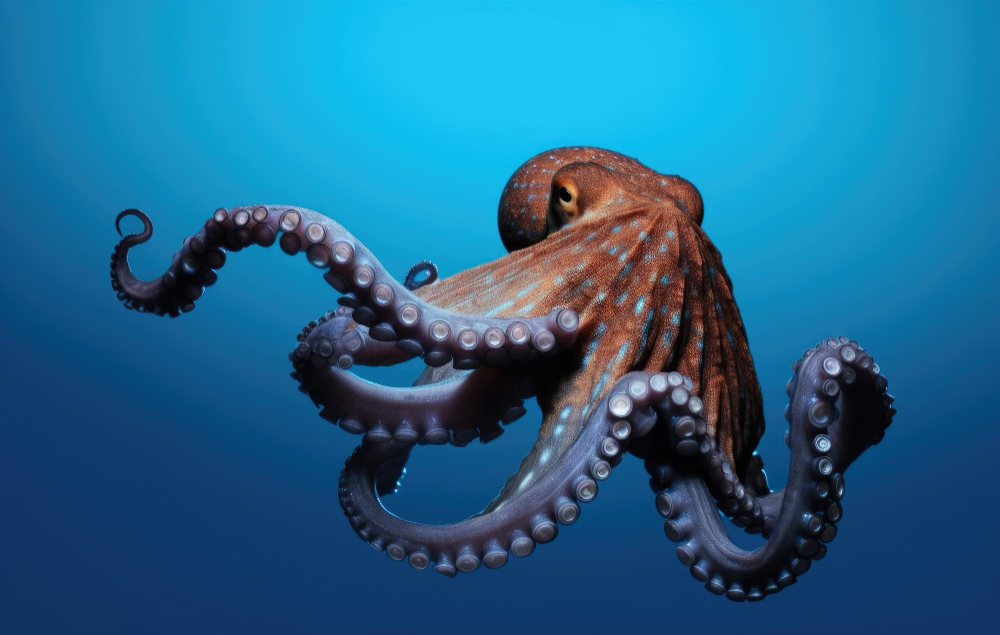
Setting aside the interpretive questions, a body of experimental work establishes specific capacities.
They solve problems requiring manipulation — opening containers, navigating mazes, retrieving food from enclosures — and improve with experience.
They use objects, including carrying materials to assemble shelter, which meets most definitions of tool use.
They discriminate between individual humans in laboratory settings and behave differently toward them, which indicates individual recognition.
They learn by observation in some reported studies, though this finding is contested and replication has been mixed.
And they show behavioural variation between individuals consistent enough that keepers describe distinct temperaments, which is anecdotal in form and consistent enough to be worth noting.
There is a constraint worth noting that shapes everything about these animals. They are short-lived, generally by a year or two, and most species reproduce once and do not survive long afterwards.
That is a curious combination with sophisticated cognition, since the usual expectation is that expensive nervous systems pay off over a long life. Whatever the payoff is here, it is being collected quickly.
Why It Evolved Separately
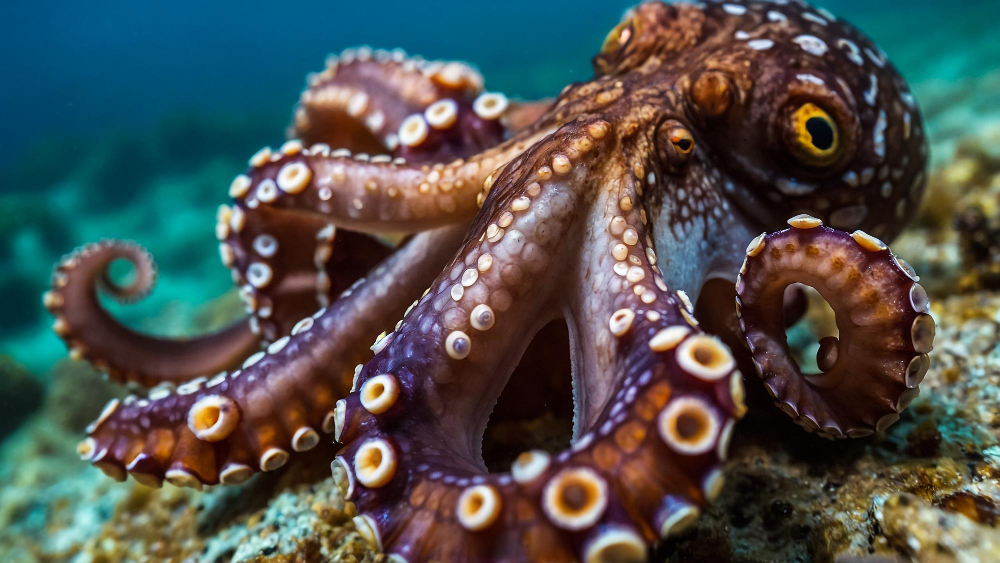
The evolutionary context is what makes the case significant beyond the animal itself.
The lineages leading to octopuses and to vertebrates diverged an extremely long time ago, at a point when the common ancestor had a nervous system of great simplicity.
That means every feature of cephalopod cognition developed independently. It is not a variation on a shared design; it is a separate solution reached from a very different starting point.
The proposed driver is the body. An animal with a soft body, no skeleton, extreme flexibility and no protective shell faces enormous control problems and enormous predation pressure, and both reward sophisticated behaviour.
Losing the ancestral shell is generally identified as the pivotal change — it removed protection, which required behavioural solutions, and it removed a constraint on movement, which made those solutions possible.
The Skin as a Display System
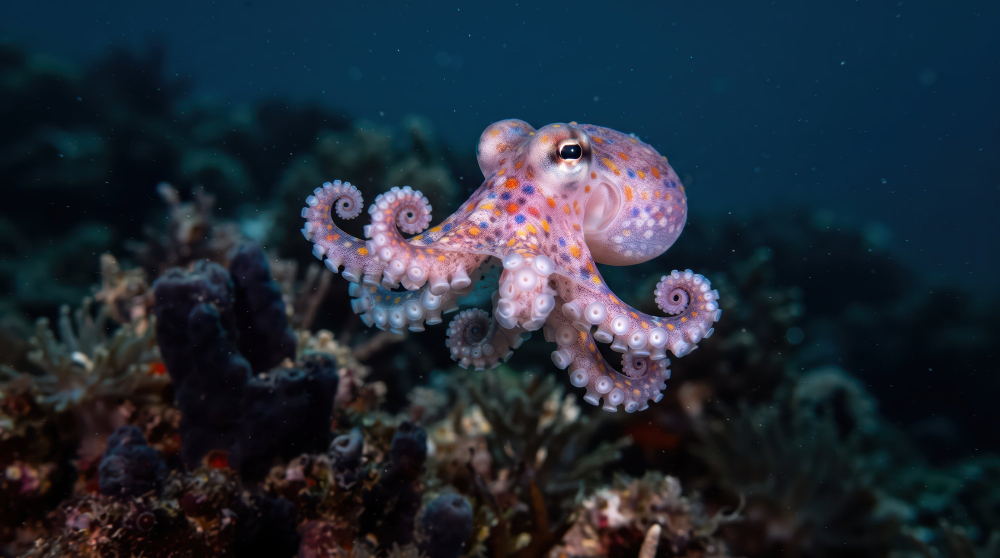
The colour-change apparatus deserves its own treatment, because it is arguably more remarkable than the neuron distribution and is less discussed.
The skin contains enormous numbers of pigment-containing cells, each surrounded by muscles that pull it open into a wide disc or allow it to contract into a point. Expanding and contracting these changes the colour of the surface directly.
Beneath them are reflecting layers that alter how light returns from the skin, contributing structural colour and iridescence on top of the pigment layer.
And separately from colour, the skin can change texture, raising and flattening projections to alter the physical surface from smooth to spiky.
All of that is under nervous control and operates in a fraction of a second, which makes it a display system with a refresh rate rather than a slow physiological change.
The unresolved part is how it is directed. If the animal cannot distinguish colours by the usual mechanism, the matching of a background must be achieved by some other route, and proposals include light-sensitive cells in the skin itself and inferring colour from the way the eye focuses different wavelengths differently.
Neither is established. What is established is that the animal produces accurate matches to backgrounds it apparently cannot see in colour, which is an unresolved problem rather than a settled fact dressed up as one.
What Should Not Be Concluded
Some limits belong here, because this subject attracts substantial overstatement.
The neuron distribution is established. The claim that each arm has an independent mind is not, and is a dramatisation of a finding about local processing.
Reports of escapes, mischief and problem-solving circulate widely, and a proportion are anecdotal, unreplicated or embellished. The laboratory findings are more modest and more reliable than the stories.
Inferring inner experience from behaviour is not something the evidence supports, in this animal or any other, and the question of what it is like to be one is not answerable by the methods available.
And these are short-lived animals with solitary habits, which is a poor match for the sociable, long-lived picture the popular framing sometimes suggests.
What the evidence truly supports is narrower and more interesting: that a sophisticated nervous system evolved twice, from a very simple common starting point, and that the second attempt distributed most of it into the limbs — which demonstrates that the vertebrate arrangement is one answer rather than the answer.
Like our content? Follow us for more.