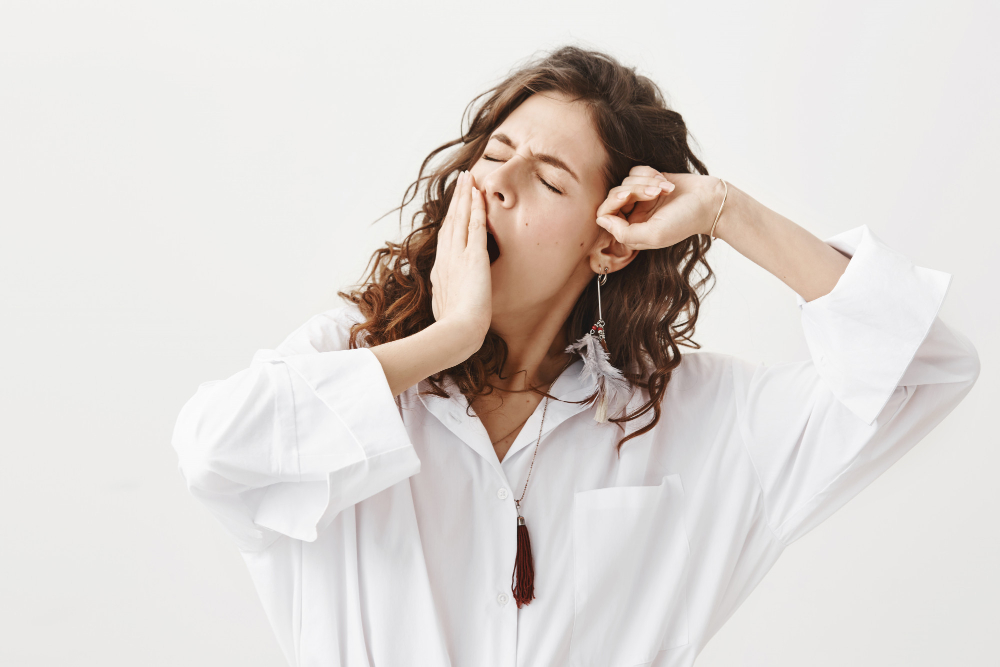
There is a class of behaviour that everybody performs, everybody recognises, nobody controls and nobody can explain, and yawning is the most conspicuous member of it.
It occurs in essentially every vertebrate group examined. It appears in human foetuses well before birth, which rules out anything learned. It is involuntary in the sense that suppressing it is possible and unpleasant and producing one on demand is difficult.
And the explanation almost everybody offers is wrong, which is unusual for a fact so widely repeated.
Here is what the evidence supports, what it rules out, and where it stops.
The Oxygen Account and Why It Failed

The standard explanation holds that yawning is triggered by a shortage of oxygen or an excess of carbon dioxide, and serves to correct it with a large breath.
It is intuitive, it has been repeated for a very long time, and it was tested directly.
Participants breathing air with reduced oxygen content did not yawn more. Participants breathing air enriched with oxygen did not yawn less. Increasing carbon dioxide increased breathing rate, as expected, without increasing yawning.
Those results separate yawning from respiration fairly conclusively. Whatever triggers a yawn, it is not the thing that triggers a deeper breath, because the manipulations that reliably affect breathing do not affect yawning at all.
The account survives in popular understanding because it is plausible and because nothing has replaced it with equal simplicity.
Like our content? Follow us for more.
What Actually Correlates
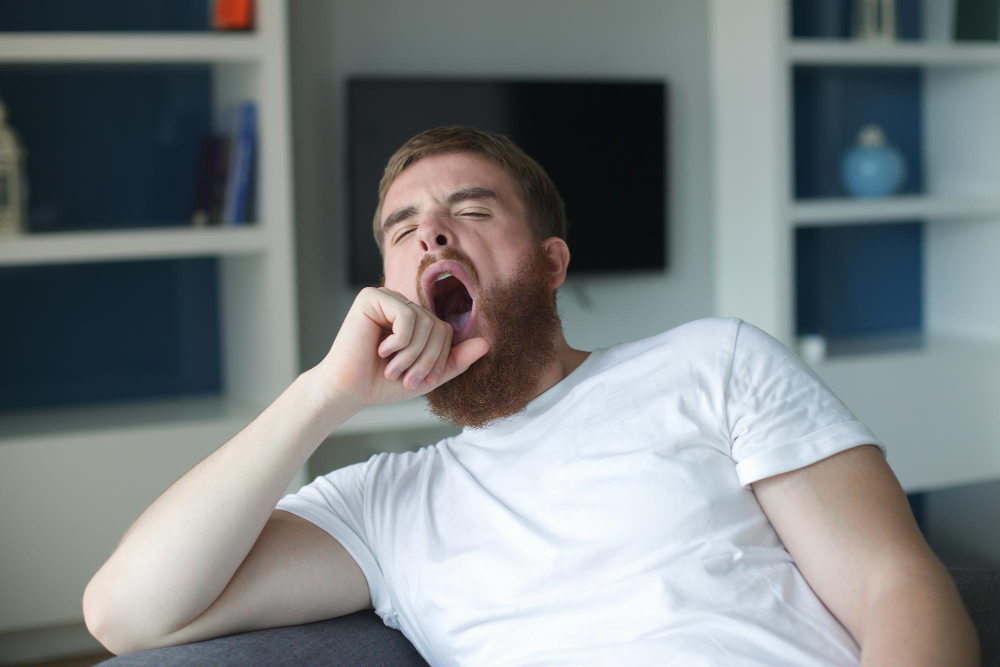
Several associations are reasonably well established, and they point in a different direction.
Yawning clusters around transitions in state — before sleep and after waking, before and after periods of activity, at the boundaries between one mode of alertness and another.
It is associated with boredom and with sustained low-stimulation attention, and also with anticipation of demanding activity, which is a combination that any explanation has to accommodate.
It correlates with body temperature in several studies, with reported effects varying by ambient temperature in ways that support a thermal proposal.
And it appears in situations of mild stress or anxiety in humans and in comparable contexts in other species.
Those are correlations rather than mechanisms, and the pattern common to them is a change of state rather than any particular state.
The Leading Proposals

Several explanations are argued and none is established.
The brain-cooling account proposes that the deep inhalation and the stretching of the jaw increase blood flow and heat exchange in a way that lowers brain temperature slightly. It fits the temperature correlations and the transition timing, and the magnitude of any cooling effect is disputed.
The arousal account holds that yawning accompanies a shift in alertness — a physiological adjustment marking a transition rather than correcting a deficit. It fits the clustering around state changes and explains why yawning occurs both when tired and when anticipating exertion.
The communicative account treats it as a signal, on the reasoning that a behaviour this visible, this contagious and this widespread across social species is likely doing something socially whether or not it also does something physiologically.
These are not mutually exclusive, and the current position is probably that a physiological behaviour acquired a social function, which is a common pattern.
What Yawning Is Physically
A yawn is a stereotyped sequence rather than a single action – a long inhalation with the jaw opening progressively wide, a brief peak and a shorter exhalation, consistent between individuals and across occasions, lasting around five or six seconds.
The jaw opens further than in almost any other ordinary behaviour, facial muscles contract, the eyes frequently narrow and tear production increases in many people. Blood flow to the head changes during the sequence, which is the observation the cooling account rests on.
That fixed form is itself informative. A behaviour with a stereotyped shape and duration, present before birth and shared across vertebrates, looks built in rather than assembled – which makes the absence of an agreed function more striking rather than less.
The Contagion Is the Solid Finding

If the function is unclear, the transmission is not, and it is the best-documented part of the subject.
Seeing somebody yawn increases the likelihood of yawning, and so does hearing one, reading about one or thinking about one — as a proportion of people reading this paragraph are currently demonstrating.
The effect strengthens with social closeness. Contagion is strongest between family members, then friends, then acquaintances, then strangers, and the gradient has been replicated.
It develops with age. Young children yawn spontaneously but show little contagious response, which appears in most children around the age of four or five.
It occurs between species, with dogs shown to yawn in response to human yawns, more strongly in response to familiar humans.
And it is reduced in conditions affecting social processing, which is one of the observations supporting a link to whatever underlies emotional resonance between individuals.
What the Contagion Might Mean

The social gradient is the finding that constrains explanations, because it is difficult to account for physiologically.
If yawning were purely a bodily adjustment, there would be no reason for seeing another person do it to trigger it, and certainly no reason for the effect to depend on how well you know them.
The proposal generally offered is that the contagion reflects a general capacity for automatic behavioural matching between individuals, which appears in posture, expression and speech patterns as well, and which is stronger between people who are socially closer.
On that account, contagious yawning is not a separate mechanism but one visible instance of something happening constantly and invisibly.
There is also a group-synchronisation proposal, holding that spreading a state-change signal through a group coordinates activity and rest — plausible, difficult to test, and not established.
There is one further complication for the communicative account. If yawning signals something, the signal is unusually ambiguous – it accompanies tiredness, boredom, anticipation and mild stress, which are not obviously one message.
A signal that means several different things depending on context is possible and is harder to demonstrate than one with a single meaning.
Why It Stays Unresolved

The obstacles are practical and explain the lack of progress.
Yawning cannot be reliably induced except by contagion, which is precisely the thing under investigation, so most experimental designs are circular in some respect.
It cannot be prevented without introducing a confound, since asking somebody to suppress a yawn changes their state.
The behaviour is brief, spontaneous and unpredictable, which makes it hard to catch under measurement.
And the proposed functions are subtle enough that detecting them requires precision the available methods do not have — a small change in brain temperature is difficult to measure in an intact person.
None of that is unusual for a common involuntary behaviour, and it is why several of them remain unexplained.
The mechanics are worth describing, because they are more elaborate than the impression of simply opening the mouth.
A yawn is a stereotyped sequence rather than a single action. There is a long inhalation with the jaw opening progressively wide, a brief peak, and then a shorter exhalation, and the pattern is remarkably consistent between individuals and across occasions.
The jaw opens further than in almost any other ordinary behaviour, which stretches the muscles and joints substantially and is part of why suppressing one is uncomfortable.
Facial muscles contract, the eyes frequently close or narrow, and tear production increases in many people — which is why yawning sometimes produces watering eyes.
Blood flow to the head changes during the sequence, which is the observation the cooling account is built on.
The duration is fairly fixed at around five to six seconds in humans, and attempts to cut one short generally leave a sense of incompleteness that prompts another.
That stereotypy is itself informative. A behaviour with a fixed form and a fixed duration, present before birth and shared across vertebrates, has the signature of something built in rather than assembled from parts — which makes the absence of an agreed function more striking rather than less.
An Ordinary Mystery
There is something worth appreciating in a behaviour this available remaining unaccounted for.
It requires no equipment to observe. It happens to everybody, several times a day, in public, and has done throughout recorded history. It appears in animals that can be studied under controlled conditions.
And the confident explanation everybody carries is demonstrably wrong, while the alternatives are proposals rather than answers.
That combination is not rare. A considerable number of ordinary bodily behaviours are in the same position, which suggests the accessible questions are not always the tractable ones — and that a phenomenon being universal, visible and frequent does not make it easy to explain.
Meanwhile the reliable finding remains the socially useless one: that reading several hundred words about yawning makes people yawn, which nobody disputes and nobody can fully account for either.
Like our content? Follow us for more.