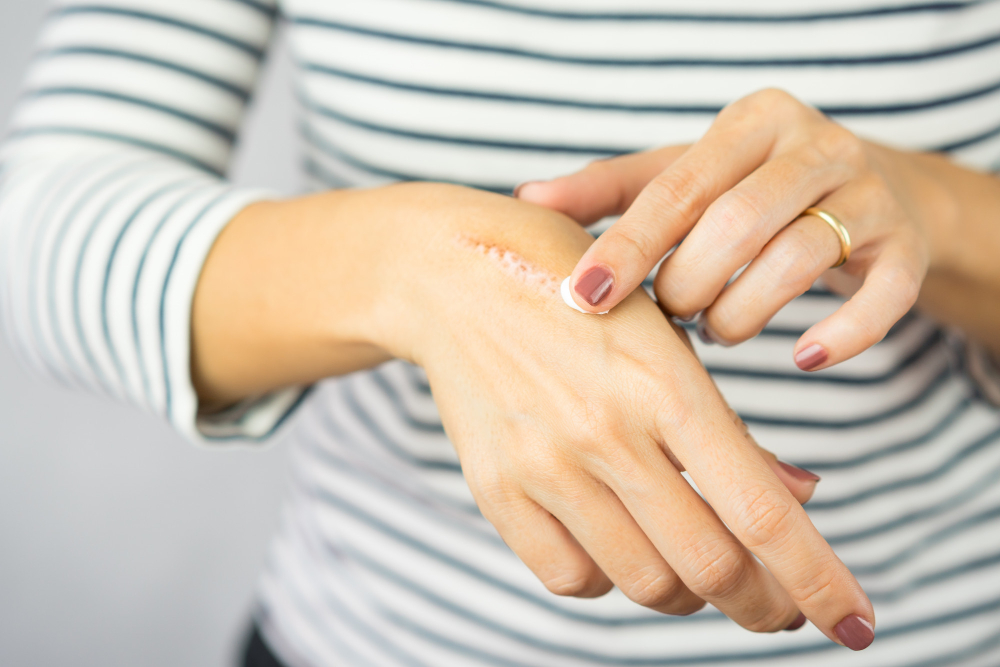
A scar is usually read as a failure: the body tried to put the skin back and did not quite manage it. That is not what happened. Scarring is the outcome of a deliberate trade, and once you know what was traded away, every odd property of a scar follows – why it has no hair, why it does not sweat, why it is a different colour, why it stays paler than the skin around it and why it never quite reaches the strength of what it replaced.
Normal Skin Is a Structured Weave
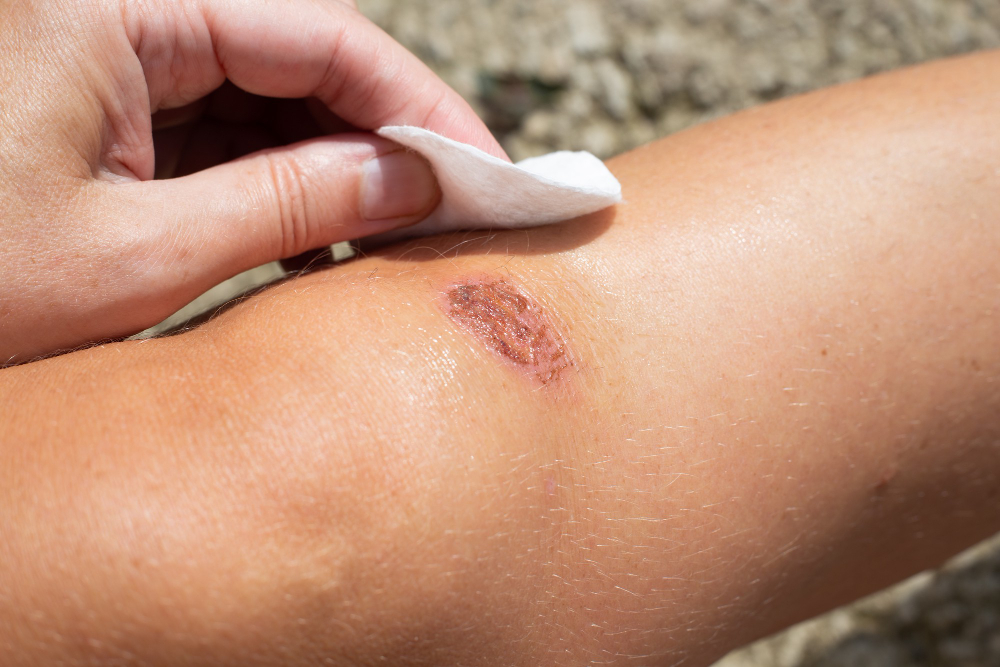
To see why a scar is different, look at what it is replacing.
The bulk of skin’s strength comes from the dermis, the layer beneath the surface, and the dermis is largely collagen. The important thing is not that the collagen is there but how it is arranged: in healthy skin it forms a basket-weave, fibres running in many directions and interlacing, which is what allows skin to be pulled in any direction and spring back.
Embedded in that weave is everything else that makes skin skin. Hair follicles. Sweat glands. Oil glands. Pigment-producing cells at the base of the surface layer. Nerve endings. Blood vessels. Elastic fibres, a separate protein from collagen, which give skin its recoil.
All of that is the product of development, assembled over months in the womb and refined afterwards, and the instructions for building it from scratch are not available to an adult wound. That is the constraint the whole process runs into.
Like our content? Follow us for more.
Shallow Injuries Heal Properly. Deep Ones Cannot
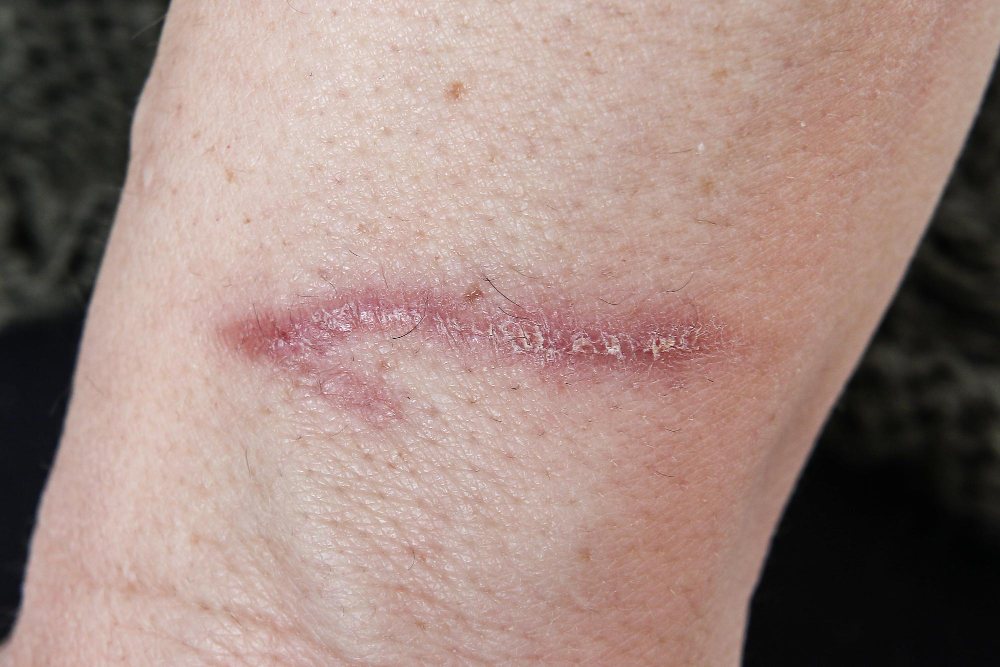
The dividing line is the depth of the injury relative to the dermis, and it explains a great deal.
A graze that removes only the outer layer heals perfectly, because the outer layer is designed to renew itself continuously and the cells to do it are still present in the follicles and glands beneath. There is no scar because nothing structural was lost.
Once the injury goes into the dermis, that changes. The follicles and glands in the damaged patch are destroyed, and an adult has no mechanism for building new ones. Whatever fills the gap will not contain them, because there is nothing left to grow from.
This is why a deep scar is hairless, does not sweat and does not produce oil, and why a large burn scar leaves someone unable to sweat across that area – which for extensive burns is a real problem, since it removes part of their cooling system. It is not that the scar tissue is faulty. Those structures were never rebuilt.
What the Body Does Instead
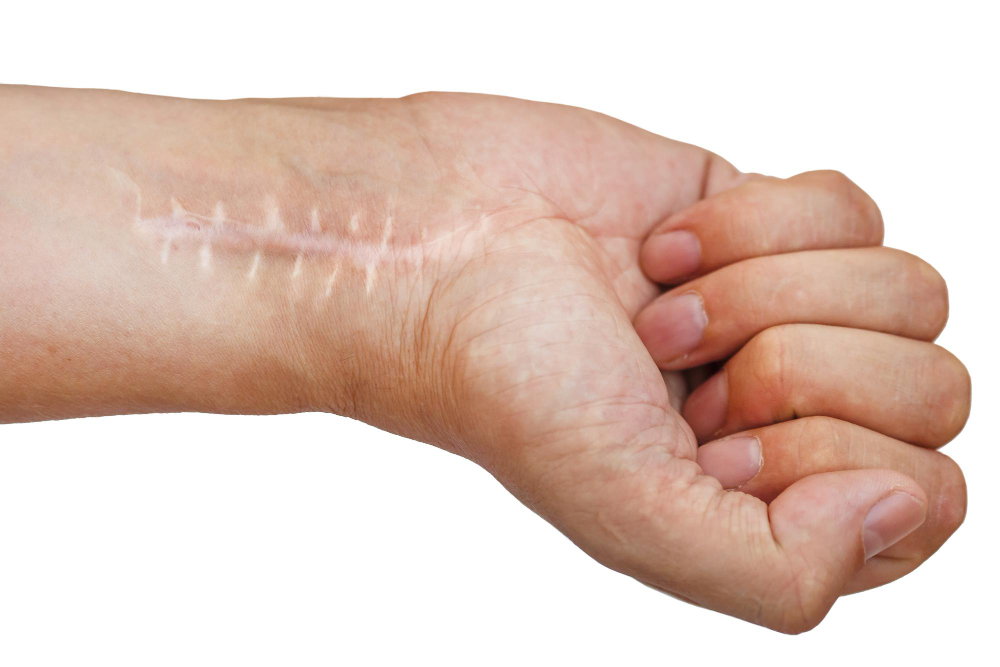
The repair runs in overlapping stages, and each has a job.
Bleeding stops first, through clotting, which also produces a temporary scaffold of fibrin across the gap. Inflammation follows: cells arrive to clear debris and bacteria, which is why a fresh wound is red, warm and swollen, and why that phase is a normal part of healing rather than a sign of trouble.
Then fibroblasts move in, and they are the cells that make a scar. They multiply in the wound and begin producing collagen as quickly as they can. Simultaneously, new blood vessels grow into the area, so the developing tissue is unusually well supplied and appears bright red. Some fibroblasts acquire the ability to contract, and they pull the wound edges together, which reduces the area that has to be filled.
The collagen they lay down is the point. It is deposited fast and it is deposited badly. Instead of a basket-weave, the fibres run largely parallel, aligned along the lines of tension in the wound. It is also a different mix of collagen types initially, and it is denser than normal dermis.
Then comes remodelling, which takes months to years. The excess vessels regress, which is why a scar fades from red to pale. The collagen is partly reorganised and cross-linked, and the tissue becomes stronger and flatter. But it is reorganisation within the parallel arrangement, not a conversion back to a weave. A mature scar is a permanently different material.
Why Everything About a Scar Follows From the Arrangement
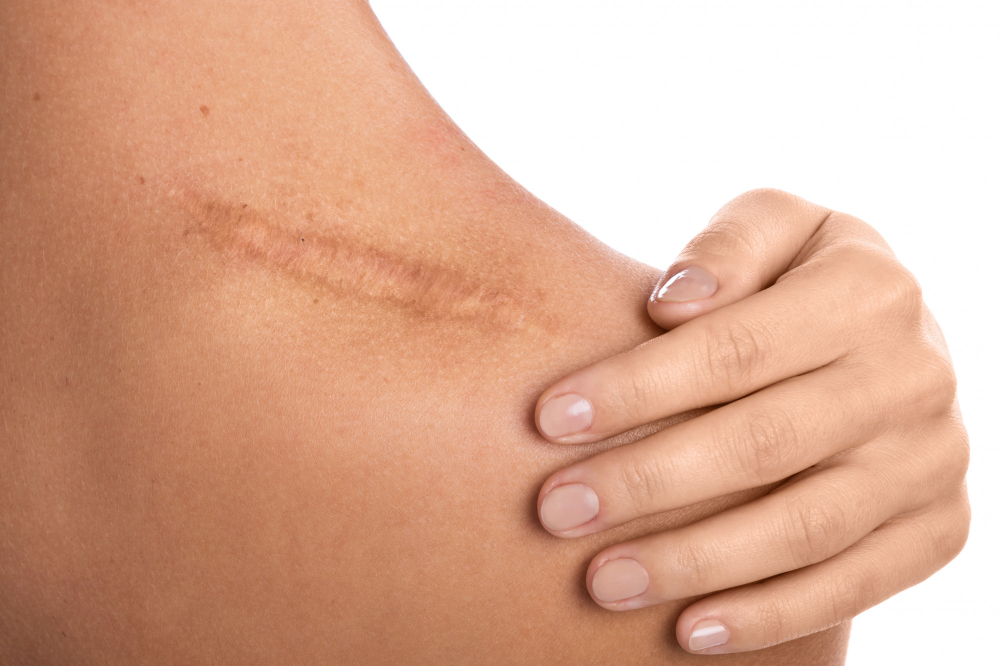
Almost every familiar property of scars is explained by parallel collagen and missing structures.
Scars are paler because the pigment-producing cells were lost and are not replaced in the same density. On skin of any colour a scar tends to end up a different shade from its surroundings, and on darker skin it can end up darker rather than lighter, depending on how the pigment cells at the margins behave.
Scars do not tan, for the same reason.
Scars are less flexible, because parallel fibres resist stretch in one direction while normal skin’s weave allows it in all of them, and because elastic fibres are barely regenerated.
Scar tissue is weaker. Healed skin typically recovers something in the region of seventy to eighty per cent of the original tensile strength and does not reach the original figure. The weave was stronger than the bundle.
A scar is often shiny, because the surface layer over it is thinner and flatter, lacking the normal fine texture that the underlying structures create.
And sensation is usually altered, sometimes reduced and sometimes uncomfortably heightened, because nerve endings regrow into the area incompletely and imprecisely.
The Repair Can Overshoot
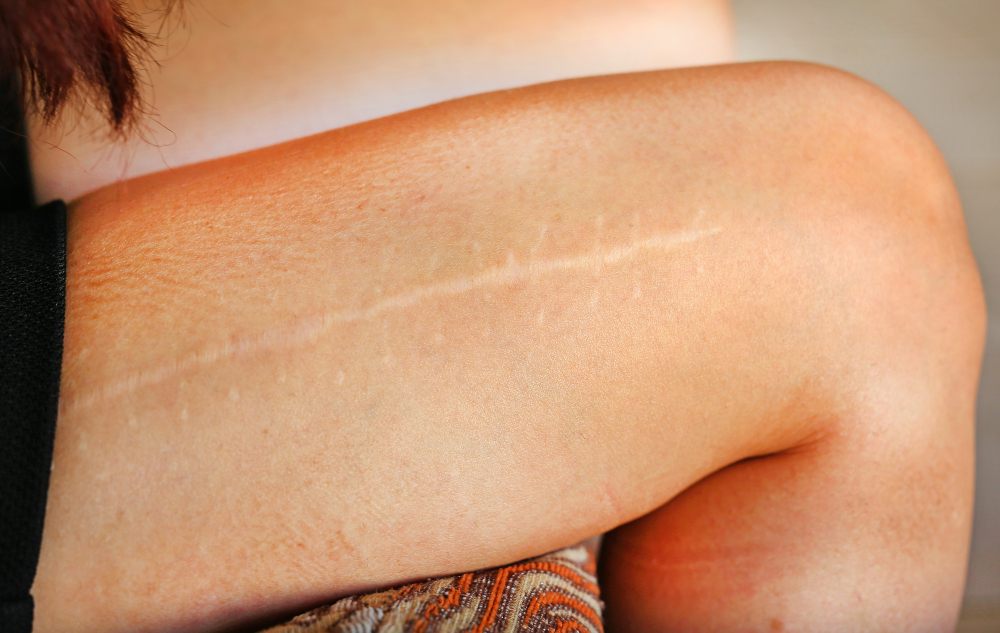
Since a scar is the product of cells producing collagen under signals telling them to fill a gap, the obvious failure mode is the signal not switching off.
A hypertrophic scar is raised and thickened but stays within the original wound boundary, and it often improves gradually over a year or two. A keloid goes further: the growth continues past the edges of the original injury, spreading into skin that was never damaged, and it does not tend to resolve on its own. Keloids run in families, are far more common on some skin types than others, and favour particular sites such as the chest, shoulders and earlobes.
At the other extreme, prolonged tension across a healing wound produces a stretched, widened scar, because the contracting and depositing tissue is being pulled apart while it sets. This is why scars across joints, or anywhere skin moves a great deal, tend to be broader, and why the direction of a cut relative to the natural tension lines in the skin makes a large difference to how the eventual scar looks. Surgeons plan incisions around those lines for exactly this reason.
How any individual scar turns out is a clinical matter and varies enormously between people and sites; anything about a specific scar belongs with a doctor rather than an article.
Some Animals Do Not Scar, and Neither Do Foetuses
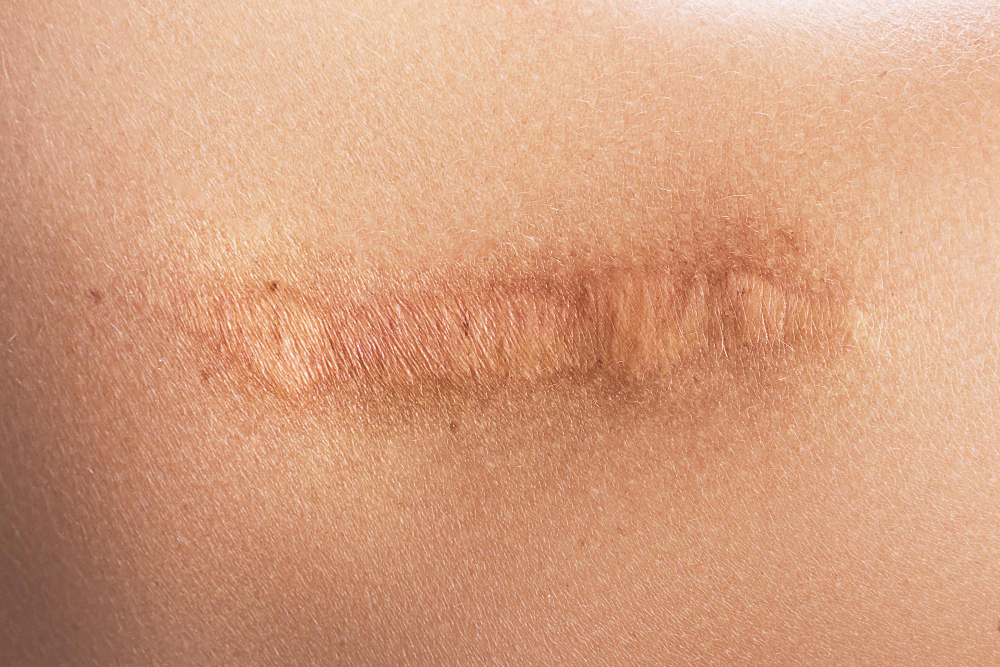
The most interesting thing about scarring is that it is not the only option available to living tissue.
A salamander can regrow an entire limb, complete with bone, muscle, nerve and properly organised skin, and the regrown limb is not a scarred approximation. Some fish and amphibians regenerate rather than repair as a matter of course. Even among mammals, the African spiny mouse can lose and regrow substantial patches of skin including hair follicles.
And mammalian foetuses, humans included, heal skin wounds in early development without scarring at all, producing normally organised dermis. The capability is somewhere in the mammalian repertoire. It is switched off, or overridden, at some point before birth.
Why is the open question, and the usual answer is speed and infection. A regenerating limb takes weeks to months and the site is vulnerable throughout. For a large warm-blooded animal in a world full of bacteria, an open wound is a much more immediate threat than a stiff patch of skin, so a mechanism that closes the gap in days and accepts a permanent imperfection outcompetes one that rebuilds it properly over months. Rapid closure is also thought to trade against cancer risk, since tissue with strong regenerative capacity has to keep tight control over cell proliferation.
This is the reason to read a scar as a decision rather than a shortcoming. The body is not failing to rebuild your skin. It is declining to, on terms that have worked out well for a very long time.
A Patch, Not a Repair
So the next time you look at an old scar, the useful way to see it is as a record of a trade made in the first few days after the injury.
Something went through the dermis. The follicles and glands in that patch were destroyed with no way of replacing them. Cells arrived and laid down collagen as fast as they could manage, in the wrong arrangement, because the arrangement was not the priority. The gap closed in days rather than months. Then years of slow reorganisation flattened and faded it into what you have now.
It is pale, hairless, dry, slightly stiff, a bit weaker than the skin around it, and permanent. Every one of those is the cost of having the wound shut quickly. It is, in that sense, not a mark of damage. It is a receipt for a repair that prioritised the right thing.
Like our content? Follow us for more.