

Breathe Out as Hard as You Can
Do it now. Force everything out, then force a bit more, then hold it. There is still air in there, and there is more than you would guess: roughly a litre and a bit in an average adult, which is somewhere around a quarter of the volume you can actually move.
That remainder has a name and it cannot be removed by any effort. No breathing technique, no amount of squeezing and no position gets rid of it, because the chest wall will not compress any further and the lungs are held open by their attachment to it.
This is not a design flaw or a limitation. It is essential. A lung that emptied completely would stick to itself, and the surfaces inside are so thin and so wet that the sticking would be very hard to undo. Reinflating a fully collapsed lung from the inside is enormously difficult, which is why it is a serious medical problem when it happens rather than a routine occurrence.
So your lungs are permanently part inflated, you have never seen the inside of them empty, and the air in them right now includes air you have been carrying around since before you can remember.
Like our content? Follow us for more.
Which Means You Never Breathe Fresh Air
Follow the consequence through. Because a substantial volume stays behind, every breath you take in mixes with the stale air already there rather than replacing it.
The volume of an ordinary quiet breath is around half a litre, and roughly a third of that never reaches the part of the lung where gas exchange happens at all. It fills the windpipe and the larger airways, which have thick walls and no blood supply arranged for exchange, and it simply sits there and comes back out again.
That portion is called dead space and it is pure overhead. What actually arrives in the exchanging regions is a few hundred millilitres of fresh air being added to a couple of litres of air that is already partly used.
The practical consequence is counter-intuitive and important. The composition of the air deep in your lungs is remarkably stable, and it is nothing like the composition of the atmosphere. It is warmed to body temperature, saturated with water, depleted of oxygen and enriched with carbon dioxide, and it stays within a narrow band through every breath.
That stability is the point. Blood arriving at the lungs meets a buffered reservoir rather than the outside world, which means your body chemistry does not swing with each inhalation. The dead space and the residual volume, which both look like inefficiencies, are what make breathing smooth.
The Urge to Breathe Is a Carbon Dioxide Alarm
Hold your breath and the sensation that eventually becomes unbearable feels unmistakably like running out of air. It is not.
The body’s primary respiratory drive comes from sensors monitoring carbon dioxide, mostly indirectly through the acidity it produces, and those sensors are extremely sensitive. A small rise in carbon dioxide produces a powerful and rapidly escalating urge to breathe.
There are oxygen sensors as well, in the arteries, and they do contribute. But they are comparatively insensitive and they only begin to drive breathing hard once oxygen has fallen a long way. Under ordinary circumstances they are not what is shouting at you.
The demonstration is straightforward and is why this matters. If a person breathes rapidly for a short period beforehand, they wash out carbon dioxide and can then hold their breath considerably longer, because the alarm takes longer to reach threshold. Oxygen has not been increased by any meaningful amount; only the warning has been delayed.
And that is exactly why it is dangerous, which is the one practical point in this piece and the reason the technique is specifically warned against before swimming or diving. Removing the alarm does not remove the problem. A person can reach the point of losing consciousness from low oxygen without ever experiencing the urgent need to breathe that would otherwise have made them surface. Nothing here should be read as a description of how to do it.
The Surface Area Is Absurd
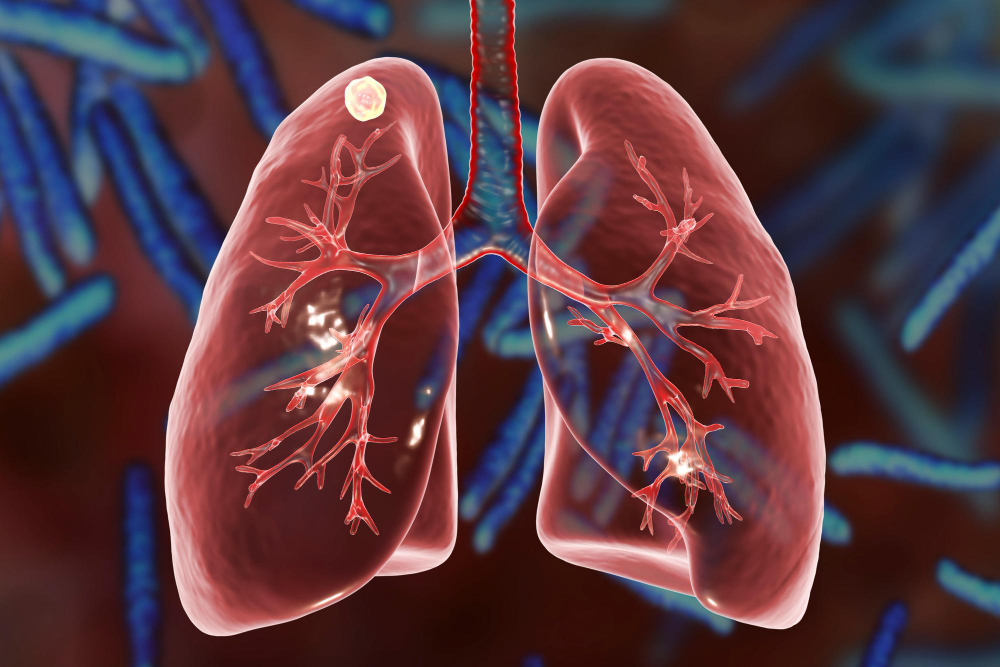
The exchanging part of the lung is not a bag. It is a branching tree ending in several hundred million tiny thin-walled sacs, and the reason for that arrangement is surface area.
Gas exchange happens by diffusion across a membrane, and the amount that can cross is proportional to the area available. A simple pair of bags of the same volume would offer a few hundredths of a square metre. The actual arrangement offers somewhere in the region of seventy square metres, packed into a space you can cover with your hands.
The airways branch roughly twenty-three times from the windpipe to the smallest sacs, with each generation smaller than the last, and the total cross-sectional area increases enormously as it divides. Which means air moves fast in the windpipe and extremely slowly in the small airways, so slowly that in the final generations it essentially stops flowing and the remaining movement is diffusion alone.
The barrier itself is startling. At the point where air meets blood, the separation is well under a thousandth of a millimetre, which is thinner than a single red blood cell is wide. It is the thinnest sheet of tissue the body maintains, and it has to be, because a thicker one would not pass enough gas.
It is also why lungs are so vulnerable. A structure built from several hundred million fragile sacs and a membrane that thin, held permanently open and continuously exposed to everything in the air, is the most exposed internal surface the body has by a very wide margin.
Why They Do Not Stick Together
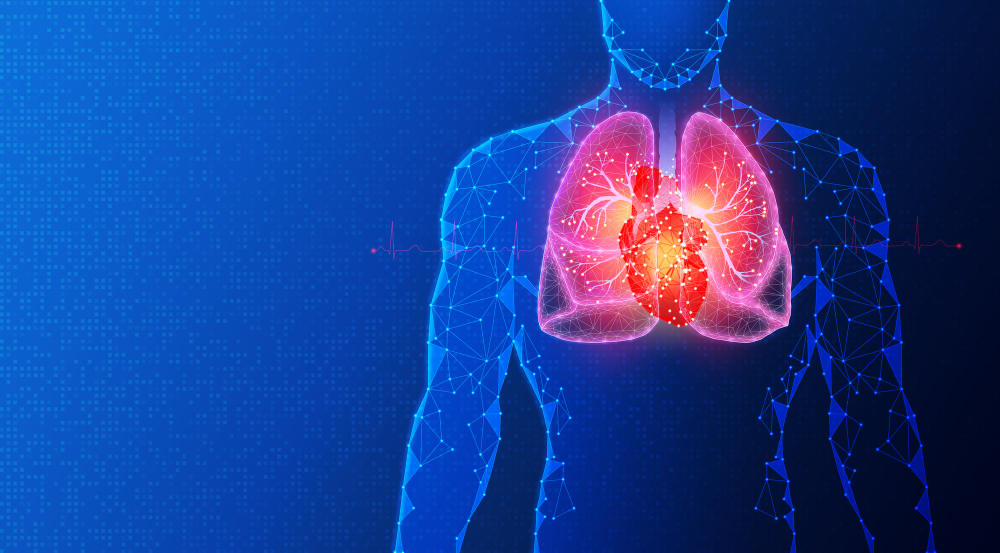
A thin wet surface folded against itself sticks, through surface tension. That is why wet paper is difficult to separate and why a wet glass is hard to lift off a wet counter.
Several hundred million tiny wet sacs ought therefore to collapse and stick shut, and the smallest ones ought to be the worst affected, because surface tension pulls harder in a smaller curve. Left alone, the small sacs would empty into the large ones and the lung would reduce to a few big bubbles with almost no surface area.
That does not happen because of a substance secreted onto the inner surface by specialised cells. It is a mixture of fats and proteins and it works by getting between the water molecules and reducing the surface tension.
The clever part is that it does so unevenly in exactly the right way. When a sac is small the substance is concentrated and reduces the tension a great deal; when a sac is stretched the substance is spread thin and reduces it less. So the small sacs are protected more than the large ones, which cancels the instability and keeps the whole population open at a range of sizes.
It is one of the most elegant pieces of chemistry in the body, and its absence is the central problem in the lungs of a baby born very prematurely, because the substance is one of the last things to be produced before birth.
The Two Lungs Are Not the Same
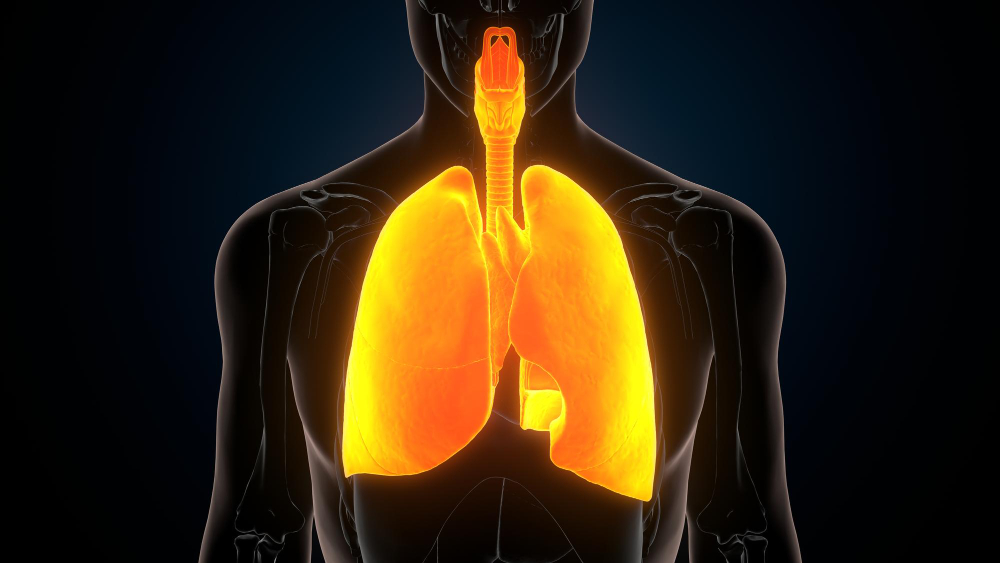
They look like a symmetrical pair and they are not, and the reason is simply that something else needed the space.
The heart sits slightly to the left, so the left lung is smaller and carries a distinct notch in its front edge where the heart presses against it. It has two lobes. The right lung has three, is wider and shorter, and holds a larger share of the total volume.
The airways are asymmetrical to match. The passage to the right lung leaves the windpipe at a shallower angle and is slightly wider, which has a consequence that is well known in clinical practice: anything inhaled accidentally is considerably more likely to end up in the right lung than the left, for purely geometric reasons.
And the whole assembly is not attached to the chest in the way most people imagine. The lungs have no muscle of their own and cannot inflate themselves. They are held against the inside of the chest by a film of fluid and by the pressure difference across two thin membranes, one lining the chest and one covering the lung, which slide against each other as the chest moves. The chest expands, the lungs are pulled open with it, and air follows.
Which means breathing is done entirely by muscles that are not in the lungs: principally the diaphragm beneath them, with the rib muscles assisting. The lungs are passive. They are bellows operated from outside.
You Lose Weight Through Your Lungs
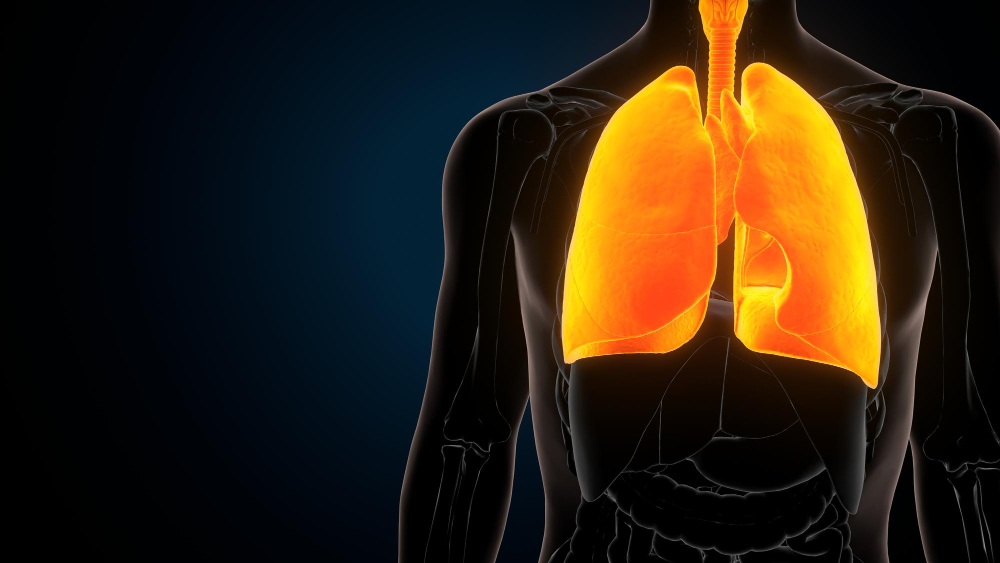
Here is the consequence of all this that surprises people most. When fat is used for energy, its carbon and hydrogen have to leave the body, and the overwhelming majority of the carbon leaves as carbon dioxide, which leaves through the lungs.
So the mass of a person who loses weight departs mostly as exhaled gas, with the rest as water. It does not go anywhere else and it is not converted into anything. Breathing out is the principal route by which body mass exits.
The same arithmetic applies to everything you eat that is burnt for energy, which is why the carbon in a meal and the carbon in a breath are the two ends of the same process. A person at rest exhales a few hundred grams of carbon dioxide a day and considerably more during exercise.
It also means the lungs are a water loss route. Exhaled air is saturated with water vapour at body temperature, and the volume involved over a day is substantial, which is why breathing dry air is dehydrating and why cold air produces visible breath.
None of which is normally thought of as a lung function. The organ everybody associates with taking oxygen in is also the body’s principal exhaust, its main route for shedding mass, and a significant source of water loss.
A Passive Organ Doing Several Jobs
So: you have never emptied your lungs and physically cannot, you never breathe fresh air because every breath mixes with what was already there, and the stability that creates is the reason your blood chemistry does not lurch with every inhalation.
The urge that forces you to breathe is an acidity alarm rather than an oxygen one, which is why it can be fooled and why fooling it is dangerous. The exchanging surface runs to tens of square metres behind a membrane thinner than a blood cell. A secreted mixture of fats and proteins is the only reason several hundred million wet sacs do not collapse into each other. The two lungs are different shapes because the heart needed the room. And the organ has no muscles at all, so every breath you have ever taken was done by something else pulling it open.
For an organ most people describe as a pair of bags for air, that is a considerable amount of machinery.
Like our content? Follow us for more.
