

Nothing in There Is Looking at the Bread
This is the fact that reorganises everything else. A domestic toaster contains no sensor pointed at the toast, no measurement of its colour, no thermometer in contact with it and no feedback of any kind from the thing it is cooking.
It is an open-loop device, which is engineering language for a machine that performs a fixed action and then stops, with no information about whether the action achieved anything. It is in the same category as an egg timer and a completely different category from an oven, a kettle or a thermostat, all of which measure something and respond.
Which means a toaster cannot make toast to a specified darkness. It can only run for a particular length of time, and the darkness that results depends on everything the toaster does not know: how thick the bread is, how stale it is, how much moisture it holds, whether it came out of a freezer, what it is made of and how much sugar is in it.
Every frustration anybody has ever had with a toaster follows from that. The appliance is being asked to deliver a result and is only capable of delivering a duration.
Like our content? Follow us for more.
The Dial Is Not a Darkness Setting
The numbers on the dial are commonly assumed to mean levels of brownness. They do not. In the great majority of toasters the dial adjusts how long the machine runs, and nothing else.
In the simplest mechanical designs it does this through a bimetallic strip: two metals bonded together that expand by different amounts when heated, so the strip bends. The strip sits inside the toaster where the elements warm it, and when it has bent far enough it trips a catch, releases the carriage and cuts the power. The dial adjusts how far the strip has to bend before that happens.
In electronic designs it charges a capacitor through a resistor and releases the carriage when the charge reaches a threshold, with the dial setting the resistance. That is a timer with no temperature involvement at all.
Either way, the setting is a duration. And the mechanical version has a consequence that explains the single most-complained-about behaviour of the entire appliance.
Why the Second Slice Is Darker
If the trigger is a strip of metal warmed by the elements, then its starting temperature matters enormously.
In a cold toaster the strip begins at room temperature and has to be warmed through its whole range before it bends far enough to trip. That takes a while, and the bread gets the benefit of all of it.
In a toaster that has just finished a cycle, the strip is already hot. It is already part-way bent. It therefore reaches the trip point much sooner, the carriage releases earlier, and the second slice gets less time than the first on exactly the same setting.
The effect runs the other way too, slightly: the toaster’s body and the reflective interior are also warm, so the bread is receiving heat from the structure as well as the elements. But the dominant effect is the shortened cycle, and the net result for most machines is that the second slice comes out darker than the first despite having less time, because the whole cavity is already up to temperature.
So the familiar sequence of a pale first slice followed by an over-browned second one is not the machine being badly made. It is the direct and predictable consequence of using the temperature of the appliance as a substitute for a clock, which was a cheap and ingenious thing to do and has this one irreducible side effect.
The Elements Are Doing It by Radiation
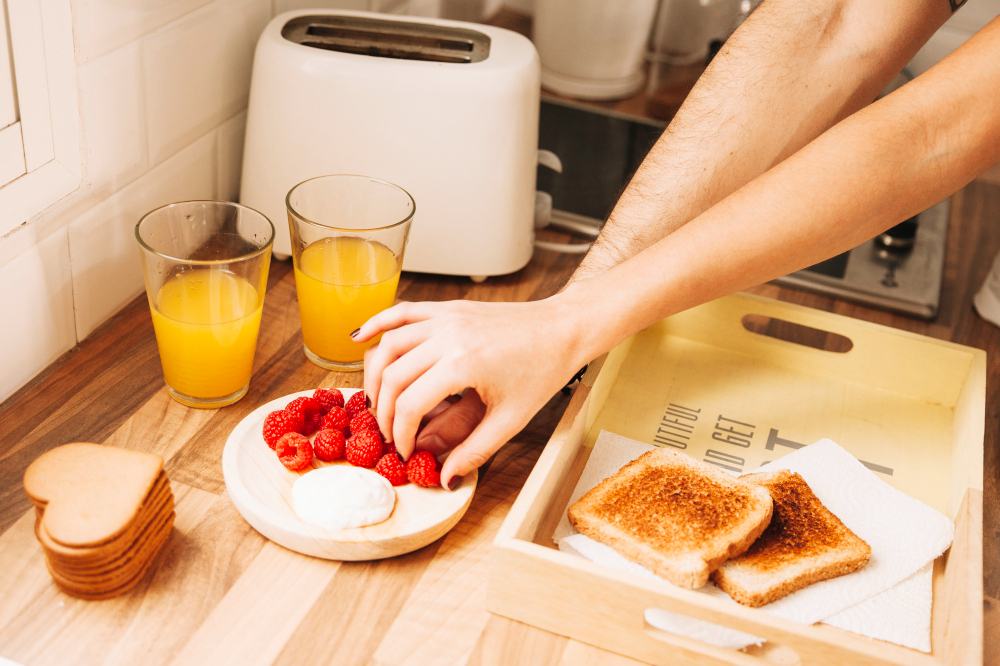
The glowing orange strips are a resistance alloy, typically a nickel and chromium mixture, chosen because it has high electrical resistance, tolerates repeated heating to red heat without oxidising away, and keeps its shape.
They are usually flat ribbons wound around a flat insulating former, which is a deliberate geometry. A ribbon presents a large flat surface facing the bread, and that matters because almost all of the heat transfer here is radiant.
This is the second thing that separates a toaster from an oven. An oven heats a volume of air and the food is warmed by that air and by the surfaces around it. A toaster barely heats the air at all. It points infrared radiation directly at the bread surface from a few millimetres away, which is why the outside toasts while the inside stays soft, and why the process is so fast.
The interior walls are bright and reflective for the same reason: to bounce radiation that missed back toward the bread rather than absorbing it. A toaster that had matt black interior walls would waste a large share of its output heating itself.
And it is why the slots are the shape they are. The gap between element and bread is small and fixed, because radiant intensity falls off with distance, and a slot that allowed the bread to lean would toast one face more than the other.
Toasting Is Two Processes, Not One
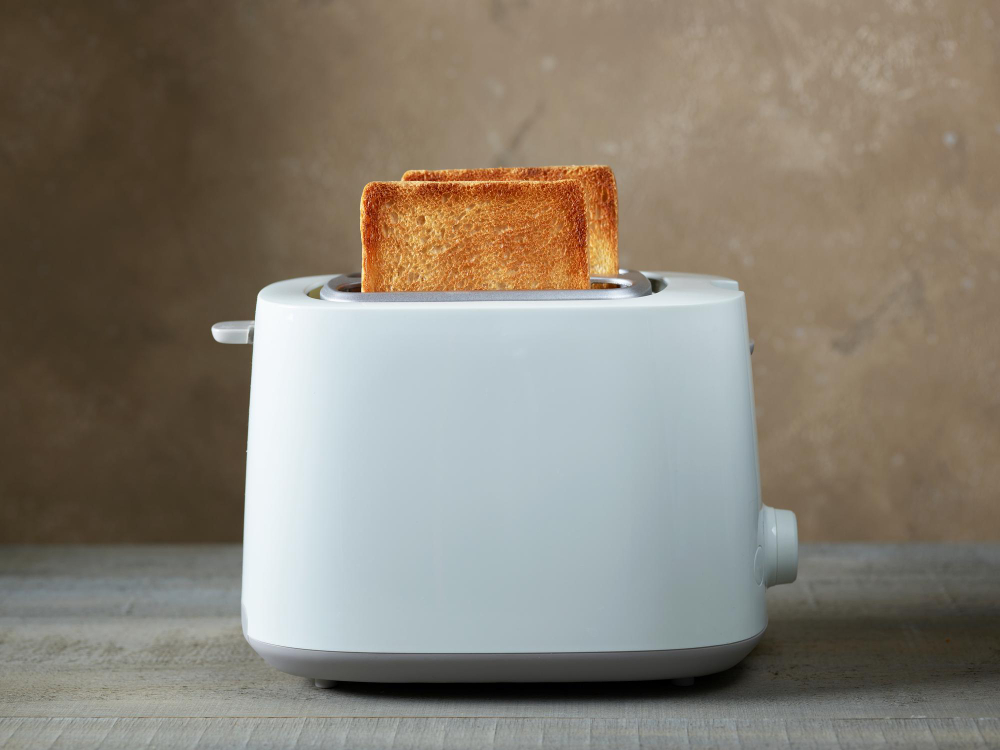
What happens to the bread is a sequence, and separating the two stages explains why timing is so unforgiving.
First, water leaves. The surface of the bread has to dry out, and while it is drying its temperature cannot rise much above the boiling point of water, because evaporation carries heat away as fast as it arrives. Nothing visible happens during this phase. The bread goes slightly stiff and stays pale.
Then, once the surface is dry, there is nothing to hold the temperature down and it climbs rapidly. At that point the browning reactions begin, between sugars and proteins in the bread, generating colour and a large number of new aromatic compounds. This is the stage that produces everything anybody wants from toast.
The trouble is that the first stage is slow and the second is fast. Most of the cycle is spent drying and the colour appears in the last fraction of it, which is why the difference between pale toast and burnt toast is a few seconds, and why staring at it does not help.
It also explains the behaviour of bread straight from a freezer, which has to lose a great deal more water before anything happens, and of stale bread, which has already lost some and therefore browns sooner than expected.
The Carriage Is Held by a Magnet
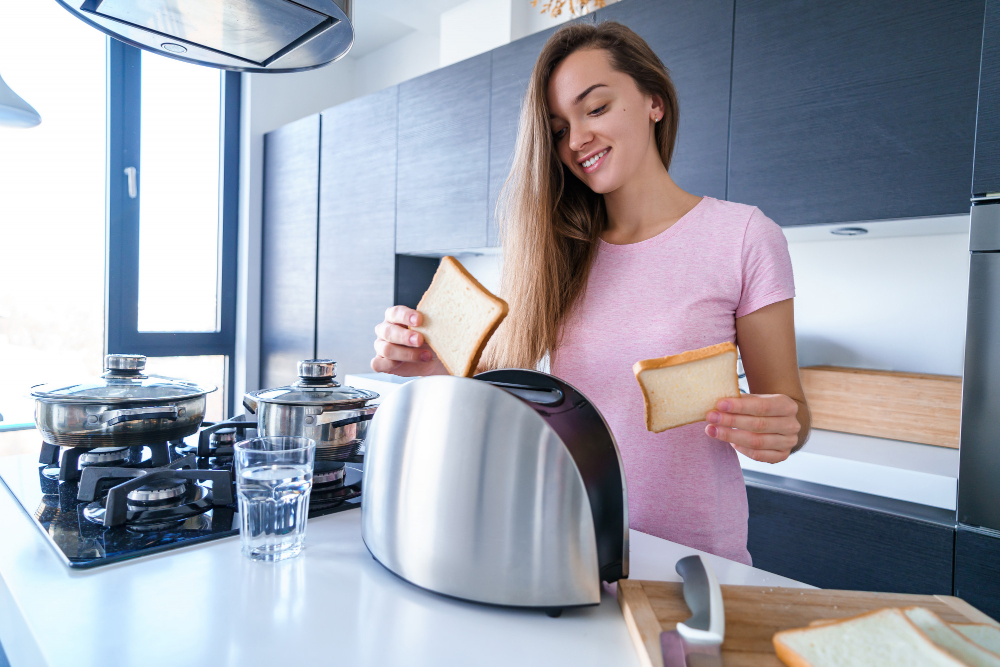
The lever you push down does several things at once, and in most modern toasters the last of them is to make contact with an electromagnet.
Pushing the lever down closes the switch supplying the elements and simultaneously brings a small steel plate on the carriage against an electromagnet. Current through that magnet holds the carriage down for the rest of the cycle. When the timer decides the cycle is over, it cuts the current to the magnet, the magnet lets go, and a spring throws the carriage up.
Which has a consequence everybody has seen without connecting it to anything. If the power is interrupted, or the plug is pulled, or the cancel button is pressed, the magnet loses its grip and the toast pops up immediately. It is not a safety feature that was added; it is an unavoidable property of holding something with electricity.
It also means a toaster fails in a safe direction. Essentially every fault that interrupts the supply also releases the bread, because the thing keeping the bread inside is the same current doing the cooking.
Why One Side Is Always Worse
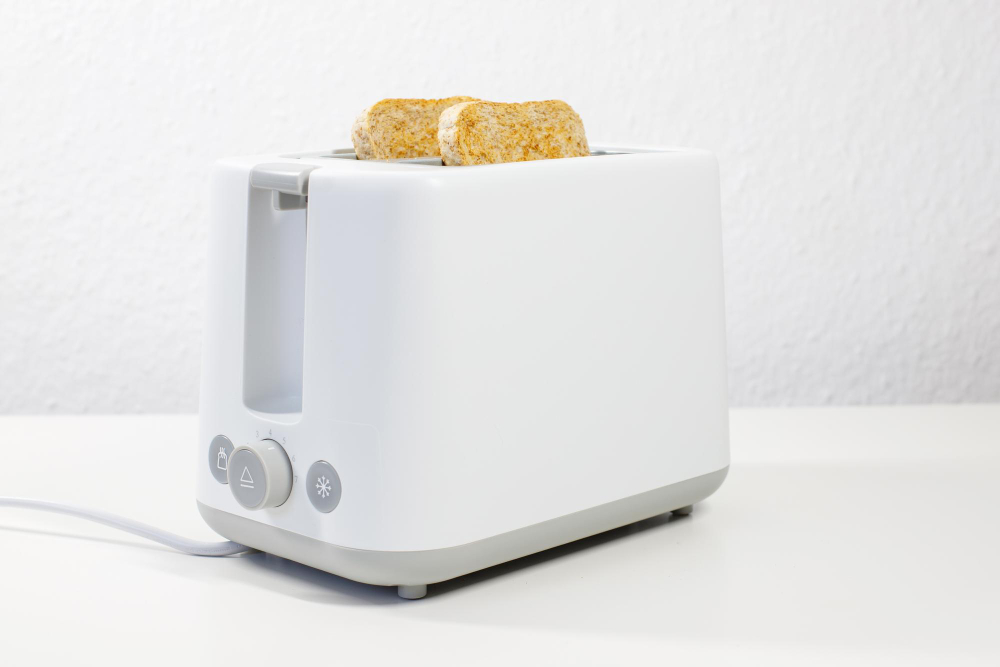
Almost every toaster browns unevenly, and the asymmetry is usually consistent: one slot, or one side of one slot, is reliably darker.
The reasons are geometric. An outer slot has an element on only one of its faces, with the other face against the cold outer wall, so a single slice placed in a two-slot toaster toasts unevenly unless the design compensates. Many do compensate, by running the outer elements at higher power or by using a different element arrangement, which is also why some toasters have a single-slice setting.
Airflow adds to it. Heat rises, so the top of a slice receives more than the bottom, and the top edge of toast is frequently darker than the lower corners. The crust behaves differently again, because it is already dry and browns immediately.
And the bread itself is not uniform. The large holes in an open-textured loaf are air rather than bread and cannot brown, which is why toast from an airy loaf has a mottled appearance that no appliance can fix.
None of which is solvable by a machine that cannot see what it is doing, which is the running theme of the whole object.
Why It Was Never Improved
Sensing toast properly is possible, and toasters with optical sensors watching the colour of the bread have been built and sold. They work. They have not displaced the open-loop design, and the reasons are a good lesson in why cheap engineering survives.
A sensor adds cost to an appliance whose entire selling price is low. It adds a component that can fail in a hot, crumb-filled environment. It has to cope with the fact that the surface it is looking at is uneven, partly in shadow and sometimes a different colour of bread entirely. And the thing it would deliver, consistency between the first and second slice, is a convenience rather than a necessity.
Meanwhile the bimetallic strip costs almost nothing, has no electronics, tolerates heat indefinitely and has no failure mode more serious than drifting slightly.
So the design persisted, essentially unchanged in principle, for the better part of a century, and the appliance everybody owns is still a timer with a heater and a magnet, which does not know what bread is, cannot tell whether it succeeded, and gets the second slice wrong for a reason that is built into the way it decides to stop.
Like our content? Follow us for more.
