

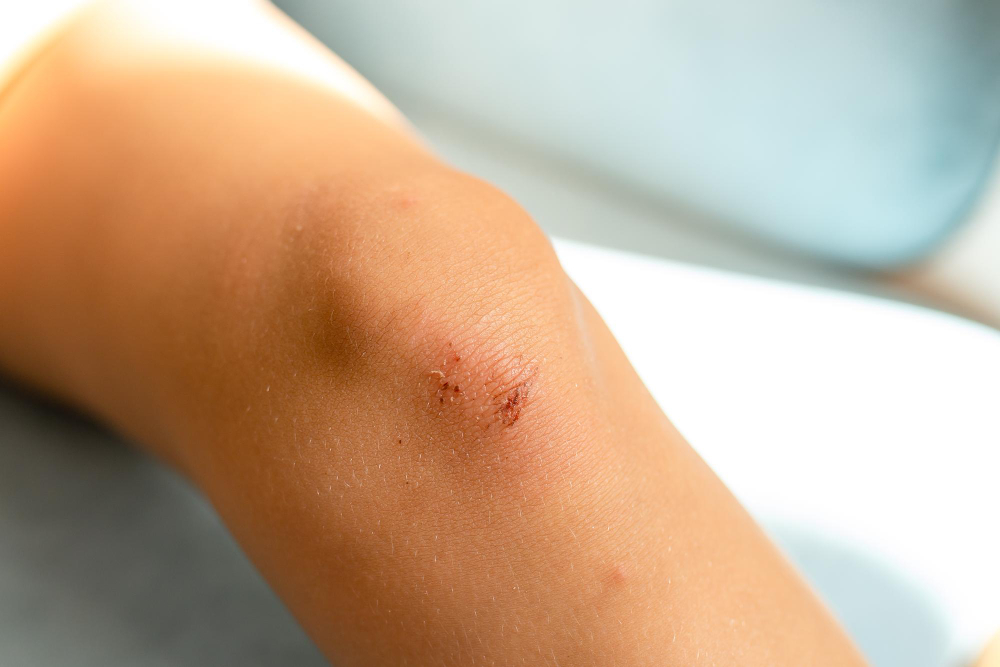
The common description is that a scab is blood that has dried, and that is close enough to be misleading. If you leave a drop of blood on a table it dries into a flake, and that flake is not a scab. It has no structure.
What forms over a break in the skin is a mesh. One of the proteins dissolved in blood plasma is soluble and inert until it is activated, at which point it converts into long insoluble strands that polymerise into a tangled three-dimensional network across the gap. That network is built, not deposited – the conversion is the end point of a cascade of signals that begins the moment a vessel wall is damaged.
Into that mesh get caught the cell fragments that arrived first and stuck to the damaged edges, along with red cells and the white cells that follow them in. The result is a gel: a fibrous scaffold with cells embedded in it, spanning the wound.
Only then does it dry. The exposed surface loses water to the air and hardens into the dark crust that everybody recognises, which is the part most people think is the whole thing. Underneath the hard surface, for most of its working life, a scab is not dry at all.
Like our content? Follow us for more.
What the Mesh Is Actually For
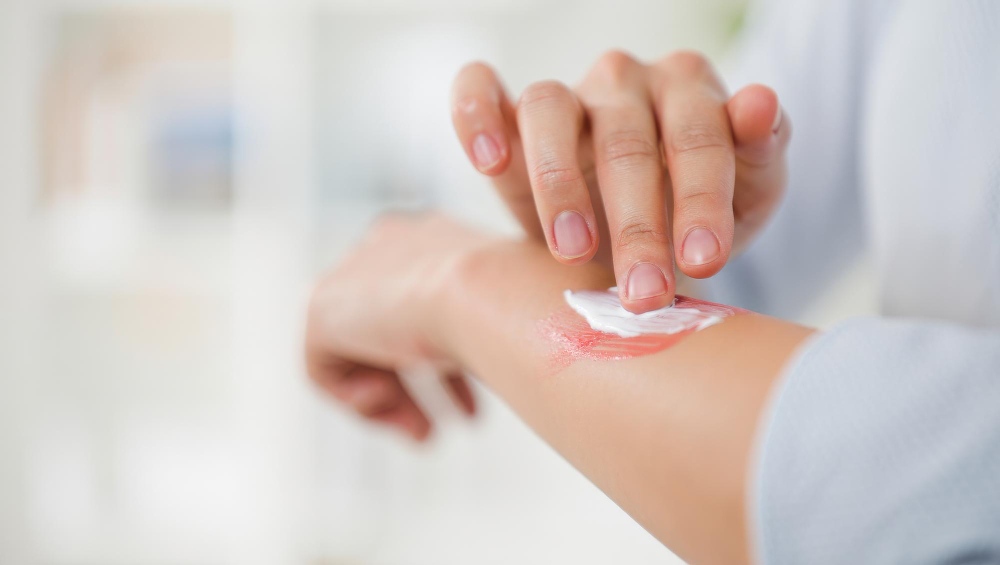
The first job is obvious and is the one everybody credits it with: stopping the bleeding. The mesh plus the sticky cell fragments caught in it block the opening, and it does this within minutes.
The second job is less obvious and is arguably the more important one. The mesh is a surface. The cells that have to rebuild the skin cannot swim and cannot jump; they move by crawling, and crawling requires something to crawl on. An open wound has no such surface across its middle – there is a gap. The mesh fills the gap with something that can be gripped.
The third job is logistical. The scaffold is porous, and the signalling molecules and the immune cells that have to work in the wound move through it and are concentrated by it. It holds the workspace together, which is the difference between a repair site and a mess.
So a scab is less like a sticking plaster and more like the scaffolding and hoardings around a building site. It is not the repair. It is the temporary structure that makes the repair possible, and like all such structures it is designed to be taken down.
The Repair Is Happening Underneath It, Not Behind It
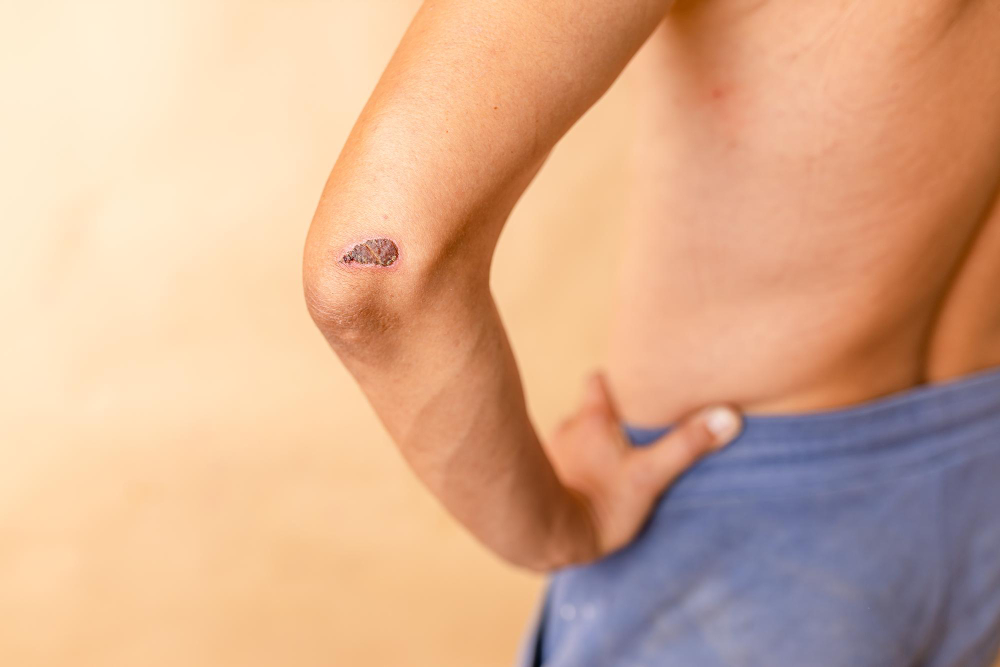
Here is the part that changes the picture. People tend to imagine the scab sitting on top while new skin grows upward beneath it, filling the hole from the bottom like a pothole being repaved.
That is not the geometry. Skin does not regrow from underneath. It regrows from the sides.
At the edges of the wound, the outermost layer of skin remains intact and anchored. The cells at that cut margin let go of their neighbours, flatten out, and begin to crawl inward across the wound, advancing as a thin continuous sheet from every edge at once. Behind the advancing front, the cells that are no longer at the edge divide to supply more.
And that sheet travels along the underside of the scab. It uses the base of the mesh as its floor and the moist tissue below as its medium, tunnelling inward between the scaffold above and the wound bed beneath. The sheets from opposite edges meet somewhere in the middle, fuse, and the skin is closed – and all of this is finished while the scab is still visibly sitting there looking like the main event.
And the Scab Is Being Cut Away From Below While It Works
The advancing sheet does not simply slide under the mesh. It cannot, because the mesh is attached to the wound bed and is in the way.
So the cells secrete enzymes that dissolve it. As the sheet advances, it digests a path through the base of the scaffold immediately in front of itself, breaking the strands down and clearing the route. A second set of enzymes in the wound fluid is doing the same thing more broadly, degrading the fibrous network throughout once it is no longer needed.
The consequence is that the scab is being destroyed from below from very early on. While the upper surface is hard, dark and apparently permanent, the underside is being eaten away by the repair it is enabling. It is scaffolding being dismantled by the builders working beneath it, from the bottom up, while the top is still standing.
Nothing about this is visible from outside. A scab on day two and a scab on day eight can look identical, and be in completely different states – one resting on an intact base, the other sitting on almost nothing.
Which Is Why It Comes Off When It Does
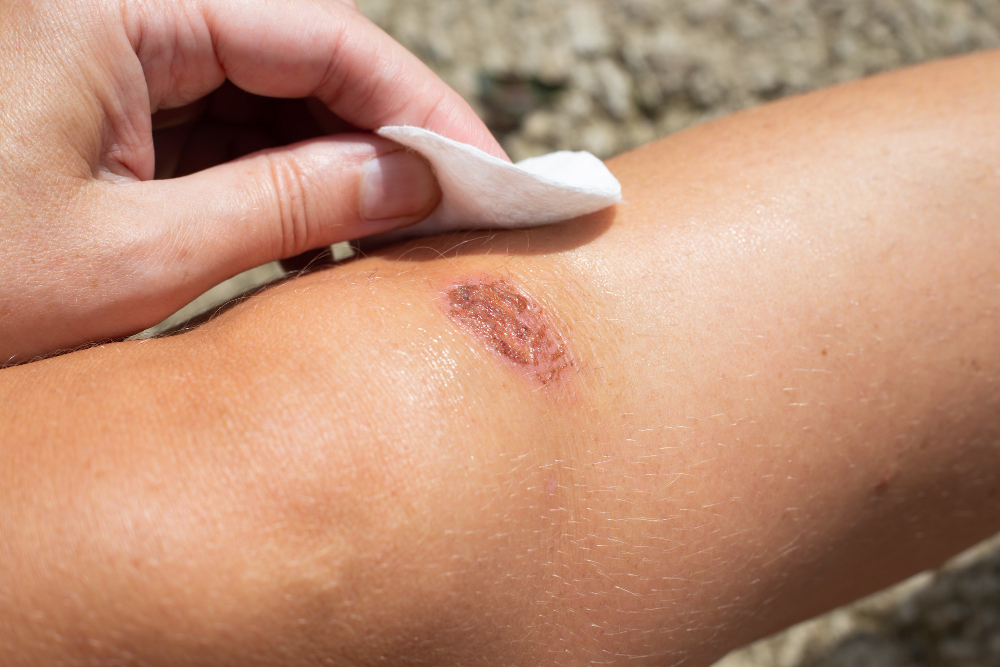
This explains something that otherwise has no good explanation: why a scab detaches at a particular moment, cleanly, rather than gradually wearing away.
It is not that it has finished drying, and it is not that it has been worn off by rubbing. It falls off because it has been cut loose. The enzymatic undermining proceeds until there is no longer any continuous attachment between the crust and the tissue below, and at that point the only thing holding it on is the rim. Once the sheet of new skin has run all the way under and closed, the rim goes too, and the scab is simply a loose object sitting on a surface.
Which is why the skin revealed underneath is already whole rather than raw. It was closed days before. The scab stayed on afterwards for the same reason a hoarding stays up for a week after the building is finished – it is no longer doing anything, and nothing has yet removed it.
It is also why interfering with a scab has the effect it does. The crust is attached to the advancing front of the repair at its edges. Lifting it does not remove a spent covering from completed skin; it tears off the leading edge of the sheet that was doing the closing, and that sheet has to be regrown from the margin again.
It Is Also Pulling the Wound Shut
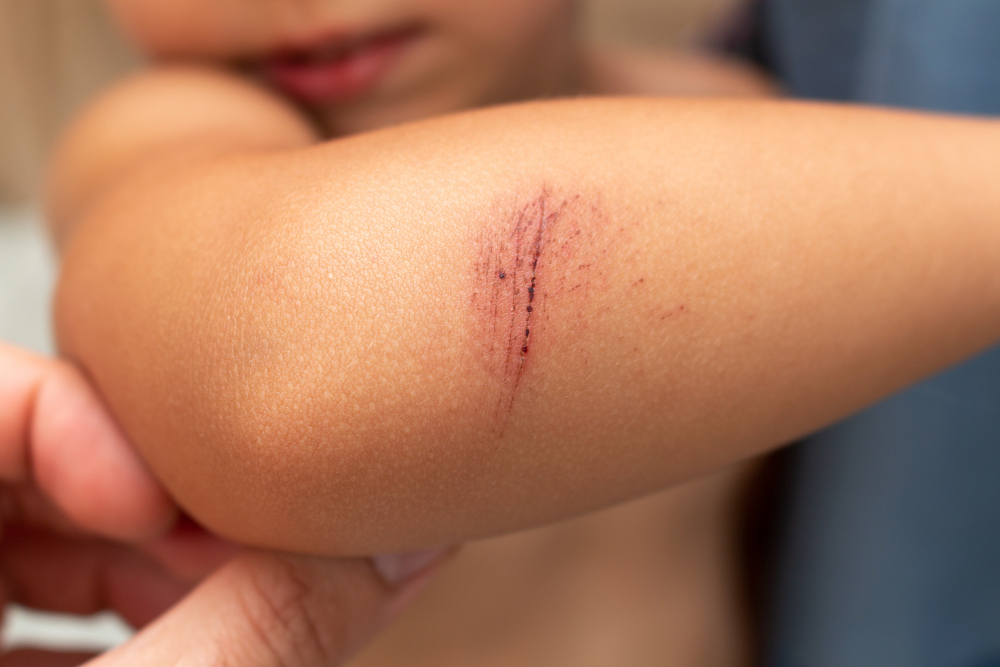
There is a further function that follows from the mesh’s physical behaviour rather than from anything cellular.
The fibrous network does not stay the size it was built. It contracts, actively, and as the whole assembly also loses water to the air it shrinks further. Both effects pull inward, and because the scaffold is anchored to the wound margins all the way round, the margins are pulled with it.
Over a day or two this draws the edges measurably closer together. For a small wound that is a real contribution, because the distance the migrating cells have to travel is now shorter, and the gap they have to bridge is smaller than the one originally made.
It is also responsible for the characteristic feeling. A scab tightens, and the tightness is felt as a pull in the surrounding skin that increases over the first days and then eases. That sensation is not the wound healing in some vague sense. It is a contracting mesh under tension, physically hauling on the skin it is attached to.
A Scab Is What You Get When a Wound Meets Air, and It Is Not the Fast Option
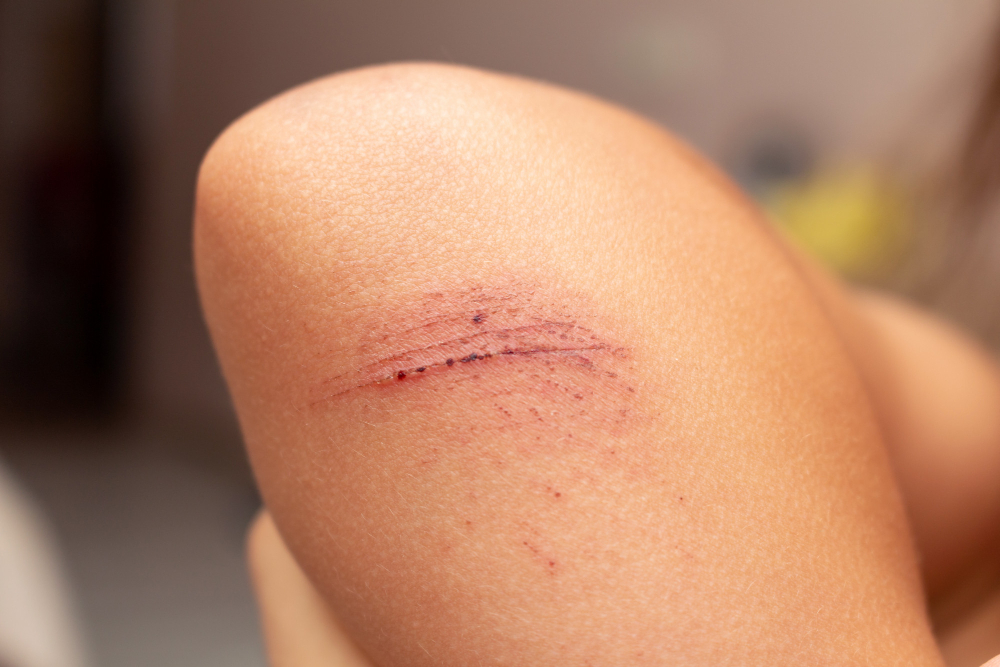
For most of history the scab was treated as the goal. A wound that had crusted over was a wound doing well, and the standard approach was to let it dry.
The finding that overturned this is now decades old and is one of the more useful counterintuitive results in the field: a wound kept from drying out closes substantially faster than an identical wound left to form a crust, and the difference is not marginal.
The reason follows directly from the geometry already described. If the surface dries into a hard crust, the sheet of migrating cells cannot travel over it and has to go under it, which means working its way through or beneath a dense obstruction while simultaneously dissolving it. If the surface stays moist, the sheet slides straight across the top of the wound bed with nothing in the way, and it moves far more quickly.
So the scab is not an optimal piece of engineering. It is a compromise forced by circumstance. Exposed to open air, a wound has no choice: the surface dehydrates, a crust forms, and the repair has to tunnel. The body’s response is extremely good at working around the crust, which is not the same as the crust being helpful.
The Place Where You Never Get One
The best evidence that the scab is a consequence of exposure rather than a necessary stage is that there are wounds which never form one at all.
Break the lining of your mouth and no scab appears. The tissue is permanently wet, nothing dehydrates, no crust can form, and the repair proceeds without one. Those wounds also close noticeably faster than comparable breaks in skin, and tend to leave markedly less behind.
Several things differ about that environment, and the moisture is only one of them, so it is not a single clean comparison. But it demonstrates the central point. A scab is not a stage in healing that the body has evolved to pass through. It is what happens when the repair has to be carried out in air, and the cells doing the repair spend much of their effort getting rid of it.
Which makes the ordinary scab on an ordinary knee a slightly different object than it appears: not a protective lid waiting for the skin beneath to be ready, but a temporary structure that was useful for an hour, tolerable for a week, and under demolition the entire time.
Like our content? Follow us for more.
