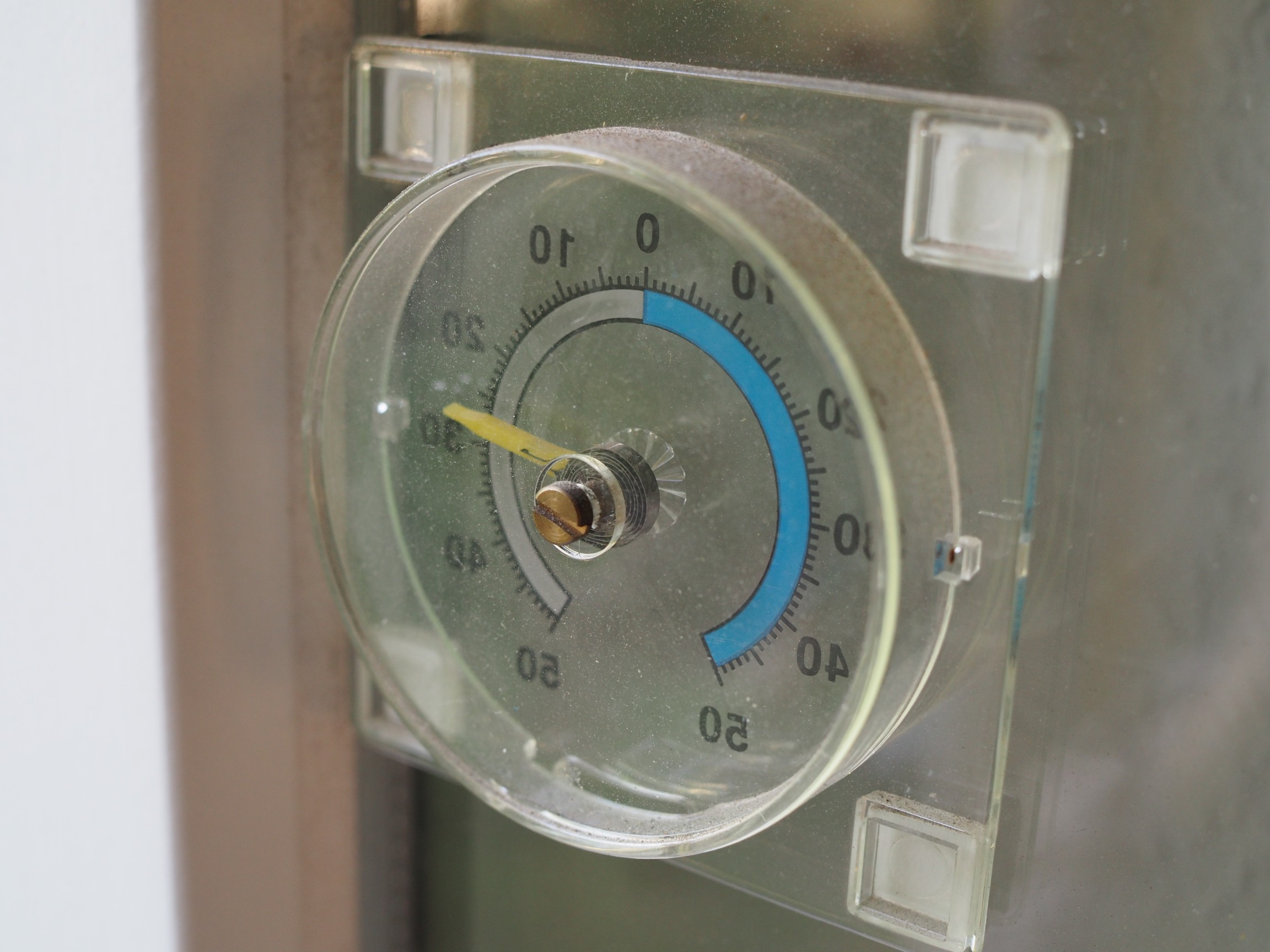
It was stuck to the outside of the glass with two rubber suction cups, or screwed to the frame, and it had a dial with a needle and numbers in two colours – red above freezing, blue below.
Somebody looked at it every morning, through the window, and announced a number. That number governed what the children wore.
What Was Actually Inside It
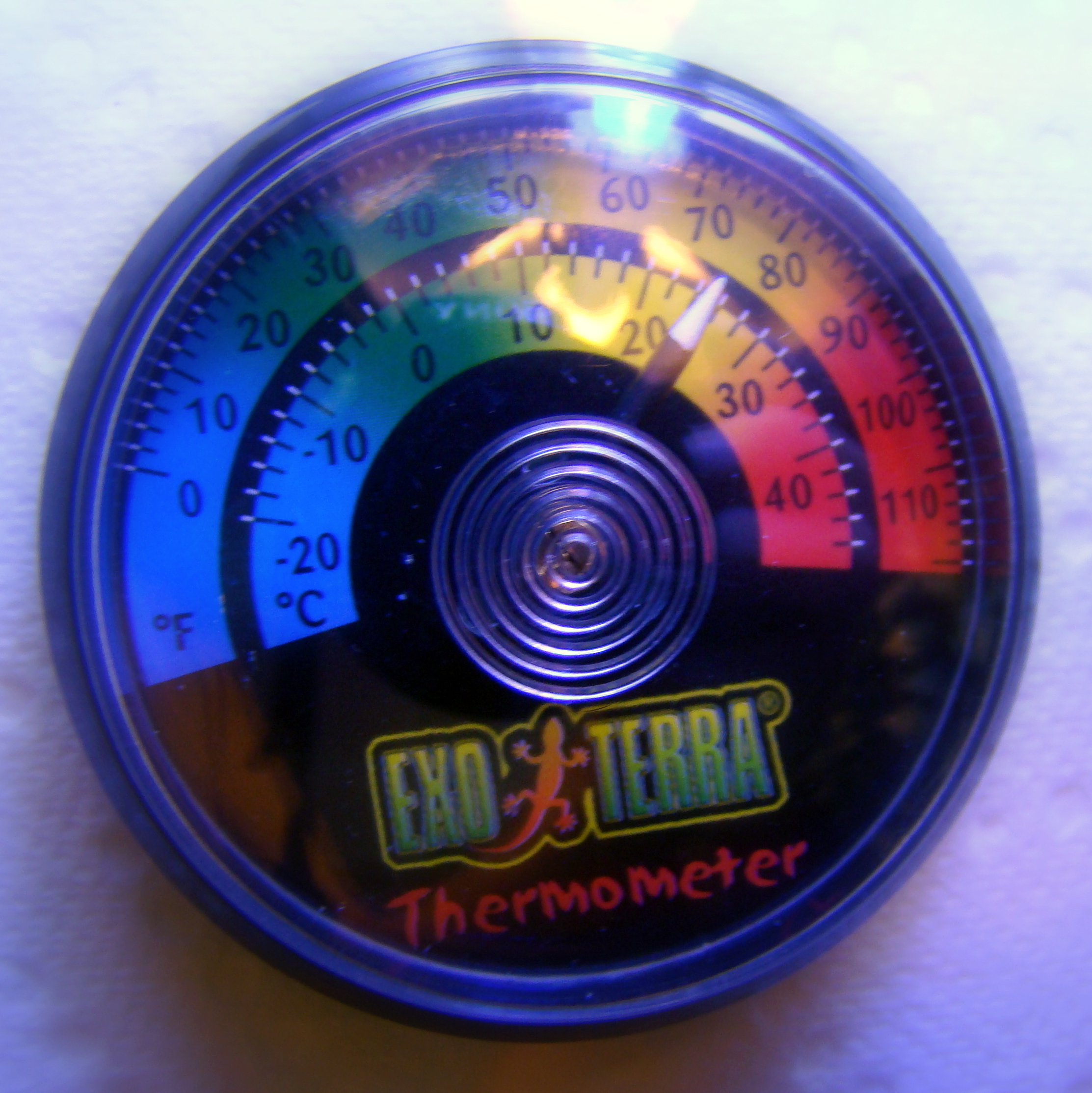
The common household type was a bimetallic dial thermometer, and the mechanism is a genuinely elegant piece of nineteenth-century engineering.
Two different metals – commonly brass and steel – are bonded together in a strip. They expand at different rates when heated, so the strip cannot stay flat: it has to bend, and the amount it bends is proportional to the temperature. Coil that strip into a spiral, fix the outer end and attach the inner end to a shaft, and heating the coil rotates the shaft. Put a needle on the shaft and a printed dial behind it and you have a thermometer with no liquid, no glass tube and nothing to break.
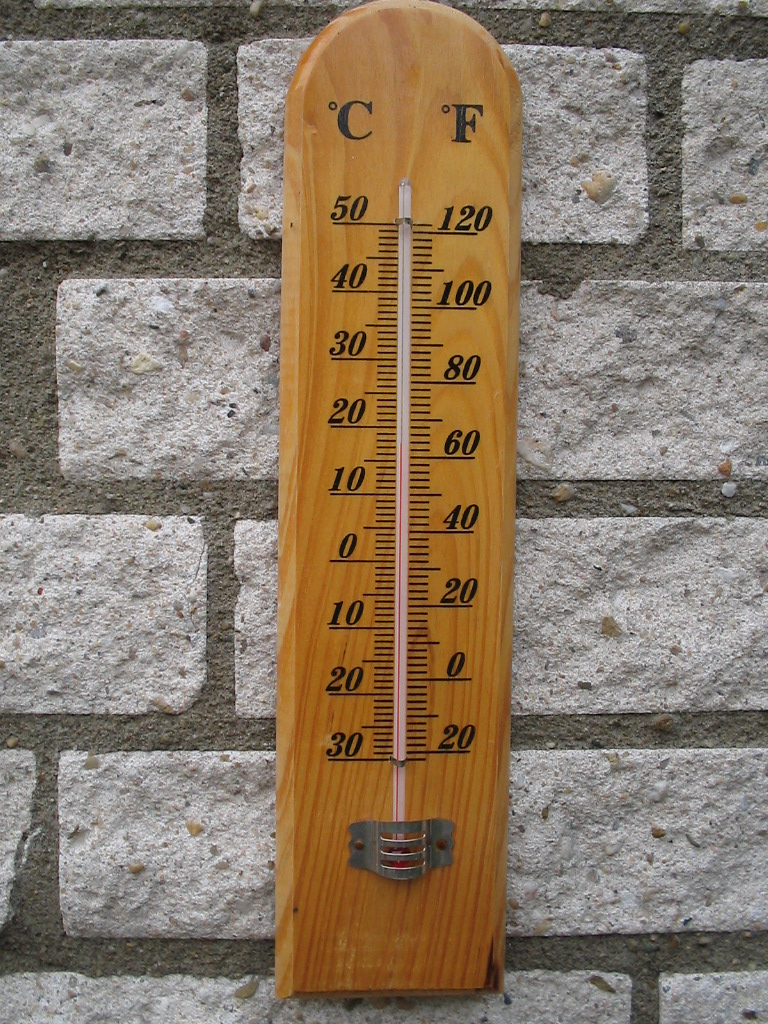
The alternative was a liquid-in-glass tube on a printed backing board – usually with an advertisement on it for a feed company, a hardware store or an insurance agency, because these were given away as promotional items by the thousand.
Like our content? Follow us for more.
It Was Almost Always Wrong
Here is the part that explains every argument any household ever had about the temperature.
A thermometer measures its own temperature, not the air’s. For the two to be the same, the instrument has to be shaded from the sun, exposed to moving air, and far enough from any surface that is radiating heat.
A thermometer suction-cupped to a window satisfies none of those conditions.
If the window faced east, the morning sun struck the dial directly and the reading ran high – sometimes by a great deal, since a dark dial face in sunlight will sit well above air temperature. If it faced north it was permanently in shade and read low in the afternoon. It was mounted flat against glass, which conducts heat out of a warm house, so on a cold night the instrument was being warmed from behind. It sat in still air trapped against the pane rather than in moving air. And it was within a few feet of a wall that had been absorbing sunlight all day and was releasing it after dark.
So the number on the window was a measurement of a very specific microclimate two inches from the glass on one side of one house – and it was reported, every morning, as the temperature.
Everybody Knew Theirs Was Off and Nobody Moved It
The households that had these were not naive about it, which is the interesting part.
People developed corrections. Ours reads five degrees high in the morning. Don’t look at it after two. It’s about right in winter. Those adjustments were held in the family’s heads, passed on, and applied automatically – and because the error was consistent for a given window, the corrected reading was frequently quite good.
Which is a reasonable piece of amateur instrumentation. A systematically biased instrument whose bias you know is more useful than an accurate one you have to go outside to read, and the household was effectively calibrating against experience.
Nobody relocated the thermometer to a properly shaded, ventilated position away from the building, because the entire point was that you could read it through the window without getting dressed.
The Weather House Was the Other One
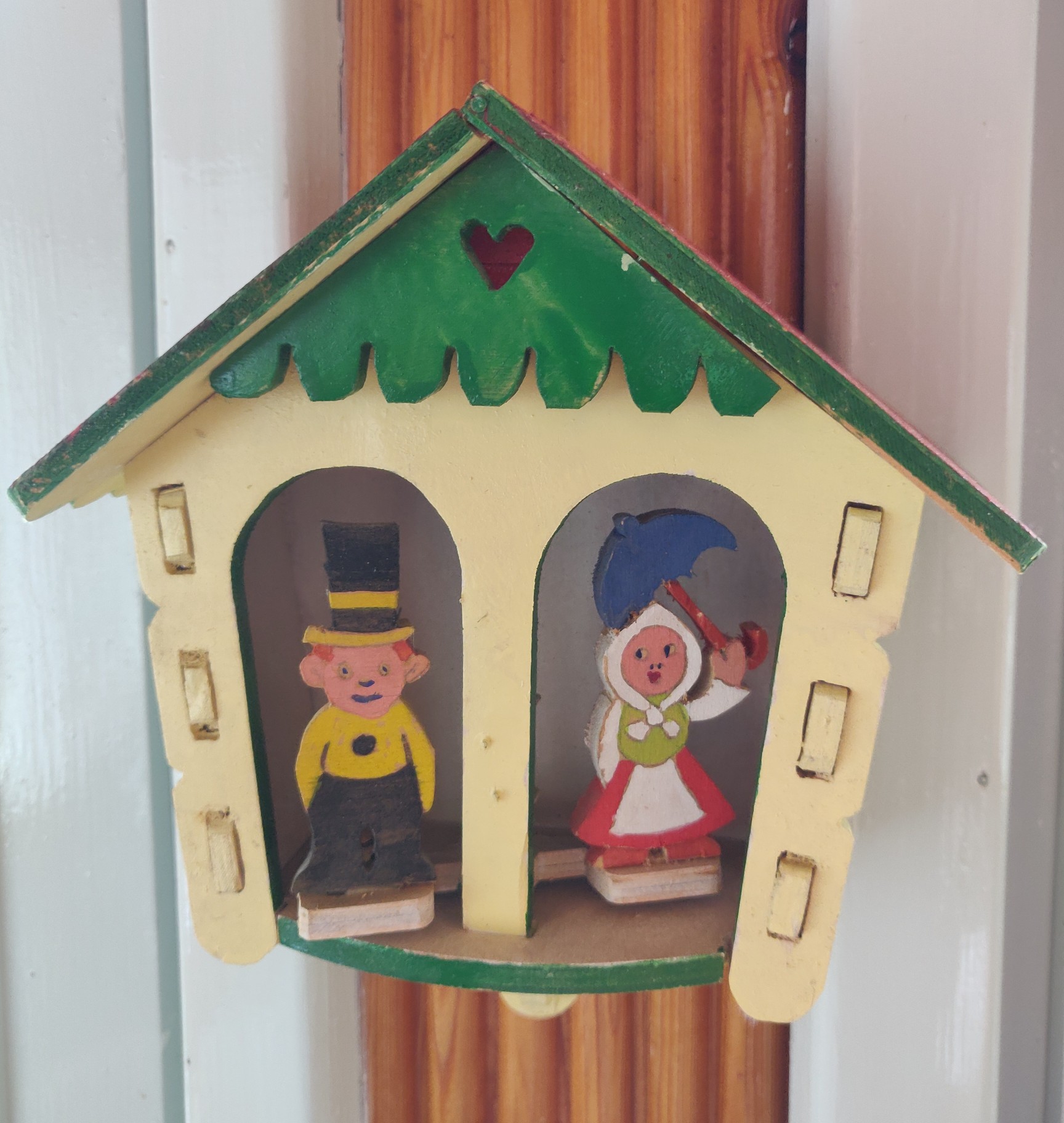
Alongside the thermometer, a great many American homes had a weather house: a small wooden chalet with two doorways, from which one of two figures emerged – traditionally a woman in fine weather and a man with an umbrella in wet.
The mechanism contains no electronics and no thermometer. The two figures hang from a twisted strand of natural material – gut, or hair – which absorbs moisture from the air. As humidity rises the strand swells and untwists; as it falls it dries and twists tighter. The platform the figures stand on rotates with it, and one of them comes out.
So the weather house is a hygrometer, measuring relative humidity, and it is a perfectly genuine one. The folk connection it relies on is sound as far as it goes: rising humidity frequently precedes rain, because a weather system bringing precipitation generally brings moist air ahead of it.
It is not a forecast, and it was treated as one. The figures also respond to anything else that changes indoor humidity, which in a 1974 kitchen meant a boiling kettle, a bath running, somebody cooking, or a window being opened – so a weather house in a house where somebody was making soup predicted rain with great confidence.
The Barometer on the Hall Wall Was Doing the Serious Work
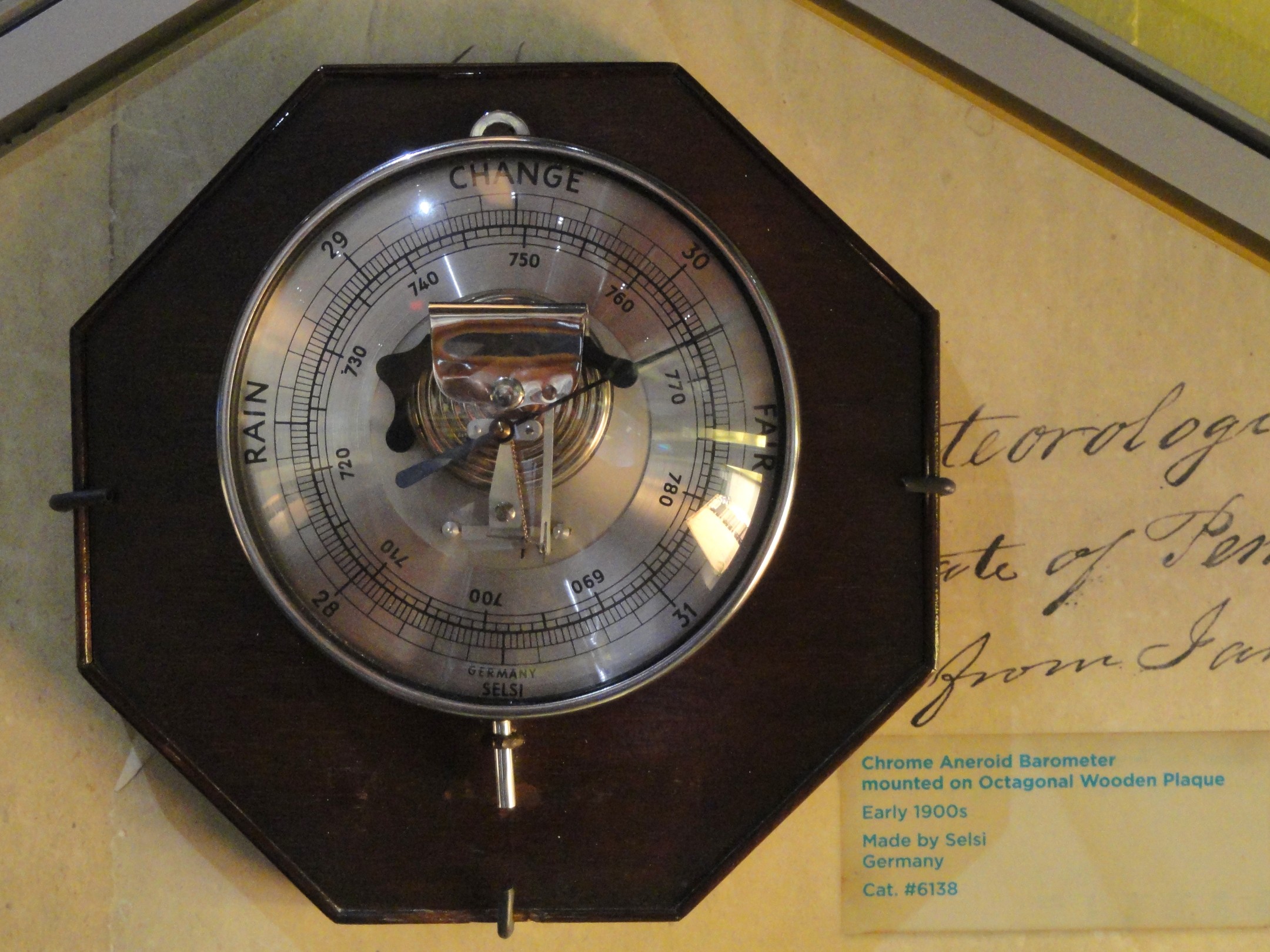
The instrument that actually forecast anything was the aneroid barometer, and it was treated as decoration.
A barometer measures air pressure, and the useful information is not the number but the direction of travel – which is why these had a second, manually set needle. You moved the brass pointer to line up with the reading, came back some hours later, and saw whether the actual needle had risen or fallen away from it.
Falling pressure means an approaching low, which generally means wind and rain. Rising pressure means a building high, which generally means settled weather. Rapid change in either direction means the weather will change soon and probably sharply.
That is a real forecasting method with real skill in it, available free, on a wall, with no power – and most households that owned one tapped the glass, read the number, and never set the second needle, which meant they had a decorative dial instead of an instrument.
The Number Decided What Children Wore

The practical function of all this was clothing, and the arrangement was more consequential than it sounds.
A household in 1974 dressed its children once, in the morning, for the whole day, from a single reading taken through a window before anybody had been outside. There was no hourly forecast, no afternoon correction, and no possibility of a child changing at lunchtime – so the number on the dial at seven o’clock determined whether four people were comfortable until six.
Which is why the morning reading was announced aloud, discussed, and occasionally disputed. A child arguing that it was warmer than that was arguing against an instrument, and losing – and the standard outcome was a coat carried rather than worn, which is a compromise every American parent and child negotiated independently and arrived at identically.
The errors mattered most at exactly the wrong moments. An east-facing dial in April sun reads warm at eight in the morning, which is precisely the day somebody goes to school without a coat into a wind.
The Dial Was Frequently an Advertisement
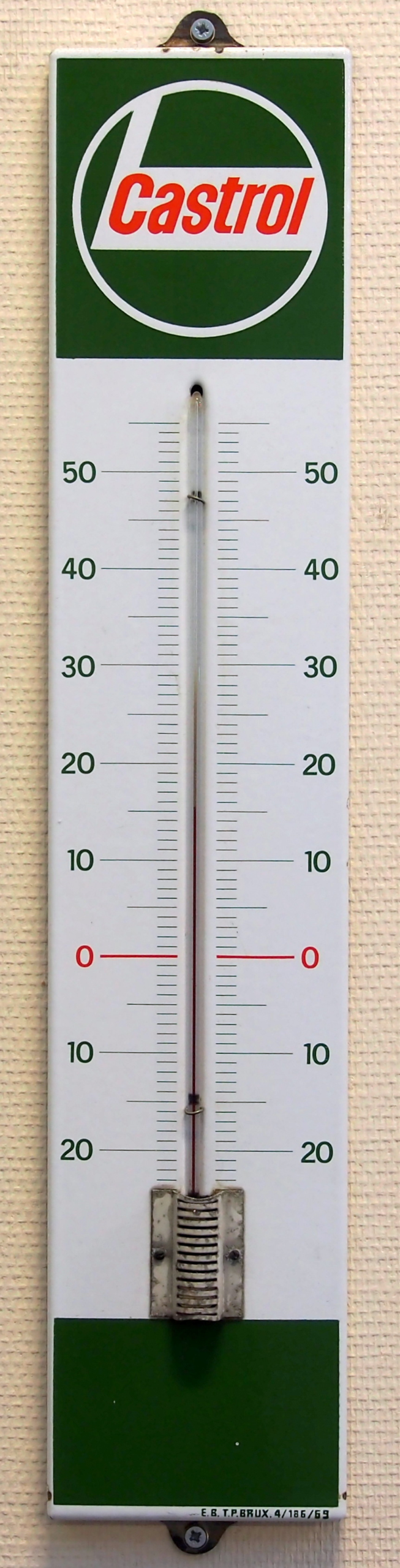
The giveaway promotional thermometer is worth a paragraph on its own, because it shaped what the instruments looked like.
They were produced in enormous numbers as advertising: a printed metal or card backing carrying a company’s name, a slogan and sometimes a telephone number, with the actual thermometer as a small component in the middle. Feed and seed companies gave them to farmers. Hardware stores, lumber yards, insurance agents, funeral homes, dairies and bottlers all handed them out.
The logic was excellent. A thermometer goes on a wall or a window in a place where it is looked at every single day, deliberately, by everybody in the household, for twenty years – which is a quality of advertising placement that almost nothing else achieves, at the cost of a stamped metal plate.
It also means a great many American households never chose a thermometer at all. They had whichever one somebody had given them, mounted wherever it happened to fit, which is a further reason nobody was optimising the siting.
The Twist: We Did Not Get Better Instruments, We Got Somebody Else’s
The obvious story here is that household weather instruments were replaced by better ones, and that is not what happened.
What happened is that the measurement moved. The number a household now uses comes from a professionally sited instrument in a properly shaded, ventilated enclosure at a standard height at an airport or a weather station, possibly some miles away, transmitted to a phone – and it is vastly more accurate as a measurement of the regional air temperature than anything ever stuck to a window.
But it is a measurement of somewhere else.
Which has a consequence that is easy to miss. The old reading was wrong about the region and right about the house. If the sun was on your kitchen window, your thermometer said so. If the north side was in shade and the wind was on it, that showed up too. A household reading its own window was getting bad data about the climate and quite good data about the specific conditions in the place where it actually lived.
The phone gives the opposite: excellent data about a point several miles away and nothing whatsoever about your own wall, your own garden, your own frost pocket or the way your street holds cold air.
Which is why the instruments came back, and they did. Wireless home weather stations with a remote sensor you site yourself are sold in quantity, and the serious ones come with instructions about shading and ventilation that the suction cup never did. People who grow things, keep bees, worry about pipes freezing or simply want to know what is happening outside their own door buy them, for exactly the reason their grandparents had a dial on the glass.
The suction cup was a bad instrument in a convenient place. The replacement is a good instrument in somebody else’s place. It took about forty years for anybody to offer a good instrument in your place, and it is still a specialist purchase.
Like our content? Follow us for more.