

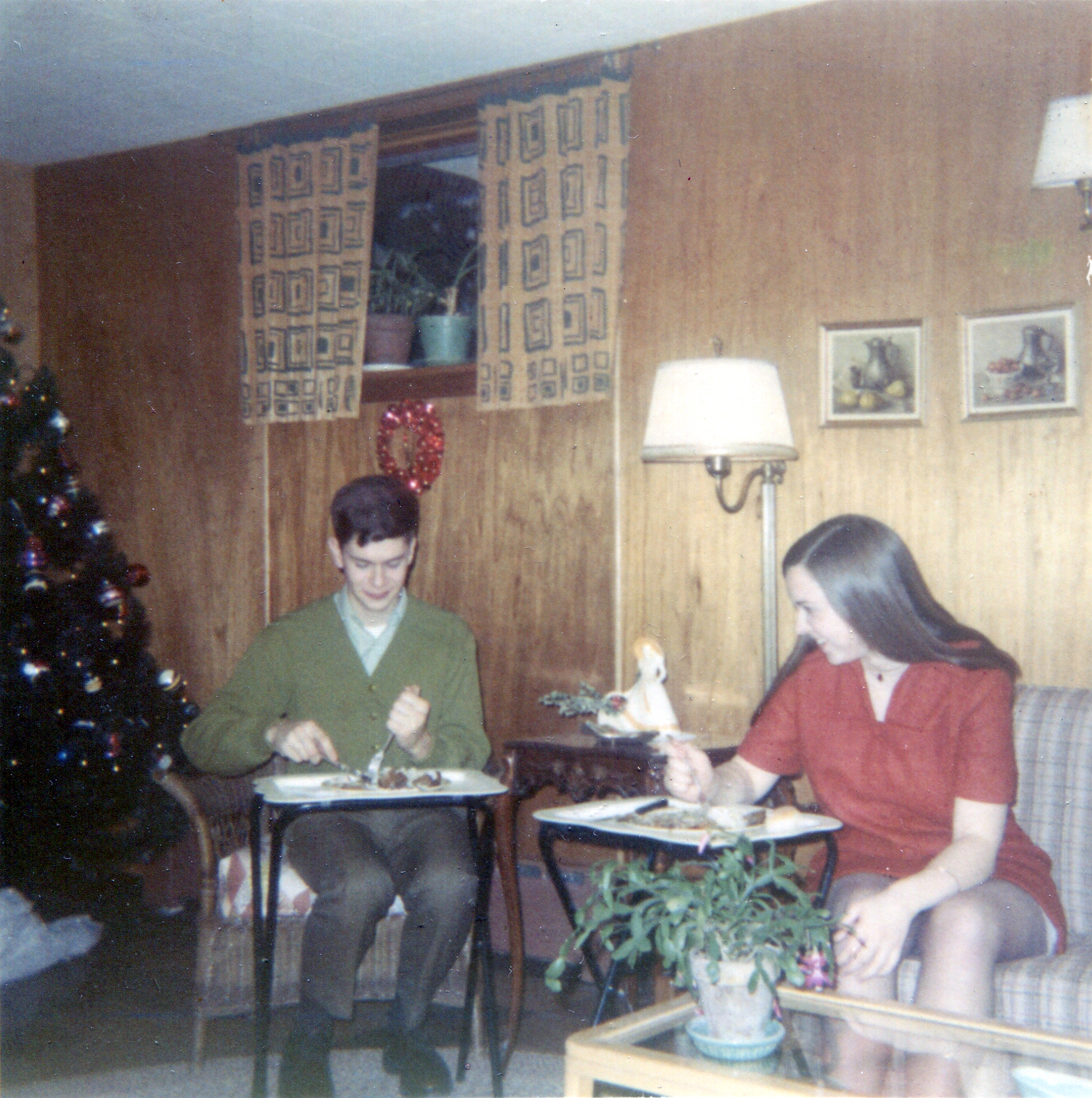
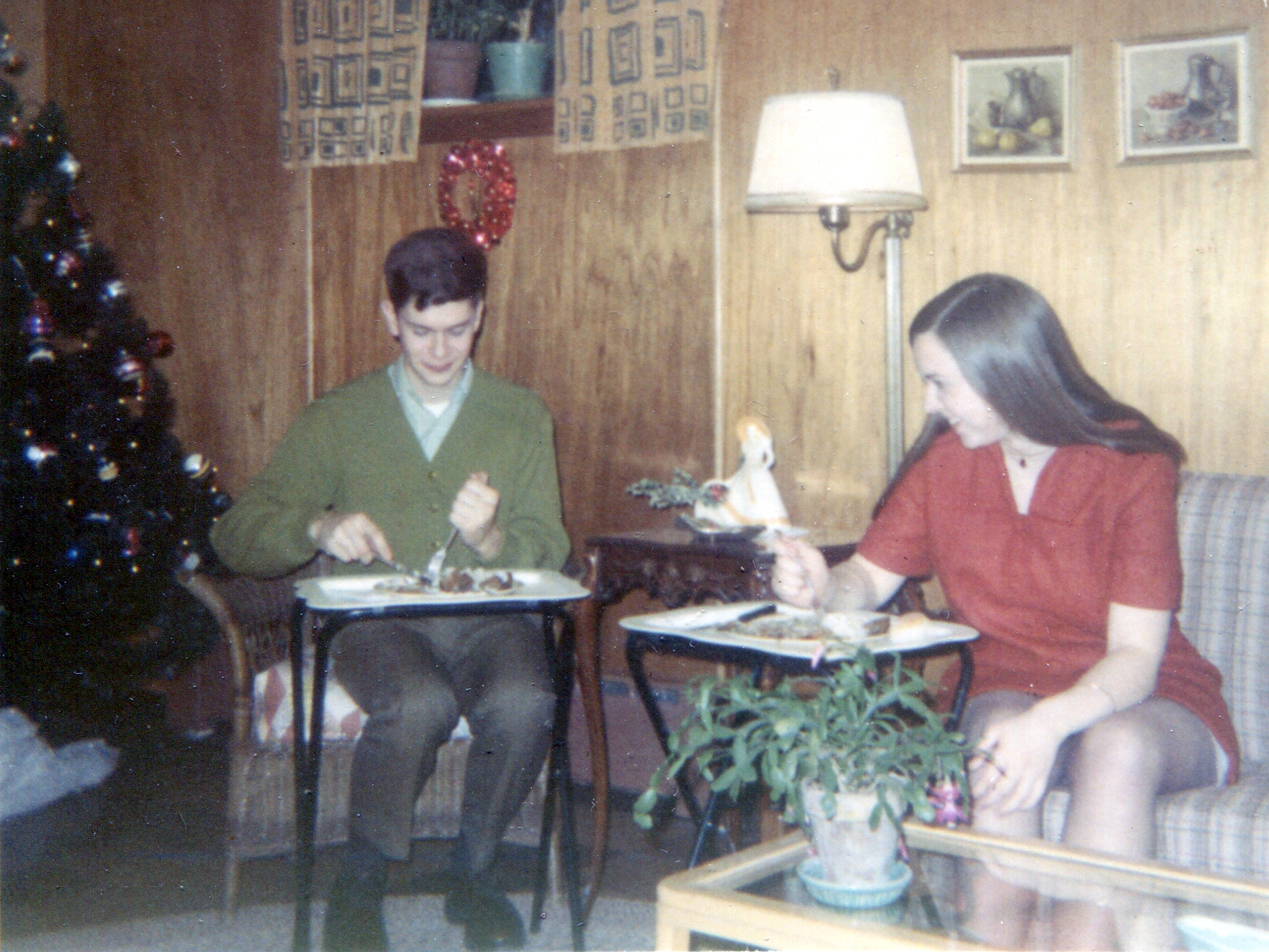
They came as a set of four, with a wire rack to stand them in, and they lived in a corner of the living room or behind a door.
Each one was a stamped metal tray on a folding wire frame, with a pattern printed on it – flowers, fruit, a gold scroll, a woodgrain, an autumn scene – and the pattern was almost always slightly scratched in the middle where plates had been put down for a decade.
The Construction Was Cheaper Than It Looks and Better Than It Needed to Be
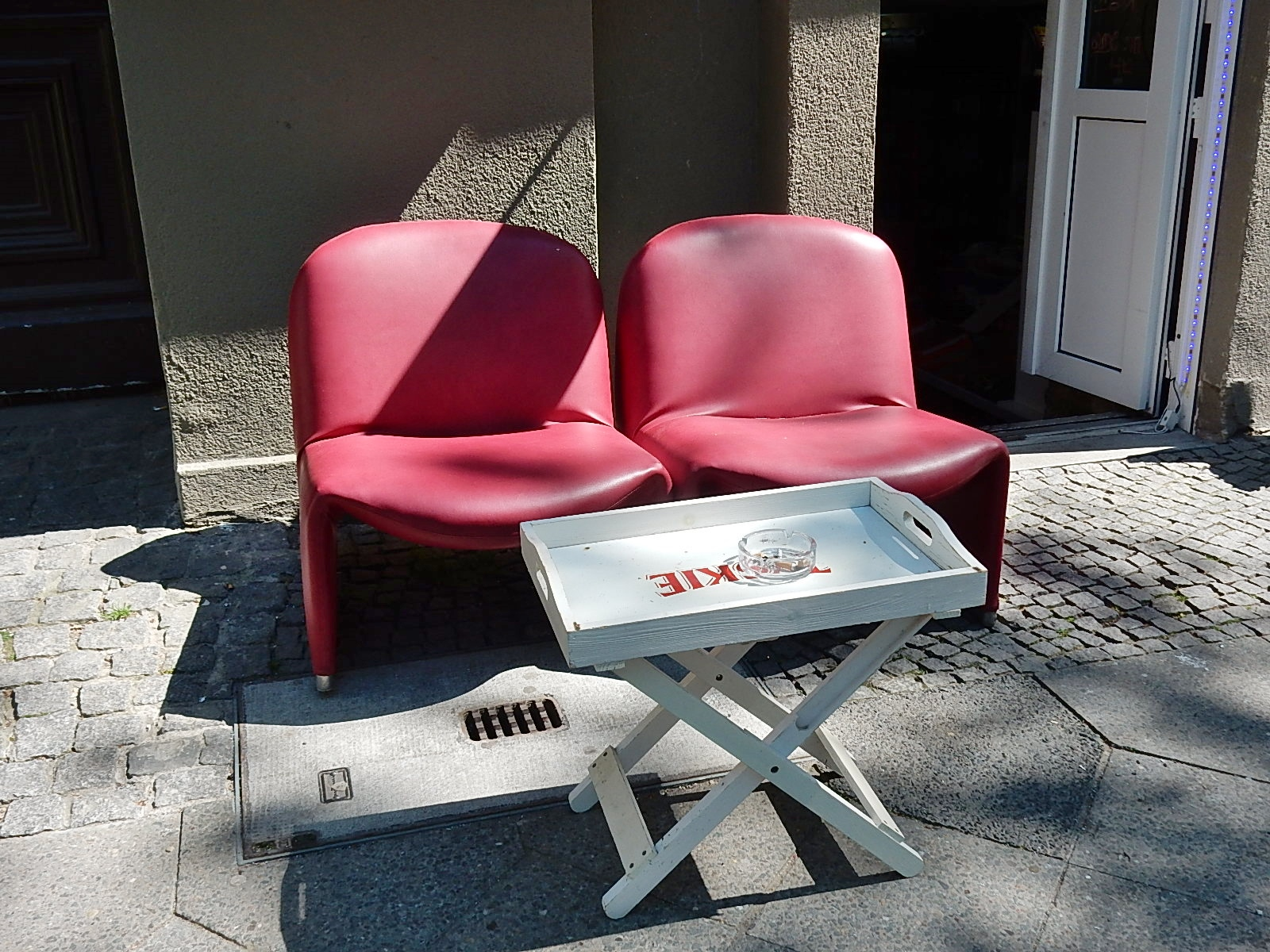
The engineering is minimal and almost perfect for the job.
The top is a sheet of steel, pressed into a shallow tray with a rolled lip, which does two things at once: the lip stiffens an otherwise floppy sheet, and it stops a glass rolling off. The pattern is lithographed onto the metal before pressing and then clear-coated, which is why the colours are so saturated and why they wear only where something abrades them.
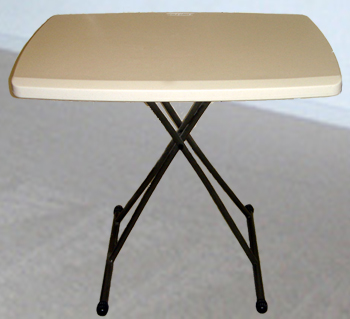
The legs are a single piece of wire bent into a double X, pivoting on a rivet, with the top rail sliding into a channel under the tray. Open it and the geometry locks; lift the tray and it folds flat. There are perhaps six parts and no fasteners that can work loose.
The later and more expensive version had a laminate top on a tubular frame with a locking catch, and a few households had wooden ones. But the stamped metal tray on a wire X is the object everybody remembers, and it was sold by the million because it cost almost nothing to make.
Like our content? Follow us for more.
It Did Not Cause the Family to Eat in Front of the Television
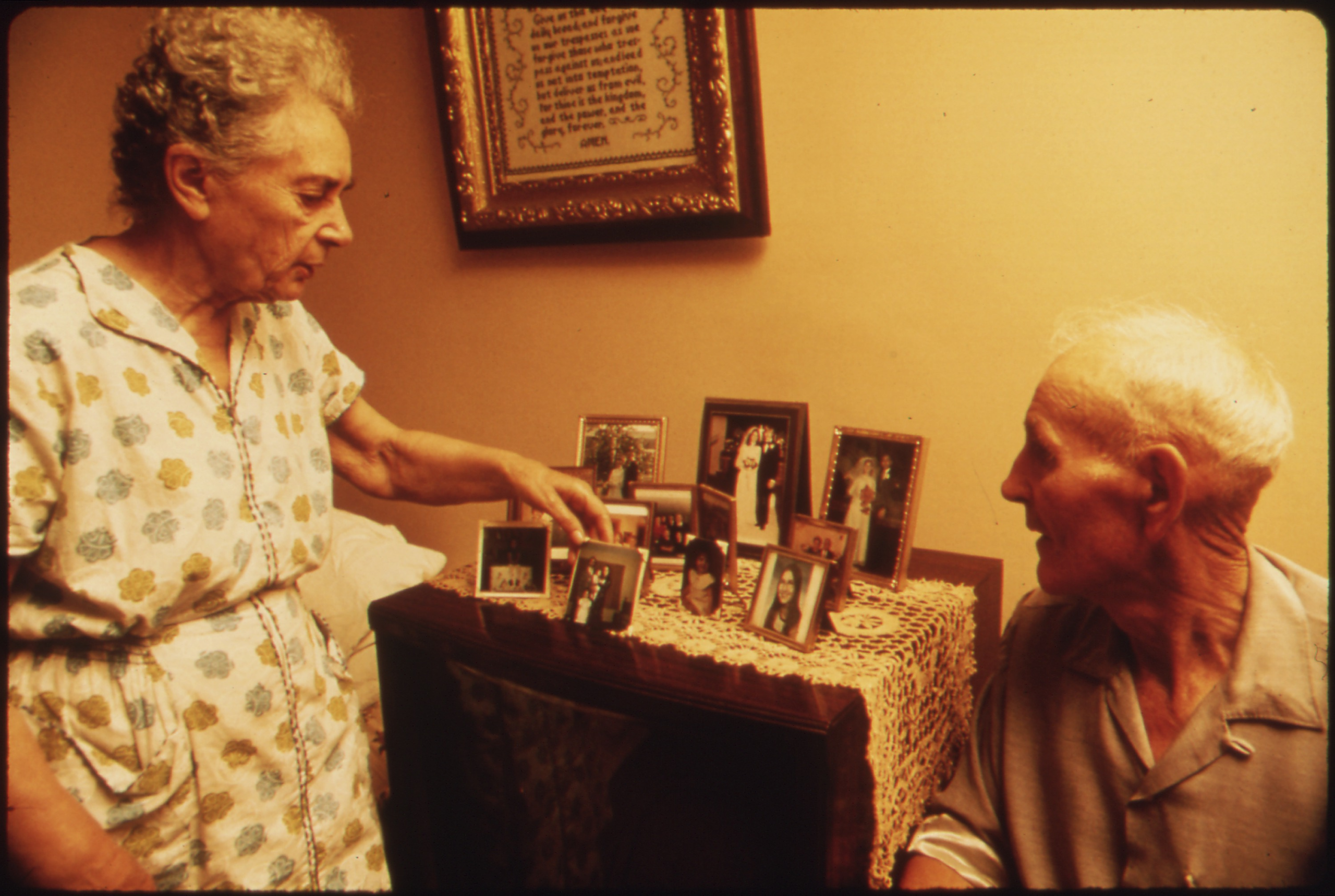
The tray table is usually presented as the villain of American family dining – the object that took everybody out of the dining room and parked them in front of a screen.
That gets the sequence backwards.
The television was already in the room where the family spent its evenings, which in most American houses was not the dining room. The dining room, where there was one, was frequently the formal room used for visitors and holidays. The family room or the living room was where people actually were.
So the question was not whether to eat in front of the television instead of at a table. It was what to put a plate on, in a room full of soft seating, which had no table in it because nobody had ever needed one there.
The tray answered that, and it answered it after the fact. It is a response to a change in where people sat, not the cause of one – and the same object would have been just as useful in a room with a radio in it, which is roughly what it had been doing for the previous twenty years under other names.
The Patterns Were the Product
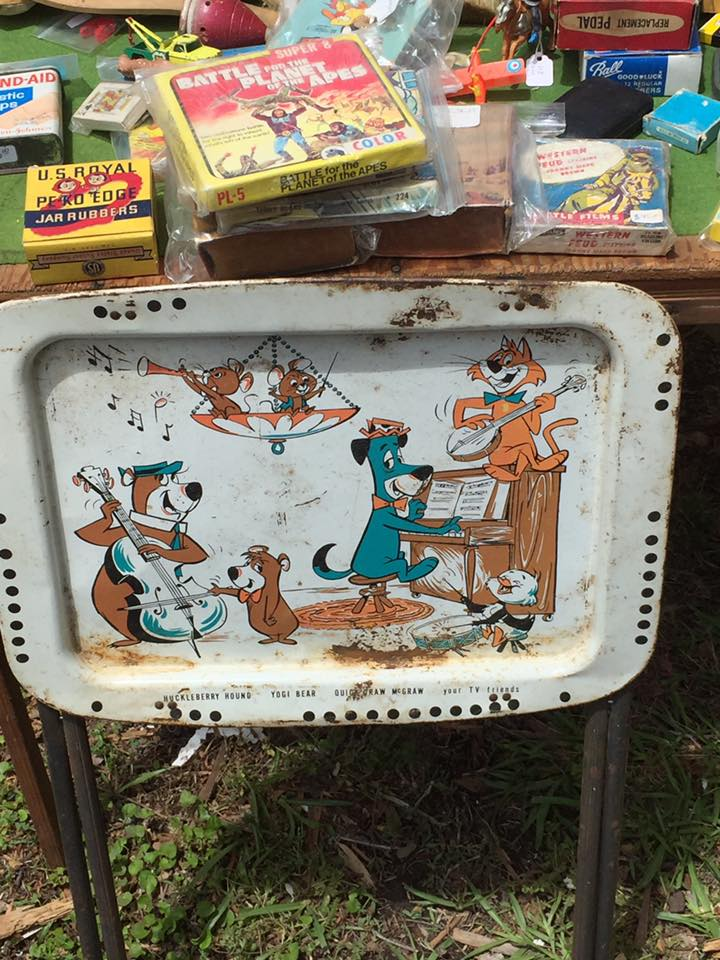
Because the thing cost almost nothing to manufacture, competition happened entirely on the printed surface.
Sets were sold on their design, seasonally, in styles meant to coordinate with a room – gold and black scrollwork, roses, a fruit arrangement, a hunting scene, a colonial motif, a woodgrain to match panelling. Manufacturers issued new patterns constantly, and department stores and catalogues sold them as a decorative purchase rather than as equipment.
Which is why they date a room so precisely. A tray table is a dated graphic on a piece of steel, and it dates to within a couple of years, in the same way the printed glass ovenware of the same period does. The two were frequently bought to match.
They were also a standard inexpensive gift – a wedding present at the low end, a Christmas present from an aunt, a housewarming item – which is why households ended up with two mismatched sets.
Everybody Used Them for Everything Except Eating
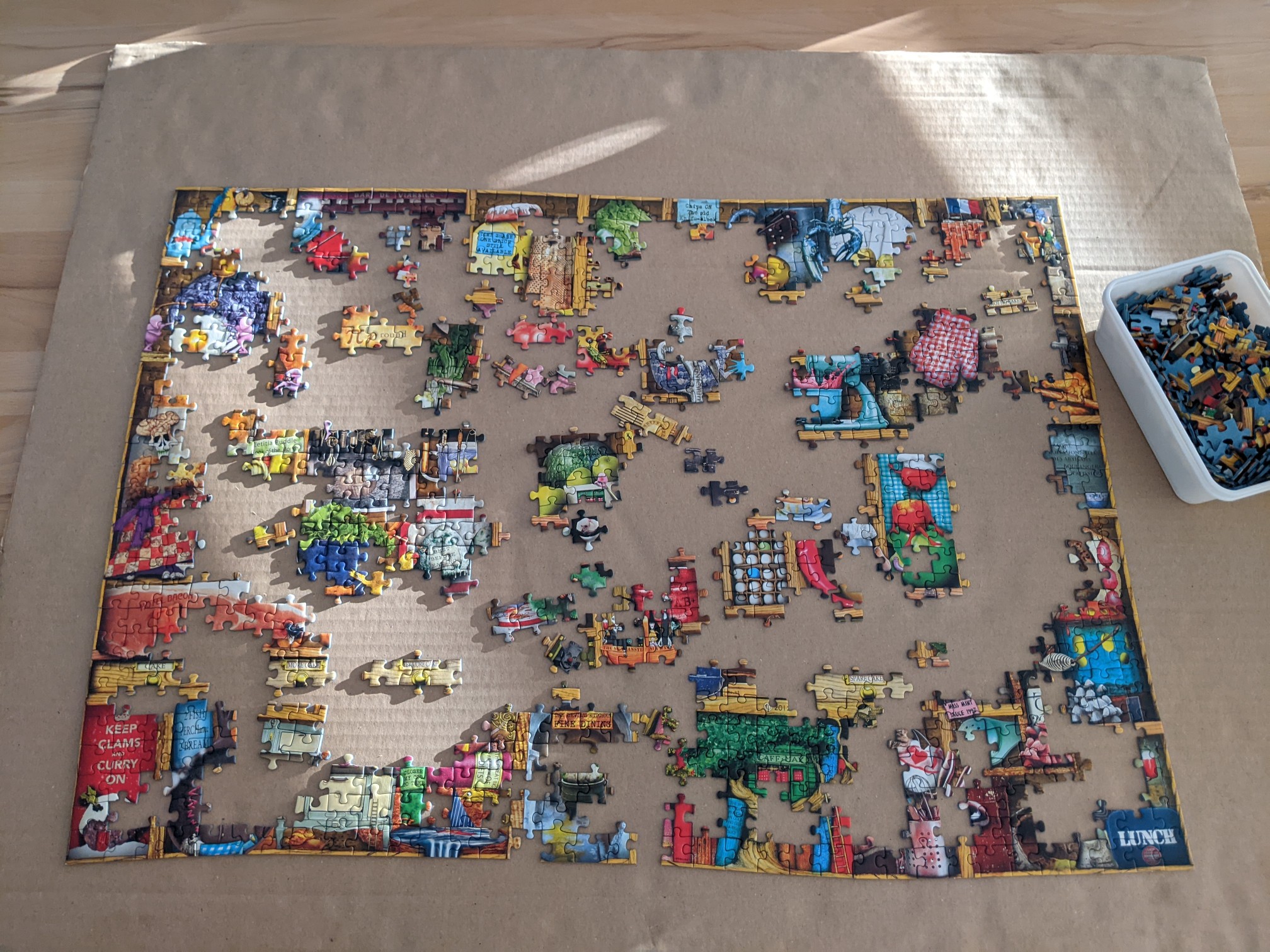
The surprising thing in people’s accounts is how little of the usage was meals.
They held jigsaw puzzles, which is probably the single most common secondary use, because a tray with a lip is the correct object for a puzzle in progress. Card games. Homework in front of the television. A sewing project. A model kit. Letters being written. A board game, with the box lid as a second surface.
In households with somebody unwell, a tray table beside a bed or a chair was the whole domestic infrastructure of being ill – a glass, a bowl, a book, a box of tissues and a bell, within reach, for a week.
And they held the overflow at any gathering: drinks at a party, a plate of something at Christmas, the coffee during a card evening. A set of four light tables that appear from a rack in ten seconds and disappear again is genuinely useful furniture in a house with a fixed amount of floor.
They Were Also the First Piece of Furniture a Child Was Trusted With
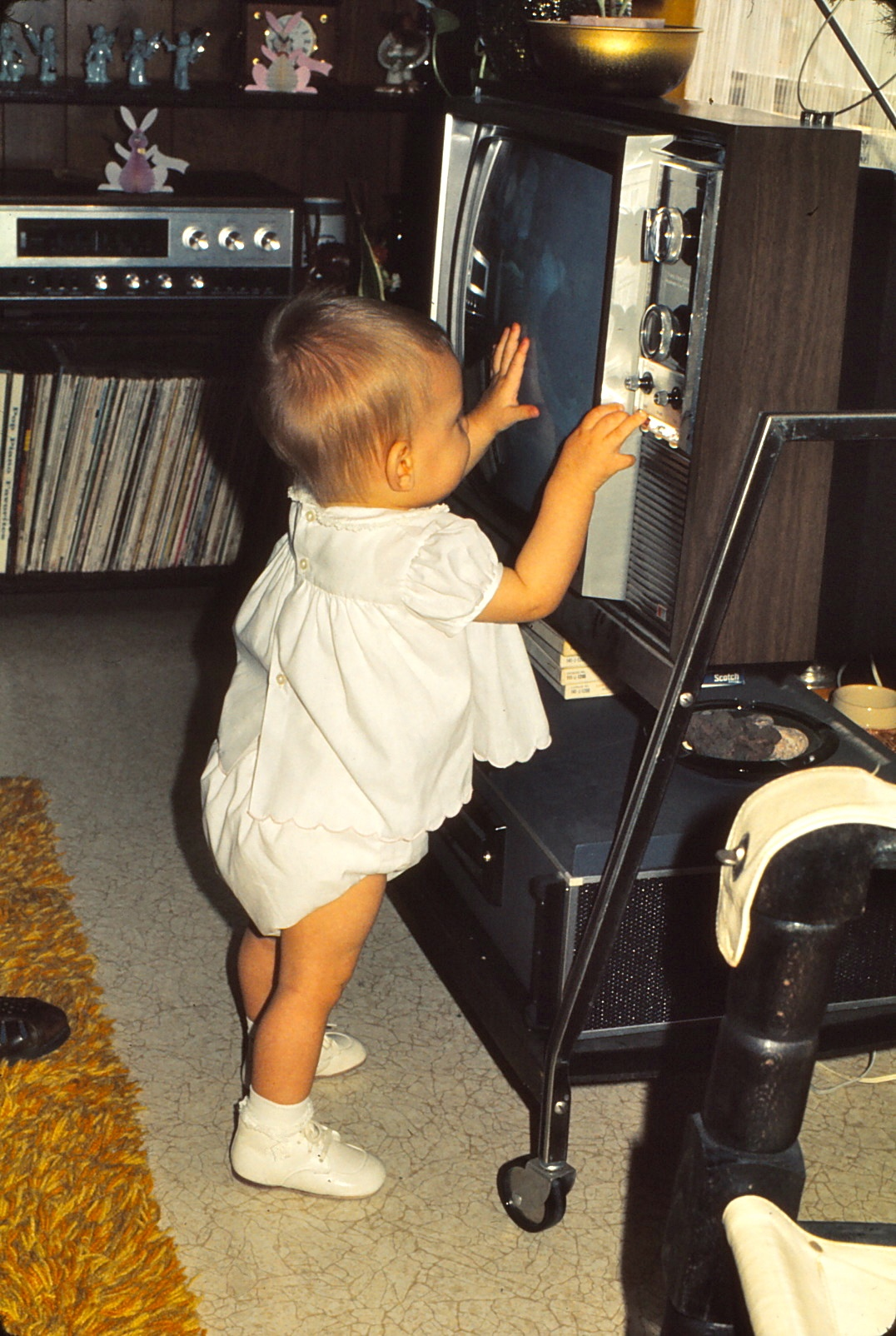
The small detail that comes up repeatedly is that the trays were a child’s responsibility.
Setting them up before a meal, carrying them to the right chairs, fetching the one from the rack for whoever had arrived, and folding them away afterwards was a task small enough for a five-year-old and visible enough to feel like a job. The wire frames pinch, the trays are light but awkward, and getting four of them standing without one collapsing is a real if minor skill.
Which means a great many Americans’ earliest memory of contributing to a household is a folding tray table, and the particular noise of the frame snapping into position is one of the sounds people name without prompting.
The Rack Was the Reason Households Owned Four
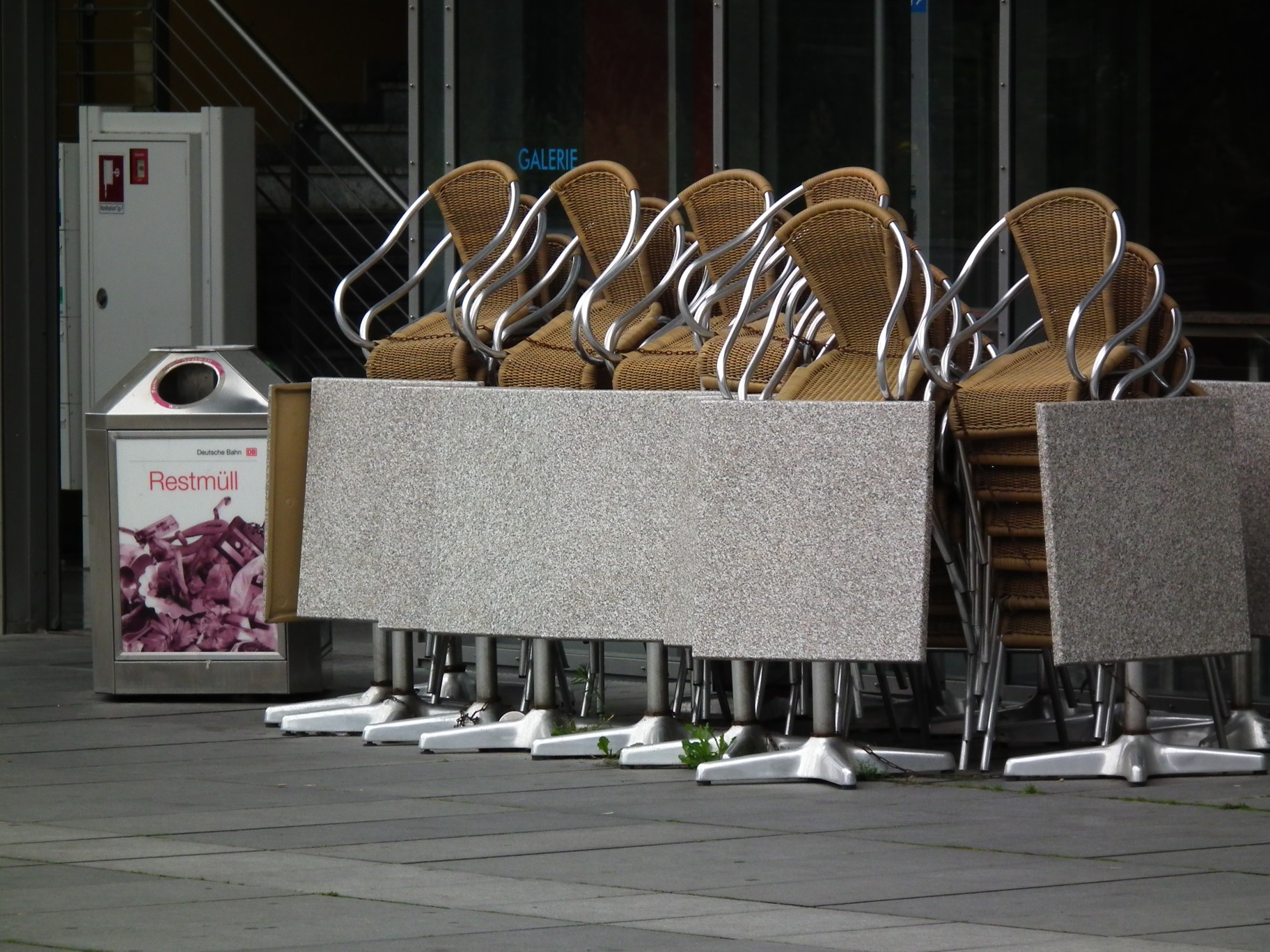
The wire stand that came with the set deserves its own paragraph, because it is the part that made the product work as furniture.
Four folded trays stacked against a wall fall over, slide, and get put somewhere else by whoever is cleaning. A rack holds them upright in a slot each, takes up about eight inches of floor, and can stand in a corner, beside a chair or behind a door – which means the set has a home, and a set with a home does not get dispersed.
That sounds trivial and it is why these survived in households for twenty years when similar light furniture did not. The failure mode of folding furniture is not breakage; it is that the pieces end up in four different rooms and then in a basement. The rack solved that for a few cents of bent wire.
It also made the set a visible object in the room rather than a stored one, which is why the patterns mattered. A rack of four trays standing in a corner is on display whether or not anybody is eating, so it had to look like something somebody had chosen.
What Went Wrong With Them
Three things, none of which is about dining habits.
They are unstable, and that is intrinsic rather than a defect. A narrow-footed folding frame with a top at knee height, holding a plate and a glass, standing on carpet, in a room with children and a dog in it, goes over – and when it goes over it goes over completely. Every household that owned them has an incident.
They are also small. A tray sized to be carried and folded is not big enough for a full plate, a glass, a side dish and cutlery, which means something is always balanced on the edge or held in a lap anyway.
And the furniture around them changed. The coffee table got bigger, the sectional sofa arrived with a built-in console, side tables multiplied, and the open-plan kitchen island put a usable eating surface in the room people were already in. The job the tray was invented for got absorbed by furniture that was already there.
The Twist: They Came Back, With a Different Name
Folding tray tables are manufactured and sold in volume today, and they are not sold as tray tables.
They are sold as laptop desks. Bed tables. Breakfast trays. Sofa tables. Standing desk converters. Snack tables. Work-from-home tables. The expensive versions have a tilting top, a cup recess, a slot for a tablet and a cooling fan for a computer.
And the proposition is word for word the original one: a light, foldable, portable surface at seated height, for a person who is doing something in a comfortable chair in a room that has no table in it.
Which is the whole lesson of the object. The tray table was never about television and never about dinner. It was about a basic mismatch in how American houses are built – the rooms with the comfortable seating have no work surfaces, and the rooms with the work surfaces have no comfortable seating – and that mismatch has not been resolved in sixty years.
So the same object keeps being reinvented, in plastic and bamboo and powder-coated steel, with a cup holder, for twice the price, to do exactly what a stamped tin tray on a bent wire frame did for a dollar in 1974.
The patterns were better then.
Like our content? Follow us for more.
