Americans visiting Europe discover that food scraps go in a bin, and Europeans visiting America discover a switch on the wall that makes a noise like a small industrial accident and then silence.
The device is close to unknown in most of the world and close to standard in the United States, and the split is not about whether the technology works. It is about a decision each country made regarding where food waste should end up, and that decision was made by the people who run the sewage works rather than by anybody in a kitchen.
What It Actually Does
It is worth being clear about the mechanism, because the name is misleading in a way that matters.
The device does not have blades and it does not cut. A motor spins a plate at the bottom of a chamber, and two blunt lugs on that plate are free to swing. Food is thrown outward by the spin and driven against a stationary ring with holes and sharp edges, and the lugs push it against that ring until it is small enough to pass through. It is a grinder working by impact and abrasion, not a blender.
That design is why it tolerates things a bladed device would not – a blunt lug hitting a bone is fine, whereas a blade would chip – and it is why the common fear of a sharpened spinning edge is misplaced.
What comes out is a slurry of fine particles in water, and this is the critical point for everything that follows. The device does not dispose of anything. It converts solid food waste into suspended organic matter in the wastewater, and sends it to the sewage treatment works. The waste has not gone away; it has changed form and changed address.
Like our content? Follow us for more.
Why America Said Yes
The American adoption was driven by three things that lined up.
The first is the sewer system. American municipal sewerage was built out largely in the twentieth century, to generous capacity, as part of an expanding housing stock. A system with headroom can absorb an additional organic load without much argument.
The second is the kitchen itself. The American postwar kitchen was being designed and sold as a technological space, and the device fitted that marketing perfectly: it was electrical, it was concealed, it eliminated an unpleasant task, and it was exactly the kind of thing a modern house was supposed to have. It arrived at the same moment as the dishwasher and the wall oven and was sold alongside them.
The third is that in a hot climate a bin of food waste is a real problem. Across much of the United States, kitchen scraps left in a container for several days in summer attract insects and rodents and smell, and until frequent separate food-waste collection exists – which in most of America it still does not – the sink is the quickest way to get the material out of the building.
And there is a fourth factor that is rarely mentioned: in several American jurisdictions the device became a requirement rather than an option, specified in building codes for new dwellings on the reasoning that it reduced the solid waste a city had to collect.
Why Several Countries Said No
The objections are specific and they come from the treatment side.
The first is hydraulic and organic load. Food waste ground into the sewer arrives at the treatment works as additional organic material, which increases the demand on the biological stages of treatment, increases the sludge the works has to handle, and in a system already near capacity is simply an additional cost borne by the utility rather than by the household.
The second is the pipes. Food waste in a sewer contributes to the accumulation of fat, oil and grease, which combines with other material to form the blockages that cities now spend substantial sums removing. The device does not cause that problem alone – cooking fat poured down the sink is a far larger contributor – but it adds to the organic load that the deposits build on.
The third is the counterargument from resource use. Food waste collected separately can be composted or digested to produce gas and fertiliser, both of which have value. Food waste sent down the drain cannot be recovered in that form, and from the point of view of a country that has built separate organic collection, grinding the material into the sewer destroys a resource it has gone to some trouble to capture.
That third point is the one that explains the prohibitions. A country with kerbside food-waste collection and anaerobic digestion has an alternative destination that is better in its own terms, and permitting the sink route undermines the system it has built.
The Comparison Is Closer Than It Looks
It is tempting to conclude that one side is simply right, and the honest position is that it depends on what already exists.
If a country has separate food-waste collection, treatment capacity designed around it, and digestion or composting at the other end, then the sink is clearly the worse route: it loads the sewage works, contributes to blockages and destroys recoverable material.
If a country has no separate collection, sends its food waste to landfill in bags, and has sewerage with capacity to spare, the arithmetic changes substantially. Food waste in landfill decomposes without oxygen and produces methane, which unless captured is a considerably worse outcome than the same material arriving at a treatment works. Against that baseline the sink can be the better of the two available options, and studies comparing the routes have found results that vary with exactly these local conditions.
Which is why the sensible summary is that the device is not inherently good or bad. It is a decision about which of a country’s existing systems absorbs the material, and the right answer differs by country – and is why neither side’s position is the obvious one it is usually presented as.
The One Country That Went Further Than America
There is an instructive exception that cuts across the whole argument, and it is a city rather than a country.
A number of American and Canadian municipalities went beyond permitting the device and actively encouraged it, on the reasoning laid out above: every pound of food waste that leaves by the sewer is a pound the city does not have to send a truck for. Collection is the expensive part of municipal waste management, far more so than treatment, and a device that diverts material out of the truck and into a pipe the city already owns and already pumps is a straightforward saving.
That reasoning only holds under two conditions, and they are the conditions that decide this whole question. The treatment works has to have spare biological capacity, and the sewers have to be in good enough condition to carry the extra organic load without the deposits becoming a maintenance problem.
Where both hold, the sink is cheaper for the city than the truck. Where either fails, the city has moved a cost from a department with a visible budget to one with a less visible one, and the saving is a transfer rather than a reduction.
Which is the most honest way to state the entire disagreement. Nobody is disputing the physics. They are disputing which municipal department ends up paying, and whether the material is worth recovering when it gets there.
What It Did to American Kitchens
The device had second-order effects on how American kitchens are used, and they are the part that is invisible from outside.
It removed the kitchen bin from the sink area. In a kitchen with a disposal, wet waste goes down the drain and the bin handles dry packaging, which means the bin is smaller, smells less, needs emptying less often and can live in a cupboard. A European kitchen bin has to accommodate wet food waste and is sited and sized accordingly.
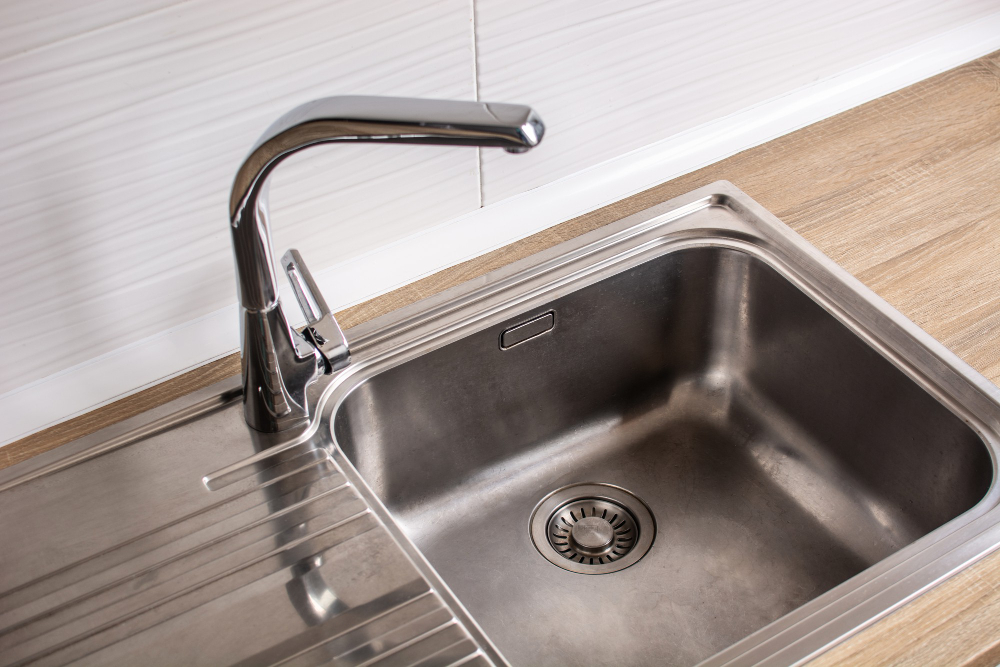
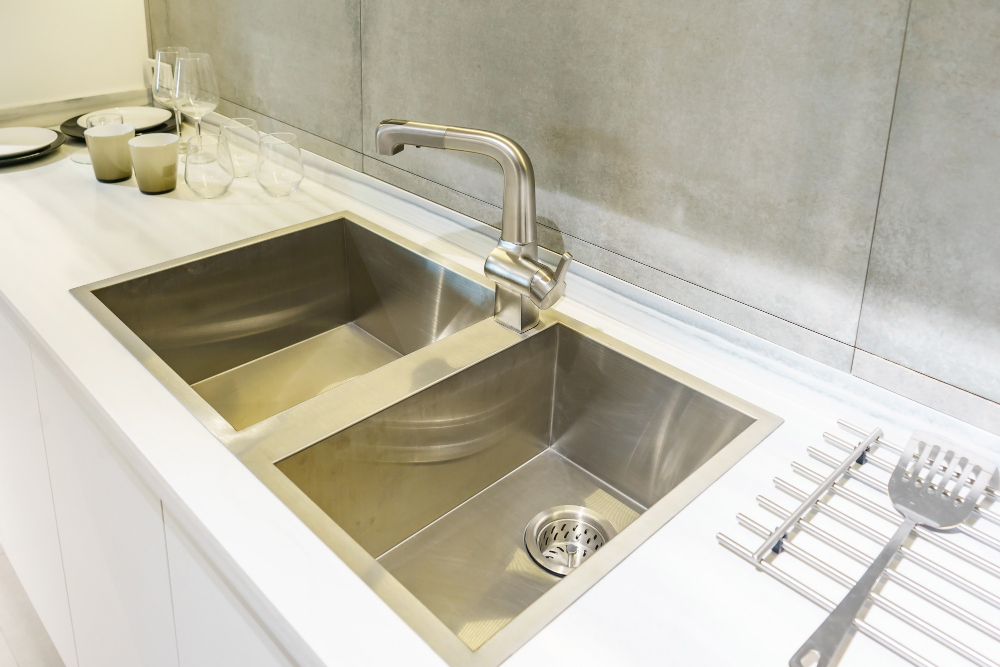
It changed plate scraping. The American habit of scraping a plate directly into the sink under running water, rather than into a bin, is a behaviour the device created, and it is why American sinks are configured with the disposal under the larger bowl and why the double-bowl sink persisted so long.
And it made the under-sink cupboard a mechanical space. An American under-sink contains a motor, a power connection and a drain configuration built around it, which is why that cupboard holds less than its European equivalent and why replacing a sink in an American kitchen is an electrical job as well as a plumbing one.
The Honest Summary
The device under an American sink is not a disposal. It is a grinder that converts food waste into suspended solids in wastewater and transfers it from the household’s bin to the municipal sewage works.
America adopted it because it had sewer capacity, because the postwar kitchen was being sold on exactly this kind of technology, because a bin of scraps in a hot climate is a real nuisance, and in some places because building codes required it.
Several European countries restricted or prohibited it because they had decided food waste should be collected separately and turned into gas and fertiliser, and because grinding it into the sewer loads the treatment works, feeds the blockages and destroys a resource they had built a system to capture.
Both positions are defensible and neither is universal, because the answer depends entirely on what the alternative is. Against separate collection and digestion, the sink is the worse route. Against a bag going to landfill, it is arguably the better one.
Which means the switch on an American wall is not a quirk of plumbing. It is the visible end of a national decision about where the leftovers go.
Like our content? Follow us for more.