

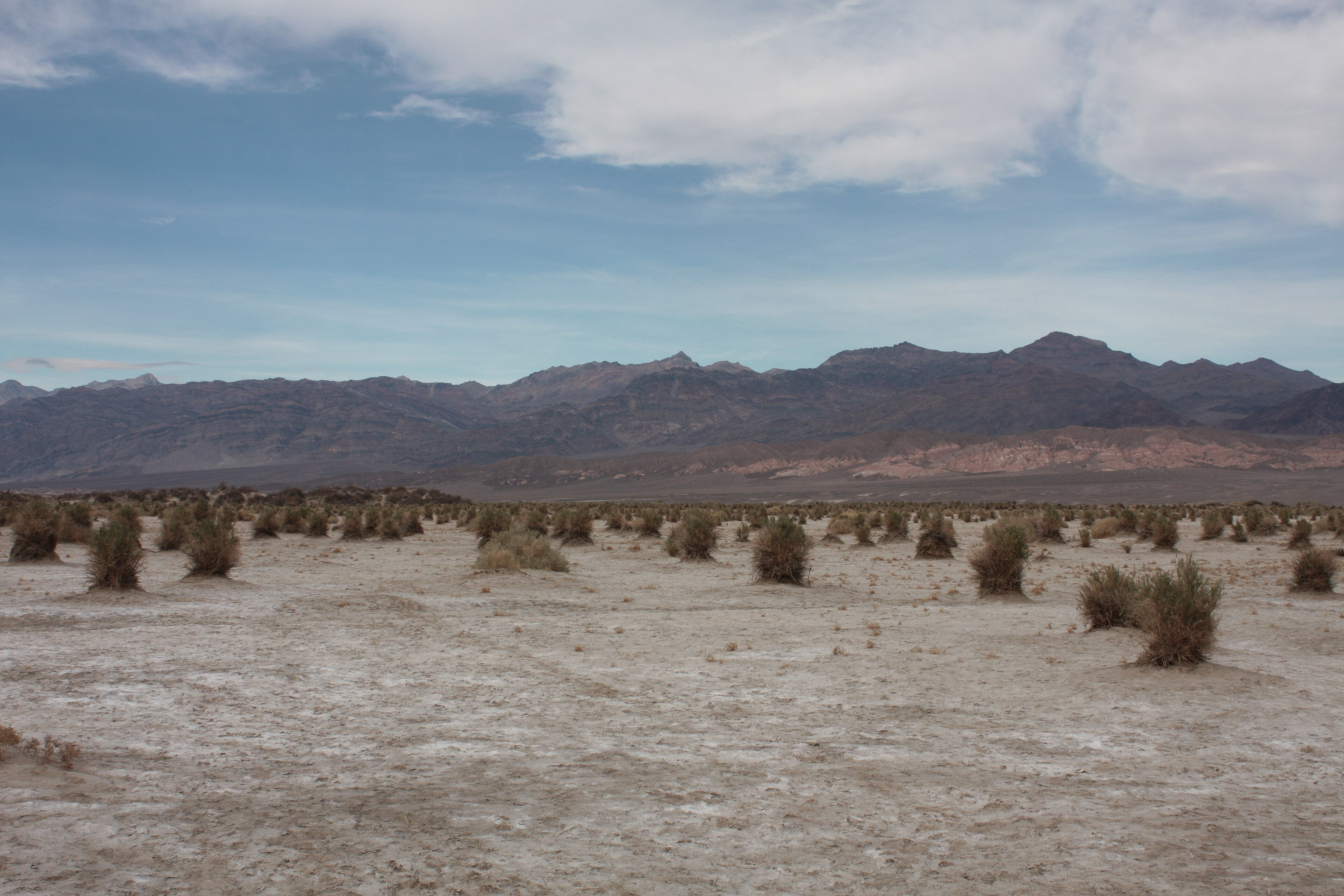
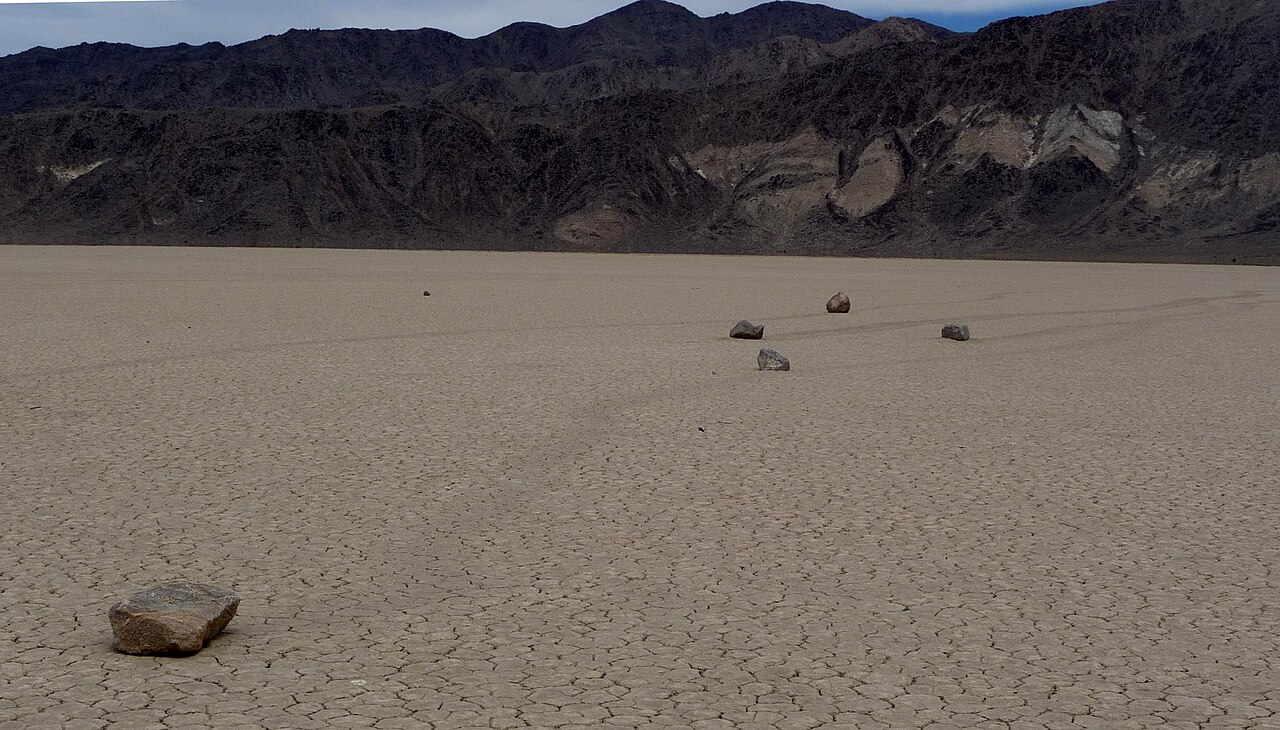
In the remote northern reaches of Death Valley National Park lies a flat, dry lakebed called Racetrack Playa, and scattered across its cracked mud surface are hundreds of rocks that appear to have gone for a walk. Behind each one trails a long groove pressed into the ground — some tracks running for hundreds of feet, some dead straight, some curving and looping, a few making sharp turns. The rocks look exactly as though something dragged them across the playa. But nothing did. There are no tire marks, no footprints, no sign of any hand at work. The stones, it seems, moved themselves.
For roughly a century, the sailing stones of Death Valley were one of the most tantalizing small mysteries in science. The tracks were obvious proof that the rocks moved, sometimes hundreds of pounds of rock traveling hundreds of feet, yet no one — not visitors, not scientists studying them since the 1940s — had ever witnessed a single stone in motion. That combination of clear evidence and total absence of eyewitnesses made the playa a magnet for theories, and it wasn’t until 2014 that a patient team finally caught the rocks in the act and revealed a mechanism stranger and more delicate than almost anyone had guessed.
The Evidence Everyone Could See
What made the sailing stones so maddening is that the effect was undeniable while the cause was invisible. The rocks range from small stones to slabs weighing several hundred pounds — the heaviest cited at around 700 pounds — and they sit on the flat surface of the playa at the end of trails scored into the dried mud. The tracks are typically an inch or less deep, a few inches wide, and can extend for hundreds of feet.
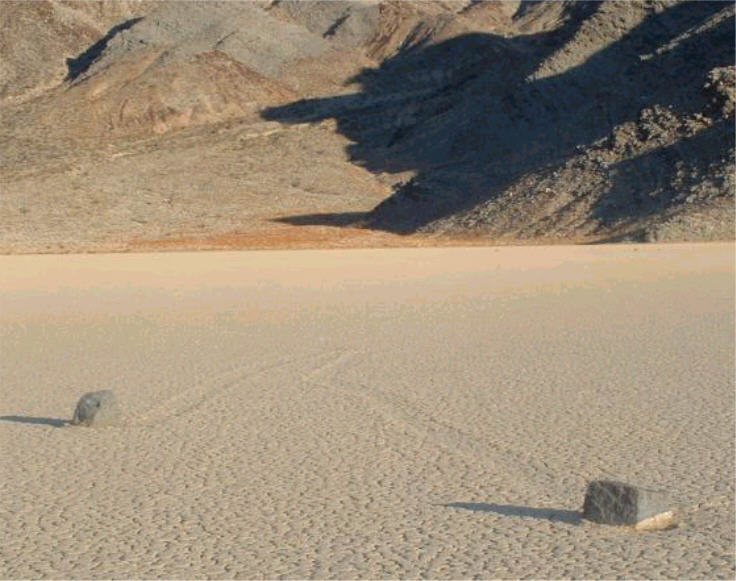
The trails themselves are full of clues that only deepened the puzzle. Some run perfectly straight; others curve gracefully or zigzag; some make abrupt directional changes. In places, multiple rocks near one another left parallel tracks that turn in sync, as though they moved together. Rocks with rough bottoms tended to leave straight, striated grooves, while smooth-bottomed rocks wandered. And most confounding of all, some stones appeared to have moved slightly uphill. Whatever force was at work was gentle enough to leave a shallow trail, strong enough to move a heavy rock, and rare enough that in decades of study nobody had ever seen it happen.
Like our content? Follow us for more.
A Century of Theories
Into that vacuum rushed explanations of every kind. Because no one could observe the movement directly, the field was wide open, and over the decades people proposed nearly everything.
The serious hypotheses centered on wind and ice. Death Valley can produce strong winds, and one long-standing idea held that powerful gusts simply pushed the rocks across a slick, wet playa surface. Another proposed that thin sheets of ice forming on the occasionally flooded lakebed somehow helped the wind move the stones, though the exact mechanism stayed murky. The less serious explanations ran the full range of the paranormal and the mischievous: magnetic fields, mysterious earth energies, pranksters sneaking out to drag rocks for fun, and — inevitably — aliens. None of the natural theories could be confirmed, because the essential thing was always missing: an actual observation of a rock moving. The stones only seemed to travel once every few years, and the tracks might persist for years afterward, so catching the event in person seemed to require either enormous patience or enormous luck.
The Experiment That Finally Caught Them
The mystery was cracked by a group of researchers who decided to stop guessing and start watching. Beginning around 2011, a team — including paleobiologist Richard Norris, his cousin James Norris, and planetary scientist Ralph Lorenz — set up a proper experiment at Racetrack Playa. They attached GPS units to fifteen rocks, brought in their own to avoid disturbing the natural ones, and built a high-resolution weather station on the playa to monitor conditions continuously. Then they waited, expecting to wait years.
They got lucky fast. In the winter of 2013 into 2014, the right conditions arrived, and in December 2013 the team was actually present when the rocks began to move — capturing the first direct observations and time-lapse footage of the sailing stones in action, backed by GPS data recording the motion. After a century of speculation, someone finally saw it happen and had the instruments running to prove it.
The Delicate Machine Behind It
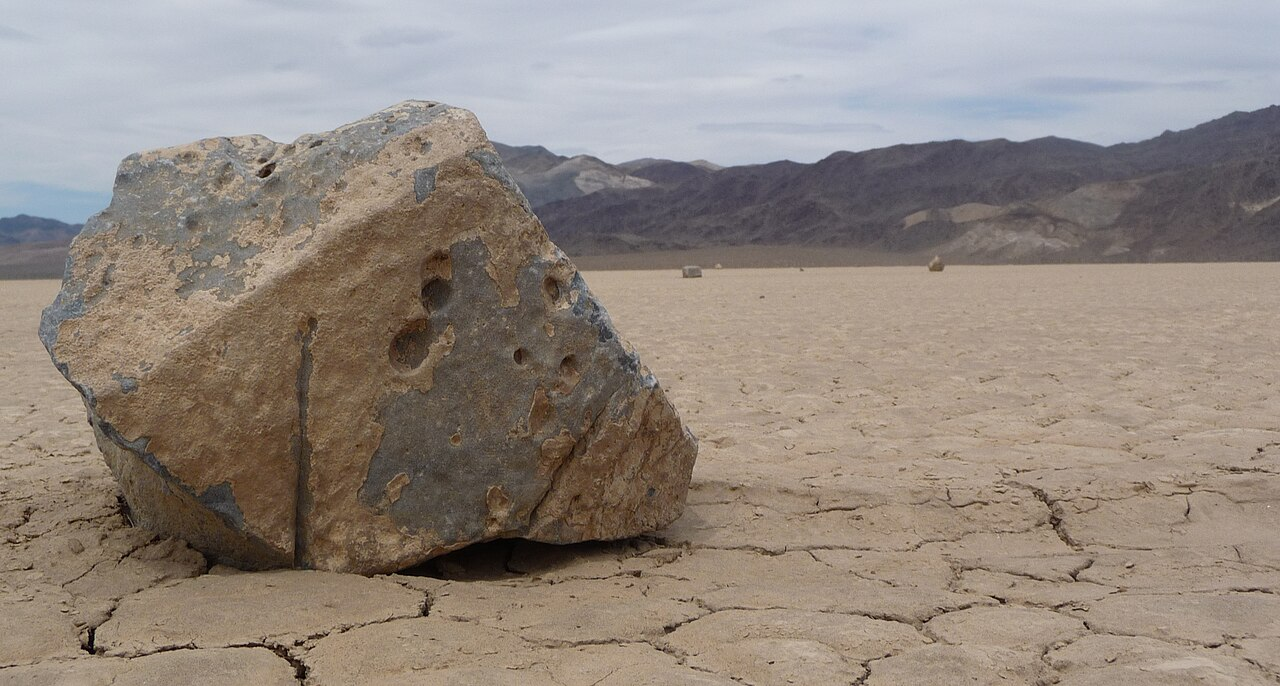
The mechanism they documented is a real Goldilocks phenomenon — it requires a precise and unlikely combination of conditions, which is exactly why it happens so rarely and why no one had ever seen it.
Here is the sequence. First, the playa has to flood with a shallow layer of water — deep enough to matter but shallow enough that the tops of the rocks stay exposed. Then, on cold winter nights, that water freezes into a thin sheet of “windowpane” ice, delicate enough to move but strong enough to hold together in large panels. When the sun comes up the next day and the ice begins to melt and break apart, the sheet fractures into big floating panels. And then a light wind — not a gale, just a gentle breeze — pushes those floating panels of ice across the water, and the ice, driving against the rocks, shoves them slowly forward. The stones slide across the soft, slick mud beneath the shallow water, carving the trails as they go.
The rocks move astonishingly slowly, only a few feet per minute, driven by ice panels tens of yards across, and the direction is set by the wind and the flow of water under the ice. This is why the trails curve and turn — as the wind shifts and the water flows, the panels change direction, and the rocks follow. As one of the researchers memorably put it, the rocks move for only about a minute out of a million minutes. In one remarkable stretch across those weeks, hundreds of rocks scooted across the playa multiple times. The mechanism, known as ice shove, is familiar from polar regions but had never before been documented moving rocks in a desert like this. The uphill movement, the synchronized tracks, the abrupt turns — all of it fell out naturally from thin ice, shallow water, and a light breeze.
Why It’s Better Solved Than Mysterious
There’s sometimes a sense of disappointment when a beloved mystery gets explained, but the sailing stones are a case where the real answer is more delightful than the myths. Aliens and magnetism are lazy explanations; a mechanism requiring the precise coincidence of flooding, overnight freezing, thin windowpane ice, morning melt, and a gentle wind — recurring only once every few years and moving rocks at the speed of a minute hand — is a truly elegant piece of natural machinery.
It’s also a small triumph of scientific patience. The answer had been hovering near the truth for decades — wind and ice were both part of it — but confirming it required someone to commit to sitting on a remote desert lakebed with GPS trackers and a weather station, prepared to wait years for a rare event, and then to be fortunate enough to be standing there when it finally happened. The stones kept their secret for a hundred years not because it was supernatural but because the conditions that reveal it are so fleeting.
Visiting the Racetrack
For travelers, Racetrack Playa is one of the more rewarding hard-to-reach spots in the American Southwest, precisely because getting there is an effort. It sits in a remote part of Death Valley National Park, reached by a long, rough, unpaved road that typically requires a high-clearance vehicle and good tires — flats are common, and there’s no quick help out there. It is not a casual drive, and the park service’s cautions about preparation, water, and vehicle capability should be taken seriously in a place this hot and isolated.
Those who make it find a vast, flat, cracked expanse ringed by mountains, with the mysterious rocks and their trails scattered across the surface near the southern end. The cardinal rule is to look and never touch: walking on the playa when it’s wet leaves footprints that can scar the delicate surface for years, and moving or taking the rocks destroys the very phenomenon people come to see. Photographs of the stones and their long trails, especially in raking morning or evening light, are among the most striking images in the Southwest — a landscape that looks like another planet, where the rocks go for walks when nobody’s watching.
The Rocks That Kept Their Secret
The sailing stones endure as a favorite story because they sat for a century at the perfect intersection of obvious and inexplicable. The proof was right there in the mud, unmistakable and permanent, and yet the cause stayed hidden the entire time, because it revealed itself only for a minute at a stretch, once every few years, in the freezing dark of a flooded desert. No wonder people reached for aliens.
The truth — thin ice, shallow water, a light breeze, and rocks sliding a few feet per minute across slick mud — is the kind of answer that makes the world seem more interesting rather than less. Nothing pushed those rocks but the delicate physics of a desert that floods and freezes just often enough to move them. They really do sail across the ground on their own, in a sense. It just took a hundred years, some GPS units, and a great deal of patience to catch them doing it.
Like our content? Follow us for more.
