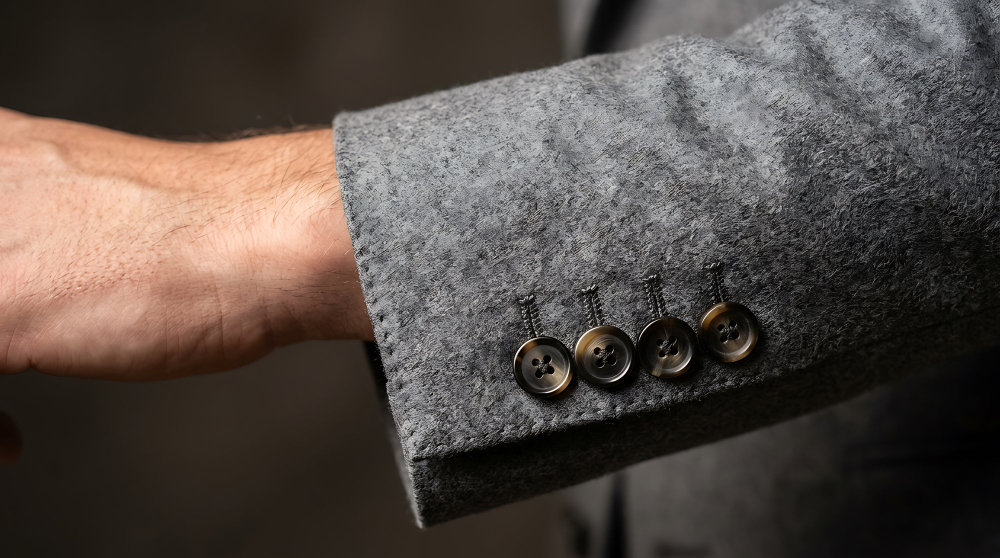
There are buttons on the sleeve of almost every jacket, and on almost every jacket they do not do anything.
They cannot be undone, because on most garments there are no holes beneath them. The buttonholes are stitched onto solid cloth as decoration, the buttons are sewn on top, and the entire arrangement imitates a closure that does not exist.
This is not a modern cost-cutting measure. It is the surviving trace of something that was once genuinely useful, and the small number of garments where the buttons still work are the reason the detail is worth understanding at all.
The Buttons Were Once a Real Closure
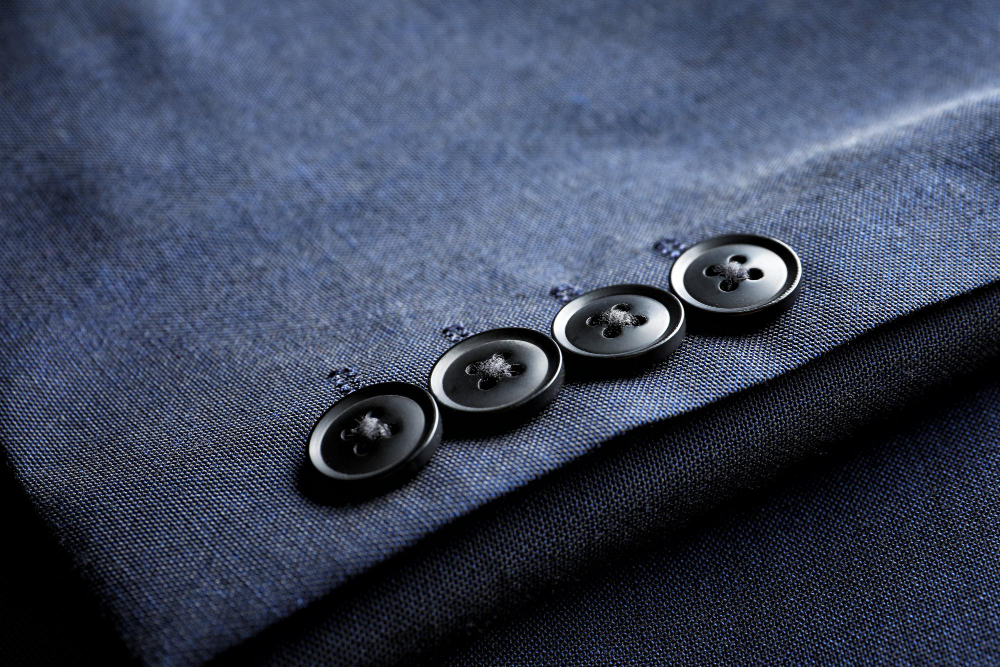
Before jackets were made in standard sizes, a sleeve was cut long and fitted to the arm of the person who was going to wear it. A working closure at the wrist let the cuff be adjusted, let it be opened to get the hand through a narrow sleeve, and – the use that mattered most to anyone working with their hands – let it be turned back out of the way.
That last use is the one that explains the detail’s survival. A man who needed to wash his hands, work at a bench, or do anything that would ruin a cuff could unbutton and fold the sleeve back rather than take the coat off. In a period when a coat was not removed in company, that mattered.
Once ready-made clothing arrived, sleeves were cut to standard lengths and finished at the factory, and the working closure became pointless. Removing the buttons entirely was not an option, because by then they read as part of what a jacket was. So they stayed, and the holes stopped being cut, and a functional feature became a signature.
The number settled at four on most tailored jackets, though two and three are both common and some garments carry one. The number carries no meaning in itself, whatever anybody tells you, beyond the conventions of a particular maker or period.
Like our content? Follow us for more.
The Surgeon’s Cuff Is the Version That Still Works
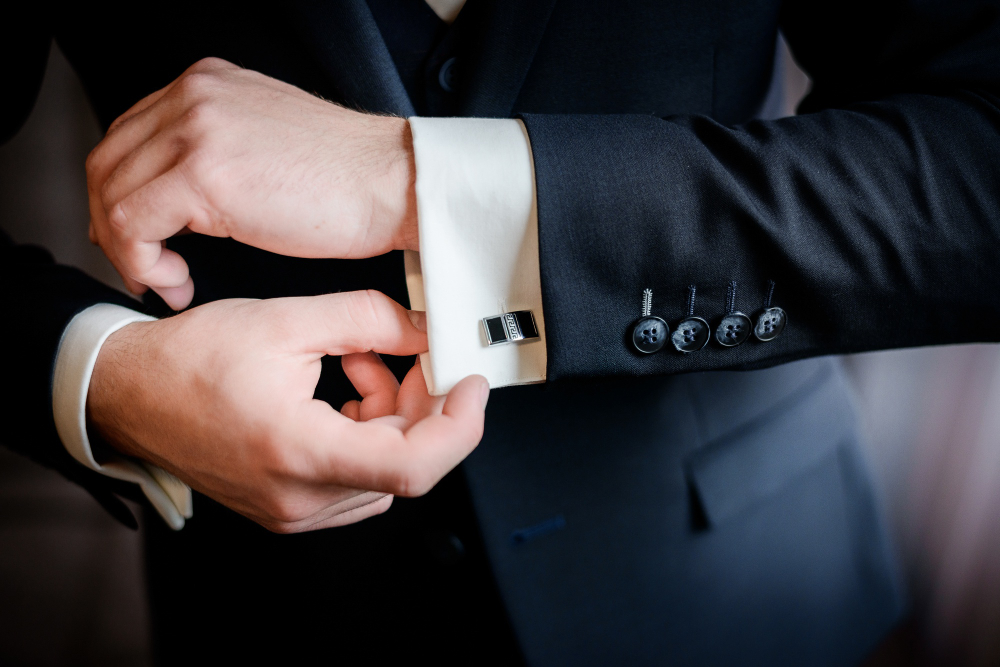
A sleeve where the buttons genuinely unbutton is known in tailoring as a working cuff, or a surgeon’s cuff – the second name from the claim that surgeons needed to turn their sleeves back, which is plausible, undocumented as an origin, and almost certainly attached to the feature long after the fact.
Whatever it is called, it is a marker. Cutting real buttonholes in a finished sleeve is extra work, and more importantly it removes the ability to alter the sleeve length later, because shortening a sleeve from the cuff means cutting through the buttonholes. A maker who cuts working holes is committing to that sleeve length permanently, which only makes sense if the sleeve was measured for one specific person.
So a working cuff is not primarily a luxury feature. It is evidence that the garment was made to a measurement rather than to a size. That is why it appears on bespoke and high-end ready-to-wear and almost nowhere else, and why it has become a thing people check.
It has also, inevitably, become a thing people fake. Garments exist with real buttonholes cut through a cuff that was never fitted to anybody, purely so the buttons can be shown undone – which is a signal about a signal, and tells you nothing except that the maker knew the signal existed.
Leaving One Undone Is a Signal About a Signal
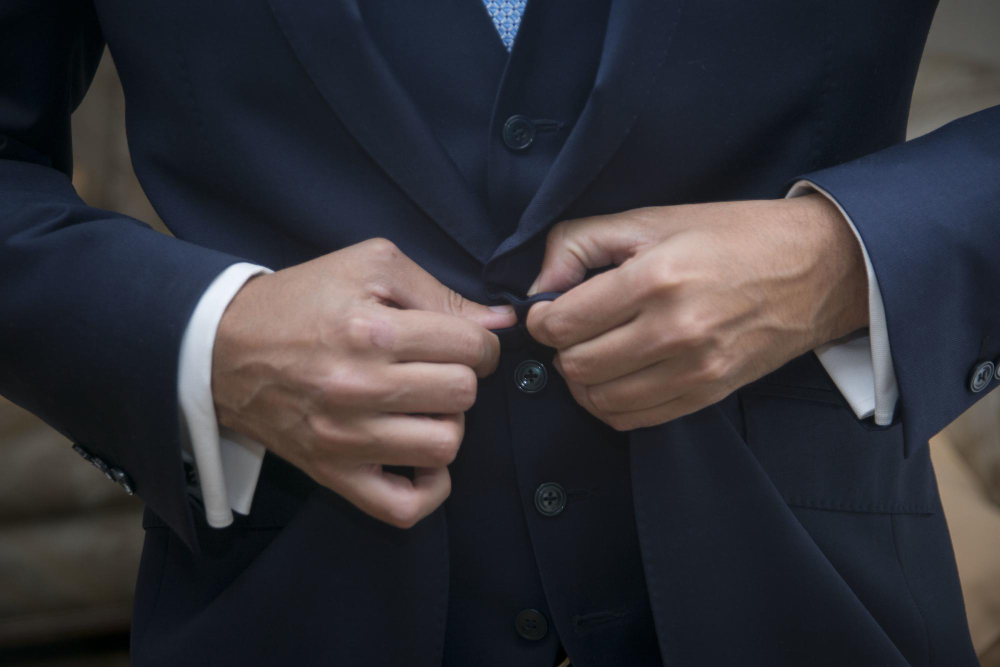
Because a working cuff is uncommon, people who have one sometimes leave the last button undone to demonstrate that it can be.
Within tailoring this is treated as somewhere between a wink and a mild vulgarity depending on who you ask, and the disagreement is genuine rather than settled. One view is that a feature with no remaining function may as well be enjoyed, and that an undone cuff button is a quiet nod to anybody who knows what it means. The other is that deliberately displaying evidence of expenditure is the opposite of what tailoring at that level is supposed to be doing, and that the point of a good coat is that it does not announce itself.
Both positions are coherent. What is not in dispute is that the gesture only exists because the feature stopped being useful. Nobody in 1890 left a cuff button undone to prove anything – the cuff was undone when there was a reason for it to be undone, and done up the rest of the time.
The Same Thing Happened to Almost Every Detail on the Coat
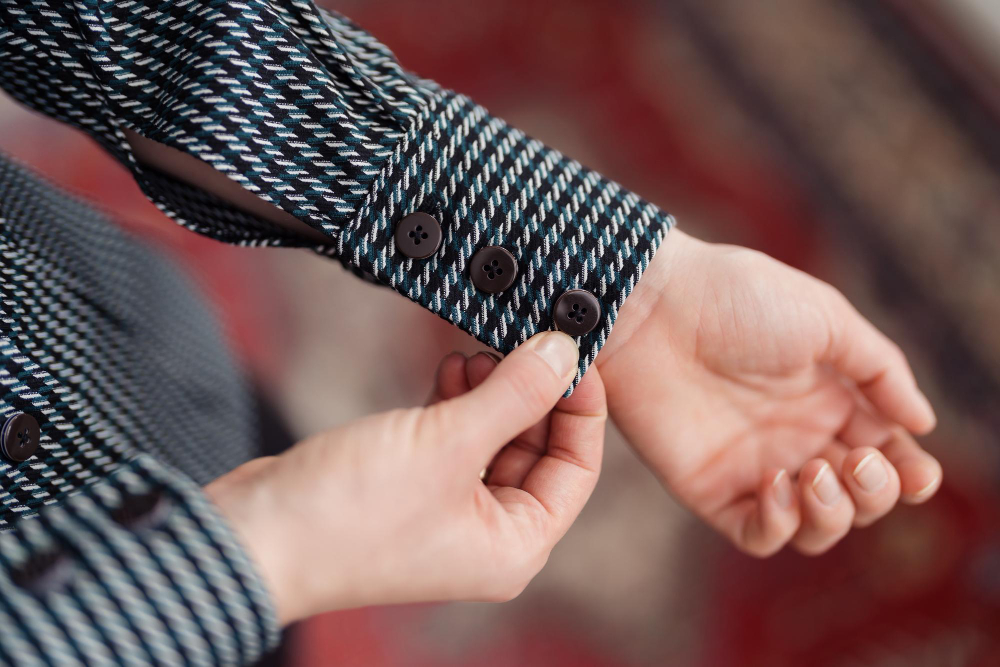
Once you notice it on the sleeve, the pattern turns out to describe most of the jacket.
The notch in a lapel is the remnant of a collar that buttoned up to the throat and was later folded open and left that way. The buttonhole in the left lapel, which now holds a flower on formal occasions, is the hole that button went through. The vents at the back of the skirt exist because the coat was cut to be worn on a horse. The two buttons on the back of a coat above the vents once anchored a belt or held a sword hanger.
The lowest button on a waistcoat is conventionally left undone, and the usual explanation involves a monarch who could not fasten his – a story that is repeated everywhere, cannot be verified, and persists because it is a better story than the alternative, which is that waistcoats were cut in a way that made the bottom button pull and people simply stopped using it.
In every case the function went and the shape stayed. Clothing is unusually conservative in this respect, because a garment is read by other people, and a feature that has become a recognised part of what something looks like cannot be removed without the result looking wrong – even when nobody can say what it was for.
Nobody Can Agree How Many There Should Be
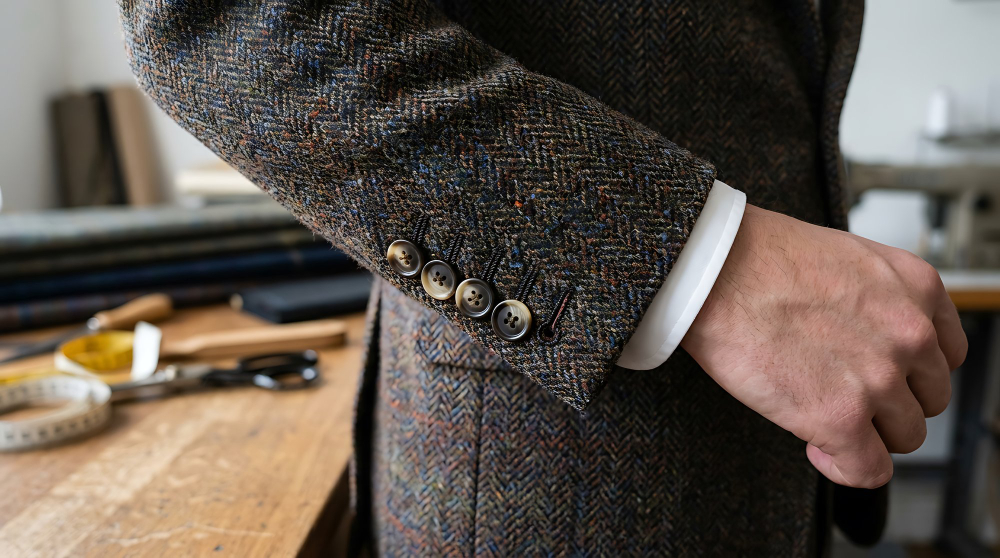
The number of buttons on a sleeve is the part of this that generates the most confident nonsense.
Four is the usual count on a tailored suit jacket. Three is common on a blazer or a sports coat, and on a great deal of ready-made clothing. Two appears on some older garments and on certain regional tailoring traditions. One turns up on casual jackets and on some very expensive ones, where it reads as deliberate restraint.
The explanations offered for these counts are almost all retrospective. You will be told that four indicates a suit and three a sports coat, that a particular number denotes a particular tailoring house, that the count signals formality in a fixed order. None of that holds up across periods or across countries – the conventions are real within a given tradition and at a given time, and they do not generalise into a rule.
What is true is narrower and more interesting. The buttons on a sleeve are spaced so that they sit between the wrist and a point a few inches up the forearm, and that distance only accommodates a certain number at a sensible spacing. Four is about the maximum before the row starts climbing into the sleeve. One looks sparse on a formal garment and deliberate on a casual one. The rest is fashion, and fashion is allowed to be arbitrary.
The buttons also overlap slightly on many tailored sleeves – described as kissing buttons when the edges just touch – which is a sign of a sleeve where the buttons were positioned by hand rather than by a template. It is a smaller and less faked signal than the working cuff, and a more reliable one.
What the Detail Is Actually Good For
There is a practical use for all this, and it is not showing off.
If you are buying a jacket and want to know whether the sleeve can be altered, the buttons tell you. Non-functional buttons on a plain cuff mean the sleeve can usually be shortened from the wrist, which is the normal and much better alteration. Real buttonholes mean it cannot, and the sleeve has to be shortened from the shoulder instead – a far more difficult operation that involves taking the sleeve out and reseting it, and which on many garments is not worth doing.
That is the genuinely useful thing. The feature that reads as the mark of a superior garment is also the feature that makes the most common and most worthwhile alteration impossible, and anybody buying ready-made clothing is better served by the version that does nothing.
Which is a fitting conclusion for a detail whose entire history is a function disappearing and the shape of it refusing to.
Have a look at your own sleeve. If the holes are stitched on top of solid cloth, that jacket was made to a size.
And if they are real, somebody decided the length of that sleeve once and for all, and committed to it permanently.
Like our content? Follow us for more.