

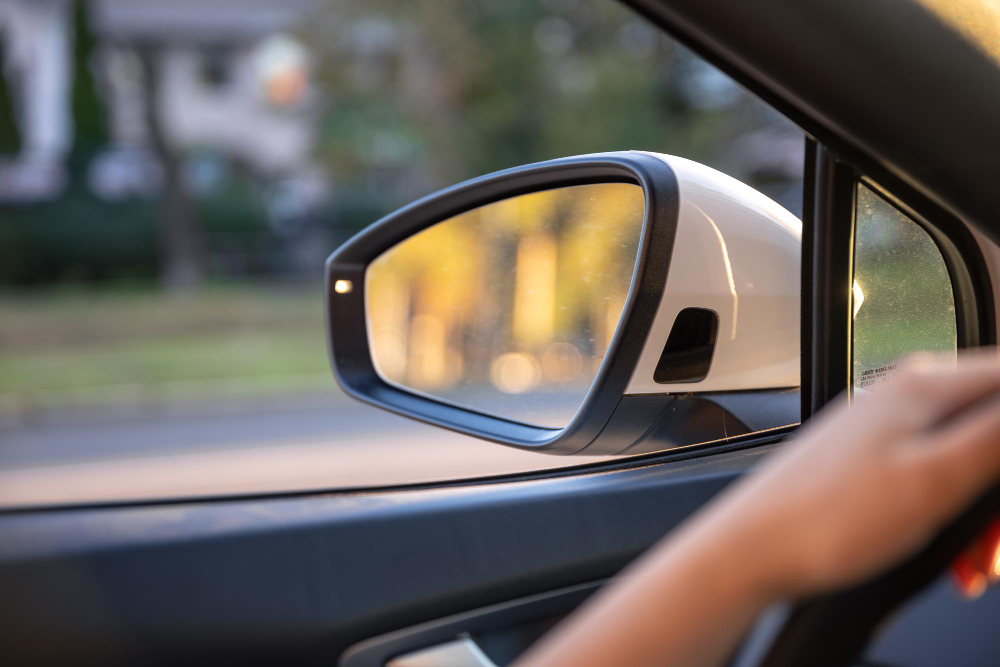
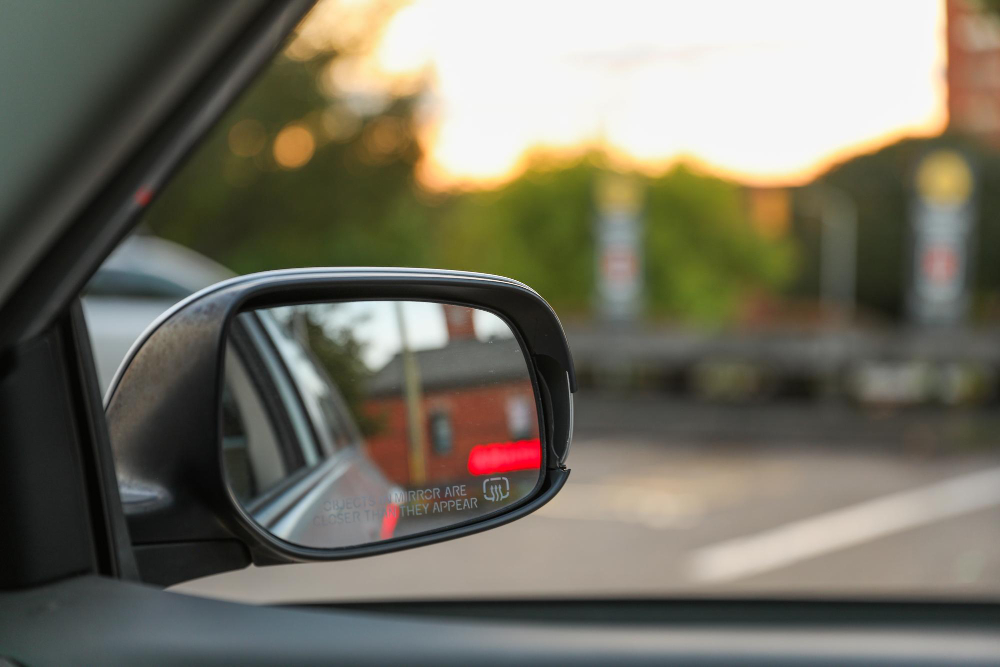
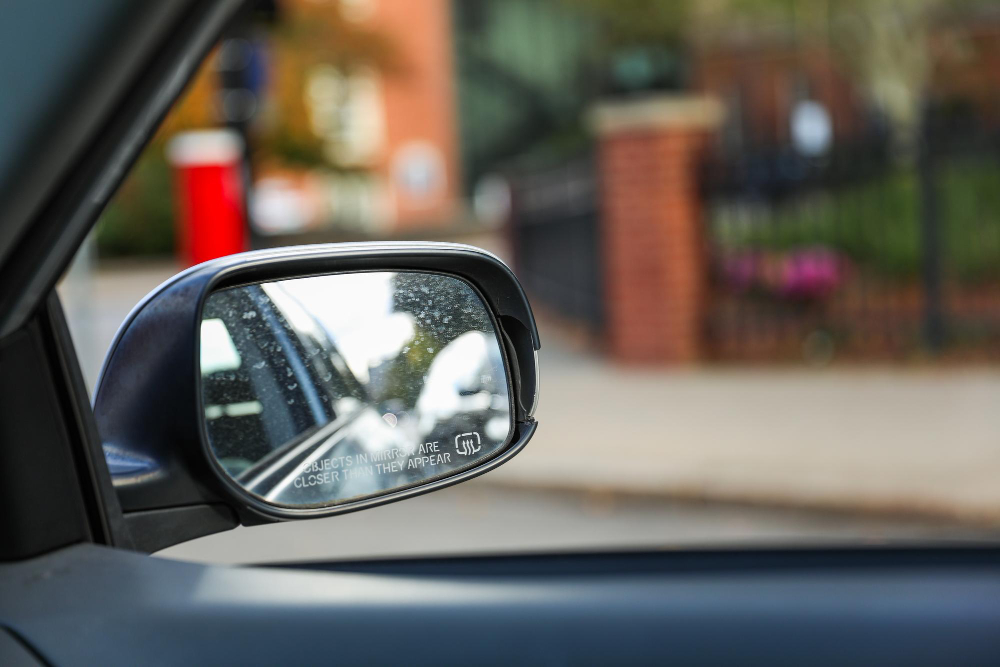
On a great many cars there is a line of text etched into the passenger-side mirror warning that objects are closer than they appear, and nothing of the kind on the driver’s side.
People generally read this as legal caution – a manufacturer covering itself. It is not. The two mirrors are different objects made to different shapes, and the warning appears on exactly the one where it is true.
One Mirror Is Flat and the Other Is Not
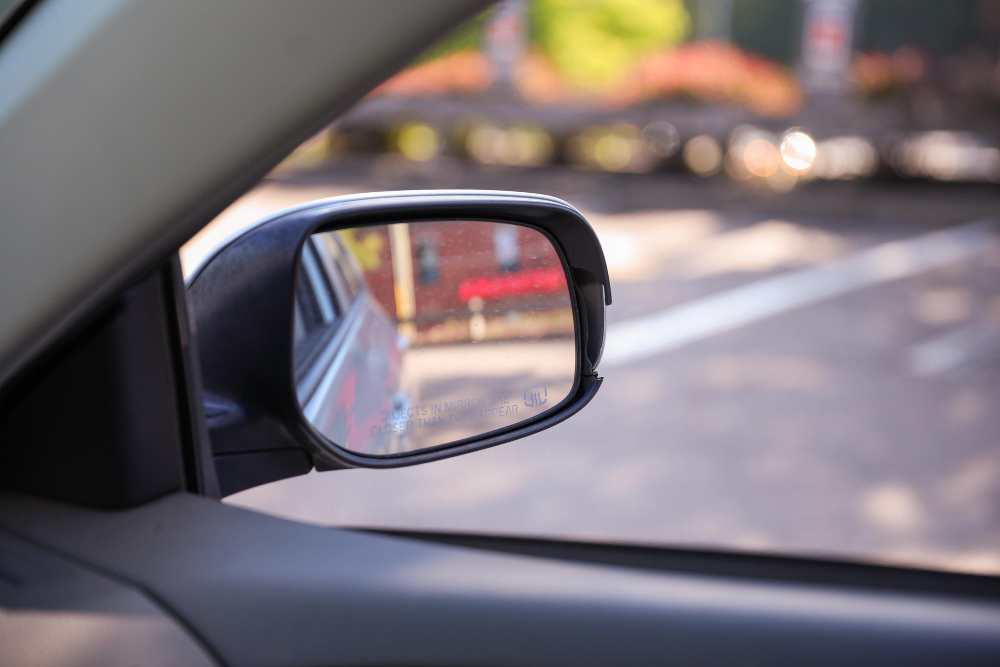
The mirror on the driver’s side of a car is usually flat, or very nearly so. A flat mirror shows things at their actual angular size, which means your judgement of distance from it works the way your judgement of distance normally works. You look in it, you see a car, and your estimate of how far away that car is will be about right.
The mirror on the passenger side is convex – curved outwards, like the back of a spoon. A convex mirror does something a flat one cannot: it compresses a much wider scene into the same area of glass. Everything visible in it is shrunk, and because the brain estimates distance partly from apparent size, everything looks further away than it is.
That is the whole explanation. The warning is on the convex mirror because the convex mirror genuinely misleads you about distance, and it is absent from the flat one because the flat one does not.
Like our content? Follow us for more.
Why Accept a Mirror That Lies

The obvious question is why anybody would fit a mirror that distorts distance, and the answer is that the alternative is worse.
A flat mirror shows a narrow slice of the world behind the car. On the driver’s side that is tolerable, because the driver sits close to that mirror and can see a reasonable field in it, and can also turn their head and look.
On the passenger side the mirror is much further from the driver’s eye. A flat mirror at that distance shows a very narrow field indeed – narrow enough to miss an entire vehicle sitting alongside. Curving the glass widens that field substantially and brings the region beside the car into view.
So the trade is explicit: accuracy about distance in exchange for coverage of area. On the side where you can least afford a hidden vehicle and can least easily check by looking, the designers took coverage and accepted the distortion, then etched a warning onto the glass to tell you what they had done.
The driver’s side keeps accuracy because the driver can see enough in a flat mirror and because distance judgement on that side is what matters most – it is the side you pull out into on most roads, and misjudging a closing speed there is the more dangerous error.
Which Means the Mirrors Are Not Symmetrical and Never Were
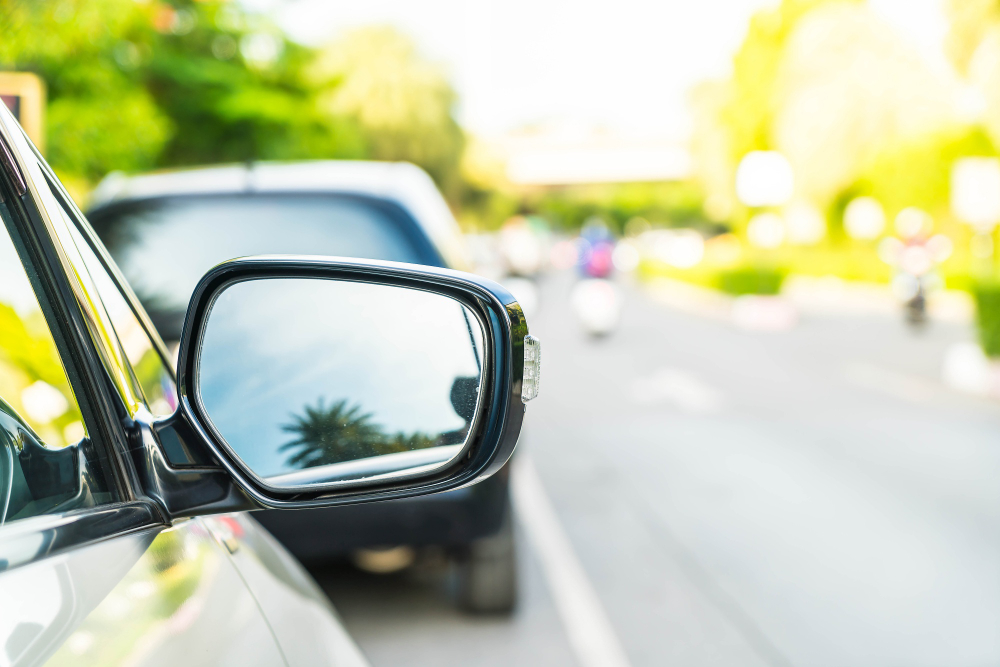
This also explains why the two mirrors are not interchangeable, which anybody who has tried to replace one has discovered.
The glass is a different shape. The curvature is specified, and on many cars it varies across the mirror, with a flatter inner section for distance judgement and a more strongly curved outer section to pick up the area beside the car. Where that happens there is often a visible vertical line on the glass marking the change – which most people have looked at for years without registering what it is.
A mirror that combines two curvatures like this is attempting to have both things at once: usable distance estimation in the part of the mirror you check most, and wide coverage in the part that matters for anything coming alongside. It works reasonably well and it takes some getting used to, because a vehicle crossing the dividing line appears to change speed.
The Curvature Is Specified, Not Chosen by Eye
The amount of curve in a convex mirror is not a stylistic decision. It is a number, and it is regulated.
A mirror’s curvature is described by its radius – the radius of the sphere that the mirror’s surface is a section of. A large radius means a gently curved mirror, close to flat, with mild distortion and a modest gain in field of view. A small radius means a strongly curved mirror, a wide field and heavy compression.
Regulations in most places set a minimum radius, which is a maximum on how strongly curved the glass may be, precisely because of the perception problem. Below some amount of curve, objects in the mirror become so compressed that a driver stops being able to judge anything from them at all, and the extra coverage is bought at a price that is no longer worth paying.
So the passenger mirror on a car sits at a deliberate compromise point: curved enough to be worth curving, not curved enough to be useless, with the exact value set by rule rather than by whoever designed the housing. This is also why mirrors across different cars feel broadly similar to use despite looking very different – the glass inside them is working to a narrow range of permitted curvatures even where the shape of the housing varies enormously.
And it is why a replacement mirror has to match the original specification rather than simply fit the hole.
Where This Leaves the Blind Spot
None of this removes the region beside and slightly behind a car that no mirror shows, and understanding why the mirrors are shaped as they are also explains why that region persists.
A mirror can only show what the glass is aimed at. Widening the field by curving the glass reduces the hidden region but cannot eliminate it, because the car’s own bodywork, the pillars and the seats block part of the view regardless of what the mirror does. Beyond a certain amount of curvature the image becomes so compressed that a vehicle in it is too small to notice, which is a different failure rather than a solution.
The practical answers have therefore mostly come from elsewhere: aiming the mirrors further outward than most people do, which reduces the overlap with what the interior mirror already shows and extends coverage sideways; small additional convex mirrors stuck onto the glass, which work but reduce the main mirror’s area; and electronic monitoring that watches the area with sensors and signals when something is in it, which does not depend on the geometry at all.
That last one is why the warning etched on the glass may eventually become a historical curiosity. A system that detects a vehicle and tells you about it does not care how big that vehicle looks.
Interior Mirrors Are a Third Case Entirely
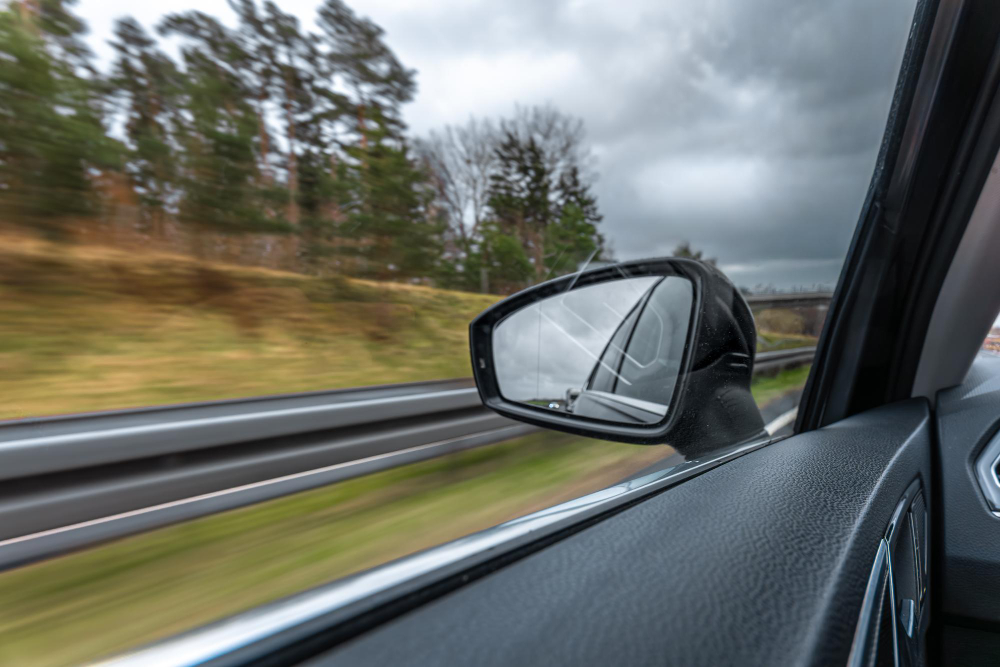
The mirror inside the car behaves differently again, and it is worth including because it completes the picture.
An interior mirror is flat, like the driver’s wing mirror, and it shows a narrow field through the rear window – which is adequate, because it is close to the driver’s eye and the rear window is roughly in line with it.
What it does that neither wing mirror does is dim. A conventional interior mirror has two reflecting surfaces: the silvered back, used normally, and the front face of the glass itself, which reflects only a few per cent of the light. Flipping the lever tilts the wedge-shaped glass so the driver sees the weak front-surface reflection instead of the bright silvered one, which is why headlights behind become faint and why everything else in the mirror becomes almost invisible at the same time.
A driver who has flipped the lever is therefore seeing far less than they think. It cuts glare by cutting almost all the light, not by selectively removing the bright part.
Automatic dimming mirrors solve this differently, by sandwiching a layer that darkens when a current is passed through it and using a light sensor to decide how much. That genuinely reduces glare without the all-or-nothing penalty, and it is one of the clearer cases in a car of an electronic solution outperforming a mechanical one rather than merely replacing it.
Three mirrors, three different pieces of optics, and only one of them tells you in writing what it is doing to your perception.
The Text Itself Is a Small Piece of Design History
The warning is etched or printed onto the glass rather than put on a label, because a label on a mirror would obscure the mirror and would come off.
It sits low on the glass, where it interferes least with the part of the mirror actually used. It is short, because there is very little room and because a driver reading a sentence is a driver not looking at the road. And it is phrased as a statement about appearance rather than an instruction, which is unusual for a safety marking and is also the only honest way to put it – the mirror is not telling you to do anything, it is telling you that your own estimate from this particular piece of glass will be wrong in a particular direction.
Very few warnings manage that. Most tell you not to do something. This one explains a limitation of your own perception and leaves the conclusion to you, in about six words, on a curved surface, for the life of the car.
Next time you are in a car, compare the two mirrors directly. The difference in how much of the world each one contains is much larger than you would expect.
And the one with the writing on it is the one being straight with you.
Like our content? Follow us for more.
