

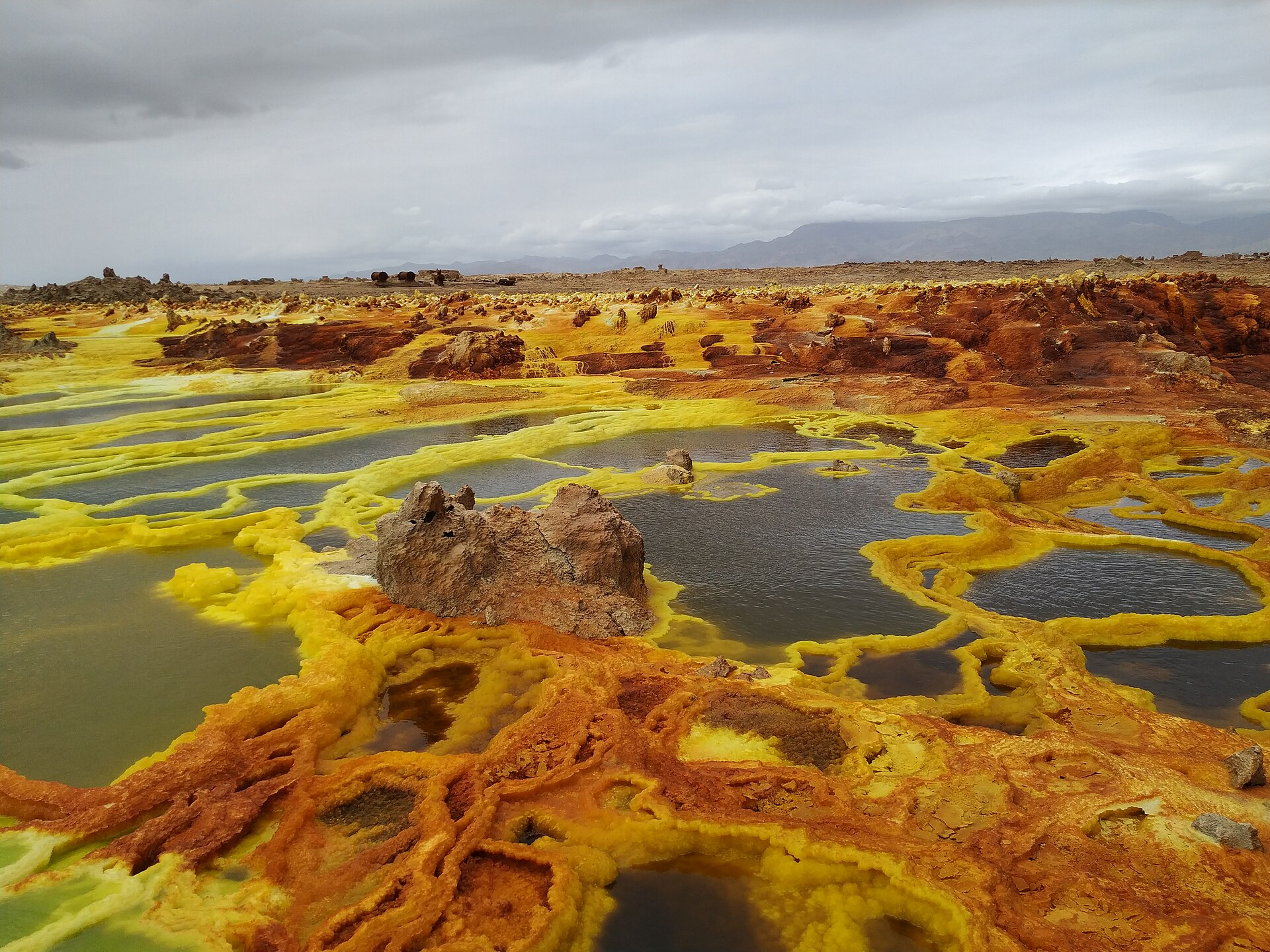
There are landscapes that look like other planets, and then there is the Danakil Depression, which scientists actually use as a stand-in for one. It sits in the Afar region of northern Ethiopia, near the northern end of the Great Rift Valley, and it is a real contender for the most extreme place on the surface of the Earth.
The numbers are difficult to absorb. The floor of the depression lies more than 100 meters, over 400 feet, below sea level, making it one of the lowest points on land anywhere. Average daily temperatures are among the highest recorded on the planet, and readings well past 50 degrees Celsius, over 120 Fahrenheit, occur. Rain is essentially absent, and no streams flow out; whatever water enters simply evaporates. The region contains salt flats stretching to the horizon, active volcanoes, at least one persistent lava lake, and hydrothermal springs that paint the ground in colors that look artificially saturated.
And yet people work there, tourists visit there, and scientists study it because its conditions may resemble environments beyond Earth. Here is the story of one of the strangest places on the planet.
How You Build a Landscape Like This
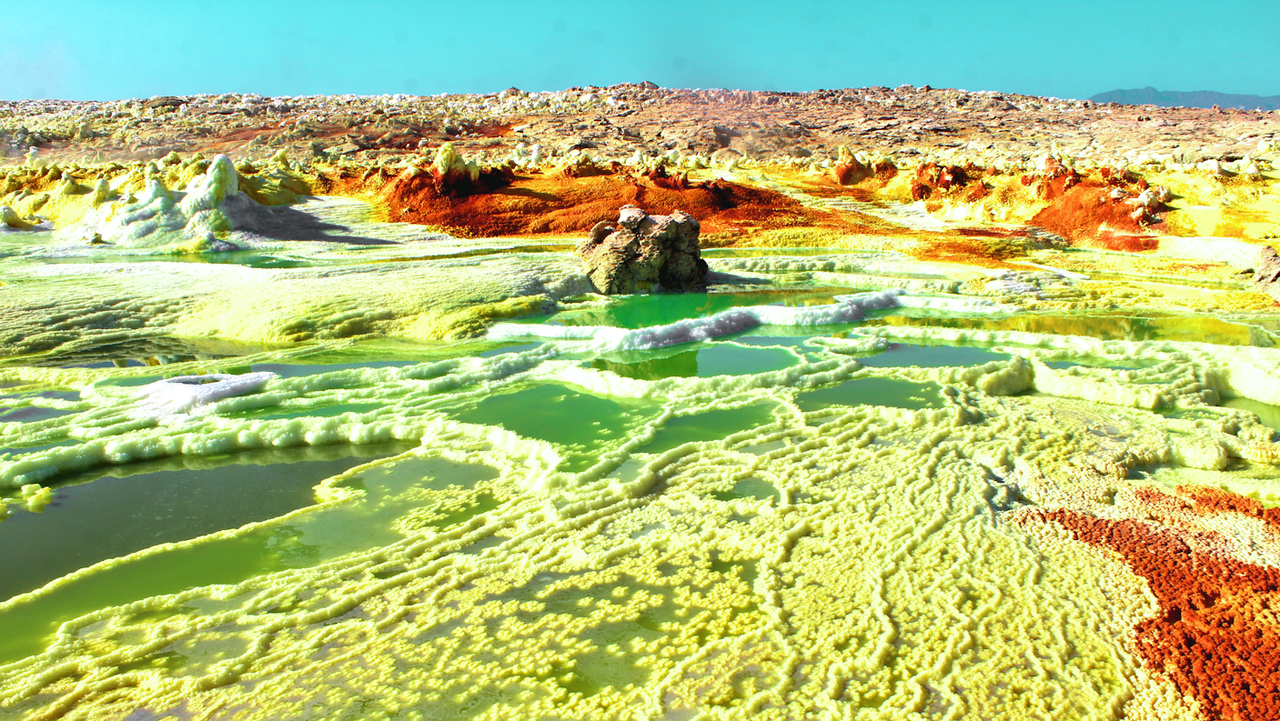
The Danakil owes its existence to plate tectonics operating in an unusually visible way. The depression sits in the Afar Triangle, at a point where three tectonic plates are pulling apart from one another. The land between them is being stretched and dropped, which is why the floor of the depression sits so far below sea level.
This is, in geological terms, an ocean in the earliest stages of being born. Over millions of years, as the plates continue to separate, the sea is expected to flood in permanently. For now, active volcanoes along the margin hold back the Red Sea, leaving a sunken basin sealed off from the water that would otherwise fill it.
The region’s salt comes from earlier episodes when the sea did get in. Ancient inland waters flooded the basin and then evaporated in the heat, leaving their dissolved minerals behind. Repeated over geological time, this has produced salt deposits of remarkable thickness across the depression floor, with more than ten million tons spread across it. Lake Karum and similar bodies are hypersaline remnants of the same process, shallow sheets of brine that mirror the sky.
Like our content? Follow us for more.
The Colors of Dallol
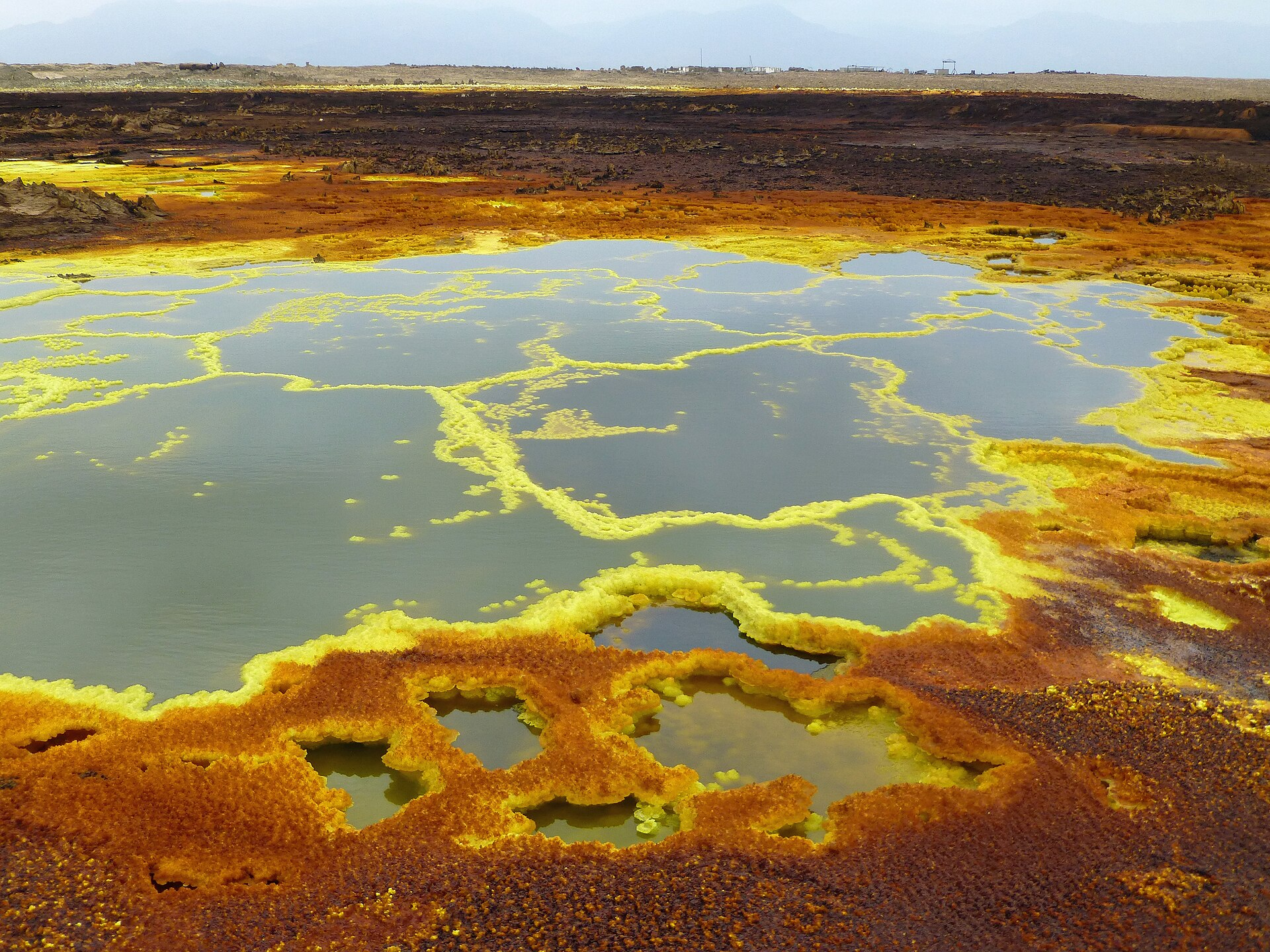
The most photographed part of the Danakil is Dallol, a hydrothermal area surrounding a low volcanic feature, and it does not look like anywhere else on Earth.
Groundwater percolating down through the salt beds is heated by magma below, dissolves enormous quantities of salts, potash, sulfur, iron, and other minerals, and rises back to the surface as hot, chemically loaded springs. As that water reaches the air and evaporates, the dissolved minerals precipitate out into crusts, terraces, and small pools. The colors are the result: sulfur yellows, iron oranges and rusty reds, copper and salt greens, and stretches of blinding white. The overall effect is of a landscape rendered in fluorescent paint.
The chemistry underneath is severe. Some of the acid ponds have been measured at an average pH around 0.2, and at least one sample site has organisms living at a pH of essentially zero, which would potentially set a record for life in an acidic environment. The air carries hydrogen sulfide, giving the whole area a strong rotten-egg smell, along with chlorine vapor in places; researchers working there sometimes need gas masks. It is beautiful in photographs and truly punishing to stand in.
Why Astrobiologists Come Here
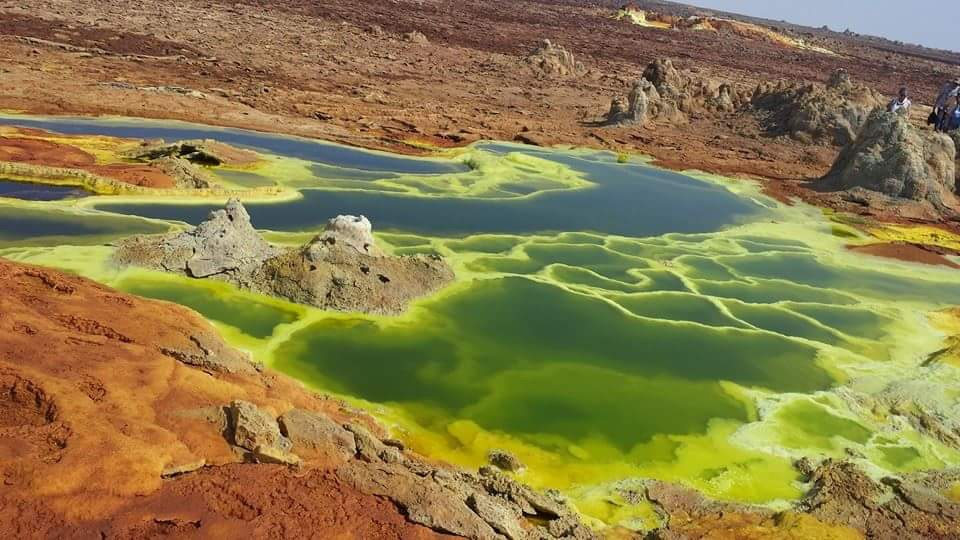
The scientific interest in the Danakil is not primarily geological. It is biological, and it points off-world.
Since 2013, an international research consortium has been studying the region to determine whether these conditions can support life, and what kind. The answer has turned out to be yes, in the form of polyextremophiles: microorganisms that tolerate not one extreme condition but several simultaneously. Surviving high heat is one challenge. Surviving high heat, extreme acidity, heavy salt concentration, and elevated metal content at the same time is a much steeper one, and researchers have reported DNA evidence of organisms doing exactly that.
The relevance to other planets is direct. If life can establish itself in water that is boiling, acidic, saline, and metal-rich, then the range of environments elsewhere in the solar system that might host life expands substantially. Mars is the obvious comparison, with its history of salty, acidic water, and teams from Spanish, Italian, and Ethiopian institutions have worked in the Danakil with precisely that question in mind. The area functions as a natural laboratory for testing what the outer limits of habitability actually are.
There is a caveat worth including, because it is scientifically interesting in its own right. Not everything that looks biological in these pools is alive; some structures that resemble microbial formations turn out to be purely mineral precipitates. Distinguishing the two is difficult in the Danakil and would be far harder on Mars, which is part of why the site is so useful for developing the methods.
The People of the Salt
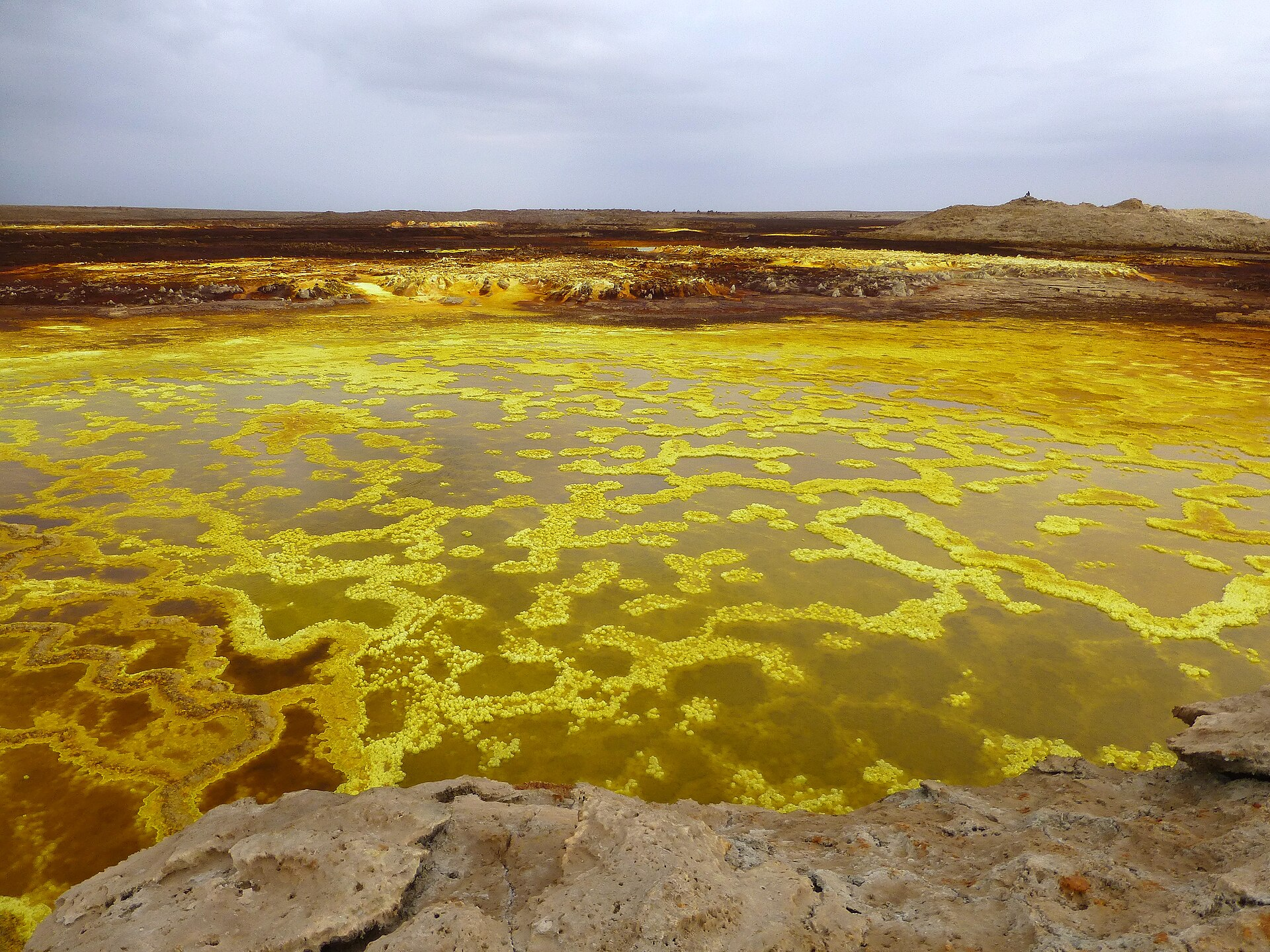
For all the talk of an alien landscape, the Danakil is not empty. The Afar people live in the region and have done so for a very long time, and the salt that makes the depression so hostile is also what has sustained a trade there for centuries.
Salt is cut from the flats into standardized blocks by hand, in temperatures that would be dangerous for most outdoor labor anywhere else, and loaded onto camels. Caravans then carry the blocks out of the depression toward the highlands, a journey of days along routes that have been used for generations. It is among the last working camel salt caravans in the world, and it is a livelihood rather than a performance for visitors.
This is a useful corrective to the “most inhospitable place on Earth” framing that the Danakil usually receives. It is extreme by any measurement. It is also somebody’s home and workplace, and has been throughout the period when outside observers were describing it as uninhabitable.
The region has a further claim on human history. In 1974, researchers working in the Afar region recovered the partial skeleton of an early human ancestor dating back roughly 3.2 million years, known as Lucy, now held at the national museum in Addis Ababa. The area that looks least like anywhere people could live turns out to be part of the landscape where our lineage got started.
Visiting, and the Practical Realities
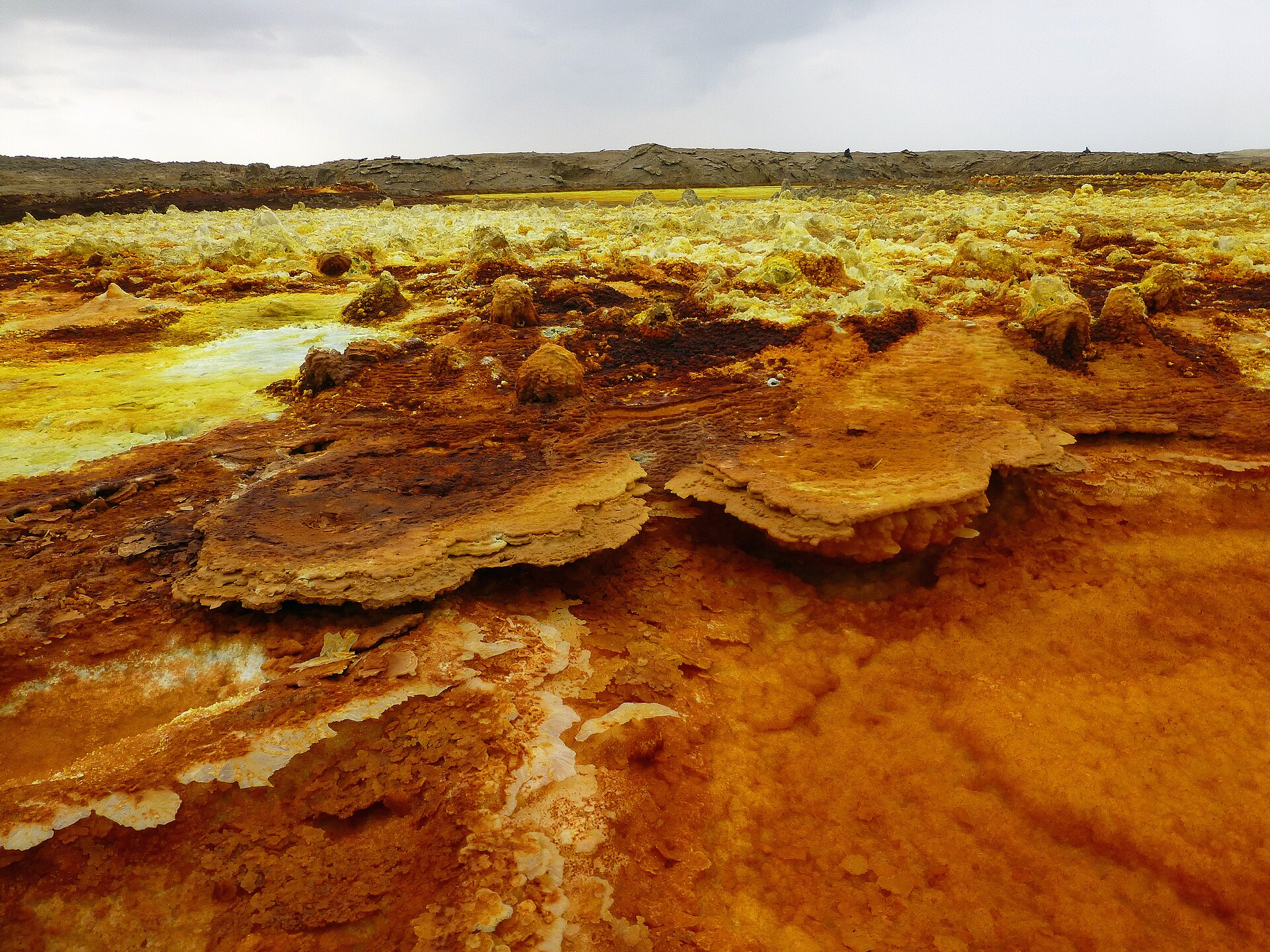
The Danakil has become a destination for travelers drawn to extreme landscapes, and it is worth being clear-eyed about what that involves.
Trips are organized expeditions rather than independent travel. Most depart from Mekele, the nearest sizeable town, in convoys of four-wheel-drive vehicles, on a drive of several hours that begins on asphalt and finishes on lava rock. Itineraries typically combine Dallol’s mineral terraces with Erta Ale, the shield volcano whose name means “smoking mountain” in the Afar language and which has held a persistent lava lake. Local guides and, on many routes, official escorts accompany groups.
Timing matters enormously. The season generally considered viable runs from around November to March, when daytime temperatures merely reach the nineties Fahrenheit rather than the extremes of the hot months. Operators describe the June-to-August window as unsuitable, and while tours sometimes run then, the experience is reported as arduous rather than enjoyable.
One further point deserves plain statement: this is a border region that has experienced instability and conflict at various times, and conditions change. Anyone considering a visit should check current government travel advisories and consult reputable operators about the security situation, rather than relying on any article, including this one.
The Value of a Place Like This
There is a temptation to treat the Danakil purely as a spectacle, a place to photograph neon pools and post the results. That undersells it.
What makes the depression significant is that it functions as a limit case. It shows what happens when a landscape is pushed to extremes of heat, chemistry, and elevation simultaneously, and what still manages to persist under those conditions. It is a working laboratory for understanding the boundaries of habitability, a place where the Earth’s crust is visibly tearing itself apart to make a new ocean, an ancient trade route, and part of the landscape where human ancestry begins.
The Sahara has its dunes and the Amazon has its canopy, but there is nowhere else that offers a sunken salt desert, a permanent lava lake, acid springs the color of highlighter ink, camel caravans, and a research program aimed at Mars, all within the same few dozen miles. Whether or not you would ever want to stand in it, the Danakil is a reminder that the planet still has corners that stretch the definition of what a landscape can be.
Like our content? Follow us for more.

