

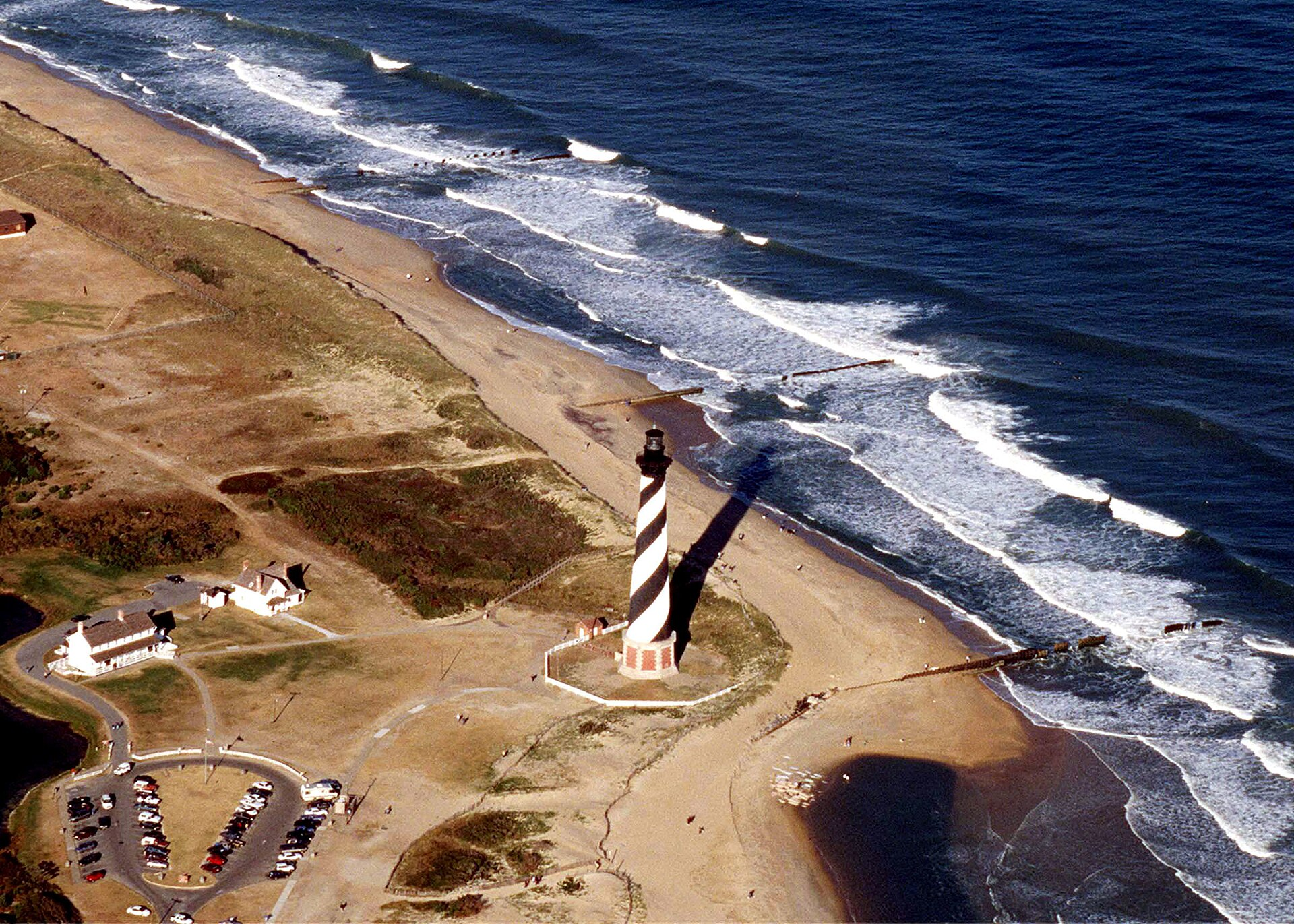
Every summer, thousands of visitors climb the 257 steps of the Cape Hatteras Lighthouse, admire the barber-pole spiral and the Atlantic view, and descend without realizing the strangest fact about the building: it isn’t where it was built. The entire tower — the tallest brick lighthouse in the United States, a structure roughly the weight of a Navy destroyer — took a trip in the summer of 1999, rolling inland along steel beams at inches per minute while the country watched on the news and a great many people confidently waited for it to fall over.
It didn’t. The move of the Cape Hatteras Lighthouse remains one of the most celebrated feats in American preservation — the day the country decided that when the sea comes for a landmark, the landmark can simply leave — and it turned an already famous tower into something better: proof of concept for every coastal community now doing the same math.
The Sentinel of the Graveyard
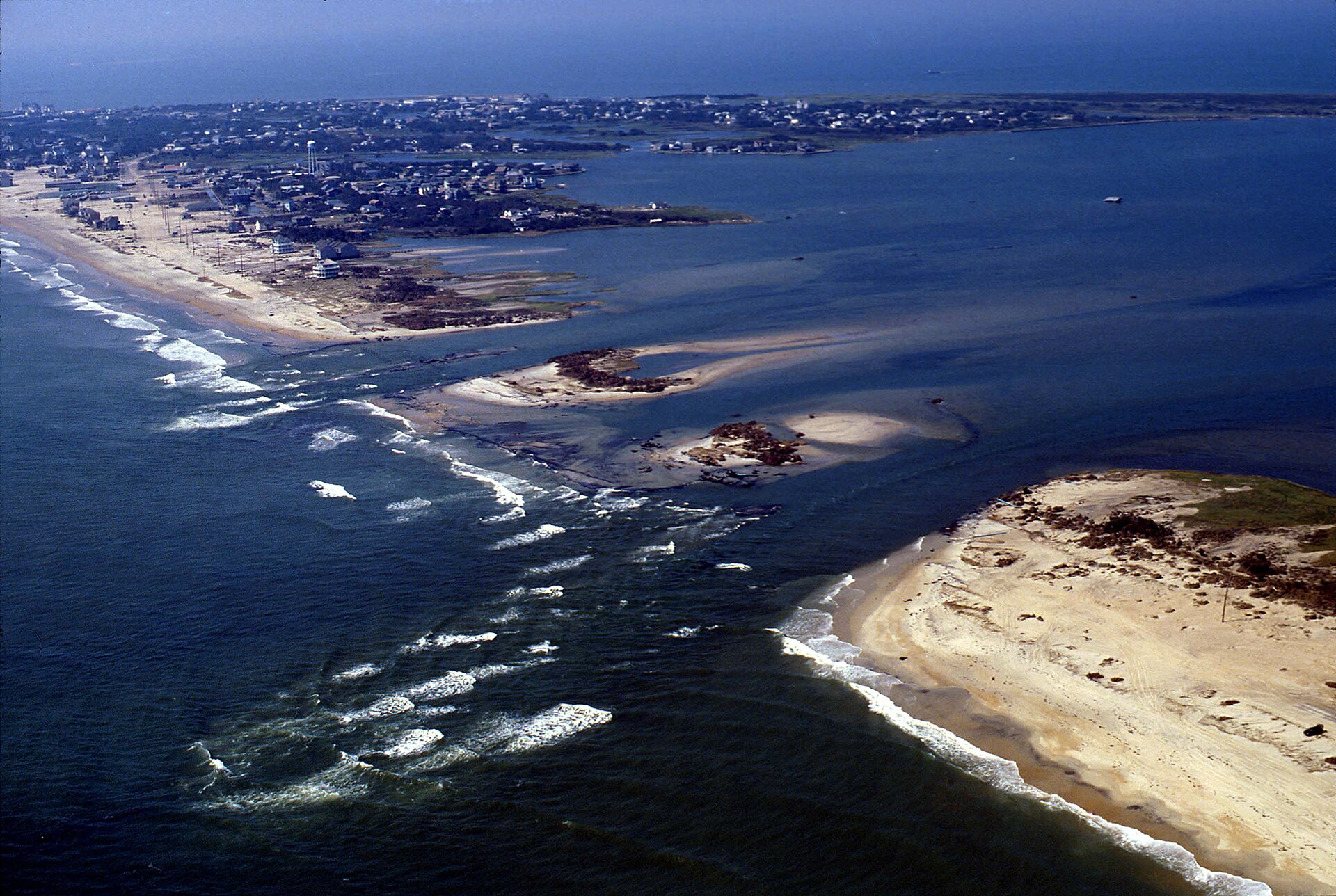
The lighthouse earned its stature the hard way. Off North Carolina’s Outer Banks, the warm Gulf Stream and the cold Labrador Current collide over the shifting shoals of Diamond Shoals, a stretch so lethal to shipping that it has been called the Graveyard of the Atlantic for centuries — the resting place of an estimated thousand-plus wrecks, from colonial traders to a Civil War ironclad to tankers torpedoed within sight of the beach in 1942. Marking it mattered enormously, and after an underpowered predecessor disappointed generations of mariners, the present tower was completed in 1870: 198 feet of brick — about 1.25 million bricks — painted in 1873 with the black-and-white spiral “daymark” that made it identifiable at a glance and, eventually, one of the most recognized structures in America.
The builders of 1870 made one understandable miscalculation: they trusted the beach. The tower rose about 1,500 feet from the waterline, a comfortable margin — except that barrier islands are not land in the usual sense but slow rivers of sand, perpetually migrating, and Hatteras Island was migrating west. Decade by decade the Atlantic closed the distance. By 1919 the sea had halved it; by the 1930s waves reached near enough that the light was temporarily moved to a steel skeleton tower inland while engineers tried groins, sandbags, artificial dunes, and even beach nourishment. Everything slowed the ocean; nothing stopped it. By the 1990s, storms were breaking within 120 feet of the foundation, and a single direct hurricane hit stood a fair chance of putting the most famous lighthouse in America into the surf.
Like our content? Follow us for more.
The Argument: Let It Stand, or Let It Walk
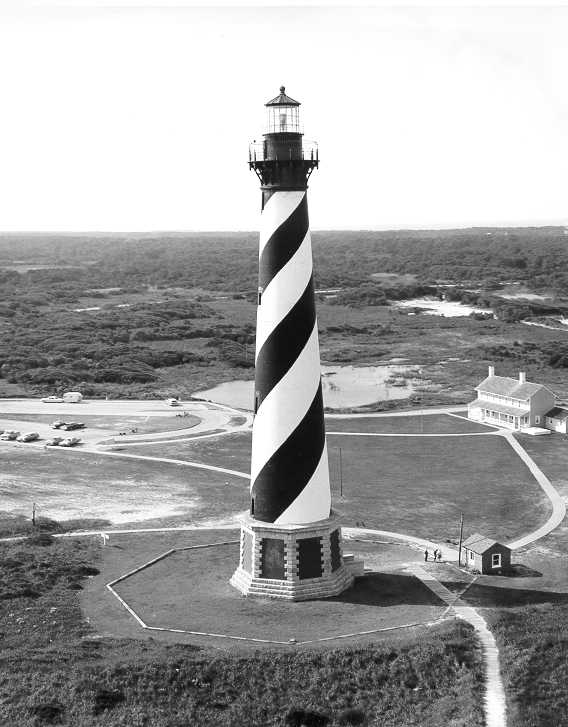
What followed was a decade of one of preservation’s great fights. The National Park Service, guided by a National Academy of Sciences study, concluded the only permanent rescue was relocation — move the tower a half-mile back and buy it a century. A vocal opposition, including local voices and some engineers, considered the plan reckless bordering on absurd: the tower was a 129-year-old unreinforced brick tube, already cracked here and there, never designed to travel, and hauling it over sand seemed a fine way to convert a landmark into rubble. “Move it and you’ll kill it” was the argument’s blunt form; lawsuits and hearings gave the debate its full airing. There was also a deeper local objection, harder to engineer around — the lighthouse belonged where the keepers had tended it, where the wrecks had happened, on the spot itself.
The Park Service weighed sentiment against surf and chose the move, hiring the specialist firms who had relocated large structures before — though never one this tall, this heavy, and this beloved. The budget ran to about $11.8 million. The insurance conversations, one imagines, were vivid.
Twenty-Three Days at a Snail’s Pace
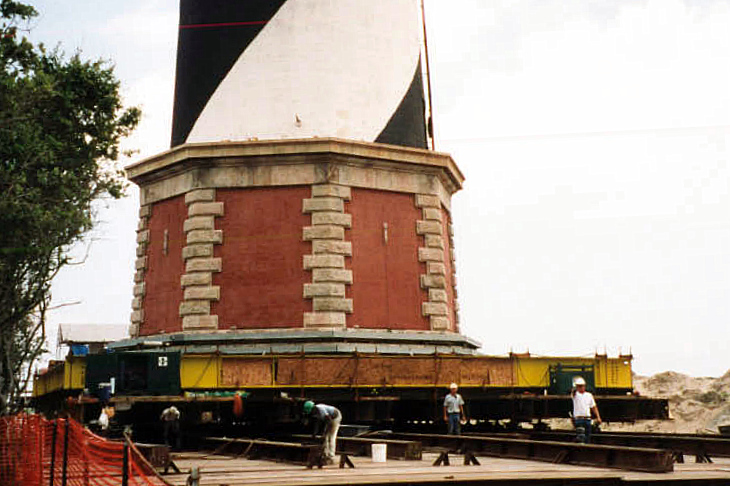
The 1999 operation unfolded like a magic trick performed in slow motion. Crews excavated beneath the tower, severed it from its granite-and-timber foundation, and transferred the full weight — commonly put at around 4,800 tons — onto a temporary steel mat of beams, where hydraulic jacks lifted the entire lighthouse about six feet. Under it went roll beams and a push system of hydraulic rams; ahead of it, a prepared travel corridor of compacted sand topped with steel track, laid and re-laid in sections as the tower advanced, leapfrog fashion, along its 2,900-foot route.
Then, on June 17, 1999, the lighthouse started walking. Progress ran a few feet at a stroke, sensors monitoring tilt and stress at every ram push; on a good day the tower made a couple of hundred feet, tourists and news crews lining the safety fence to watch a skyscraper-sized object move at garden-slug speed. The engineering held so steady that the crew’s party trick entered lore — the ride was smooth enough to have carried a full glass of water without a spill. Twenty-three days after departure, on July 9, the tower rolled onto its new foundation 1,600 feet from the ocean — restoring, by design, roughly the same sea-distance the builders had chosen in 1870 — and settled onto a modern base engineered for the next long wait. The keepers’ quarters and cisterns made the trip too, the whole historic compound re-created in its original arrangement. That November, the light was relit. The doubters, to their credit, mostly showed up to cheer.
Climbing It Now
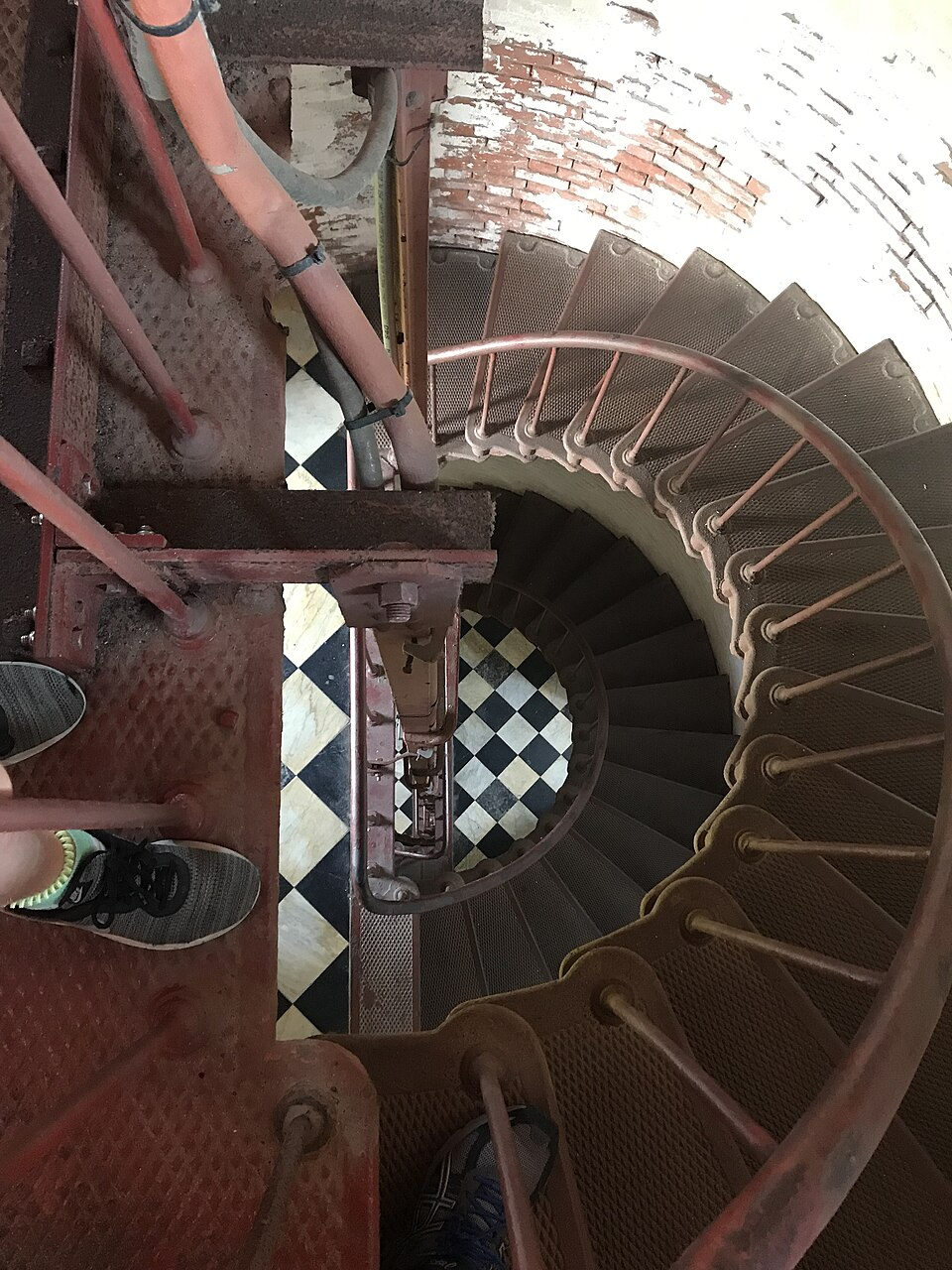
Today’s visit hides the drama in plain sight. The lighthouse anchors Cape Hatteras National Seashore near the village of Buxton, and in season visitors can climb the 257-step spiral — a workout the Park Service compares to a 12-story building with no elevator, rewarded at the gallery by a view running from the Atlantic across the island to Pamlico Sound, with the tower’s own shadow laid across the maritime forest. Timed tickets manage the summer crowds; early morning slots beat both the heat inside the brick and the haze outside it. (A multi-year restoration completed in the mid-2020s refreshed the ironwork and masonry — worth a status check when planning, as climbing schedules have varied.)
The original 1870 site is marked where the foundation stones remain, ringed today by the names of the lighthouse’s keepers — and standing there delivers the whole story in one glance: the granite circle, the surf uncomfortably close behind it, and the tower itself a half-mile away, safe, striped, and slightly smug. Sunset draws photographers to the tower’s west side for the silhouette shot, and the beach at the old site — reachable by a short walk — offers the strangest angle of all: the surf rolling exactly where 198 feet of lighthouse stood for 129 years.
The Graveyard of the Atlantic Museum down the island in Hatteras village supplies the shipwreck context, and the wide, wild seashore supplies the rest; this remains one of the East Coast’s great unbuilt beaches, with the villages of Hatteras Island supplying seafood shacks and fishing charters in exactly the proportions a lighthouse trip wants.
The Lighthouse That Started a Conversation
The 1999 move was sold as a preservation project; it has aged into a precedent. As seas rise and shorelines wander, the question Hatteras answered — do we defend landmarks in place, or move them? — has become a standing item for coastal towns, park services, and island nations, and the tall striped tower in North Carolina is the case study every feasibility report cites: proof that even a five-thousand-ton piece of national identity can retreat with dignity, and come out of it more loved than before. Other lighthouses have since made similar journeys; more will.
The precedent had company, and gathered more. Massachusetts moved two lighthouses in the years bracketing Hatteras — Cape Cod’s Highland Light rolled back from its eroding bluff in 1996, and Nauset Light made a similar retreat — while Block Island’s Southeast Light had walked inland in 1993, each move smaller than Hatteras but proof the method scaled. Since then, the question has crossed from lighthouses to entire communities: the same managed-retreat logic now appears in plans for coastal villages from Alaska to Louisiana, and preservation conferences treat the 1999 move as the moment relocation shed its stigma. When engineers today reassure a nervous historical society that a beloved structure can travel, the slideshow’s first image is nearly always the same striped tower on its steel beams, mid-stride.
There’s a neat symmetry in that. For 130 years the Cape Hatteras light existed to warn travelers away from a moving, hungry coastline. Then, when its own turn came, it took the advice — picked up, backed off, and lived. The moral is posted 198 feet in the air, in black and white spirals, and several thousand climbers a week go up to collect it.
Like our content? Follow us for more.
