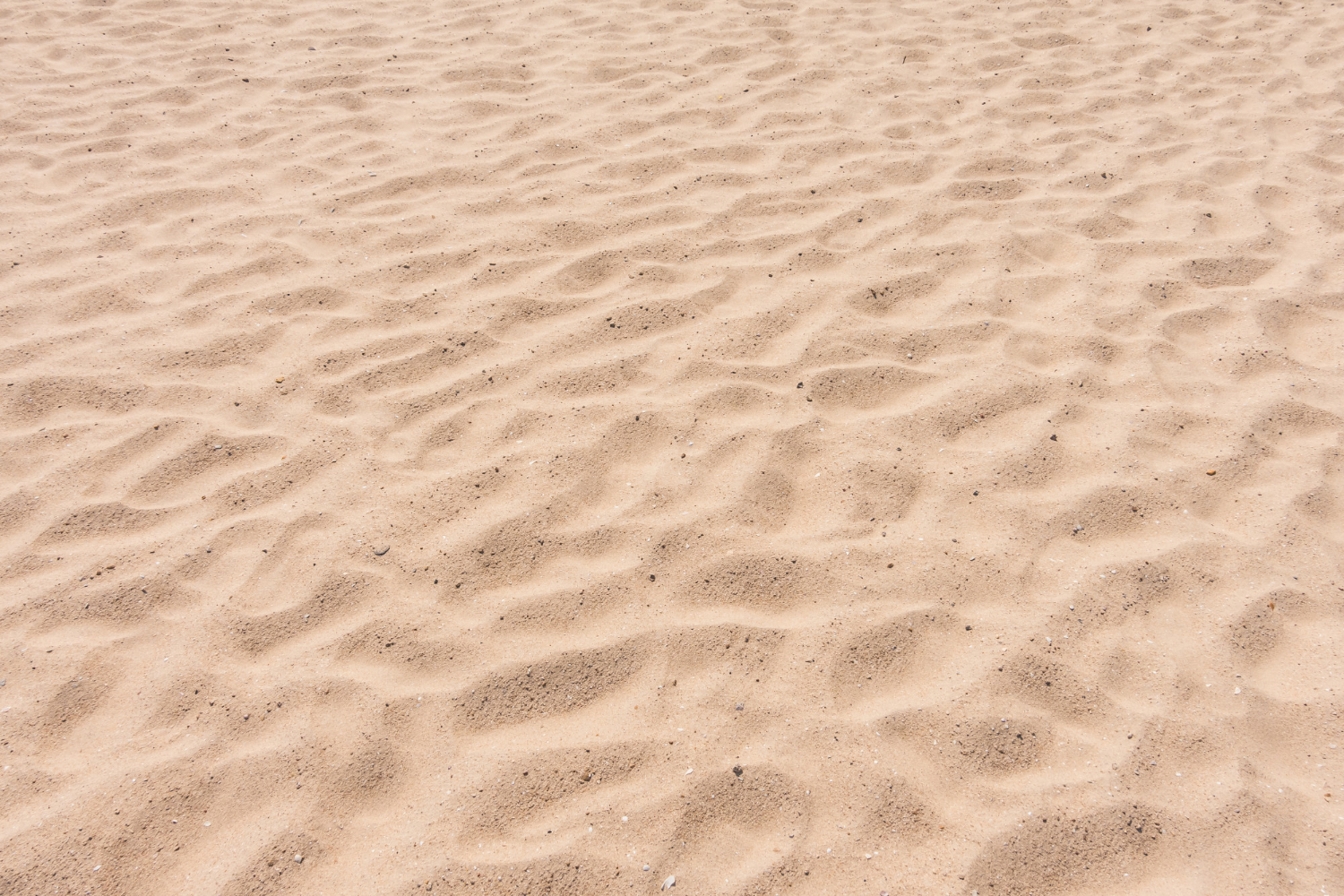
Sand seems like the least plausible thing to run short of. It is the archetype of abundance — the thing in the metaphor about counting grains, covering deserts and beaches and seabeds across the planet.
And yet sand is the second most consumed natural resource on Earth after water, demand is rising, and extraction has become contentious enough to be a serious policy problem in a number of countries.
The paradox has a widely repeated resolution: desert sand is useless for construction because wind has polished the grains round, and round grains will not bind. That explanation appears everywhere, it contains something true, and specialists have been pointing out for some time that it is not the whole story.
Here is what is actually going on.
Why Concrete Needs Sand at All

Start with what the material is doing, because it explains everything downstream.
Concrete is not mostly cement. Cement is the binder, and the bulk of the volume is aggregate — coarse stone and fine sand — with the cement paste coating the particles and holding them together after it hydrates.
That means the strength of concrete depends heavily on how the particles fit together. Coarse aggregate forms the skeleton. Fine aggregate fills the spaces between the larger stones. Cement paste occupies what remains and bonds the whole assembly.
If the particles pack well, there are few voids, less cement paste is needed and the result is strong. If they pack badly, the mixture is full of gaps that have to be filled with more paste and more water, and the concrete is weaker.
So the requirement is not simply sand. It is sand with the right distribution of particle sizes, in the right shape, without excessive fine material.
Like our content? Follow us for more.
The Part of the Popular Story That Is True
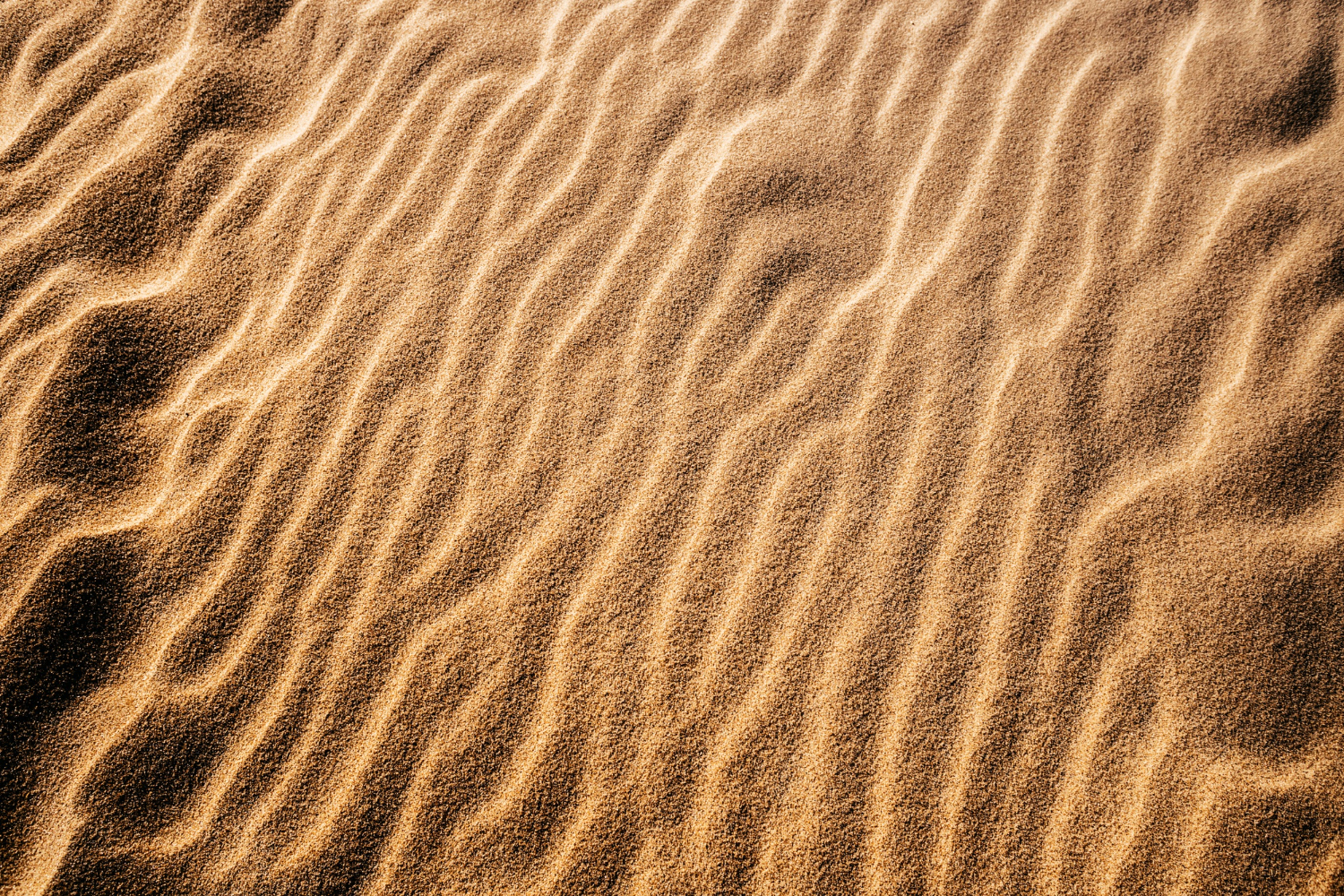
Wind is an efficient sorting machine, and that is the root of the problem.
Air can only carry grains within a fairly narrow size range, so wind-deposited dune sand tends to be extremely uniform — a great many grains of very similar size and comparatively little of anything else.
Uniform particles pack badly. If every grain is nearly the same size, there is no smaller material to fill the gaps between them, and the mixture leaves voids that cement paste has to fill.
A review of concrete made with dune sand found that in some reported samples more than ninety percent of grains fell below a particular fine threshold, with grading values outside the requirements normally specified for fine aggregate.
Excessive very fine material causes a second problem. Fine particles have an enormous combined surface area, and surface area has to be coated, which increases the water demand, changes how the mixture shrinks and raises the quantity of binder required.
This is why engineers specify a particle size distribution rather than accepting anything that looks and feels like sand.
The Part That Is Oversimplified

The familiar version — every desert grain is a polished sphere — turns out not to survive close inspection.
Shape does matter. Angular grains interlock mechanically and give the cement paste a rough surface to grip, while smooth rounded grains slide past one another and bond less effectively. The comparison with building from marbles rather than small bricks captures the idea well.
But studies across different deserts have found substantial variation. Some dune sands are indeed smooth and rounded; others contain a considerable proportion of sub-angular grains. The blanket claim that desert sand is unusable purely because of roundness does not hold up as a general statement.
The grading problem is more consistent and more fundamental than the shape problem. Uniform particle size is the reliable disqualifier; roundness is a contributing factor that varies by location.
There are further complications that depend on the source. Some desert deposits carry significant clay or silt coatings on the grains, which interfere with the bond between cement and aggregate. Some contain soluble salts, which matter because reinforced concrete contains steel and salts promote corrosion of it.
None of which means desert sand is permanently unusable. It means using it requires processing, blending or modification rather than simply digging it up — which is a cost problem rather than a physical impossibility, and research into making it work is active.
Where Construction Sand Comes From Instead

The alternative sources explain why this became a scarcity issue at all.
Rivers are the classic supply. Water tumbles and fractures rock differently from wind, producing grains that are more angular and, crucially, better graded across a range of sizes. River sand has historically been the preferred fine aggregate almost everywhere.
Quarried rock, crushed and screened to specification, is the other major source, and manufactured sand from crushing has the advantage that the grading can be controlled deliberately rather than accepted as found.
Marine sand is used in some regions, with the complication that it requires washing to remove salt before it can go near reinforcement.
Each of these has limits. River extraction removes material that the river is transporting, with consequences for the channel and everything downstream. Quarrying requires suitable rock, a site and permission. Marine dredging is disruptive and expensive.
So the constraint is not the quantity of silica on the planet. It is the quantity of appropriately sized, appropriately shaped, appropriately clean granular material within economic transport distance of somewhere that wants to build.
The Scale of the Demand

The figures are difficult to hold in the head.
Around fifty billion tonnes of sand and gravel a year is the commonly cited global consumption. One agency has expressed the annual volume as sufficient to build a wall twenty-seven metres high and twenty-seven metres wide around the entire planet.
Projections suggest demand could rise substantially further in the coming decades as urbanisation continues.
That volume is the reason the shortage is real despite the apparent abundance. Sand is heavy, low in value per tonne and expensive to move, so it is generally sourced as close to the construction site as possible — which means local depletion happens long before any global figure becomes relevant.
The frequently cited illustration is a very tall building in a desert city, constructed with sand imported from the other side of the world while surrounded by dunes. Whether every detail of that story is accurate, the principle it illustrates is sound: proximity does not equal usability.
Where the Alternatives Are Heading

Given a constraint that is about specification rather than quantity, the responses divide into three approaches, and all of them are being pursued.
The first is manufacturing the material. Crushing rock to a controlled grading produces fine aggregate that meets specification by design rather than by luck, and the proportion of construction sand that is manufactured rather than dug has been rising for decades. It costs more energy and removes the dependence on finding the right deposit.
The second is using less. Concrete formulations that replace a portion of the cement and aggregate with industrial by-products are established practice, and reducing the total volume of material required for a given structure is a live engineering objective in its own right.
The third is recycling. Demolition produces enormous quantities of concrete, and crushing it into aggregate for new concrete is technically viable, increasingly common and limited mainly by the cost of separating and processing it cleanly.
There is also active research into processing desert sand into something usable, on the reasonable basis that a great deal of it is sitting next to places that are building rapidly.
None of these removes the constraint. What they do is shift it from finding a deposit toward paying for a process — which is the general direction of travel for a great many resources described as running out, and a substantially more tractable problem than the alternative.
An Abundance That Is Not One
The lesson underneath this is about how resources are counted.
There is an enormous quantity of sand on Earth and no meaningful prospect of that changing. What there is not is an enormous quantity of sand that meets a specification, near a place that needs it, at a price that makes sense.
That is the difference between a substance and a material. Silica is abundant; construction-grade fine aggregate is a manufactured or carefully selected product that happens to look identical to the abundant version.
It is the same distinction that applies to fresh water, to arable land and to a great many things described as running out. Almost none of them are disappearing. They are becoming harder to obtain in the specific form required, in the specific place required.
Which is a less alarming statement than a shortage and a more difficult problem, because you cannot solve it by finding more of something that was never in short supply.
Like our content? Follow us for more.