


There is a small category of objects that are fully explained by one diagram, and this is one of them.
A vacuum flask is a container inside another container, with almost nothing between them. Everything about how it works follows from what that gap prevents, and everything about how it fails follows from what it cannot prevent.
It is also a clean case of a device invented for one purpose and adopted for a completely unrelated one, which turned a specialised laboratory vessel into an object that almost every household has.
And it demonstrates something worth understanding generally: that insulation is not one problem but three, and a solution to one of them is not a solution at all.
Three Ways Heat Moves

The mechanisms have to be separated before the design makes sense.
Conduction is heat travelling through a material by direct contact between particles, passing energy along. It requires something continuous to travel through.
Convection is heat carried by a moving fluid — warm air or liquid rising, cooler taking its place — which requires a fluid that can move.
Radiation is heat travelling as electromagnetic waves, which requires nothing at all and works perfectly well across empty space.
Ordinary insulation — a jacket, a wall, a layer of foam — mostly addresses the first two, by trapping air in small pockets so it cannot circulate and by using materials that conduct poorly.
It does almost nothing about the third, which is why ordinary insulation has limits and why the flask needed a different approach.
Like our content? Follow us for more.
What the Vacuum Does and Does Not Do

The central feature addresses two of the three mechanisms and is helpless against the last.
Removing the air from the gap removes the material that conduction needs, so heat cannot travel across by that route.
It also removes the fluid that convection needs, so no circulation can carry heat across either.
Those two are dealt with completely rather than reduced, which is the advantage over any other insulation.
Radiation passes straight through an empty gap without difficulty, so a flask with only a vacuum would lose heat steadily by that route alone.
That is why the surfaces are mirrored. A reflective surface emits far less radiation than a dull one and reflects most of what arrives, so the two facing silvered walls throw the radiation back and forth rather than passing it across.
The combination is what produces the performance. Remove the silvering and it leaks by radiation; let air into the gap and it leaks by conduction and convection; and either failure alone is enough to make it an ordinary container.
The Neck Is the Weak Point
The remaining path is the one the design cannot eliminate, only reduce.
The inner vessel has to be supported and has to be open at the top, which means there is a continuous physical connection between inside and outside at the neck.
That connection conducts, and it is the principal route by which a functioning flask loses heat.
The design response is to make that path long, narrow and made of a poorly conducting material — which is why the neck is constricted and why glass was ideal for the original versions, being both a poor conductor and formable into the required shape.
The stopper matters for the same reason. It blocks convection out of the opening, it conducts poorly, and a flask left open loses heat through that route far faster than through anything else.
That is why the performance figures quoted for such vessels assume the closure is in place and why leaving one open for a few minutes undoes a considerable amount of what the vacuum achieved.
Why It Was Built

The origin is the part people find surprising.
The device was developed for laboratory work with extremely cold liquefied gases, which boil away rapidly at ordinary temperatures and were difficult to store for long enough to study.
A container that could hold such material for hours rather than minutes was a research requirement, and the vacuum vessel was the solution to that problem.
Its use for keeping drinks warm was a later commercial application by others, which is a well-known case of the laboratory version and the domestic version diverging completely.
That also explains the shape. A narrow neck and a rounded body are optimal for the original purpose, and the domestic version inherited both despite a wider opening being more convenient for its actual use.
And it explains the fragility of the early ones. Glass was chosen for its thermal properties rather than for durability, and a domestic object made of thin glass inside a metal case is a compromise nobody would have arrived at designing from scratch.
There is a construction detail worth noting. The gap must be evacuated and then sealed permanently, which means the vessel is closed off at a small point, usually at the base, and that seal is the most vulnerable part of the whole object.
Damage there is invisible and destroys the performance entirely.
Why It Works Both Ways

A point that is obvious once stated but is frequently misunderstood.
The device does not keep things warm. It slows heat transfer in whichever direction it is going, which means it keeps hot things hot and cold things cold by exactly the same mechanism.
There is no heating or cooling involved at any point. The contents are simply isolated from the surroundings, and whatever temperature they arrived at persists far longer than it otherwise would.
That is why preheating or precooling the vessel before filling makes a substantial difference. The inner wall has mass and will otherwise absorb heat from hot contents or give heat to cold ones until it reaches equilibrium, which costs a noticeable amount.
And it is why a partly filled flask performs worse. The air space above the contents provides a volume for convection and a larger surface area for exchange, so a full vessel holds temperature better than a half-empty one.
Why Other Insulation Cannot Do This

A comparison clarifies why the design persists despite being awkward.
Foam, fibre and fill materials work by trapping air in small pockets so it cannot circulate, which addresses convection, and by using material that conducts poorly, which addresses conduction partially.
Partially is the limit. There is always material present, and material conducts, so heat travels through the solid structure of the insulation itself no matter how little of it there is.
That sets a floor on performance that cannot be reduced by adding more, only approached — which is why insulation thickness produces diminishing returns.
The vacuum removes the material rather than reducing it, so that route is not reduced but eliminated, which is a different category of solution.
Against radiation, ordinary insulation does something incidental: the many surfaces within it absorb and re-emit repeatedly, which slows transfer without stopping it, and dark materials do this worse than reflective ones.
So the flask is not simply better insulation. It is the only common domestic object that addresses all three mechanisms deliberately and separately, and that is why nothing simpler achieves the same result.
The cost is that it cannot be made in arbitrary shapes, cannot be cut to fit, cannot be repaired and fails completely rather than degrading — which is the trade every sealed system makes.
What Replaced the Glass
The modern versions solve the fragility and lose something.
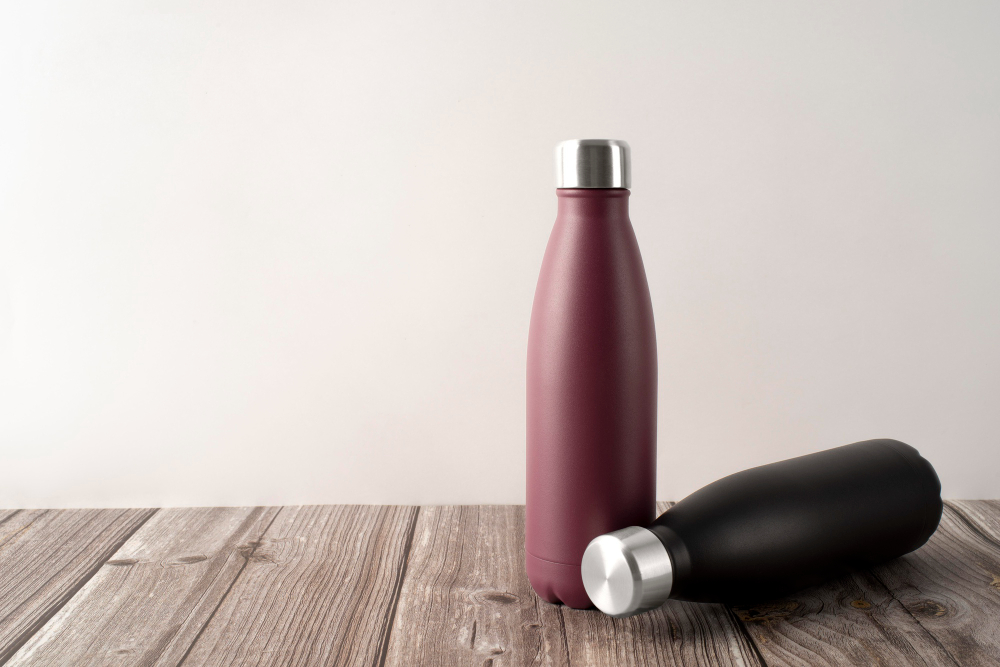
Double-walled metal construction with the gap evacuated achieves the same three-mechanism defence, is far more robust, and can be made in shapes that glass cannot.
The trade is that metal conducts far better than glass, which means the neck and the seal around the walls conduct more — so a metal flask generally performs slightly worse than an equivalent glass one while being vastly more usable.
The vacuum also degrades. Any real seal admits a very small amount of gas over years, and once enough is present the conduction and convection routes reopen — which is why an old flask that appears undamaged may simply have stopped working.
That failure is invisible and irreversible, and it is the usual reason such an object is discarded rather than any visible fault.
Which is a reasonable place to end. The device works because of something that is not there, it fails when that absence is gradually filled in by the ordinary leakage of the world, and nothing about the outside gives any indication of which state it is in.
Which is an unusual failure mode for a domestic object. Most things announce that they have stopped working, and this one performs identically right up until the contents are cold, at which point the only diagnosis available is that it used to be better.
Like our content? Follow us for more.
