The lift is the piece of machinery most people use most often without ever seeing any of it. What is visible is a box and two doors. What makes it work is in the shaft beside the box, and once you know it is there, several things that seem arbitrary about lifts stop being arbitrary: why they are so quiet, why the cables are not the safety system, why an empty car can behave differently from a full one, and why tall buildings needed this particular invention before they could exist at all.
The Counterweight Does the Heavy Part
Run a cable over a pulley at the top of a shaft. Hang the car on one end. Hang a stack of steel or concrete on the other.
If the two sides are equal, the system will sit wherever you leave it, and moving it requires only enough force to overcome friction and to accelerate the mass. The weight itself has already been cancelled out.
A lift is built to that principle, with one refinement. The counterweight is not matched to the empty car; it is matched to the car plus roughly forty to fifty per cent of its rated load. That figure is chosen because it puts the system closest to balance at the loading it experiences most of the time, since lifts are rarely full and rarely empty.
The consequence is that the motor is only ever handling the imbalance. A car carrying its rated maximum is heavier than the counterweight, and the motor works to raise it. A nearly empty car is lighter, and now the counterweight is the heavier side, so the motor is working to raise the counterweight while the car descends – and on the way up, gravity is helping.
This is why the direction that feels like work to a passenger has no particular relationship to the direction that is work for the machine. An empty car going up is being pulled up by the counterweight falling, and the motor is mostly restraining it.
Like our content? Follow us for more.
Which Is Why the Motor Is So Small
A passenger lift car might weigh well over a tonne empty, and carry another tonne. Without balancing, a motor would have to lift that entire load against gravity for the full height of the building, repeatedly, all day.
With balancing, the motor handles the difference between the two sides, which in normal use is a fraction of that. The machine that moves a lift in a large building is startlingly modest compared with the load it appears to be shifting, and modern gearless machines are small enough to sit within the shaft itself rather than in a room above it.
There is a further saving. Because a descending loaded car or a descending counterweight is doing work on the motor rather than the other way round, that motion can be used to generate electricity rather than being dissipated as heat in a brake. Many modern installations feed that energy back into the building’s supply, so a busy lift in a tall building returns a meaningful fraction of what it consumes.
The Cable Does Not Grip. It Rests

Here is the part that surprises people most. In the common arrangement, the cables are not clamped or wound onto a drum. They simply pass over a grooved wheel, and the entire system runs on the friction between the rope and the groove.
That wheel is the traction sheave, and the grooves are shaped to increase grip: an undercut groove pinches the rope slightly as it seats, multiplying the friction available. The weight on both sides presses the ropes into the grooves, the sheave turns, and the ropes move with it.
This sounds precarious and is in fact a safety feature. Because traction depends on there being weight on both sides, the system has a built-in limit. If the car reaches the bottom of the shaft and the machine keeps turning, the ropes on the car side go slack, traction is lost, and the sheave spins beneath them rather than continuing to wind the car into the pit. The same applies at the top. A drum system, which positively winds the rope, would have no such limit.
There are also several ropes, always, not one. Each is individually capable of carrying the full load with a substantial margin, and a lift runs on a set of them, so no single failure is a failure of the system.
The Safety Gear Has Nothing to Do With the Cables
The invention that made passenger lifts acceptable was not a stronger rope. It was a mechanism that works regardless of what the ropes are doing.
Attached to the car is a governor: a rope of its own running over a wheel that spins in proportion to the car’s speed. If the car exceeds a set speed, weights in the governor fly outward and trip a mechanism.
That mechanism pulls a linkage on the car which drives wedges or rollers against the vertical guide rails the car runs on. They bite into the rails and bring the car to a stop by friction against the building’s own structure.
Notice what this does not depend on. It does not need the ropes, the motor, the brake or the electricity supply. It is purely mechanical, it is triggered by the car’s own speed, and it grips the rails. The public demonstration in the nineteenth century in which an inventor had the rope over his own platform cut in front of an audience, and did not fall, was a demonstration of precisely this: not that the rope was strong, but that the rope no longer mattered.
The counterweight has its own set, for the same reason.
And at the bottom of the shaft are buffers, which are the last resort rather than the plan. The pit is deeper than the lowest floor specifically to leave room for them.
The Doors Are the Difficult Part
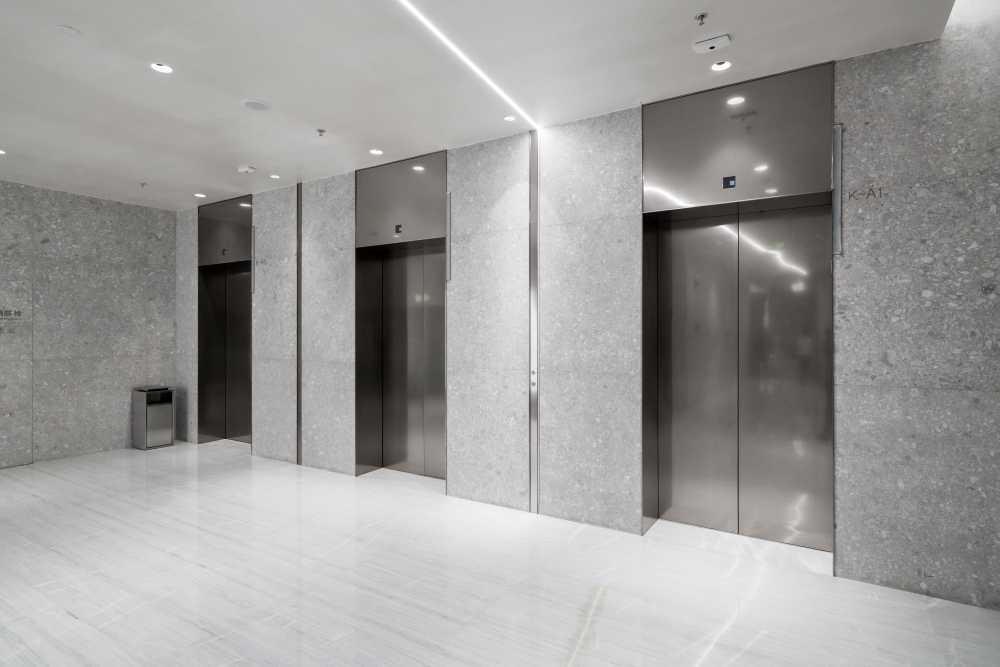
Statistically and mechanically, the doors are where the engineering effort goes, and it is worth understanding why they behave the way they do.
The car has a door. Every floor also has its own door, and those landing doors are not powered. They have no motor of their own.
Instead, the car door carries a mechanism – a vane or a pair of blades – which, when the car is correctly aligned at a floor, engages a matching set of rollers on that floor’s door and drags the two open together. Away from a floor, nothing engages, so the landing doors cannot be opened by the car door and are held shut by their own locks.
The effect is that a landing door can only open when there is a car behind it, and this is enforced mechanically rather than by a controller deciding it is safe. It also means that interference with a door between floors does not open anything.
The lift will not move unless every landing door and the car door report closed and locked, through a chain of contacts wired in series. One door not quite shut anywhere in the building stops the lift, which is why a stationary lift with no obvious problem is very often a door issue several floors away.
Why the Ride Feels the Way It Does
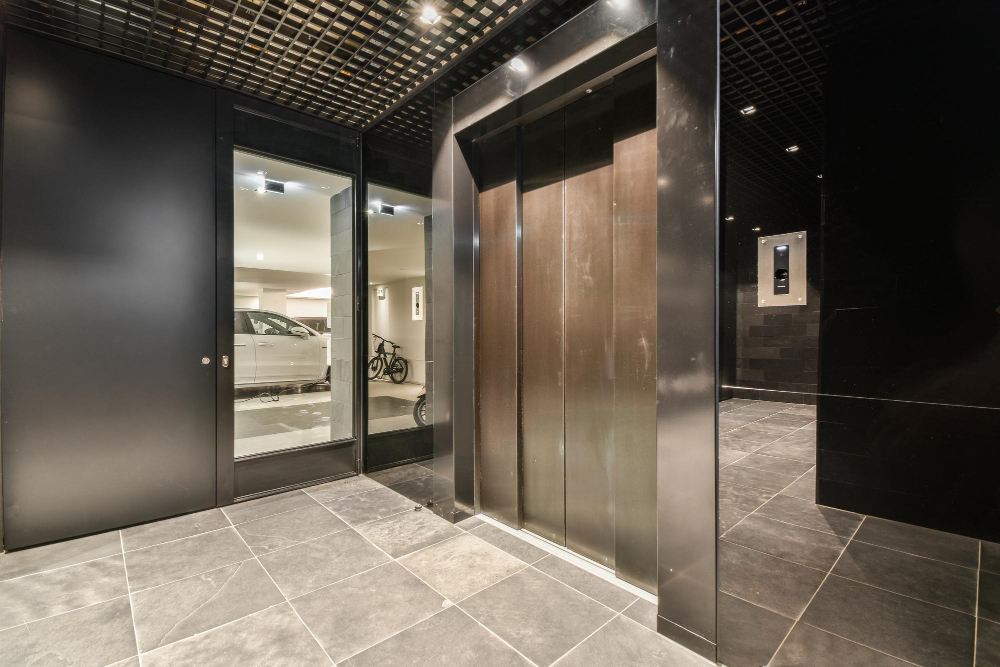
A lift is one of the few machines people judge almost entirely on comfort, and a good deal of design effort goes into a ride nobody consciously notices.
The controlling factor is not speed. It is the rate at which speed changes, and the rate at which that rate changes. A car that reached its travelling speed abruptly would be unpleasant even at a modest speed, while one that eases into it can run considerably faster without anybody objecting. Acceleration is therefore ramped rather than applied, and the same on the way out of motion, which is why a lift seems to begin moving before you can identify the moment it started.
The stop is the harder problem. Arriving level with the floor matters more than most passengers realise, because a lift stopped even a small distance high or low is an immediate trip hazard, and it is the most common cause of a lift being reported as faulty when nothing has broken. Older installations solved this by creeping slowly to the floor at the end of every journey; modern drives track position continuously and can arrive at the right height without the crawl, which is much of why a new lift feels quicker than an old one even at the same rated speed.
Ropes stretch under load, too, which means a car loaded at the top of a building sits slightly lower than the same car loaded at the bottom. Levelling has to correct for that as people enter and leave, and a lift that adjusts itself a centimetre while a crowd boards is doing exactly what it should.
Air is the other consideration. A car moving fast in a close-fitting shaft pushes a column of air ahead of it, and in tall buildings the pressure change is enough to affect ears, which is why express lifts in very tall buildings are designed around it rather than simply made faster.
What It Did to Cities
A building’s height was limited for most of history by how far people were willing to climb, which is about six storeys. Above that, floors became less valuable the higher they went, and the top floor was the cheapest accommodation in the building.
The safe passenger lift inverted that. Once height stopped costing effort, the upper floors became the desirable ones, with the light and the view and the distance from the street, and the penthouse became the most expensive rather than the least.
Steel framing is usually credited with making tall buildings possible, and structurally that is right. But a tall building nobody would climb is not a usable building, and the lift is the reason the floors above the sixth are worth constructing at all. The two inventions arrived close enough together to be treated as one event, and cities changed shape around them.
So the next time you are standing in one, there is a stack of steel in the dark beside you moving in the opposite direction at exactly your speed, and it is carrying most of your weight. The motor is only making up the difference.
Like our content? Follow us for more.