Turn a wine bottle over and there is a cone pushed up into the base. It is called the punt, or the kick-up, or the dimple, and it is the subject of more confident misinformation than almost any other object on a dinner table.
The most common claim is that a deep punt means a better wine. It does not. There is no relationship, and plenty of expensive wine comes in bottles with almost no punt at all while plenty of very cheap wine comes in bottles with a dramatic one. The depth of the dent is a decision made by a bottle buyer, not a winemaker.
It Started Because Glass Was Blown by Mouth

Before bottles were made in moulds by machines, they were made by a glassblower with a blowpipe, and the process left an unavoidable mark.
A blower would gather molten glass, inflate and shape it, and then the finished body had to be held from the other end so the neck could be opened, trimmed and finished. The tool used for that was a punty – an iron rod attached to the base of the bottle with a blob of hot glass. When the bottle was done the punty was snapped off, leaving a rough scar of glass on the bottom.
A rough scar is a serious problem. A bottle with a lump on its base does not stand up, it scratches a table, and the stress in that lump makes the bottle likely to crack. So the blower pushed the base upward into the body of the bottle before detaching the rod, which lifted the scar up inside the cone, clear of the surface the bottle would stand on.
The punt, in other words, is the solution to a problem created by the punty. That is where the word comes from, and it is the whole of the original reason.
Like our content? Follow us for more.
Then Machines Arrived and the Dent Stayed
Automatic bottle machines came in around the turn of the twentieth century, and a moulded bottle has no punty scar. The original justification disappeared completely.
The punt stayed anyway, and this time there were genuine engineering reasons for it rather than historical inertia alone.
A curved surface is stronger than a flat one. An arch pushed inward distributes pressure outward to the walls rather than concentrating it at the centre of the base, which matters enormously for sparkling wine – a bottle of champagne holds a pressure of around five to six atmospheres, roughly three times a car tyre, and the deep punt on a champagne bottle is a pressure vessel design feature rather than a decoration. This is also why a champagne bottle is noticeably heavier and its glass thicker.
A concave base also sits flat more reliably. Glass shrinks as it cools, and a large flat surface can cool unevenly and end up very slightly convex, which gives you a bottle that rocks. A bottle that touches the table only on a narrow ring around its edge always sits still.
And the arch gives the base somewhere to go. A bottle dropped on its base, or filled hot and cooled, flexes; a flat base transmits that straight into a crack, while an arch absorbs it.
The Uses That Came Afterwards

Several of the punt’s familiar functions are things people discovered it was good for rather than reasons it exists.
It gives a sommelier somewhere to put a thumb. The classic one-handed pour – thumb in the punt, fingers spread along the body, bottle held out from the shoulder – is only possible because the cone gives a secure grip on an otherwise featureless cylinder. The same hold is used when pouring from a decanter.
It collects sediment. In an unfiltered wine that has thrown a deposit, standing the bottle upright for a day gathers the solids in the ring at the outside of the punt, and the shape of the cone then helps hold them there as the wine is poured, so less of the deposit travels into the glass. This is a real effect and a modest one; careful decanting does far more.
It makes bottles stack. Punted bottles laid in a rack or a case interlock, with the neck of one sitting into the punt of the next, which produces a more stable stack than straight cylinders. This mattered a great deal when wine moved in wooden cases and straw.
And it lets a bottle be cleaned and drained. A punted bottle inverted on a drying rack drains completely, where a flat-bottomed bottle holds a pool.
Why Expensive Bottles Have Big Dents Anyway

If the punt is not a quality mark, why is it so reliably deeper on expensive wine?
Because a deep punt requires a taller, heavier bottle to contain the same seventy-five centilitres, and heavy bottles feel expensive. This is a straightforwardly psychological effect and it is well understood in the trade. A customer handed two bottles will consistently judge the heavier one to be the better wine, and bottle weight has been used as a deliberate signal of quality for decades, in exactly the way that a thick card business card or a heavy watch is.
The punt is the cheapest way to add that weight and height without adding volume. You cannot simply make the bottle bigger, because the contents are a regulated measure. You can make the glass thicker and push the base up, and you have a bottle that is visibly larger and noticeably heavier holding precisely the same amount of wine.
This has become a live issue rather than a curiosity, because glass is the single largest contributor to the carbon footprint of a bottle of wine – heavier than the farming, the fermentation or the shipping of the liquid itself in many analyses. A number of producers and retailers have moved deliberately to lighter bottles with shallow punts and publicised the fact, and some competitions and critics now note bottle weight. Which means the punt’s last remaining function, as a signal of seriousness, is in the process of being inverted: a shallow punt is starting to signal a producer who has thought about it.
The Bottle Shape Itself Is a Regional Code
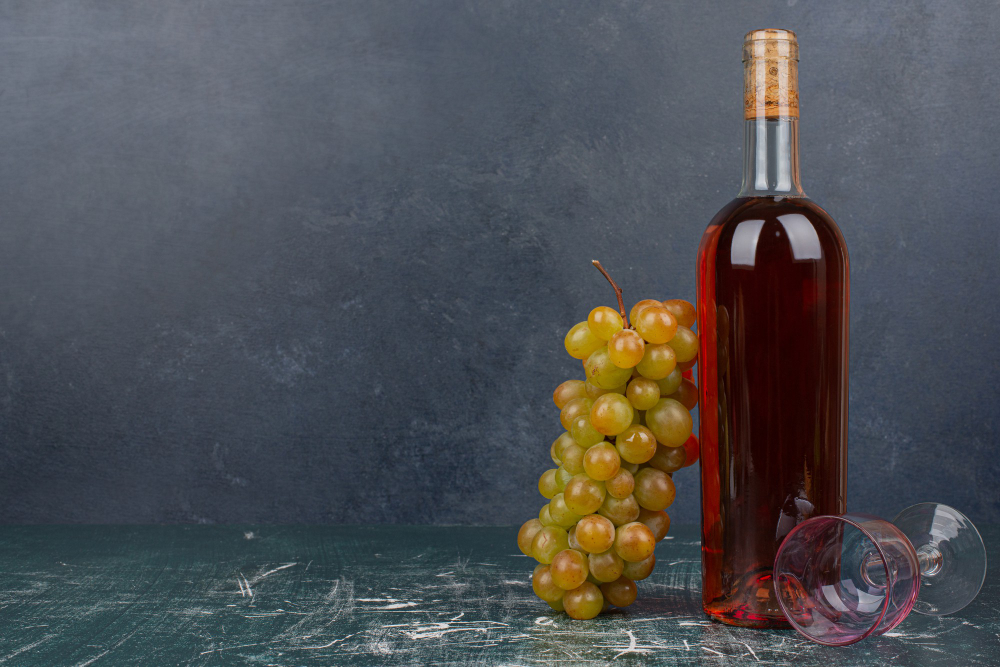
The punt is one feature of a bottle whose whole silhouette used to be a statement of origin, and largely still is.
The high-shouldered bottle with an abrupt turn from body to neck is the Bordeaux shape, and it is used for Bordeaux and for the grape varieties associated with it wherever they are grown. The sloping-shouldered bottle with a long gentle curve is the Burgundy shape, used for pinot noir and chardonnay and their descendants. The tall, slender, almost shoulderless bottle is the Alsace or Rhine flute, used for riesling and gewurztraminer, and it very often has no punt at all.
None of this is law in most places. It is convention so strong that departing from it is read as a message: a producer who puts a Burgundy-style wine in a Bordeaux bottle is either making a point or has bought whatever bottles were available.
The regional shapes also carry their own punt conventions, which is why punt depth tells you about geography and tradition rather than quality. The Bordeaux shape conventionally has a pronounced punt. The German flute conventionally has none. A bottle of fine riesling with a flat base is not a cheaper product than a bottle of ordinary claret with a deep one – it is a different tradition about what a bottle should look like, settled long before either producer was born.
How to Read a Bottle Base Properly
There are things the base of a bottle will genuinely tell you, and they are not about quality.
A deep, heavy punt with very thick glass and a reinforced ring at the lip is a pressure bottle, and the wine inside it is sparkling or was made by somebody allowing for pressure. That is a real inference.
A seam running up the sides of the bottle and over the shoulder tells you it was machine-moulded, which is almost all bottles. The absence of one on an old bottle, together with an irregular punt and a visible scar, tells you it was mouth-blown and is likely pre-twentieth century.
Numbers and letters moulded into the base are the glassworks’ own marks – the factory, the mould number and frequently the year the mould was made. These are useful for dating an old bottle and tell you nothing about the contents.
A punt with a flat, wide bottom and a shallow rise is a modern lightweight bottle, usually a deliberate choice. A perfectly flat base is a Germanic or Alsatian shape or a modern light bottle, and both are entirely normal.
What none of them will tell you is whether the wine is any good. That information has never been on the outside of the bottle, which is inconvenient, and is the reason the punt myth is so appealing in the first place – it offers a way to judge a wine without opening it, and there is no such way.
Like our content? Follow us for more.