
There is a wire coat hanger in almost every house, and nobody bought it. They arrive with dry cleaning, they accumulate, and they are the only household object most people own in quantity without having made a single decision about it.
The usual story is that it was invented in 1903 by a man named Albert Parkhouse, who worked at a wire novelty company, arrived at work to find every coat hook occupied, and bent a length of wire into a shape that would hold a coat on a rail instead.
The Part of the Story That Is Reliable

The attribution to Parkhouse is widely repeated and the detail that the patent was filed by his employer rather than by him is the part most often emphasised, usually as an injustice.
It is worth being careful. Garment hangers of various kinds existed before 1903 – there are earlier patents for shaped supports for clothing, and the idea of hanging a coat on a form rather than a hook was not new. What the wire version did was make it cost almost nothing.
The employer-filed patent is not unusual and was not unusual then. An employee inventing something in the course of their work, with their employer’s materials, on their employer’s premises, generally produced a patent owned by the employer, and that remains broadly the position in most jurisdictions today under contracts of employment.
So the story holds in outline, with the caveat that the wire hanger was an improvement on an existing idea rather than a bolt from nowhere, and that the patent arrangement was the normal arrangement rather than a theft.
Like our content? Follow us for more.
Why the Shape Is That Shape

The geometry is doing several things with one piece of wire.
The two sloping shoulders approximate the slope of a human shoulder, which spreads the weight of a garment across a width rather than concentrating it at a point – a coat hung on a hook deforms at the hook and a coat on a hanger does not.
The horizontal bar across the bottom resists the shoulders being pulled inward by the weight, which is what turns three bends into a rigid triangle. It also gives somewhere to hang trousers.
The hook is formed from the twisted ends of the same wire, which is why the twist sits at the top where the two ends meet, and why a cheap hanger unwinds there when overloaded.
And the whole thing is one continuous piece, formed in a single machine operation from a reel. No joints, no fasteners, no assembly – which is the entire reason it costs a fraction of a penny and the reason it displaced wooden hangers for everything except the garments people care about.
The Dry Cleaner Is Why You Have Forty
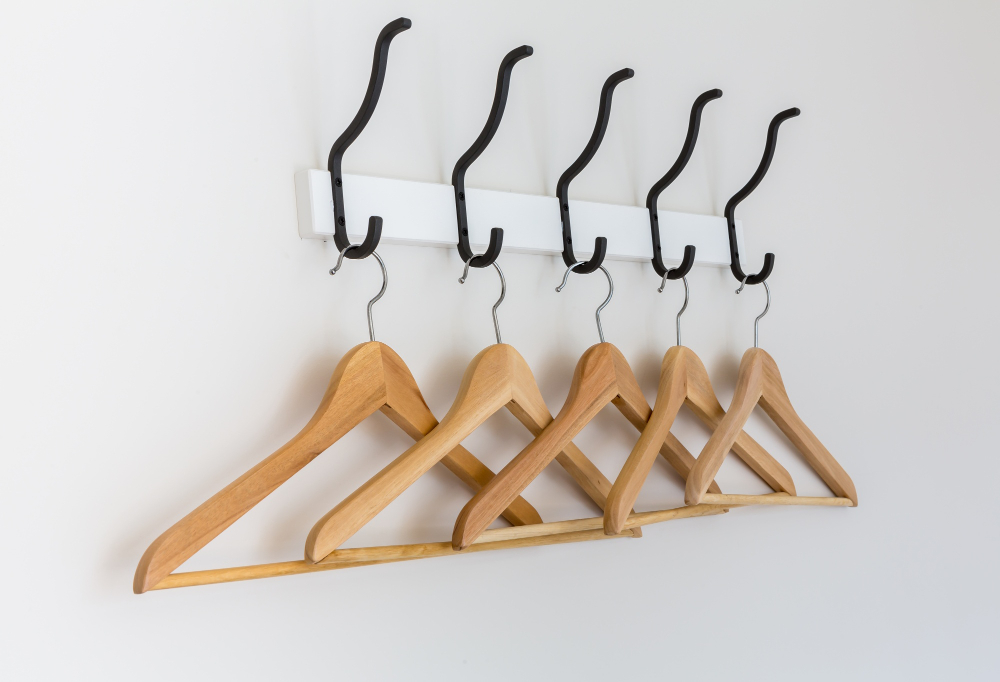
The wire hanger’s dominance is a consequence of one industry’s economics.
Dry cleaning returns garments on a hanger, because a cleaned garment has to be transported without creasing and handed over ready to hang. The cleaner needs the cheapest object that will do that, used once, in volume, and not returned.
So hangers flow one way, from the cleaner into the customer’s house, in quantities nobody wants. A household that uses a dry cleaner a few times a year accumulates them indefinitely, which is why the wire hanger is the standard example of an object that arrives without being chosen.
Several cleaners run return schemes and reuse them, which is better, and some have moved to recycled board hangers. The flow has reduced along with the use of dry cleaning generally, as fabrics and home laundering improved.
Why Wardrobes Tell You to Use Something Else
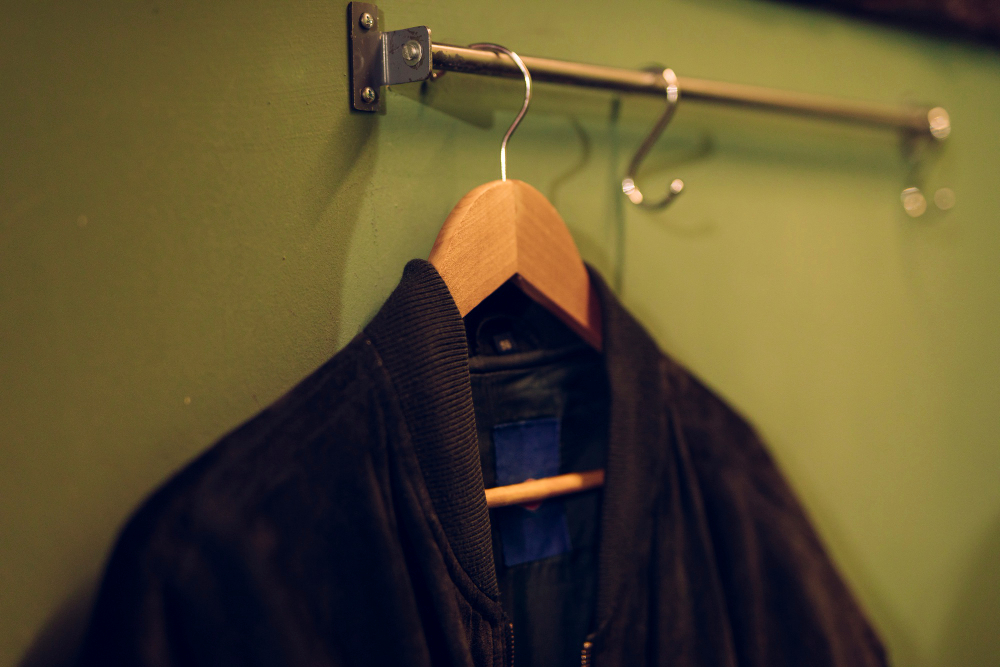
The wire hanger is bad for clothes and the reasons are mechanical rather than aesthetic.
The wire is thin, so the weight of a garment bears on a narrow line at the shoulder, which over months produces a visible dent or point in the shoulder of a jacket or a knitted garment. A broader hanger spreads it.
It is also soft. Wire deforms under load and stays deformed, so a hanger that has held something heavy no longer matches the shoulder shape and transmits the weight unevenly.
And it can mark. Bare steel oxidises in a humid wardrobe and will leave a rust mark on a pale fabric given enough time and contact.
The practical answer is uncontroversial and is what every tailor and dry cleaner says: wire for transport, something broader and shaped for storage, and nothing at all for knitwear, which should be folded because hanging it stretches it under its own weight.
Before Hangers, Clothes Were Folded or Hung on Pegs

Hanging a garment on a shaped form is a recent way of storing clothes, and the reason is that it only makes sense for a particular kind of garment.
For most of history clothing was folded and laid flat in a chest, a press or a drawer. That is the right way to store a loosely cut garment made of woven cloth, which is most historical clothing – it does not crease badly from folding, it has no tailored shoulder to deform, and a chest is a far better defence against dust, light and moths than an open rail.
What created the hanger was tailoring. A fitted jacket has a shaped shoulder, a canvas interlining and a pressed roll in the lapel, and folding it destroys all three. Such a garment has to be stored in the shape it was made in, on something that holds the shoulders apart.
So the sequence is: clothes become tailored, tailored clothes cannot be folded, the wardrobe replaces the chest, the rail replaces the shelf, and a form to hang things on becomes necessary. The wire version simply made that form free.
It is also why the advice to fold knitwear is not fussiness. A jumper is a loose knitted garment of exactly the kind that was always folded, and hanging it is applying a storage method invented for a different sort of clothing.
Then It Became the Universal Improvised Tool

The wire hanger’s second career is as the thing everybody reaches for when they need stiff wire, and it is worth separating the uses that work from the one that does not.
It genuinely works for retrieving things from behind radiators and under furniture, for clearing a blocked sink trap or a shower drain of hair, for fishing a drawstring back through a waistband, for a temporary aerial, for holding a car exhaust up long enough to get home, for unblocking a vacuum hose, and as a skewer over a fire.
The use it is famous for – opening a locked car – stopped working decades ago. Cars built since roughly the 1990s have internal shielding around the lock linkage, cable-operated rather than rod-operated mechanisms, and in a great many cases electronic locking with no mechanical linkage to reach. Anybody pushing a wire down a modern door seal is considerably more likely to damage the weather seal, the glass guide or the wiring than to open anything.
It is also worth saying that attempting it on a car that is not yours is a criminal matter, and that a locked-out driver’s actual options are a spare key, a breakdown service or a locksmith.
Why Nobody Has Replaced It
Plenty of better hangers exist and the wire one has not been displaced from its particular job.
Moulded plastic hangers are broader and kinder to garments, cost slightly more, and break rather than bend. Wooden hangers are far better and far more expensive. Padded hangers protect delicate garments. Flocked slim hangers stop things slipping and save rail space. Each is better than wire at something.
None is cheaper. For the one application that generates almost all the volume – moving a cleaned garment from a shop to a wardrobe once – cheapness is the only specification that matters, and a single piece of wire bent three times by a machine running at speed is extremely hard to beat.
So the object persists, in enormous numbers, in a role nobody designed it for, arriving in houses that did not ask for it, performing adequately at a job it is bad at, and being quietly repurposed as a general-purpose piece of stiff wire by people who have forgotten it was ever meant to hold a coat.
Which is a reasonable outcome for something a man bent out of frustration because somebody had taken his hook.
There is one practical thing worth doing with the pile in your wardrobe, and it costs nothing.
Take the wire hangers off anything you intend to keep – jackets, coats, anything tailored, anything pale – and put those on something broader. Then take the knitwear off hangers altogether and fold it. That is the whole job, it takes ten minutes, and it prevents the specific damage described above, which is cumulative and not reversible once the shoulder of a jacket has a point in it.
Then give the wire ones back. Most dry cleaners will take them, several run collection schemes, and the steel is worth recycling. Keeping two in the garage and one behind the radiator is reasonable. Keeping forty is how everybody ends up with forty.
Like our content? Follow us for more.