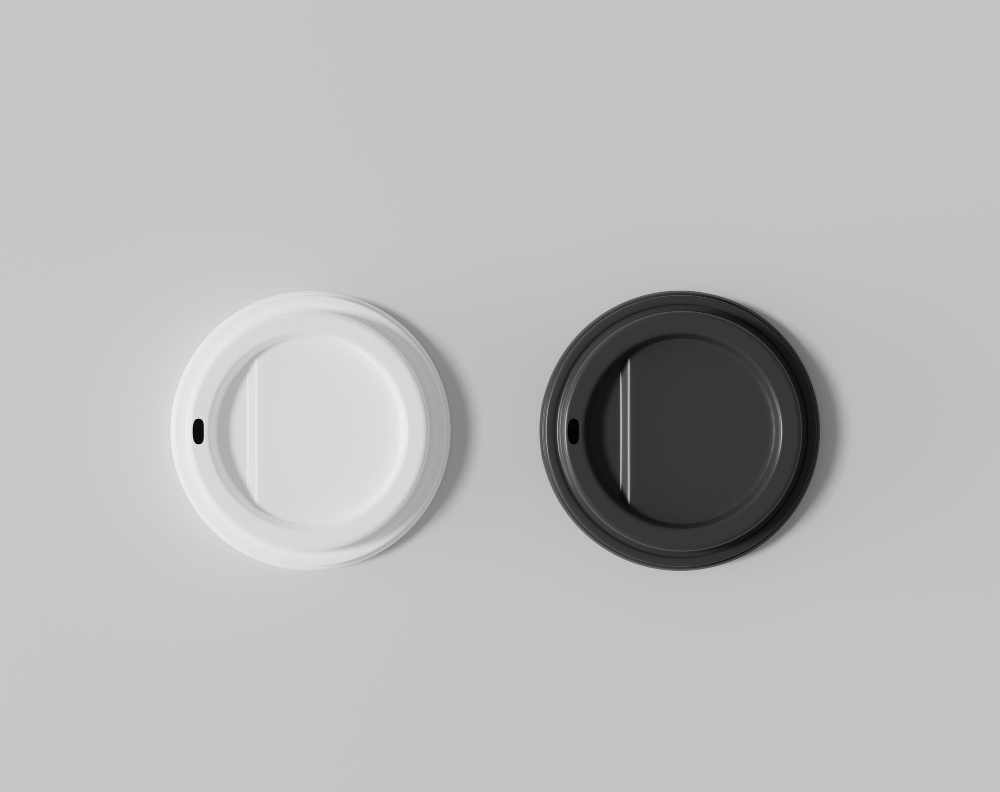
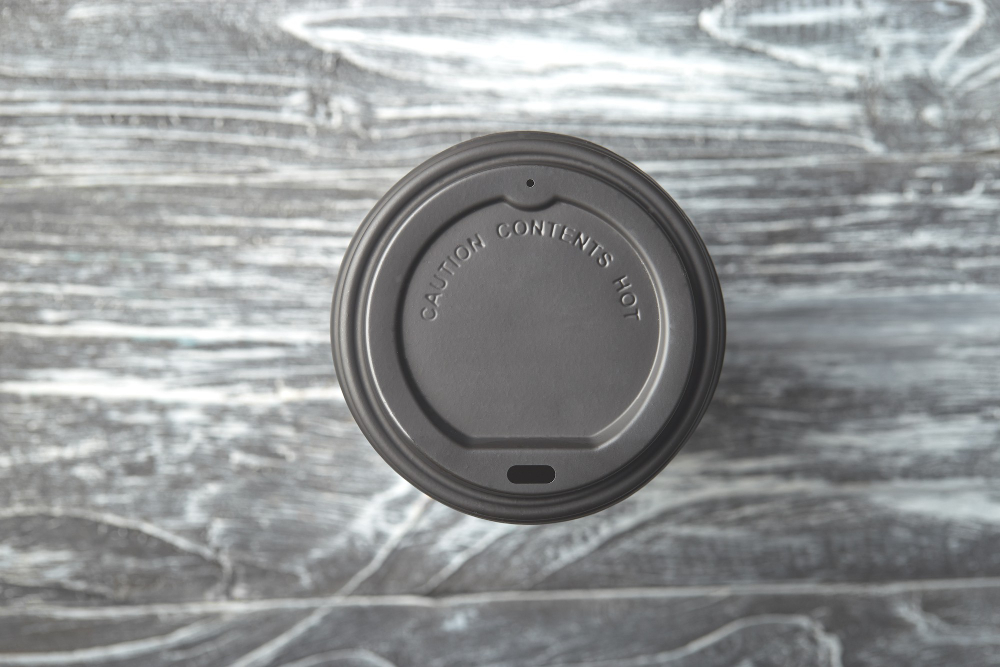
A takeaway coffee lid has a large opening you drink from and, on most designs, a small hole on the opposite side of the dome.
People assume the small one is for a straw, or for steam, or that it is a manufacturing artefact.
It is an air vent, it is doing the same job as the second hole in a watering can or the vent in a fuel container, and without it the drink would come out of the cup in uneven gulps.
Liquid Cannot Leave Unless Air Can Get In
A sealed container with one opening cannot pour steadily. Liquid leaving reduces the volume of liquid inside, and something has to occupy the space it left. If the only route in is the same opening the liquid is coming out of, the two have to take turns.
What you get is the familiar glugging – a slug of liquid comes out, the pressure inside drops, air is pulled back in through the same hole against the flow, the pressure equalises, and another slug comes out. It is uneven, it is unpredictable, and with a hot drink next to somebody’s mouth it is the exact behaviour you want to avoid.
A second opening breaks the cycle. Air enters through the vent continuously while liquid leaves through the drinking opening, the pressure inside stays at atmospheric, and the flow is smooth and controllable.
That is the entire function, and it is the same principle that governs the overflow in a washbasin, the vent in a fuel can, the second hole in a watering can rose and the breather on an oil filler.
Like our content? Follow us for more.
It Also Stops the Lid Behaving Like a Piston
There is a second effect which matters for a hot drink specifically.
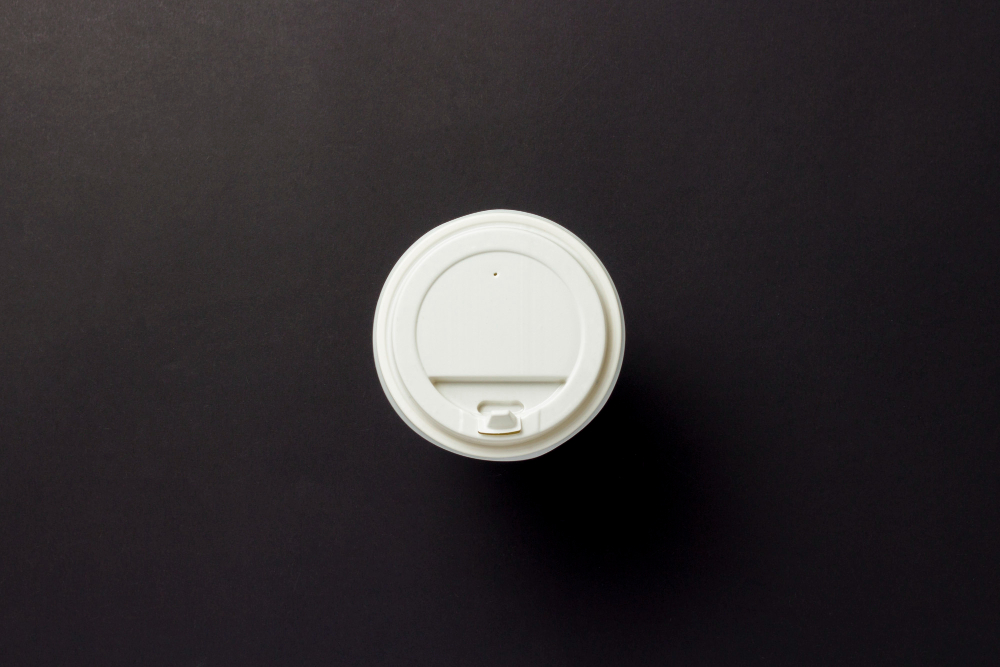
Liquid at near-boiling in a closed cup produces steam, which raises the pressure inside the dome. A sealed lid under pressure is held on firmly until the pressure finds a way out, which it does suddenly – typically by lifting one edge of the lid and releasing a spurt of hot liquid.
That is why a lid pressed firmly onto a very hot drink and then carried, squeezed or knocked can discharge through the drinking hole with some force, and it is why the vent matters more at the moment the drink is made than later.
The vent keeps the inside of the dome at ambient pressure continuously, so there is no accumulation to release.
It is also why a lid fitted to a very hot drink and then carried in a bag is more likely to leak than the same lid on a cooler one. The vent lets pressure out and it will also let liquid out if the cup is tipped, which is the trade the design accepts: a vent that cannot leak would not vent, so every lid with a working vent is one that will spill if inverted. The small plastic plugs some retailers hand out are an acknowledgement of exactly that – a way of closing the vent for transport and opening it again to drink. It is a small hole doing a pressure-relief job, which is the same function as the hole in a pen cap and the same function as the drain on a padlock – a tiny opening that exists because the alternative is pressure or liquid in the wrong place.
The Rest of the Lid Is More Designed Than It Looks
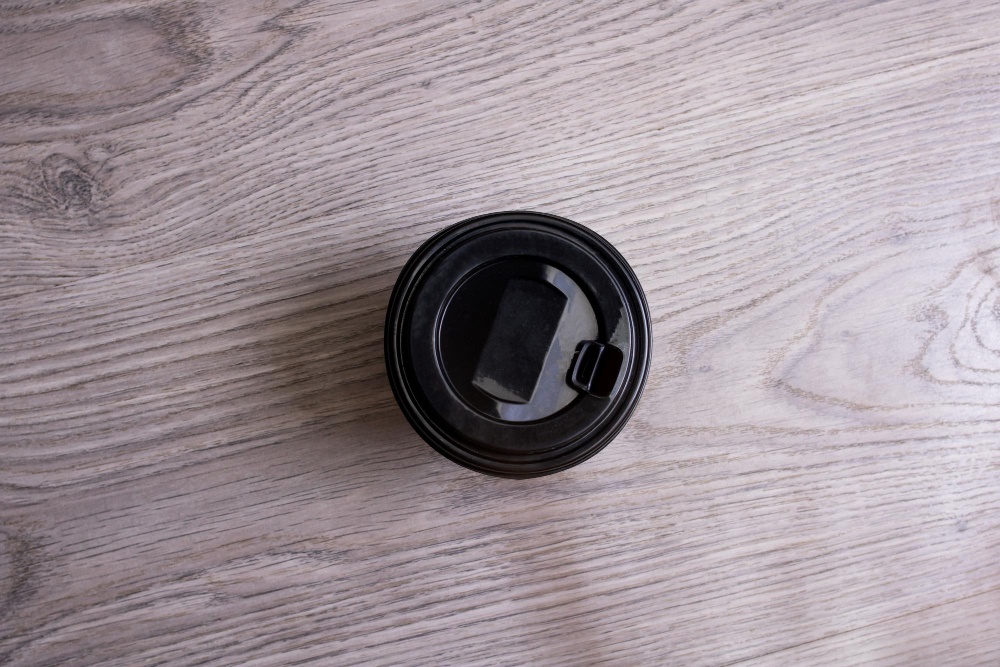
The lid is a thin piece of moulded plastic and essentially every feature on it is deliberate.
The raised dome gives the drink somewhere to move into when the cup is jostled, which keeps liquid away from the rim and the seal.
The ring around the edge grips the rolled lip of the cup, and the geometry of that joint is the entire reason the lid stays on – too loose and it comes off in a bag, too tight and it cannot be fitted by somebody holding a hot cup.
The raised tabs around the dome are mostly for stacking, so a hundred lids nest without wedging together and can be separated one at a time by somebody working quickly.
And the small pressable buttons printed with drink types on some lids are a serving aid, so a cup can be marked without a pen and read at a glance in a queue.
The drinking opening itself is shaped rather than round – usually a teardrop or a slot – because a shaped opening controls the flow rate and directs the liquid onto the tongue rather than straight to the back of the mouth, which is a genuine scald consideration and is why the openings on hot drink lids are smaller than people would choose for themselves.
The Cup Underneath Has Its Own Set of Problems

The lid is the interesting part and the cup is where most of the engineering difficulty actually is.
A paper cup has to hold a liquid at near-boiling without softening, without transferring heat to the hand holding it, without tasting of anything, and while being made of a material that loses essentially all its strength when wet.
The plastic lining solves the wetting problem by keeping the liquid away from the fibre entirely. The heat problem is handled either by a second outer wall with an air gap, by a corrugated sleeve, or by the separate cardboard band that gets handed over with it – all three being ways of putting still air between the drink and the skin, because air is the insulator and the paper is simply what holds it in place.
The rolled rim at the top does three things at once: it stiffens the mouth of the cup so it does not deform when gripped, it gives the lid something to grip onto, and it presents a smooth edge to the lip rather than a cut one.
And the base is a separate disc, crimped into the bottom of the wrapped body, which is why a cup leaks at the base joint when it leaks at all – that seam is the only part of the construction carrying the full weight of the contents.
Why the Lid Is the Hardest Part of the Cup to Recycle

Worth knowing, because the cup and the lid are frequently assumed to be the same problem and are not.
The cup is paperboard with a thin plastic lining to keep the liquid out of the fibre, which is the same laminate problem as the milk carton and requires a specialist process to separate.
The lid is a single plastic, which in principle makes it easier. In practice it is small, light, frequently dark coloured and shaped so it nests and traps other material, and all four of those defeat sorting machinery – it is below the size threshold that optical and mechanical separation handles reliably, and dark pigments absorb the infrared the sorters use to identify polymers.
So the lid is made of a material that is recyclable and is in a format that is not, which is the commonest reason a small plastic item ends up as residue.
The practical response, where facilities exist, is that cups and lids go in the dedicated collections some retailers now run rather than in general recycling, because those are the only routes set up for the formats involved. Whether those schemes capture a meaningful share of what is sold is a separate and contested question, and the honest answer is that participation is the limiting factor rather than the technology.
The Whole Object Is a Compromise With Somebody Walking
Everything odd about a takeaway lid resolves once you remember what it is for.
It has to seal well enough to survive a bag, a bicycle and a car journey, and open easily enough to be drunk from one-handed without looking. It has to be fitted in under a second by somebody serving a queue, and fitted correctly every time by somebody who is not concentrating. It has to be removable for sugar and then refitted. It has to stack in hundreds. It has to cost a fraction of a penny. And it has to do all of that with a liquid hot enough to injure somebody sitting directly underneath it.
Against that brief, a small vent hole, a shaped drinking slot, a gripping ring and a dome is a reasonable set of answers – arrived at over several decades of iteration by an industry that makes them in the billions and hears about every failure.
Which is the general shape of everything in this series: the object that looks thoughtless is usually the one whose constraints are invisible, and the feature that looks pointless is usually the one holding the whole arrangement together.
Look at the next lid you are handed and find the small hole on the far side from the opening.
Cover it with a fingertip and try to drink. That is why it is there.
It is the fastest demonstration of anything in this entire series – one fingertip, two seconds, and a mechanism that governs everything from a washbasin to a fuel tank becomes immediately obvious.
Like our content? Follow us for more.