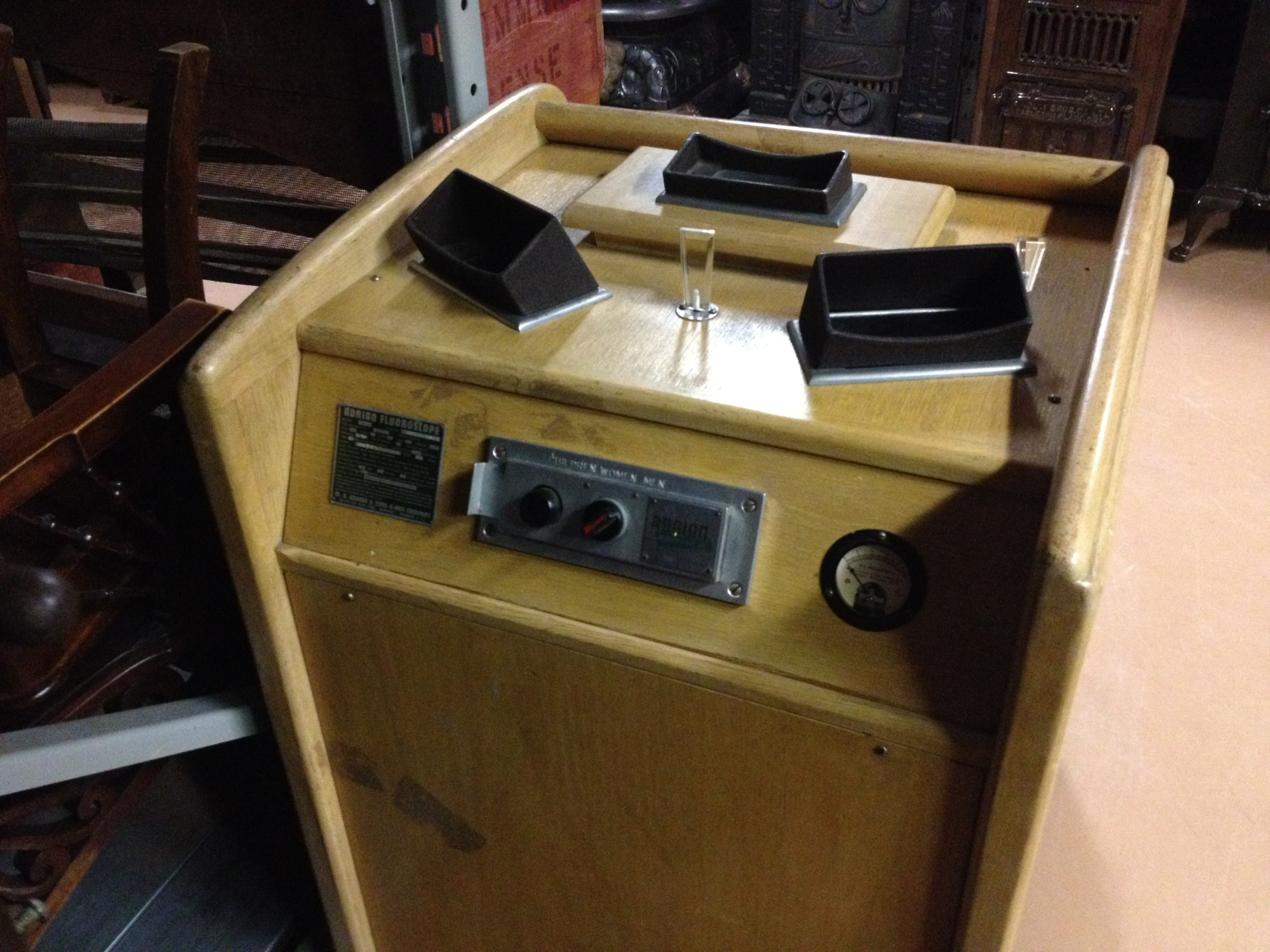
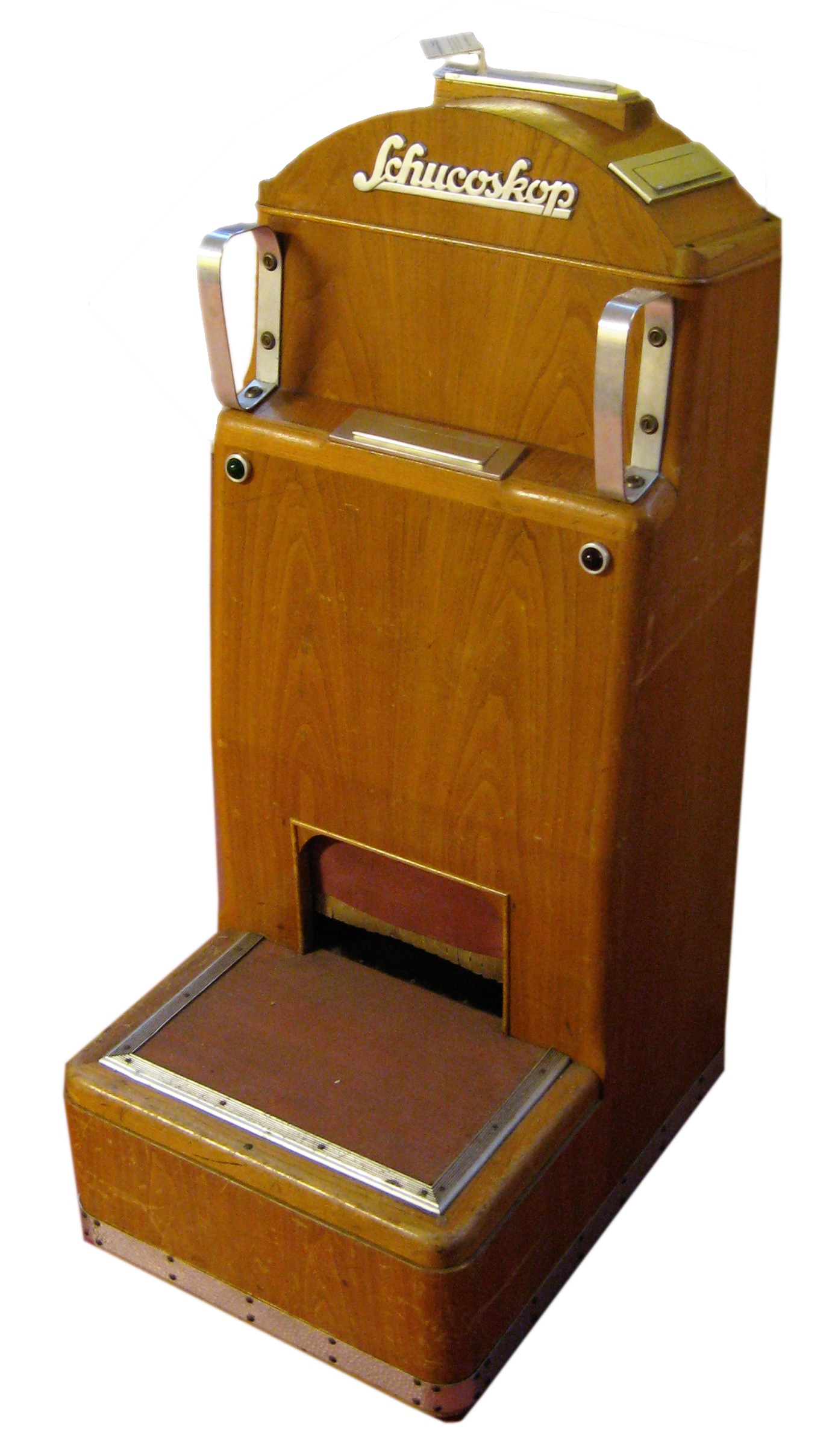
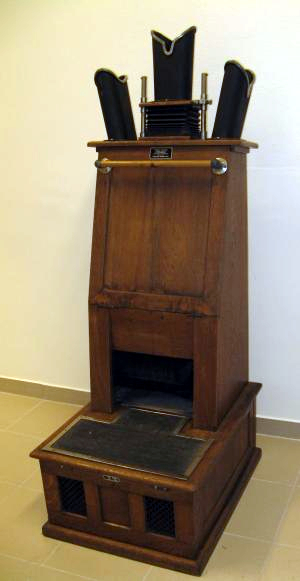
The shoe-fitting fluoroscope is the clearest example in American retail history of a technology that was adopted because it looked like science, kept because it sold shoes, and abandoned only after the people operating it had absorbed years of exposure that nobody was measuring. It was a wooden cabinet about chest high with a step at the bottom, a fluorescent screen inside and three viewing hoods on top: one for the child, one for the parent and one for the salesman.
There was no trick to the physics. An X-ray tube underneath the footplate fired upward through the shoe and the foot onto a screen, and what everybody looked at was a live image of the bones of a child’s feet inside their new oxfords. It was genuinely impressive, it was free, and for roughly thirty years it was the most persuasive piece of equipment in the store.
What the machine actually did
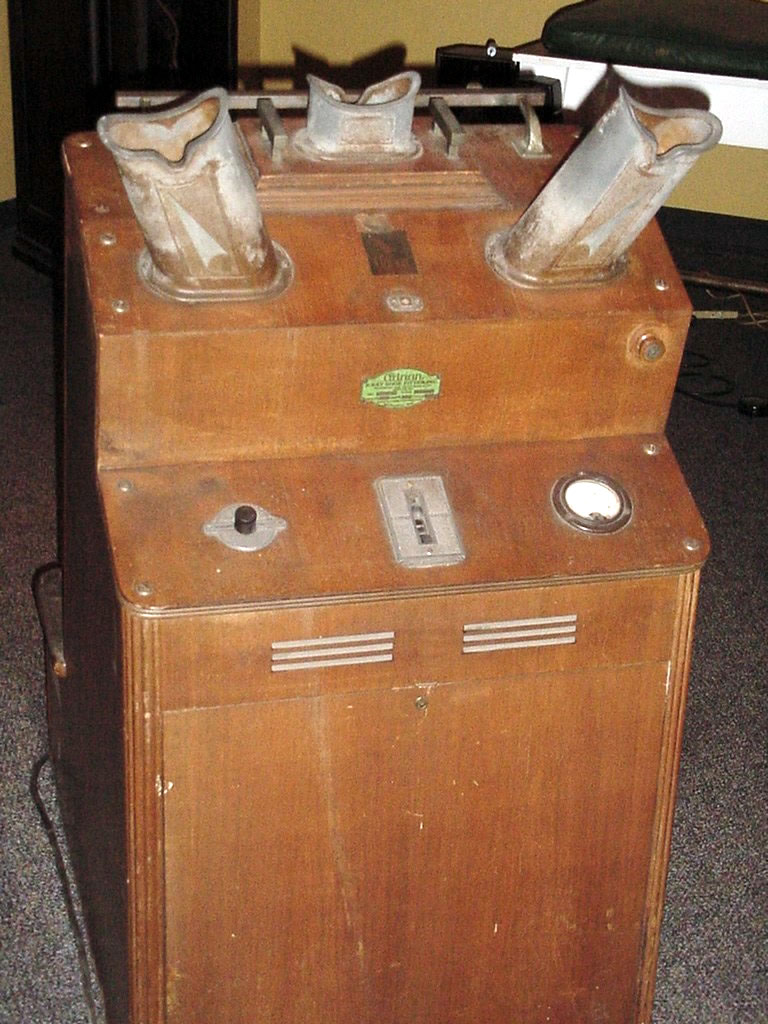
The cabinet was sold to retailers as a fitting instrument. The claim was that a parent could not know whether a growing child’s toes had room, that a thumb pressed on the end of a shoe was guesswork, and that the fluoroscope removed the guesswork by letting everybody see. Advertising leaned heavily on the health of children’s feet and on the scientific authority of the image.
In practice its function was commercial. A mother who had just watched her daughter’s toes crowding the end of last season’s shoes bought new ones, and a store with a machine took trade from a store without one. Shoe chains installed them as competitive equipment, and the fitting benefit was real only to the extent that a visible outline settled arguments faster than a salesman’s opinion.
The exposure was not incidental to the demonstration, it was the demonstration. A typical viewing ran for something in the region of twenty seconds, children frequently had three or four views in a single visit while different shoes were tried, and the machine was a toy as much as an instrument. Children went in to look at their feet without buying anything, repeatedly, and shop staff let them. There was no counter, no log and no limit, because nobody involved understood the demonstration as something that ought to be rationed.
Like our content? Follow us for more.
The dose nobody was measuring
The machines were built and sold with no meaningful standard behind them. Surveys carried out in the United States from the late 1940s onward found enormous variation between individual cabinets of the same model, with the output depending on the age of the tube, the state of the filtration, whether the shielding had been maintained and whether anybody had ever checked. Some units were found to be delivering many times the dose of others.
The exposure was also not confined to the feet. Scatter from an unshielded or poorly shielded cabinet reached upward and outward, which put the pelvis and abdomen of a standing child in the path of a fraction of the beam, and reached the operator and anybody waiting nearby. The viewing hoods themselves were open ports, not shielded windows, in a great many installations.
What makes this a genuine failure rather than simple ignorance is the timing. The biological effects of X-radiation had been understood in outline since early in the century, dose limits for occupational exposure existed, and the medical profession was already applying protective practice. The shoe trade was operating outside all of that, with equipment maintained by nobody, in premises with no monitoring, on a population consisting largely of children.
The person who stood beside it all day

The customer’s exposure was brief and occasional. The salesman’s was neither. A fitter knelt beside the cabinet with his hands and forearms near the footplate, dozens of times a day, six days a week, for years, and in many stores he operated the machine by feel while looking into the hood.
The occupational consequences are the documented part of this story. Chronic radiation injury to the hands was reported among shoe-fitting staff, one widely cited case concerned a shoe model whose repeated exposure led to such severe damage that surgical removal of part of the limb became necessary, and the broader pattern of skin changes and ulceration on fitters’ hands was recognised in the medical literature of the period.
This is the part of the subject that resists nostalgia. The children who played with the machines received a short series of exposures at an age when tissue is more sensitive than an adult’s, which is a real concern and an unquantifiable one at this distance. The staff received a continuous occupational dose with no badge, no screening and no recourse, as a condition of a retail job.
How it was stopped, one state at a time
There was no single federal prohibition that ended the practice, which is why it took so long. Regulation of the machines fell to the states, and the states moved at very different speeds. Pennsylvania is generally recorded as the first to prohibit them outright, in 1957, and through the following decade a long sequence of states either banned the machines or imposed licensing and inspection requirements so demanding that keeping one stopped being worth the trouble.
Professional bodies had been pressing the case for years. Radiological associations, public health officers and standards organisations published findings, recommended limits and in some cases called for outright withdrawal, and the trade press argued back. The commercial resistance was not subtle: a store that gave up its machine lost a differentiator, and the manufacturers continued to market them while the argument ran.
The end was slow and untidy. By around 1970 the machines had effectively disappeared from American retail, though individual units were reported still operating later than that, and the final examples were removed from provincial stores in the 1970s. Nobody made a formal announcement; the cabinets were simply unplugged, pushed into stockrooms and eventually thrown out.
What replaced it, which had been sitting there the whole time
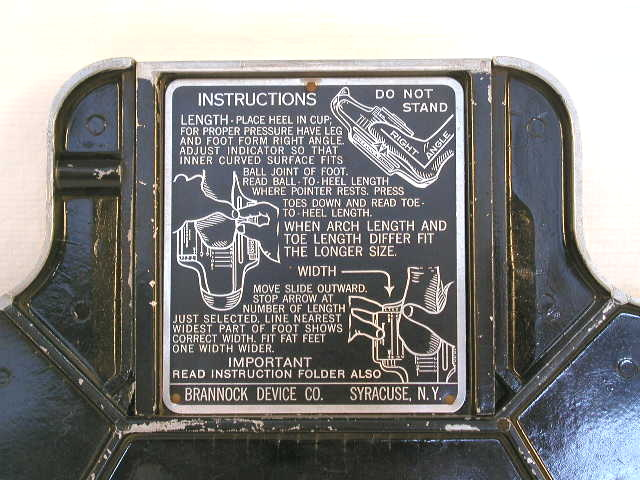
The instrument that actually solved shoe fitting was invented in the 1920s, before the fluoroscope reached its peak, and it is still in use. It is a flat metal plate with sliding scales for length, heel-to-ball measurement and width, operated by a salesman kneeling on the floor, and it requires no power supply, no maintenance and no shielding.
The modern fitting method is that device plus informed judgement: measure both feet, fit the larger one, fit late in the day once the foot has spread, allow growing room by feel and check the fit while the child stands and walks. None of that needed an image of the bones, and the profession’s current position is that a visual check of the interior of a shoe tells you nothing a careful fitting does not.
There is a broader point in the comparison. The fluoroscope was adopted because it produced a spectacular image, and the image was mistaken for better information. It answered a question nobody needed answered, at a cost nobody was measuring, and it displaced a perfectly good method for thirty years on the strength of looking more modern.
Where the cabinets are now
Surviving machines sit in museum collections, in a few shoe industry displays and in private hands, with the tubes removed. They turn up occasionally in house clearances and in the backs of old stores, which is why radiation protection authorities in several countries have at various points issued notices asking anybody who finds one to report it rather than switch it on.
For the generation that stood in them the memory is a pleasant one, and that is worth taking seriously rather than correcting. It was a green glowing picture of your own skeleton, in a shop, as a child, for free. Nothing about the experience felt like a hazard and nobody in the room believed it was one.
The lesson that has outlasted the machines is about who carried the cost. The customer’s exposure was small and infrequent and the staff’s was neither, and that asymmetry — the person operating a hazard absorbing far more of it than the person it is operated on, with no monitoring and no say — is the pattern that occupational health regulation spent the following half century addressing across one trade after another. The shoe store is simply the example with the best picture.
It is also the example that explains why so much of that regulation ended up being written around measurement rather than around intent. Nobody in the shoe trade set out to harm anybody, and the machines were sold in good faith by manufacturers who believed the exposures were trivial. What was missing was not goodwill but a number: no store knew what its own cabinet was emitting, no fitter knew what he had accumulated, and in the absence of any figure the argument could run for thirty years on assertion alone. Dosimetry badges, mandatory inspection and equipment standards exist precisely because sincerity is not a substitute for a reading.
Like our content? Follow us for more.