By 1960 the wheelwright was nearly finished as a trade. The farm cart had gone to the pneumatic-tyred trailer, the dray had gone to the lorry, and the men still building wooden wheels were doing it for a shrinking list of customers: brewers’ drays kept for show, gypsy waggons, estate carts, agricultural museums and a handful of farms in difficult country.
What they knew was a genuine piece of engineering, worked out empirically over centuries and almost entirely undocumented in any form a modern engineer would recognise. A wheelwright could not have written down the stress analysis of a wheel and he could build one that carried two tons over a ploughed field for thirty years.
Three woods, chosen for three different properties
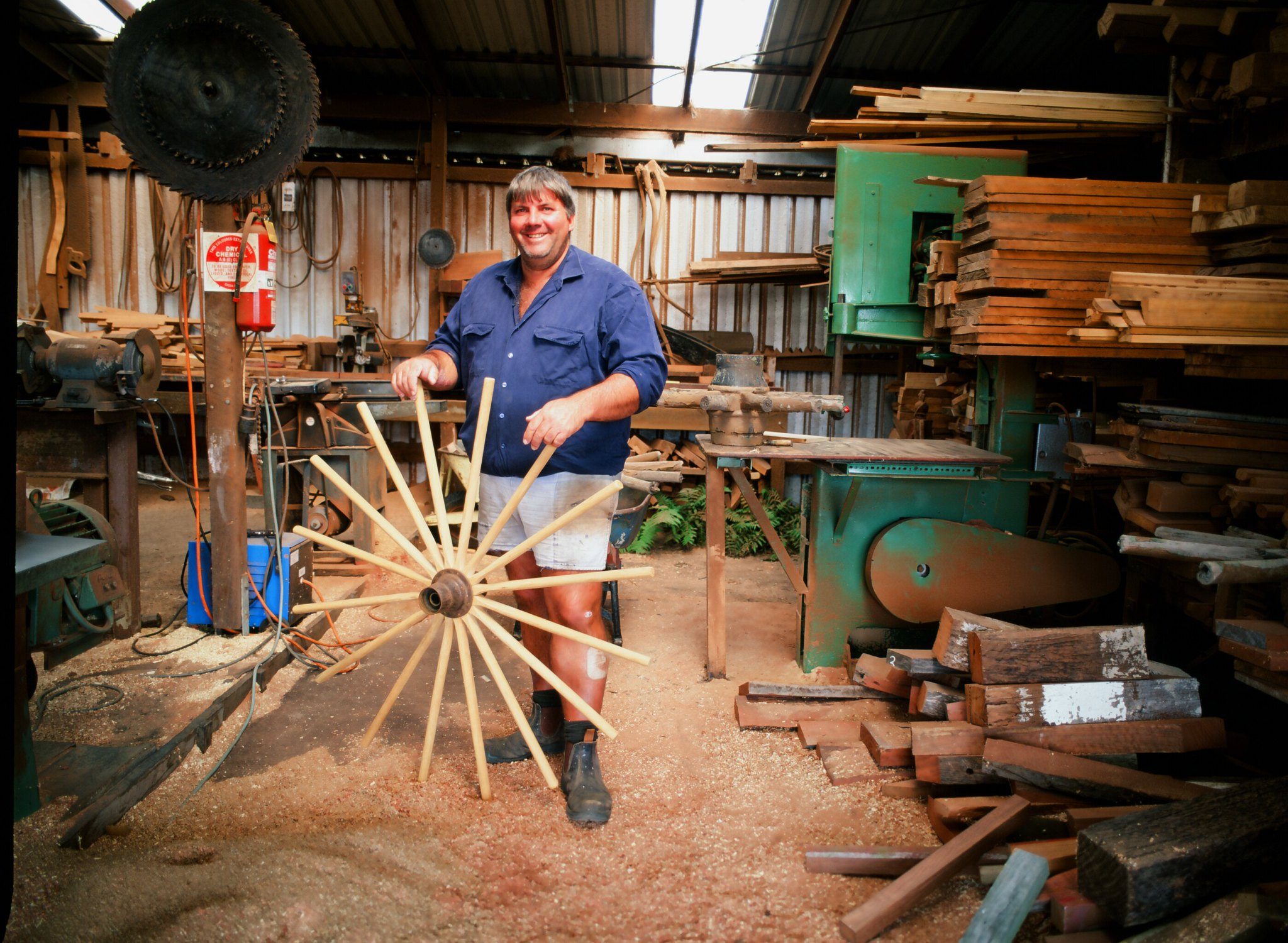
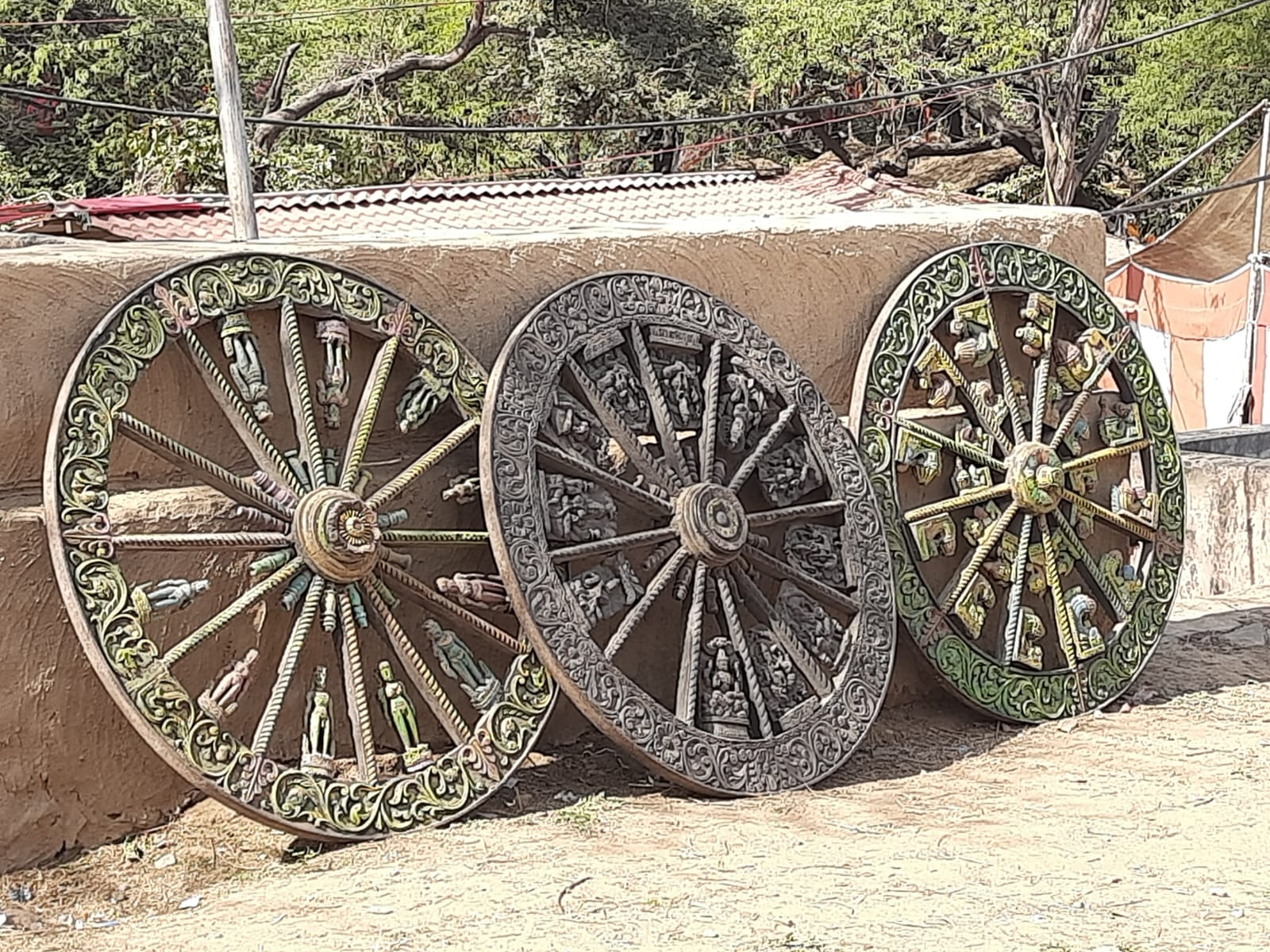
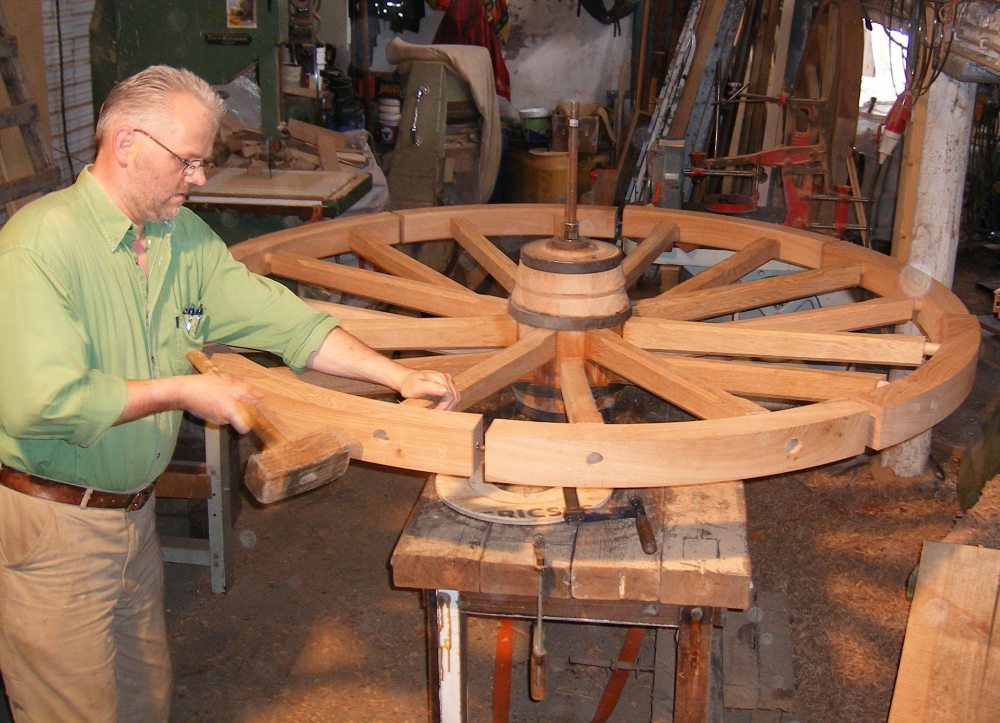
A traditional wheel uses different timber for each component, and the choices are not traditional in the sense of arbitrary. The hub, called the stock or nave, is elm, because elm does not split when it is bored through from several directions and can take the mortices for the spokes without failing along the grain. The spokes are oak, because oak is stiff and strong in compression along the grain. The rim segments, called felloes, are ash or beech, because they need to bend slightly and take a curve without breaking.
That is three species chosen for three mechanical requirements, in a trade with no materials science, and the choices are correct. Modern analysis of traditional wheel construction has repeatedly confirmed that the timber selection is close to optimal for the loads involved.
The timber also had to be seasoned, which meant years. A wheelwright’s yard held a stock of air-drying elm, oak and ash representing a long investment, and the seasoning schedule was part of the craft: the hub needed to be drier than the spokes, so that the spokes would swell slightly in the mortices rather than shrink out of them.
Like our content? Follow us for more.
Dish, which is the part nobody expects
A cart wheel is not flat. It is dished — coned slightly outward, so that the rim sits further out at the bottom than the hub does, and the spokes on the loaded side stand close to vertical when the wheel is on the axle.
There are two reasons and both are real. A dished wheel resists the sideways loading that comes from a cart lurching on rough ground and from the sway of a load, in the same way that a cone resists edge loading better than a flat disc. And it allows the body of the cart to be wider at the top without fouling the wheel.
It is also why the axle is not horizontal. The axle arms angle downward so that the lower spoke of the dished wheel stands upright under the load, which means the whole geometry of hub, dish and axle has to agree. Getting that wrong produced a wheel that wore its hub or ran off its axle, and the only check available was the wheelwright’s eye. A good man could sight along a finished wheel and see a sixteenth of an inch out of true, which is a claim that sounds like trade mythology and is confirmed by the surviving wheels.
The tyring, which is the operation worth describing

A finished wheel is a loose assembly. The spokes sit in the hub, the felloes sit on the spokes, and the joints between the felloes are open. Nothing holds it together until the iron goes on.
The tyre is a hoop of flat iron, welded into a ring, made deliberately slightly smaller in circumference than the wheel it is going onto. It is heated in a ring of fire — traditionally a circle of wood or coke laid on the ground and lit — until it has expanded enough to pass over the rim. Two or three men then lift it with long tongs, drop it over the wheel, which is bolted flat to a circular iron plate, hammer it down into position, and immediately pour water onto it.
The iron contracts as it cools and pulls the entire wheel into compression: the felloe joints close up, the spokes are driven into their mortices, and a loose assembly of wood becomes a single rigid structure. The wood smokes and chars where the hot iron sits on it, which is expected. It is a one-attempt operation, it takes about a minute, and if the tyre was cut to the wrong length the wheel is either ruined or useless.
What else was in the shop
The wheelwright was usually also the cartwright and frequently shared a yard with a blacksmith, because every wooden component needed ironwork: tyres, hub bands, axle boxes, strakes, bolts, hinges and the plates on a cart body. The two trades were interdependent to the point that in many villages they were the same business.
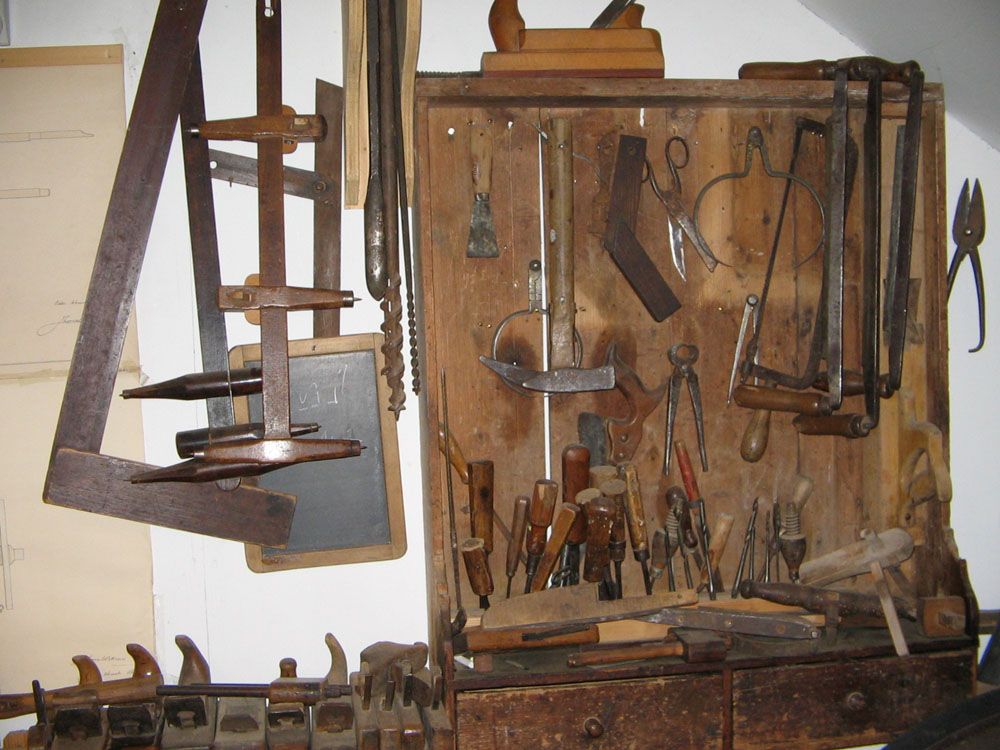
The tools were specific and most of them have no other use: the spoke dog, the samson, the traveller for measuring circumference by rolling, the boxing engine for reaming a hub, the bruzz for cutting mortices, the spokeshave and the adze. A wheelwright’s chest was worth a substantial sum and was frequently the most valuable thing a man owned.
The hazards were the ordinary ones of a wood and iron shop, with one unusual addition. Tyring involves several men lifting a red-hot iron ring over a wheel at knee height, by hand, with tongs, at speed, with water about to turn to steam underneath it. Modern practice for the few people still doing it uses the same method with proper protective equipment, a prepared area and more hands.
The quieter risk was the hub boring and the mortice cutting, done by hand with a bruzz and a mallet in elm, which is hard, stringy work on a timber that resists tools, repeated for every spoke in every wheel. Hand and wrist injury was a normal expectation of the trade and was never recorded as anything.
Why it ended, and why it did not quite
The pneumatic tyre is the whole answer. A rubber tyre on a steel rim does what the dish, the compression and the three timbers were doing, and does it better, cheaper and with no skill: it absorbs shock, it tolerates sideways loading, it does not need seasoning and it can be replaced by anybody. Farm carts converted through the 1930s to 1950s, often onto second-hand motor axles, and the trade’s customer base evaporated.
By 1960 what remained was ceremonial, agricultural in difficult terrain, and heritage. Brewery drays, show turnouts, gypsy waggons, horse-drawn funerals and museum restoration kept a small number of men in work, and a few of those businesses have survived continuously to the present on exactly that basis.
There are working wheelwrights now, in Britain and in the United States, doing the same operation with the same tools and the same ring of fire, for restorers and for the horse-drawn trade. It is one of the few trades in this whole series that was never made safe or modernised, because it was never industrialised in the first place and the method has no better version.
What the trade knew that nobody wrote down
The thing most worth recording about wheelwrighting is how the knowledge was held. There were no drawings. A wheelwright knew the dish for a given wheel, the length to cut a tyre for a given rim, the amount of set to put in a spoke and the degree to which a hub should be drier than its spokes, and he knew them as quantities he could produce rather than as numbers he could state.
That is why the trade was so hard to revive once it broke. A man who has built two thousand wheels can teach an apprentice over seven years and cannot write a manual, and when the apprenticeships stopped the information went into a very small number of heads. Most of what exists now was reconstructed in the 1970s and 1980s from surviving practitioners, surviving wheels and one or two books written by men who realised what was happening.
The best of those books was written by a wheelwright who took over his father’s shop, watched the trade die around him, and set down what the shop had known. It is read now as literature as much as as a manual, and it is the main reason the method survived at all. That is a thin margin: a craft of several centuries came through to the present because one practitioner happened to be able to write.
It is also the clearest case in this whole series of a trade that needed no safety reform and simply lost its market. Nothing about wheelwrighting was withdrawn, prohibited or found to be harmful. The pneumatic tyre arrived, did the same job for a tenth of the cost with none of the skill, and the knowledge of how to build a structure that holds itself together by compression became a heritage specialism within a single working lifetime. Most of the files in this series describe hazards that were engineered away. This one describes a solution that was simply no longer required.
Like our content? Follow us for more.