

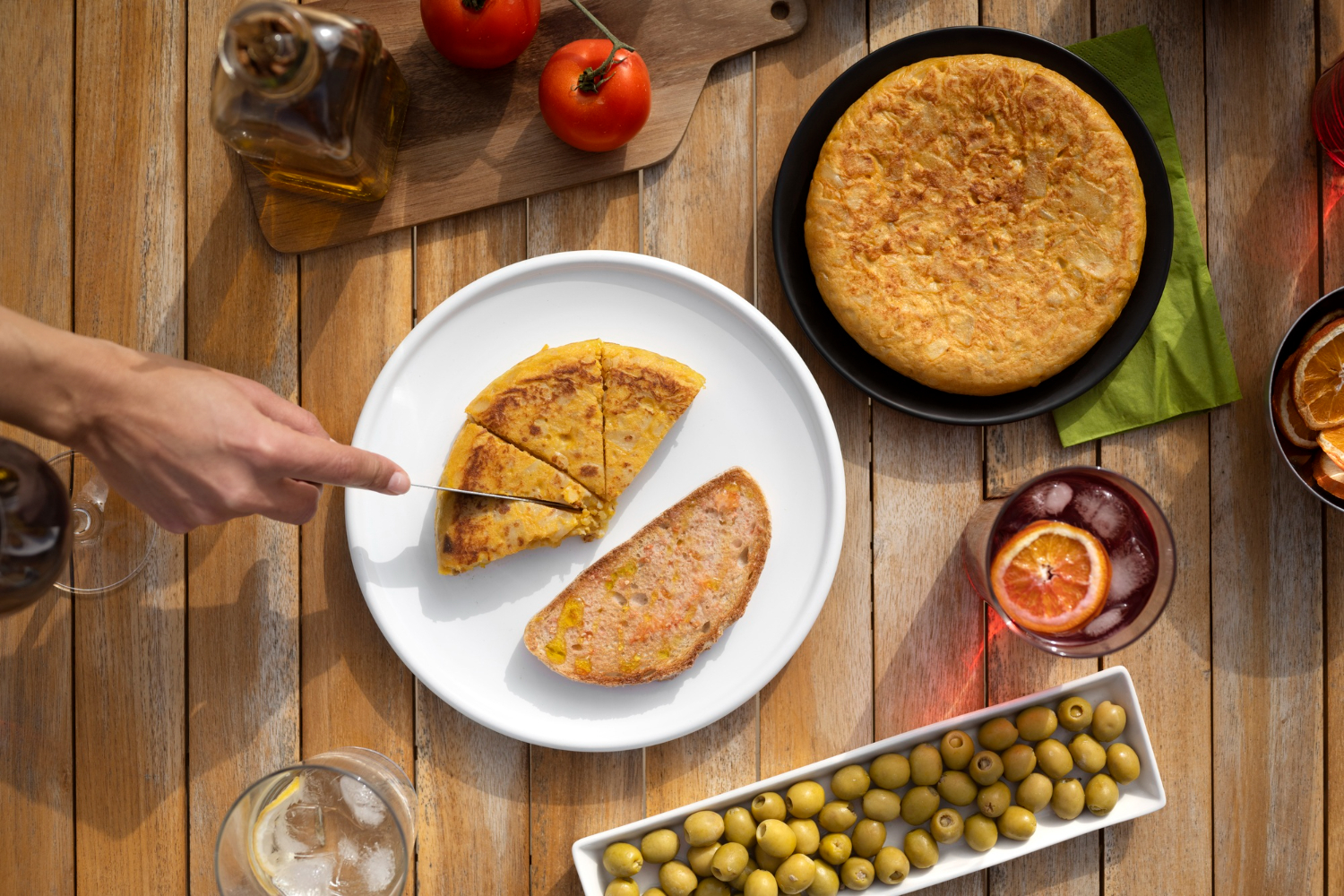
In Spain, lunch is not a meal. Lunch is the meal — the largest, longest, most socially anchored event of the day. The food itself typically takes 60 to 90 minutes. What follows the food, and what most non-Spaniards visiting the country misunderstand, is a separate institution called the sobremesa. It is the period when nobody gets up from the table. The plates are cleared, coffee or digestifs are served, the conversation slows down and deepens, and the meal becomes something else — a social ritual that can stretch one to three hours past the point when the eating actually stopped.
The Spanish word sobremesa translates literally as “over the table” — a compound of sobre (over, above) and mesa (table). The actual meaning is “the time spent at the table after the meal.” It is a noun describing a specific social activity with no precise English equivalent. The closest approximations — “lingering over coffee,” “after-dinner conversation” — capture some of the form but miss the cultural weight.
In its traditional form, the sobremesa was a daily institution structurally accommodated by the Spanish workday. The standard Spanish schedule was: morning work block (approximately 9 AM to 2 PM), a long lunch break that included sobremesa (2 PM to 4:30 or 5 PM), and an afternoon-evening work block (5 PM to 8 PM or later). This schedule accommodated the genuinely high midday temperatures in much of Spain, allowed for a substantial meal at the time of day when most cultures eat their largest meal, and kept families together for the day’s most important shared eating experience.
What Actually Happens During a Sobremesa

The sobremesa is structured but informal. After the main meal, the table is cleared but no one moves. Coffee is brought out, sometimes with a digestif — historically anís, licor de hierbas, patxaran, or in more formal settings, brandy or quality liqueur.
The conversation typically shifts in character after the food is removed. Discussion topics expand to include politics, family matters, work issues, and what Spaniards call los asuntos importantes — the important matters. The Spanish convention is that serious conversation does not happen during eating itself; eating is for the food, for compliments to the cook, for light social patter. The conversation that matters happens afterward.
The pacing matters deliberately. The sobremesa is slow. Voices stay quiet. Disagreements are made with care. Spanish sociologists who have studied family life across generations have described the sobremesa as the daily structure within which most actual decision-making in Spanish families historically occurred — the time when children heard their parents discuss things, when adolescents practiced participating in adult conversation, when families negotiated their internal matters.
What Changed in the 2010s

Spain’s relationship with its traditional schedule has been changing under economic pressure for some time. The 2008-2014 financial crisis intensified that pressure. As Spanish workplaces increasingly aligned with European business hours — to coordinate with northern European partners, to compete in global markets, to retain employees who wanted shorter total workdays — the long midday break came under strain.
In 2016, the Spanish government formally proposed shortening the workday by moving Spain to the same time zone as the United Kingdom and Portugal and reducing the standard lunch break. The proposals were controversial. Spanish unions, family advocates, and cultural commentators argued that what was being targeted was not just an inefficient schedule but an integrated social system. The long lunch and the sobremesa were arguments for the importance of family time, of shared meals, of slow social rhythms in an increasingly compressed European working life.
As a practical matter, the sobremesa survives strongly in restaurants, in retired and semi-retired households, in regions with traditional schedules (rural areas and parts of the south), and on weekends and holidays nationwide. It survives less strongly in urban professional households on workdays, where lunch is increasingly a 45-minute affair eaten at one’s desk or in a quick restaurant.
The Research Angle
The sobremesa has attracted attention from researchers in several disciplines over the past 15 years. Nutrition and digestive health research has examined whether slow, socially-anchored eating produces measurable benefits compared to fast, distracted eating. Studies generally find that slower eating correlates with better satiation signaling, lower likelihood of overeating, and improvements in some metabolic markers.
Mental health and social-connection research has examined the role of structured social meals in mental health outcomes. The Mediterranean lifestyle generally — of which the sobremesa is a component — has been associated with lower rates of depression and dementia in some longitudinal studies, though the specific contribution of post-meal social time has not been isolated from other variables.
Anthropologists studying changes in Spanish family structure have documented the role of sobremesa in family communication, with particular attention to its decline among younger urban families and the corresponding changes in how Spanish families communicate about important matters.
How to Experience an Authentic Sobremesa

For visitors to Spain, experiencing a real sobremesa requires being in the right setting at the right time. A lunch in a tourist-oriented restaurant, ordered in English, paid for with a card, and eaten in 45 minutes does not produce a sobremesa. A long Sunday lunch in a family-run restaurant in a smaller town, ordered in Spanish, with multiple courses unfolding over two hours, can produce one almost by default.
The single most effective approach for a traveler is to find a menú del día restaurant in a non-tourist area — a place that locals frequent for the multi-course set-price lunch — arrive at 2:00 or 2:30 PM, and treat the entire afternoon as the meal. Order coffee after the main course. Order a digestif after the coffee. Stay in the restaurant. The staff will not rush you. The pacing of the establishment is built around this rhythm, and adapting to it is the closest a visitor can get to experiencing the practice authentically.
Sunday family lunches in Spanish homes, when invited, are the most authentic possible form. Visitors who have local friends or extended family connections in Spain are most likely to encounter a sobremesa that runs four hours and ends not because the conversation has finished but because someone has somewhere else to be.
The Broader Question
The sobremesa is not unique to Spain in its general form. Long, socially-structured meals exist in southern Italian, Greek, Portuguese, Latin American, and many other cultures. What is distinctive about the Spanish version is the level of cultural formalization — that there is a specific noun for the practice, a specific set of rituals around it, and a specific position in the national daily schedule.
The broader question the sobremesa raises is one that anyone in a culture with shrinking shared-meal time can recognize. What is lost when meals get faster, when families eat at different times, when post-meal time disappears in favor of immediate return to other activities? The Spanish answer, as expressed in cultural defenses of the sobremesa, is that the slow conversation holding families and societies together is lost.
Whether that’s right, and whether the trade is worth making, is a question every country is in the middle of working out for itself.
