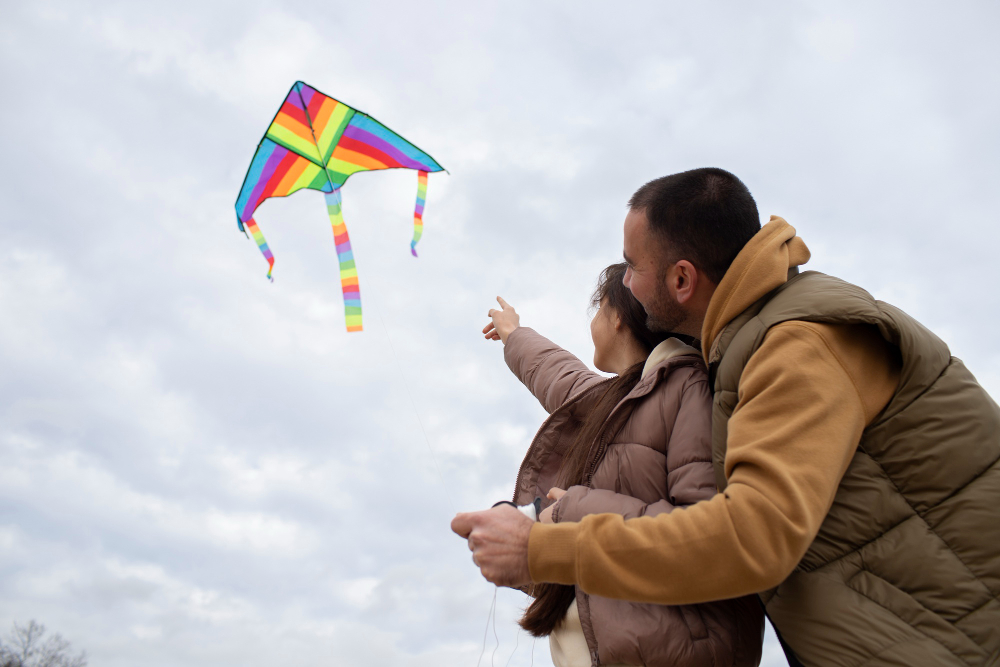
There is a widespread mental model of a kite that treats the string as a leash, restraining something that would otherwise escape.
That model produces a specific prediction: cut the line and the kite flies away. It does not. It stalls, tumbles and comes down, which is the clearest possible evidence that the string was doing something other than holding it back.
What the string is doing is providing one of the forces that keeps the kite at a working angle to the wind. Without it the kite has no way to maintain that angle, so it stops generating lift almost immediately.
Understanding that inverts the whole object, and it explains the shape, the tail, the bridle and why a kite that will not fly is almost always suffering from one specific problem.
The Three Forces
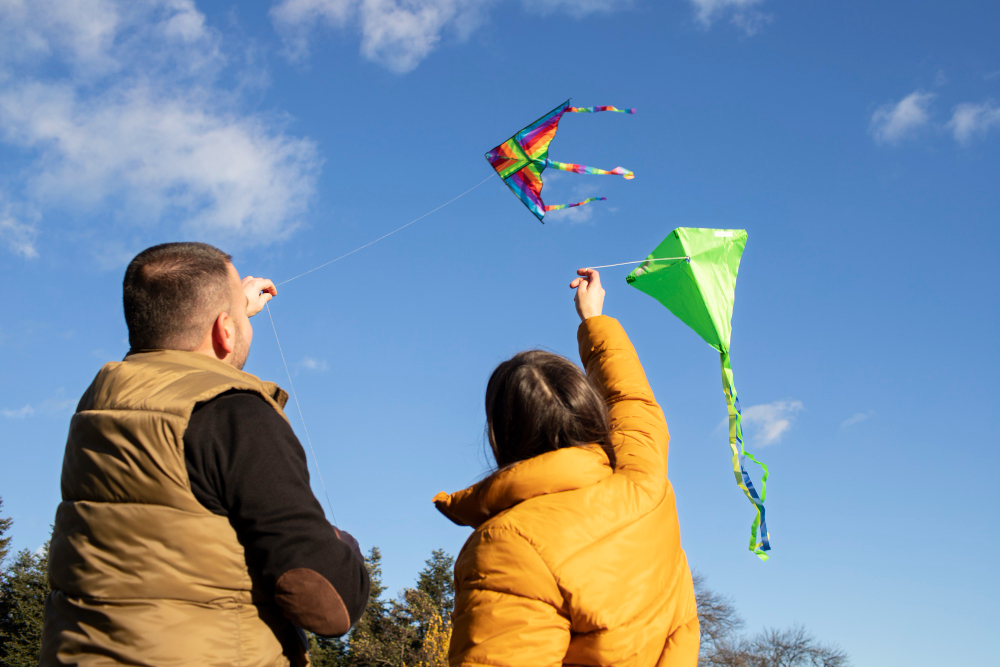
The balance is the whole subject and it is worth setting out precisely.
Air meeting the inclined surface of the kite is deflected downward, and the reaction to that deflection pushes the kite upward and backward.
Gravity pulls the kite down, in proportion to its weight.
The line pulls the kite forward and downward toward the person holding it.
At a stable flying position those three balance exactly, and the kite sits still relative to the ground while air moves past it continuously.
Change any one and the position shifts. More wind increases the first, and the kite rises and moves back until the balance is restored at a new angle; less wind and it sinks forward.
So a kite in steady flight is not being held up by the string and is not fighting it. It is resting at the single position where three forces cancel.
Like our content? Follow us for more.
Why the Angle Matters So Much
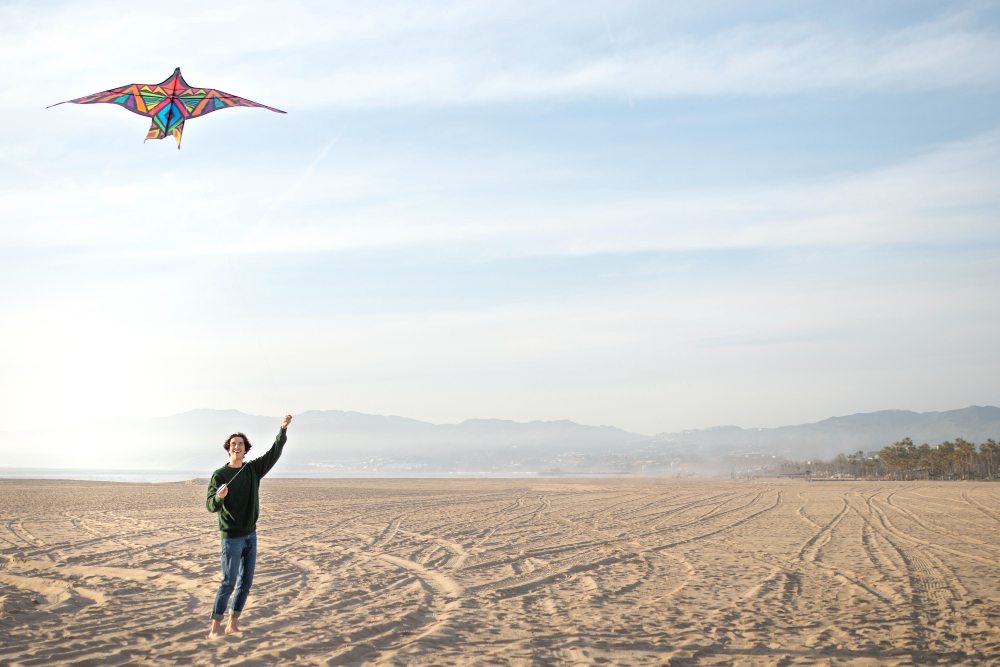
The critical variable is the angle the kite presents to the airflow, and it has a narrow working range.
Too shallow an angle and the air is barely deflected, which produces very little force and the kite sinks.
Too steep and the airflow separates from the upper surface rather than following it, which collapses the lift abruptly — the kite stalls, falls, picks up speed, recovers and repeats, which is the diving and swooping behaviour everybody has seen.
Between those is a range where the force is strong and the flow stays attached, and the entire design of a kite is about holding it there without constant intervention.
That is what the bridle does. The arrangement of lines attaching the flying line to the kite sets the angle at which it hangs, and adjusting it is the single most effective way to fix a kite that will not behave.
Too much angle produces the stalling and diving; too little produces a kite that will not climb. Almost every problem is one of those two.
What the Tail Is For
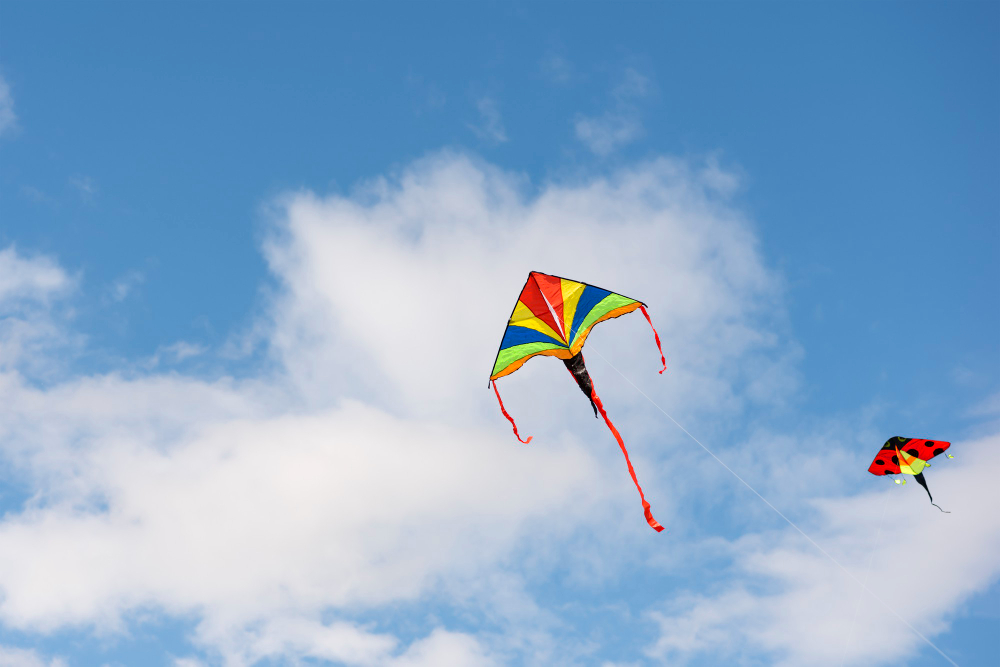
The tail is universally misunderstood and its function is specific.
It is not there for weight, and adding weight is generally the wrong fix. It is there for drag applied at a distance from the centre.
A kite tipping to one side begins to turn. The tail, being behind and below, resists that movement, and because it is far from the centre of the kite a small force produces a substantial correcting effect.
That is the same principle as the flights on a dart or the feathers on an arrow: stability comes from drag placed behind the centre of mass, which makes any deviation self-correcting.
A kite without enough tail rotates, dives and spins; one with too much is stable and sluggish and will not climb, because the additional drag has to be paid for.
Which is why tail length is adjusted to conditions rather than fixed. Stronger wind produces more disturbance and needs more tail; light wind needs the minimum that keeps it pointing the right way.
Why the Shape Varies
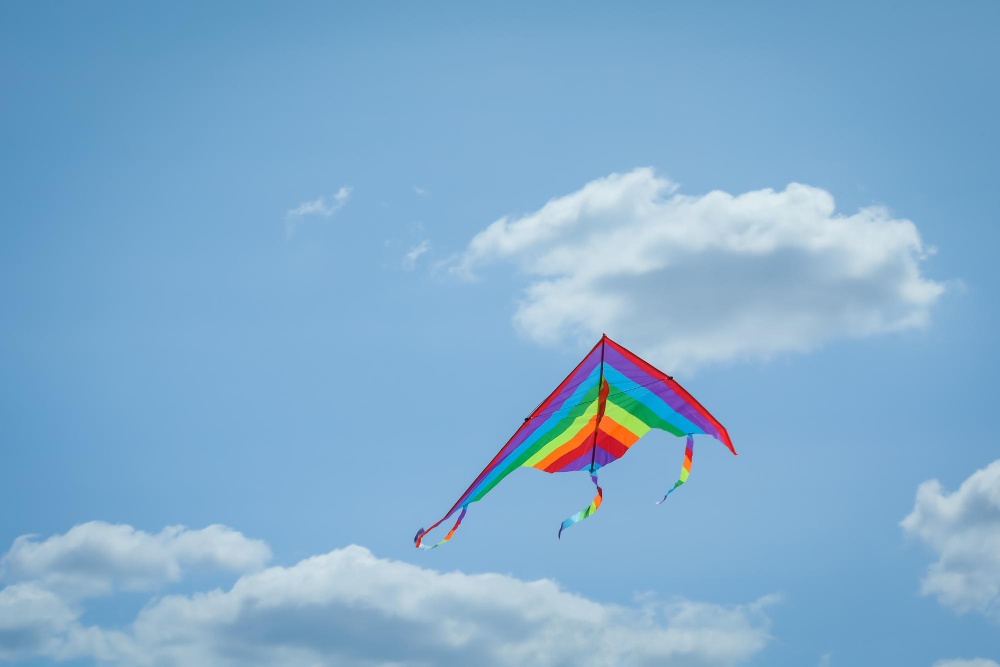
Different forms solve the problem differently and each is a set of trade-offs.
A flat kite is the simplest and requires a tail, because a flat surface has no inherent tendency to return to its orientation.
A bowed or curved kite has a shape that generates a restoring force when it tips — the lower side presents more surface to the wind than the raised one, which rights it — so it can fly with little or no tail.
A box kite achieves stability through its three-dimensional structure, with surfaces at different angles that resist rotation in every direction, which makes it steady in strong wind at the cost of weight and complexity.
A soft kite has no rigid frame and is held in shape entirely by air entering the front and inflating it, which makes it packable and dependent on sufficient wind to inflate before it will fly at all.
Each of those is the same three-force balance achieved by different means, and the choice is about conditions, portability and what the kite is for.
Why the Line Matters
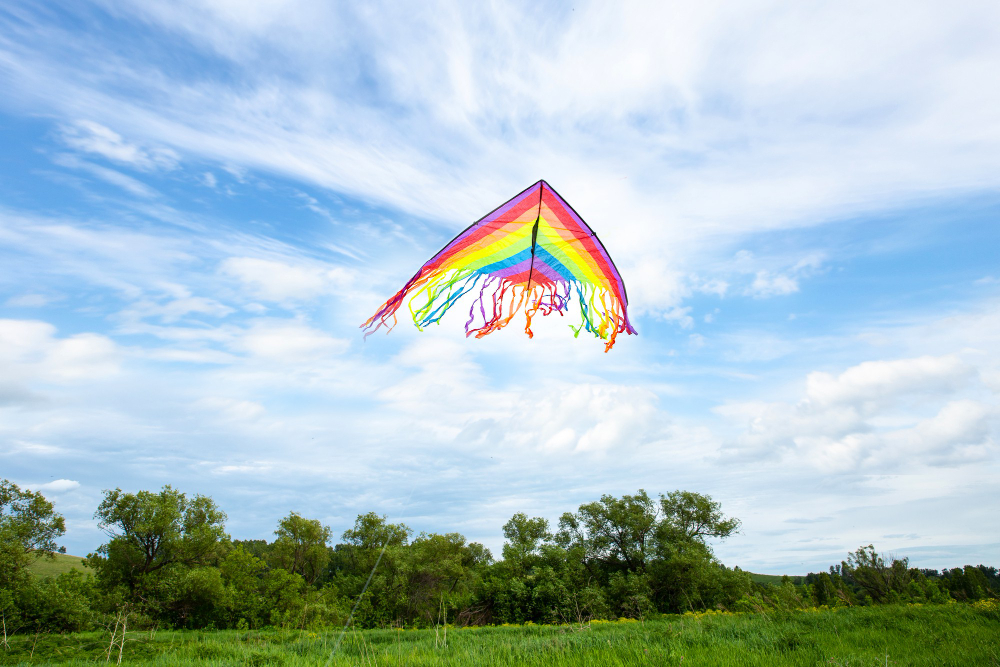
The line is a structural component and is frequently the limiting factor.
It has weight, which sags into a curve, and that curve means the angle of pull at the kite is not the angle at the hand — so a long line produces a lower flying angle regardless of conditions.
It has drag, which increases with length and with wind speed and is a substantial proportion of the total force on a large kite at length.
And it stretches, which introduces a delay between what the hand does and what the kite does, making a long line feel unresponsive.
Thinner line reduces weight and drag and reduces strength, which is the trade — and the force on a line in strong wind is far higher than people expect, which is why kite line fails and why it can cut.
That last point is worth taking seriously. Thin line under high tension is truly dangerous to handle directly, and the standard practice of using a handle or winder rather than gripping the line is a safety measure rather than convenience.
Why It Will Not Fly
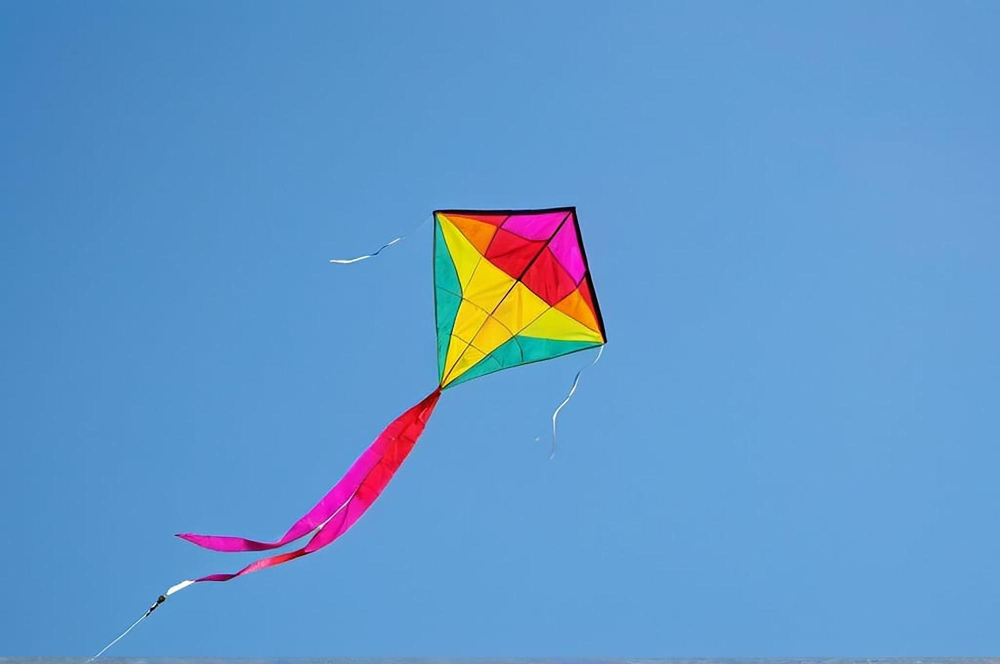
The failure modes are limited in number, which makes diagnosis straightforward once the forces are understood.
Insufficient wind is the commonest and is not fixable by running. Running generates airflow briefly and stops when you do, so a kite launched that way climbs and then sinks as soon as the runner tires.
Too much wind produces the opposite: the kite is pulled to a very high angle, stalls, dives and cannot be held at a working position at all, and the correction is a longer tail or a different kite.
An incorrectly set bridle produces either a kite that will not rise or one that oscillates and dives, and adjusting where the line attaches is the first thing to try in both cases.
Asymmetry produces a persistent turn to one side. A frame bent slightly, a tail attached off centre or a covering tighter on one side all do it, and the kite will circle until it hits the ground.
And ground turbulence defeats everything. Air near obstacles is disturbed, gusty and unpredictable for a distance several times the height of whatever is disturbing it, which means a kite launched in the lee of buildings or trees is being asked to fly in conditions no design handles.
That last one accounts for a large proportion of unsuccessful attempts, and the remedy is distance rather than technique.
What Kites Were Actually For
The applied history is more substantial than the recreational association suggests.
Kites carried lines across gaps where nothing else could, which is how the first cable was taken across certain spans — a light line flown over, used to pull a heavier one, and so on until a cable was in place.
They lifted instruments to altitudes nothing else could reach before powered flight, producing atmospheric measurements from heights otherwise inaccessible.
They lifted people, in arrangements that were exactly as alarming as that sounds and were used for observation.
They were used for signalling, for fishing, for pulling vessels, and for a range of practical purposes across many centuries and many places.
And the aerodynamic work done with them fed directly into the development of powered flight, because a kite is a wing held at a controlled angle in a moving airstream, which is precisely the thing anybody trying to fly needed to understand.
Which is a reasonable way to see the object. A kite is a wing with the airspeed provided by the weather and the position maintained by a string — and everything anybody learned about wings, they could learn from one before there was anything else to learn it from.
Which makes it an unusually honest object. Everything a wing does is visible in a kite, at walking pace, on a string – and the only reason it seems like a toy is that the problem it demonstrates was solved a very long time ago.
Like our content? Follow us for more.