

The Belief Is Universal and It Is Backwards
Ask anybody how a microwave differs from a conventional oven and you will be told that it heats from the inside out. It is one of the most widely held pieces of kitchen physics there is, and it is wrong in a way that is easy to demonstrate.
Heat a mug of soup for ninety seconds and the outside is scalding while the middle is cool. Heat a large portion of anything dense and you get a molten ring around a cold core. If the energy were being deposited at the centre and working outwards, the opposite pattern would appear every single time, and it never does.
What actually happens is that the energy is absorbed in the outer layer and then has to travel inward by conduction, exactly as it would in a pan. The outer layer gets hot very fast, which is the useful part. The centre gets hot slowly, by heat crawling in from the edges, which is why it is the last thing to warm up and why standing time matters.
So the device is not a different kind of heating. It is a very fast way of heating the outside, followed by the same waiting that every other method requires. The difference is where the energy is deposited, which is a thin shell rather than the surface, and that distinction is worth about two centimetres.
Like our content? Follow us for more.
What It Is Actually Doing to the Food
The oven fills its cavity with radio waves of a particular frequency. They are not hot, they do not carry heat, and they are not a form of heat at all. They are an oscillating electric field, reversing direction billions of times a second.
Certain molecules respond to that. A water molecule is electrically lopsided, with a slight negative charge at one end and a slight positive charge at the other, which means an electric field exerts a turning force on it. In an alternating field the molecule is pushed one way and then the other, continuously.
In a liquid, that molecule is surrounded by others and cannot rotate freely. It shoves against its neighbours, and the energy of all that shoving ends up distributed as random molecular motion, which is precisely what temperature is. The food gets hot because billions of molecules are being jostled by a field and losing the resulting motion to each other as heat.
Two things follow immediately and both are useful. The energy is absorbed wherever those molecules are, rather than being applied at a surface, which is why a microwave can heat the inside of a filled pastry while the pastry itself stays limp. And the absorption depends entirely on what the food is made of, which is the subject of the next section.
The frequency used is not special in the sense of matching any natural resonance of water. That is another widespread claim and it is not right. The frequency sits in a band set aside for this kind of equipment, and it was chosen for practical reasons including penetration depth and the availability of the components to generate it.
Why It Heats Some Things and Ignores Others
Water absorbs strongly. Fats and sugars absorb, but differently and generally less. Dry materials with no mobile polar molecules absorb almost nothing at all, which is why a dry ceramic plate comes out of a microwave cool and a wet one comes out warm.
This explains most of the oddities everybody has noticed. Jam in the middle of a doughnut becomes dangerously hot while the dough around it is merely warm, because sugar syrup is a very different absorber from a mass of starch. Fatty food heats unevenly for the same reason. A bowl of frozen food heats badly because ice is a much poorer absorber than liquid water: the molecules are locked in a lattice and cannot rotate, so until a region thaws it barely heats, and then the moment it does thaw it heats very fast and runs away from the regions still frozen.
That last effect is the single biggest practical limitation of the technology and the reason defrosting is done at reduced power. Reducing power in most microwaves does not mean reducing the intensity of the field; it means switching the generator on and off in a cycle, so that the food spends part of the time being heated and part of the time simply sitting there with heat conducting from the thawed parts into the frozen ones. The low setting is not a gentler flame. It is the same flame, intermittently, with pauses for the heat to even out.
The Energy Barely Gets In
The depth to which the field penetrates before most of it has been absorbed is, in food with normal water content, in the region of one to two centimetres. Beyond that, very little arrives.
That figure is the explanation for nearly everything about how the appliance behaves. A thin portion heats quickly and evenly because it is all within the absorbing layer. A thick portion heats at the edges and conducts inward slowly, which is why a jacket potato takes a long time and why the skin can be leathery while the centre is still firm.
It is also why spreading something out in a ring, with nothing in the middle, works so much better than piling it up, and why stirring halfway through is effective in a way it is not in an oven. Stirring physically moves the cold centre into the heated zone, which is the only way to shortcut conduction.
And it is why large items are very hard. There is no setting that makes the field reach further. The penetration depth is a property of the food and the frequency, and no amount of time or power changes it. All that extra time does is let more heat conduct inward, which is the same process a conventional oven relies on, only with the heating layer slightly inside the surface instead of on it.
The Turntable Is a Patch on a Real Problem
The cavity is a metal box, and radio waves bouncing around inside a metal box do not distribute themselves evenly. They reflect off the walls and interfere with themselves, producing a fixed three-dimensional pattern of places where the field is strong and places where it very nearly cancels out.
Those are standing waves, and they are the reason a stationary item in a microwave develops hot and cold patches in the same positions every time. The pattern is set by the size and shape of the cavity and the wavelength, and it does not move.
The turntable does not fix this. It moves the food through the pattern, which is a completely different thing and a much cheaper one. Any particular part of the food passes alternately through strong and weak regions, so the total energy it receives over several minutes averages out. The unevenness is still there; the food is simply being carried through it.
Some ovens use a rotating metal vane in the roof to stir the pattern itself rather than moving the food, which achieves the same averaging in reverse. Either way, the appliance is compensating for a limitation it cannot remove.
There is a well-known consequence of all this that turns the fault into a measurement. Because the standing wave pattern is fixed and its spacing is determined by the wavelength, laying something that melts in a thin even layer across the floor of a microwave with the turntable stopped produces a visible pattern of melted and unmelted patches, and the spacing between them corresponds to half a wavelength. From that, and the known frequency, it is possible to work out the speed of light in a kitchen appliance. It is one of the few cases where a domestic object’s design flaw is also a physics experiment.
The Holes in the Door Are a Size, Not a Decoration
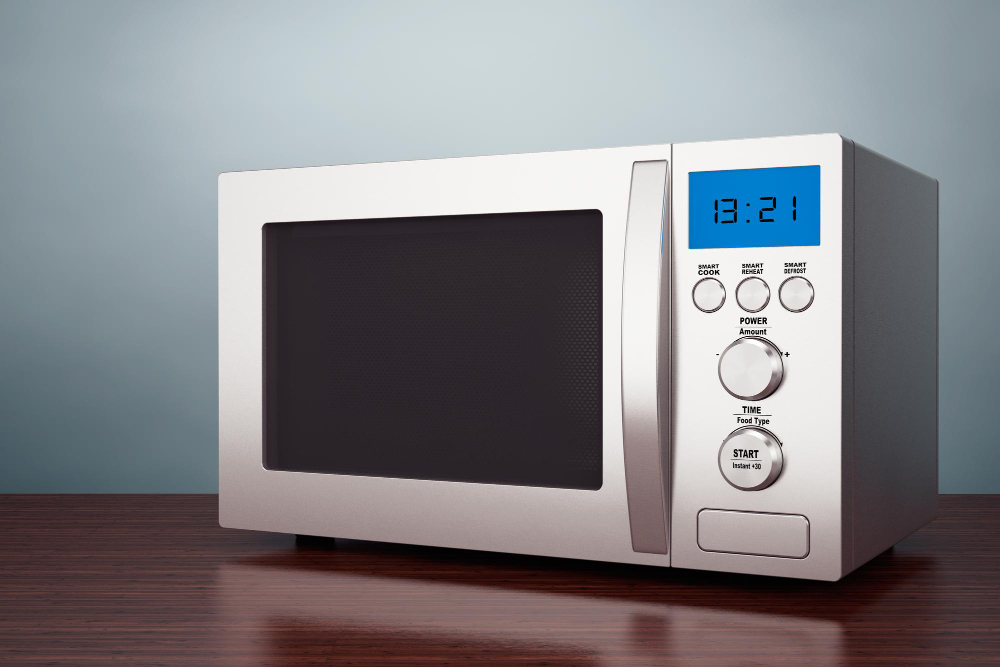
The window has a metal mesh in it, and the obvious question is why radio waves do not simply come out through the holes.
The answer is that a hole only lets a wave through if the hole is large compared with the wavelength. The waves inside a microwave have a wavelength of around twelve centimetres, and the holes in the mesh are a couple of millimetres across. To a wave of that size the mesh is not perforated at all; it is a continuous conducting sheet, and the waves reflect off it as they would off the metal walls.
Visible light, with a wavelength hundreds of thousands of times shorter, passes through the same holes without noticing them. So the mesh is transparent to one and opaque to the other, purely because of the ratio between hole size and wavelength, and that is the entire design of the door.
The same principle governs the interlocks. A microwave has several independent switches that cut the generator when the door opens, arranged so that the failure of one does not matter, because the whole safety case rests on the cavity being a closed conducting box whenever the generator is running.
Why Metal Inside Is a Problem, and Why Some Metal Is Not

An oscillating field striking a conductor drives currents in its surface. In a large smooth piece of metal those currents flow harmlessly and the metal simply reflects, which is exactly what the cavity walls do all the time.
The trouble comes with shapes. A thin edge, a point, a crumpled piece of foil or a gap between two conductors concentrates the field, and the voltage across a small gap can become high enough to break down the air and strike an arc. That is what the sparking is, and it is a geometry problem rather than a property of metal as such.
It also explains why some metal in a microwave is entirely deliberate. Certain packaging includes a metallised layer intended to absorb energy and get hot in order to brown the food, which is a use of metal rather than an accident. And the walls, the mesh and the roof vane are all metal doing their jobs.
Nothing here is advice about what to put in an appliance, and it is not intended as a guide to anything. The point is narrower: the rule people carry around is about the material, and the actual physics is about the shape.
What It Fundamentally Cannot Do
The reactions that make food brown and taste roasted need a dry surface at a high temperature. A microwave cannot produce either.
The surface cannot get dry, because the food is full of water and the energy is being deposited in that water, which turns to steam and keeps the surface wet. And the surface cannot get much above boiling point while liquid water remains, because evaporation carries heat away as fast as it arrives.
So microwaved food is steamed food, thermodynamically, regardless of what the packaging says. It can be excellent at that: it heats quickly, loses very little to the surrounding air, and because it is heating the food rather than a box of air it is one of the most efficient ways there is to warm a small quantity of anything.
What it cannot deliver is the flavour that comes from a dry surface at high temperature, which is why every attempt to produce crisp results in one has involved adding something else: a susceptor in the packaging, a grill element, a fan and a heating element, or a browning plate that gets hot by a different mechanism.
That is a fair summary of the whole appliance. It is not a small oven and it is not a different kind of fire. It is a device that puts energy directly into the water in the outer two centimetres of whatever you give it, extremely quickly and with very little waste, and then leaves conduction to do the rest exactly as slowly as it always has.
Like our content? Follow us for more.
