


The Thing That Is Missing Is Ink
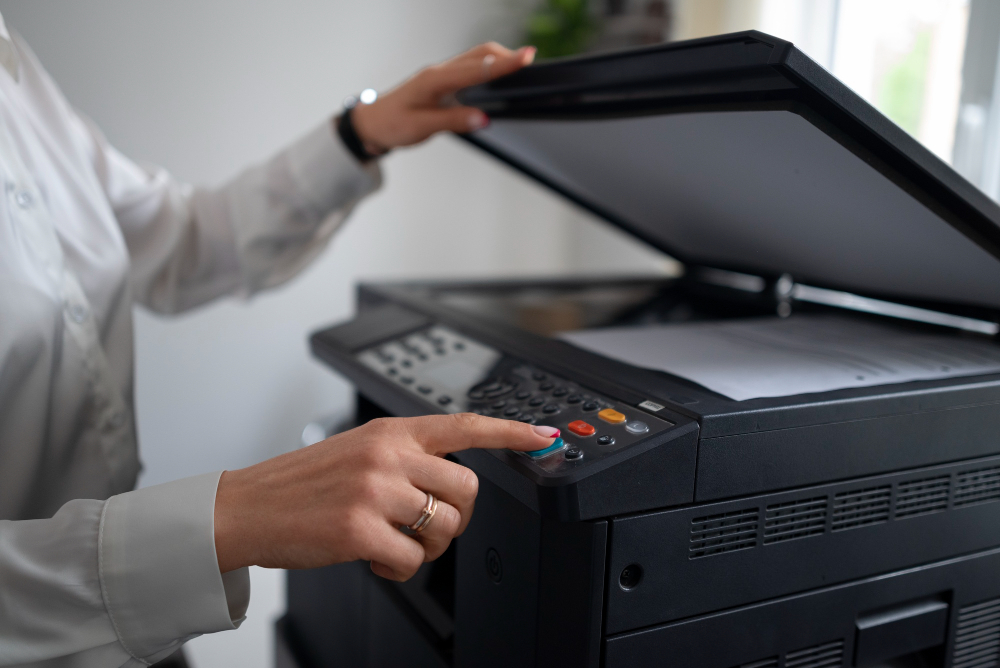
Open a photocopier and there is no liquid anywhere. No reservoir, no cartridge of fluid, no nib, no pad, no ribbon. The consumable is a black powder, and the powder is not pigment suspended in anything. It is plastic.
That single fact rules out every mental model most people have of how a copy gets made. There is nothing being pressed, stamped, sprayed or soaked. Nothing touches the paper to deposit a mark in the way a pen or a press does.
What happens instead is that an image is assembled out of electrical charge on the surface of a rotating cylinder, and then that charge is used to attract powder into the shape of the image, and then the powder is transferred to paper and melted.
It is one of the least intuitive processes in common use, it was commercially unpromising for about two decades before anybody would back it, and it is sitting in every office in the world.
Like our content? Follow us for more.
The Drum Is a Material That Changes Its Mind
The component everything depends on is a cylinder coated with a photoconductor, and a photoconductor is a substance with an unusual property: in the dark it is an insulator, and when light falls on it, it becomes a conductor.
That is the whole trick, and it is worth being clear about why it matters. An insulator will hold an electrical charge placed on its surface, because the charge has nowhere to go. A conductor will not, because the charge immediately drains away.
So a surface that switches between the two can be made to remember where light fell. Charge the whole thing in darkness and it holds that charge everywhere. Then shine a pattern of light onto it. Wherever light arrives, that patch becomes conductive for as long as the light lasts, the charge leaks away to the earthed metal underneath, and the patch ends up with nothing on it. Wherever the surface stayed dark, the charge is still sitting there.
The result is a map of charge that corresponds exactly to the dark parts of whatever was illuminated. It is a picture, it is accurate to a fraction of a millimetre, and it is completely invisible. There is nothing to see on the drum and nothing to see on the paper, which has not been involved yet.
Six Steps, and the First Two Produce Nothing Visible
The complete cycle is a sequence, and the machine runs it continuously as the drum turns, with different parts of the drum at different stages at the same moment.
First, charging. A wire or roller at high voltage lays a uniform charge across the whole width of the drum in the dark.
Second, exposure. The original is illuminated and its image is projected onto the moving drum through a lens and mirrors. The white areas of the original reflect light, the dark areas do not, so the drum receives a pattern of light that matches the white of the page. Charge drains from exactly those regions. What survives is charge in the shape of the text.
Third, developing. Powder is brought close to the drum, carrying a charge of the opposite sign, and sticks to the regions where charge remains. The invisible picture becomes a visible one made of dust, still on the drum.
Fourth, transfer. A sheet of paper is brought against the drum and given a charge stronger than the drum’s, so the powder is pulled off the drum and onto the paper.
Fifth, fusing. The paper passes between a hot roller and a pressure roller, the plastic powder melts and flows into the fibres of the paper, and on cooling it is permanently part of the sheet.
Sixth, cleaning. A blade or brush scrapes any remaining powder off the drum and the charge is neutralised, so the surface is blank and ready for the next revolution.
Every stage is doing something to charge or to powder. At no point is there anything that resembles printing as it was understood before this existed.
Why the Powder Is Plastic
It would seem obvious to use pigment. Pigment is cheap, black and does not need melting. The reason it is not used on its own gives away the whole design.
The powder must do three incompatible things. It must carry an electrical charge reliably, so that it can be moved around by fields. It must flow as a free powder without clumping, so it can be delivered evenly. And it must end up permanently bonded to paper, not sitting on the surface waiting to be rubbed off.
A thermoplastic solves all three. It accepts and holds a charge, it can be ground into free-flowing particles, and it melts at a convenient temperature and then sets. Pigment is added to the plastic to make it black, but the pigment is the passenger and the plastic is the mechanism.
The particles are also mixed with larger carrier beads that they cling to, and those beads are what actually transport the powder to the drum, releasing it where the drum’s charge is stronger than their grip. The powder is not blown or sprayed; it is carried on something and then stolen off it by the image.
This is why a copy feels very slightly raised if you run a fingernail across heavy black areas. It is a layer of melted plastic sitting in and on the paper, not a stain soaked into it, and it is also why a copy left in a hot car can smear and why pages can stick together if they are stacked while still warm.
The Paper Comes Out Warm, and That Is the Fusing
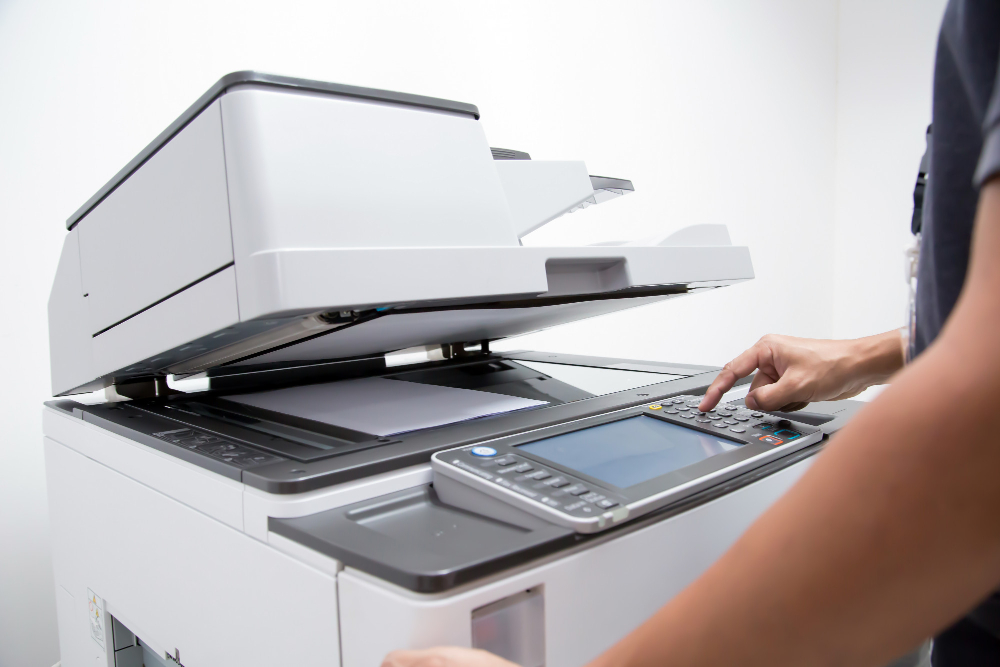
The warmth everybody has noticed is not waste heat from a motor. It is the point.
Fusing requires the plastic to be taken above its softening temperature in a fraction of a second, which means a roller running hot and a press. That roller is the single largest consumer of energy in the machine and the reason these devices draw a surprising amount of power, and it is why there is a warm-up period and why the first copy takes longer than the twentieth.
It also accounts for the smell. Melting a thin film of thermoplastic releases a small quantity of volatile material, and that particular combination of warm plastic, warm paper and ozone from the high-voltage charging stage produces an odour that anybody who has worked in an office can identify instantly with their eyes shut. It is one of the most specific and least describable smells of the twentieth century, and it is three separate processes announcing themselves at once.
The heat is also the limiting factor on what can go through the machine. Anything that will not tolerate a brief pass through a hot roller is a problem, which is the real reason certain materials are excluded rather than any issue with the electrical stages.
A Laser Printer Is the Same Machine
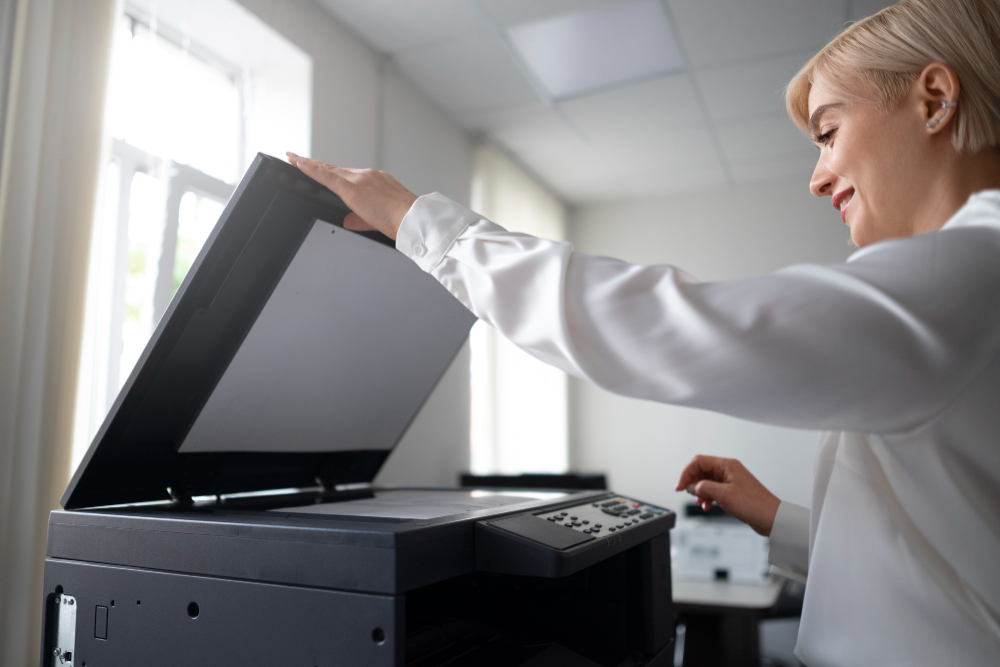
Once the process is clear, the relationship becomes obvious. A photocopier and a laser printer share five of their six steps and differ only in the second one.
In a copier, the pattern of light that discharges the drum comes from an original document being illuminated and optically projected. In a laser printer, it comes from a laser beam being swept across the drum by a spinning mirror and switched on and off as it goes.
Everything after that is identical: the same photoconductive drum, the same charged powder, the same transfer by a stronger charge, the same hot roller, the same cleaning blade. The consumables are interchangeable in principle and frequently in practice.
Which means a laser printer is a photocopier that generates its own original out of data instead of looking at a piece of paper, and that is the entire difference. The process was invented for copying and turned out to be a printing technology, which is why office printing went that way rather than developing from anything that previously existed.
It also explains the single most useful thing to know about these machines: a device that can print can almost always copy and scan, because it already contains everything required except a light and a sensor.
Why It Fails in Such Characteristic Ways
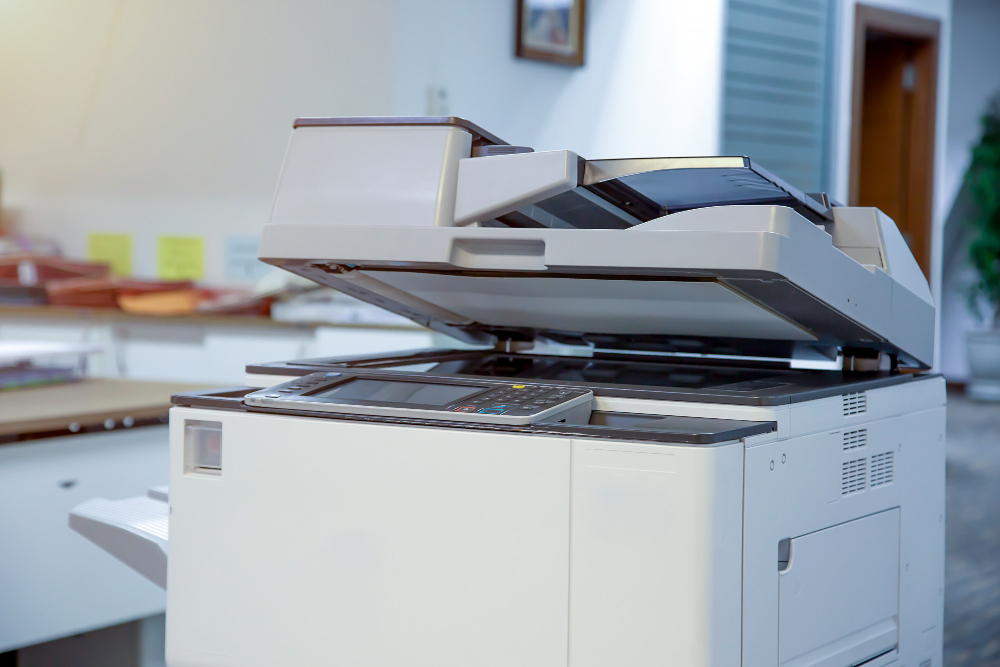
Each classic fault maps onto one stage, which makes a page of bad output surprisingly readable.
A line down the page in the same place every time is a mark on the drum or a nick in the cleaning blade, because anything that repeats at the same horizontal position is something physical in contact with a rotating surface.
A faint repeated echo of the image further down the page is incomplete cleaning or incomplete charge neutralisation, so the previous revolution’s pattern is still partly present. The spacing between the original and the echo is the circumference of whichever roller is responsible, which is how it gets diagnosed.
Overall greyness or patchiness is a developing problem: either the powder is running out or it is not holding its charge properly, and the second of those is heavily affected by humidity. Damp air makes everything slightly conductive, charges leak where they should not, and image quality degrades in a way that has nothing to do with the machine being faulty. Dry air causes the opposite problem, with paper acquiring charge and sheets clinging together.
Toner that rubs off is a fusing failure, which is a temperature problem rather than an image problem. And a blank page with the correct outline faintly visible is the one fault that tells you the electrical stages are working perfectly and only the transfer has failed.
And paper jams, which are not an electrical matter at all but a mechanical one, are overwhelmingly a consequence of the paper path having to bend a sheet around a roller, grip it, accelerate it, stop it against a fuser and release it, within a few hundred milliseconds, hundreds of thousands of times.
What It Actually Changed
The significance of the thing is not that it made copies. Copies could already be made by a dozen methods, all of which involved chemicals, specially coated paper, a wet process, a negative, or sending the document somewhere.
What this process did was make a copy on ordinary paper, dry, instantly, with no preparation and no skill, at a cost low enough that nobody needed to think about it. Each of those is a small thing and together they removed the friction from duplicating a document entirely.
The second-order effects were larger than the first. A document that can be copied freely circulates differently: it gets distributed rather than filed, it gets annotated and re-copied, it accumulates generations, and an organisation’s paperwork stops being a set of unique objects and becomes something closer to a published medium. Anybody who could reach the machine could publish to the building.
It is a reasonable candidate for the most consequential office technology before the computer, and the reason it is a good story is that the mechanism bears no resemblance to anything that preceded it. There was no incremental path from a printing press to this. Somebody noticed that a material could be persuaded to hold a picture made of nothing but charge, and built six steps around it.
Like our content? Follow us for more.
