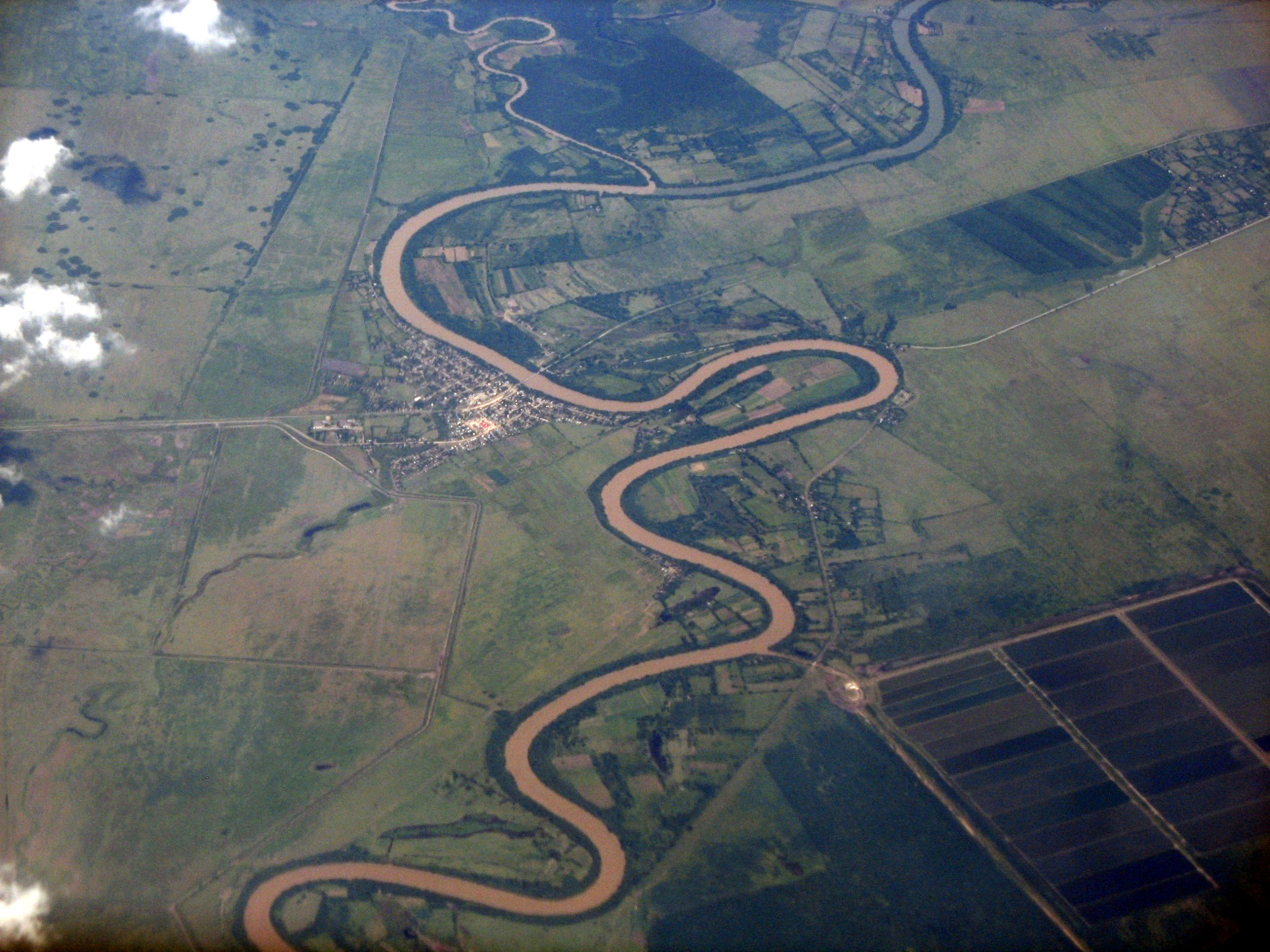
Look at a river from the air and it does something that ought to require an explanation. Water flows downhill, downhill is a direction, and the shortest route down a slope is a straight line.
Rivers almost never take it. Across any reasonably flat ground they wander in a sequence of loops that can make the channel several times longer than the direct distance, and they do this consistently, everywhere, at every scale from a stream you could step over to systems visible from orbit.
It is not a defect and it is not a response to obstacles. A river with no obstacles at all, on uniform ground, will still develop bends — and the process by which it does so is one of the more satisfying pieces of physics in the landscape.
The starting point is counterintuitive: a straight channel is not a stable configuration.
Laboratory work makes this clear. Cut a straight, regular channel in loose sediment, start a uniform flow through it, and the channel stays straight for a while — sometimes for hours or tens of hours. Then the inevitable small irregularities in the initial channel begin producing an alternating pattern of erosion and deposition along the banks, and the sinuosity increases.
Nothing was introduced to cause this. The irregularities are the ones any real channel unavoidably contains.
In a natural river the triggers are ordinary: a slightly harder patch of bank, a fallen tree, a variation in sediment, a burrow, a turbulent eddy. Any of them deflects the fastest thread of the current slightly toward one side.
Once deflected, the current strikes that bank at an angle and begins removing material from it. And that is the beginning of a process that does not stop.
The Feedback That Amplifies It
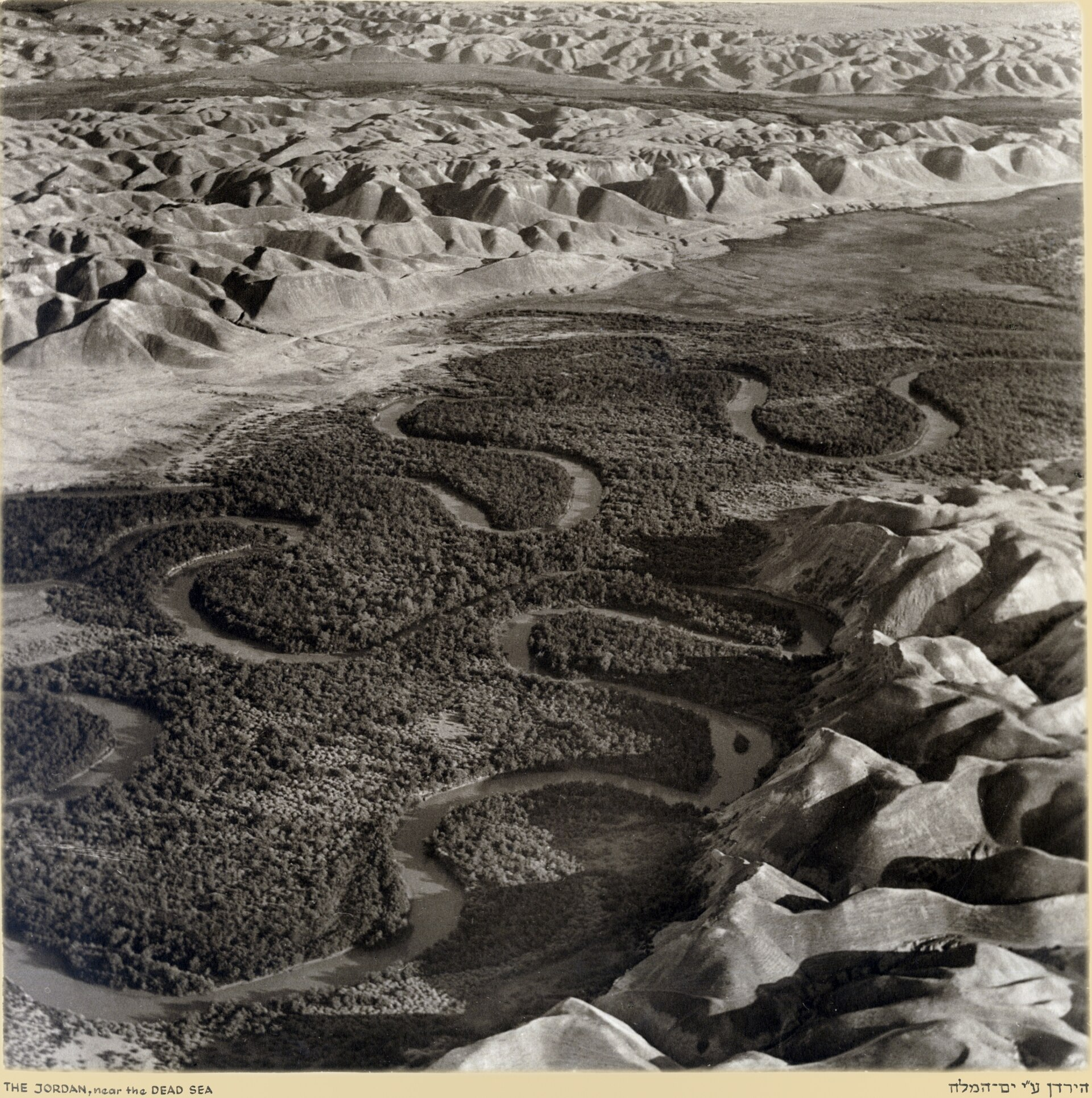
What makes a small deflection grow into a full meander is a feedback loop, and it operates on both banks at once.
Water moving round a curve travels faster on the outside of the bend and slower on the inside — the same effect as a runner on the outside lane of a track having further to go. Faster water carries more energy and erodes more effectively, so the outer bank is cut away. Slower water carries less, so the inner bank accumulates deposited sediment.
The outside is removed, the inside is built up, and the bend therefore migrates outward and grows.
Growing the bend increases the curvature, which increases the speed difference between the banks, which increases the rate of erosion and deposition. That is positive feedback: the curve creates exactly the conditions that deepen the curve.
Meanwhile the water swinging round one bend carries momentum that throws it across to the opposite bank downstream, initiating a bend in the other direction — which is why meanders alternate rather than curving continuously one way.
Like our content? Follow us for more.
The Corkscrew Inside the Channel
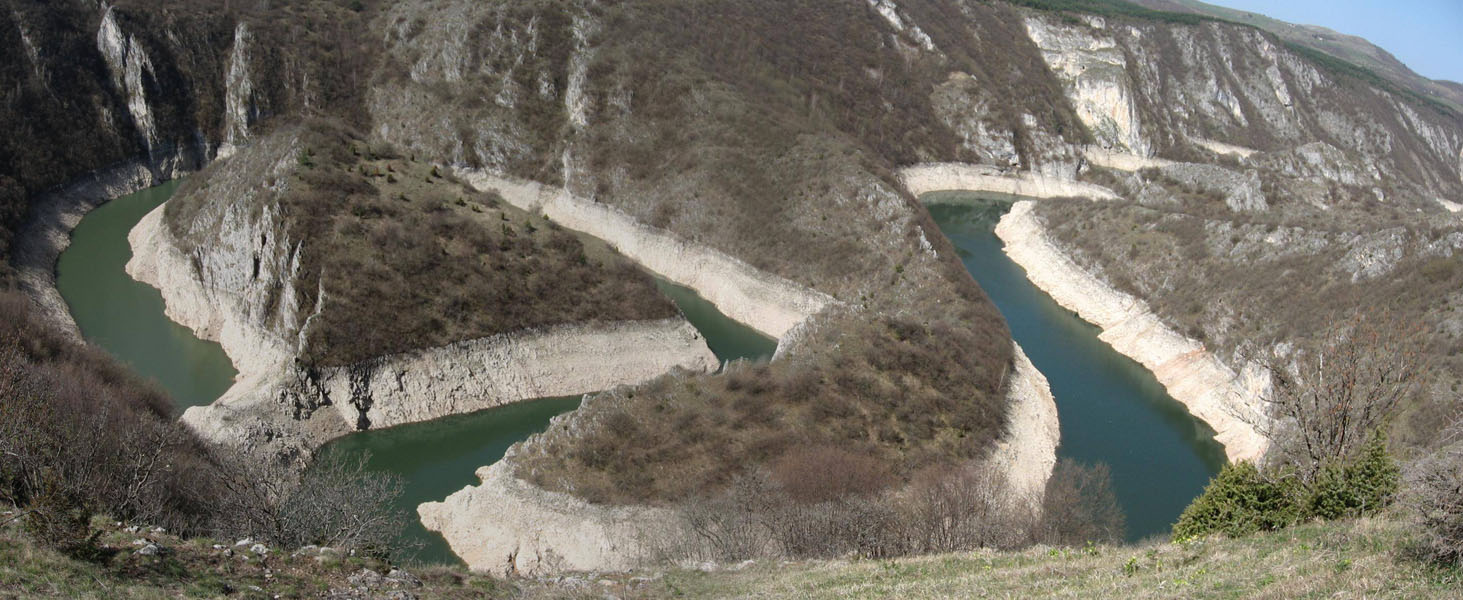
There is a further mechanism that explains where the eroded material ends up, and it is the part most people have never heard of.
Flow round a bend is not simply faster on the outside. There is a three-dimensional circulation within the channel: water near the surface moves outward toward the outer bank, plunges downward along that bank, travels back across the bed toward the inner bank, and rises again — a continuous spiral running along the length of the bend.
This is called helical or secondary flow, and it arises because the water near the surface is moving faster than the water near the bed, which is slowed by friction. Faster water is thrown outward more strongly, producing a slope on the water surface and a return circulation underneath.
The consequence is that material eroded from the outer bank is transported along the bed and deposited on the inner bank of the same or the next bend. The river is not simply losing material on one side; it is moving it across the channel and building with it.
It is worth being careful here, because popular accounts sometimes overstate this. Recent technical work notes that helical flow is a comparatively small fraction of the total flow velocity and is best understood as an effect of the pressure and momentum arrangement in the bend rather than as the cause of outer-bank erosion. It is doing the transporting; the speed difference is doing the cutting.
The Ratio That Holds Everywhere
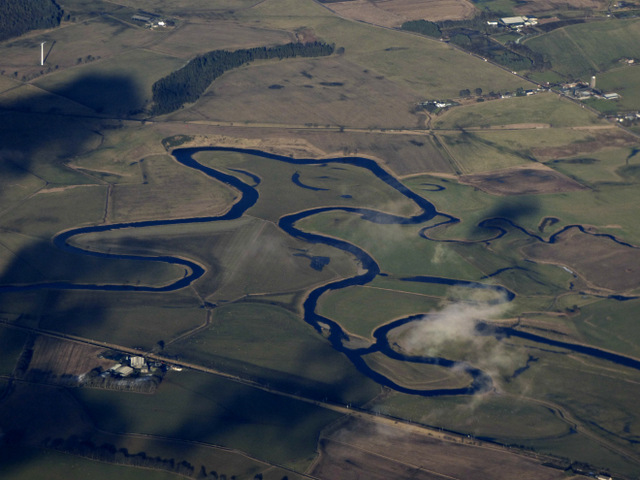
The most striking fact about meanders is that they are not arbitrary.
Measure the wavelength of a meander — the distance from one bend to the equivalent point on the next — and compare it against the width of the channel. Across an extraordinary range of rivers, that ratio comes out at roughly ten to fourteen.
This holds from very small streams to the largest rivers on the planet. It is one of the more robust scaling relationships in physical geography, and it means that a satellite image of a meandering river has a characteristic rhythm regardless of its size, which is why photographs of rivers are notoriously difficult to judge scale from.
The relationship with channel width is the direct one. The relationship with the volume of water flowing is indirect, operating through the width rather than independently.
What Happens When a Bend Gets Too Big
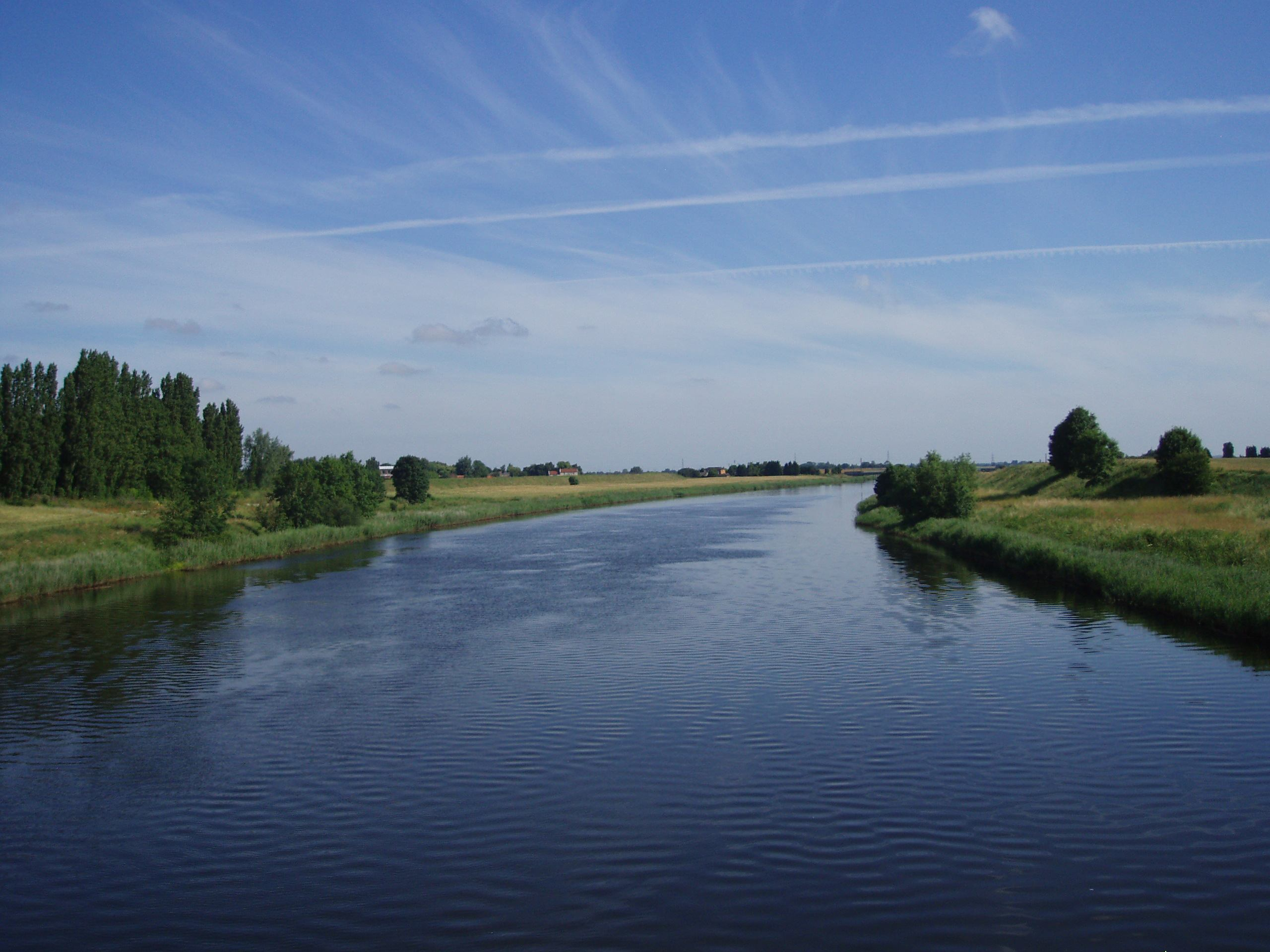
Meanders do not grow indefinitely, and the way they stop is dramatic.
As a bend grows, its amplitude increases and the neck of land at its base becomes progressively narrower. Eventually — typically during a flood, when the river has more energy and is running high — the water cuts straight across the neck.
The river abandons the loop instantly and resumes a shorter, straighter course. The severed bend becomes a curved lake sitting beside the channel, gradually silting up and filling with vegetation.
This is meander cutoff, and it means a river straightens itself abruptly at intervals to offset the gradual amplification of its bends. The overall sinuosity of a mature river fluctuates around a rough equilibrium rather than increasing without limit.
The cutoffs also record history. An aerial view of a floodplain shows abandoned loops, old channel scars and curved lakes marking where the river used to be, sometimes across a band many times wider than the current channel.
The Rivers That Do Not Meander
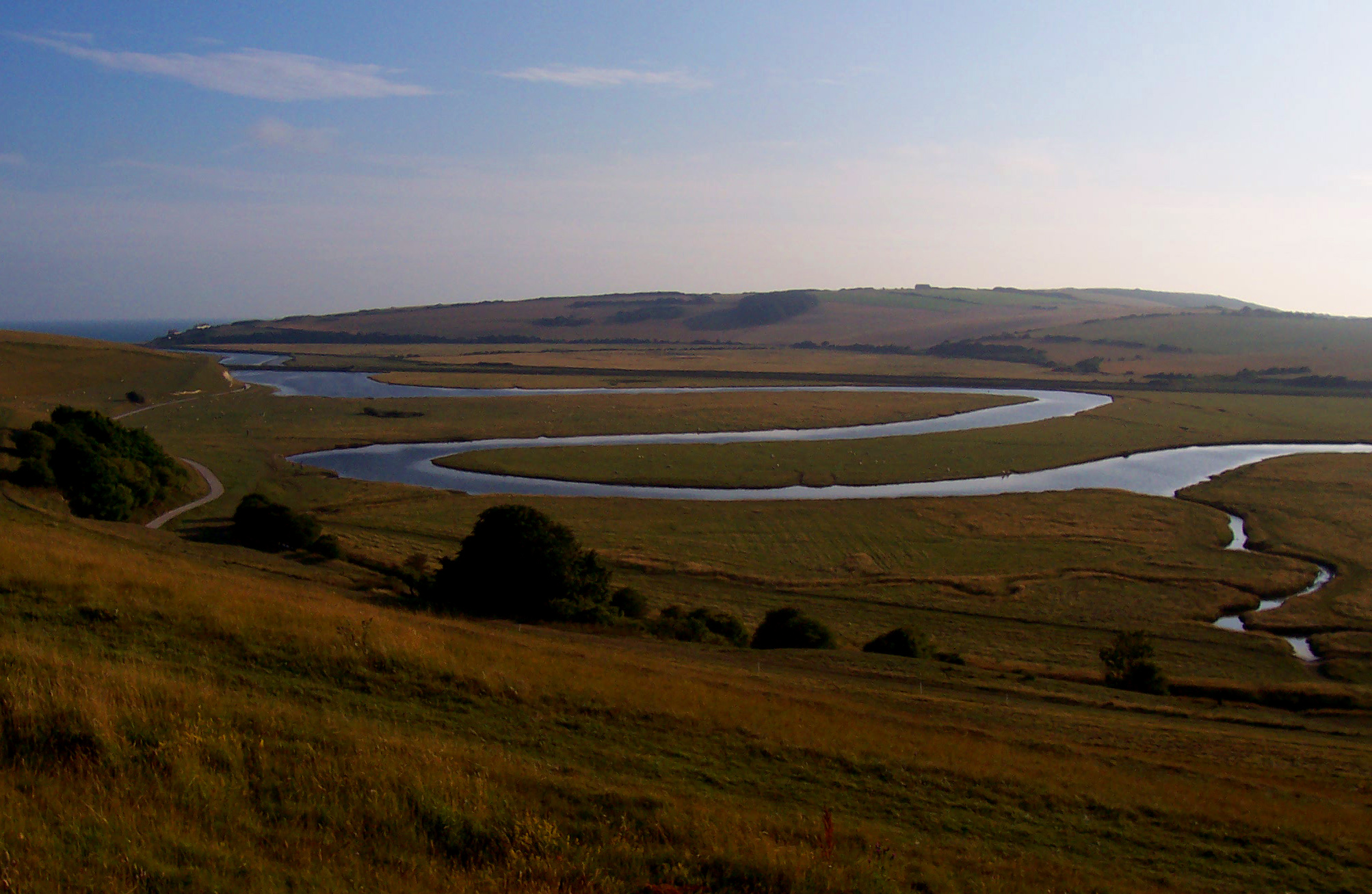
The exceptions confirm the mechanism, and there are two main ones.
A river confined in a narrow rock-walled valley cannot move sideways, because there is nothing erodible to move into. The channel is held in place by the geology rather than by any preference for straightness.
A steep mountain stream with a coarse bed frequently does not meander either, because the gradient is high enough that flow is dominated by moving downhill rather than by lateral erosion, and the bed material is too large to be shifted in the required way.
There is also a third case worth knowing, which is what happens when people intervene. Rivers have been straightened repeatedly for navigation and flood control, and the general experience is that they attempt to meander again unless continuously maintained — because the underlying instability has not been removed, only suppressed.
What the Bends Do for the River
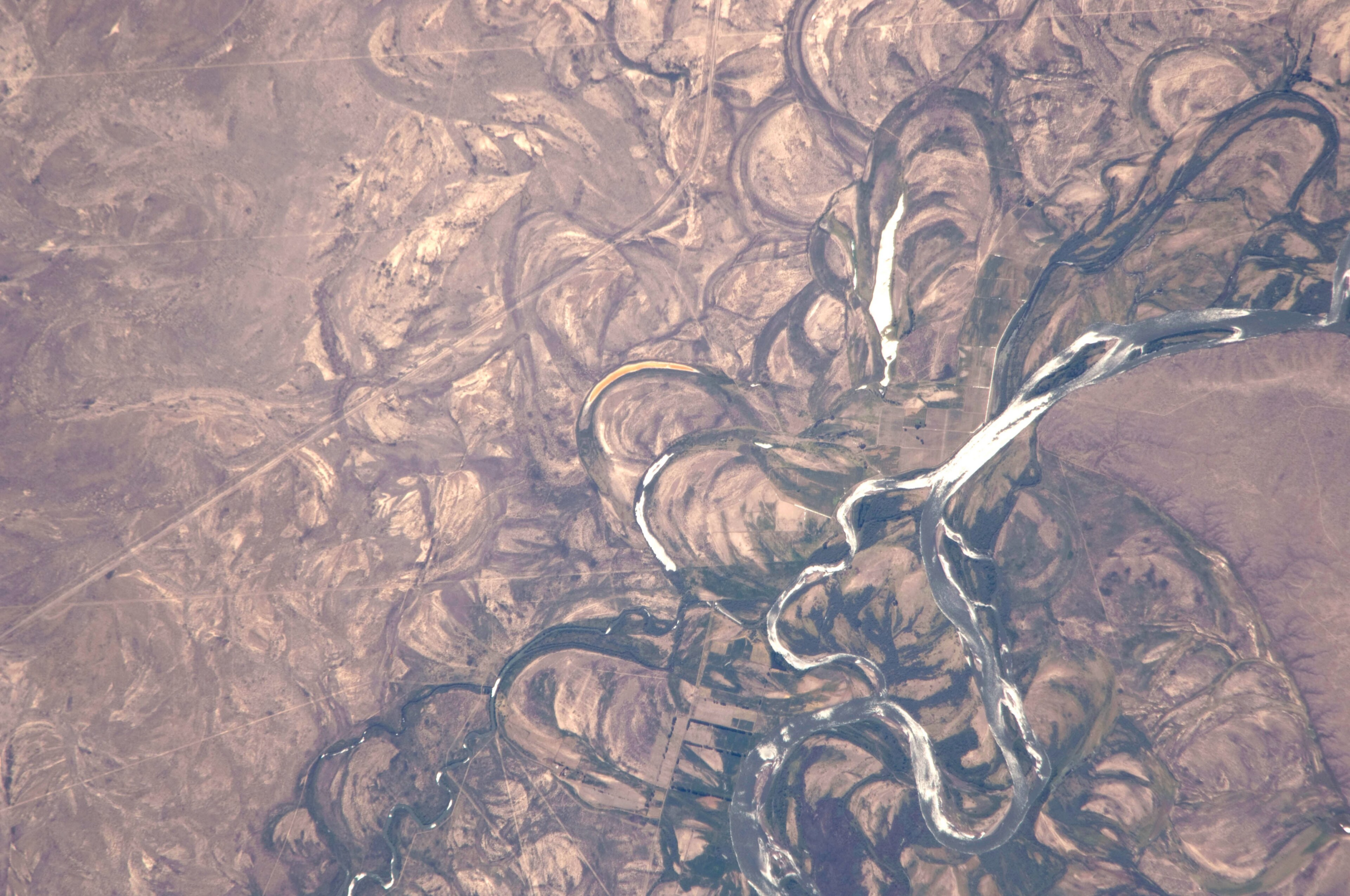
There is a question underneath all of this that is worth asking: does the meandering accomplish anything, or is it simply what happens?
The mechanism does not require a purpose. Water does not choose to bend and the feedback loop needs no justification. But the resulting geometry does have a consequence that is worth understanding.
A meandering channel is longer than a straight one between the same two points, and a longer channel over the same drop means a gentler gradient. Gentler gradient means slower flow, and slower flow means less erosive energy.
So a river that has developed bends is running less steeply than the same river running straight, which is why sinuosity tends to be greatest on gentle slopes and least on steep ones — a mountain stream has energy to spare and a lowland river does not.
Some researchers have described this in terms of the river settling toward a configuration that distributes energy more evenly along its length. That framing has been contested, and vigorously: several geomorphologists object that it smuggles in the idea of a river as an agent seeking an outcome, and argue that any such principle should be derivable from ordinary flow and sediment physics rather than added on top.
The dispute is worth knowing about because it is a real methodological argument rather than a factual one. Everyone agrees on what the water does. What is contested is whether describing the result as an equilibrium the river tends toward explains anything the mechanics do not already cover.
A Pattern That Draws Itself
What makes meandering worth understanding is that nothing is directing it.
There is no plan, no obstacle being avoided and no destination being sought. There is water, sediment, gravity and friction, and an initial irregularity too small to see.
From those ingredients a pattern emerges that is consistent enough to be measured as a ratio, recurring at every scale, on every continent, in every material that can be eroded — and the same shape appears in ocean currents and in meltwater channels on ice, where the specifics differ entirely and the geometry does not.
A river bend is a small, visible demonstration that complicated-looking patterns in nature frequently require no designer, no purpose and no intelligence. They require a feedback loop and enough time.
Like our content? Follow us for more.