

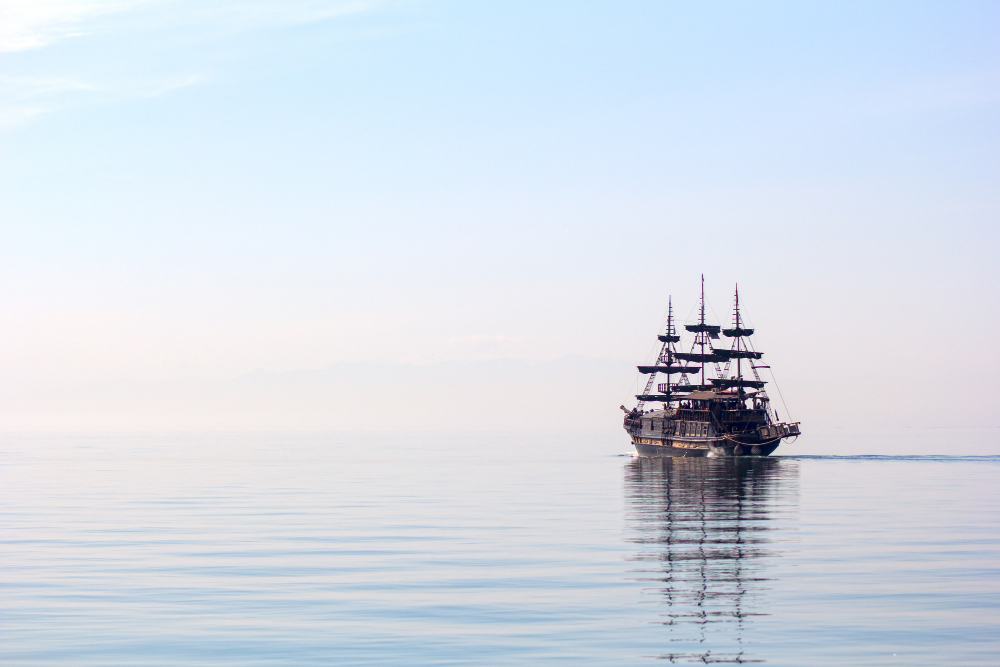
There is an idea about sailing that seems obviously true and is only half the story.
The idea is that a sail is a bag that catches the wind and gets pushed. That is what happens when the wind is behind, and it is the simplest possible arrangement: a sheet of cloth held up, and a vessel driven downwind.
It also has a fatal limitation. A vessel that can only be pushed downwind can go in one direction, and getting home means waiting for the weather to change.
Every important development in sailing has been about escaping that limitation, and the escape depends on treating a sail not as a bag but as a wing.
The Sail as a Wing
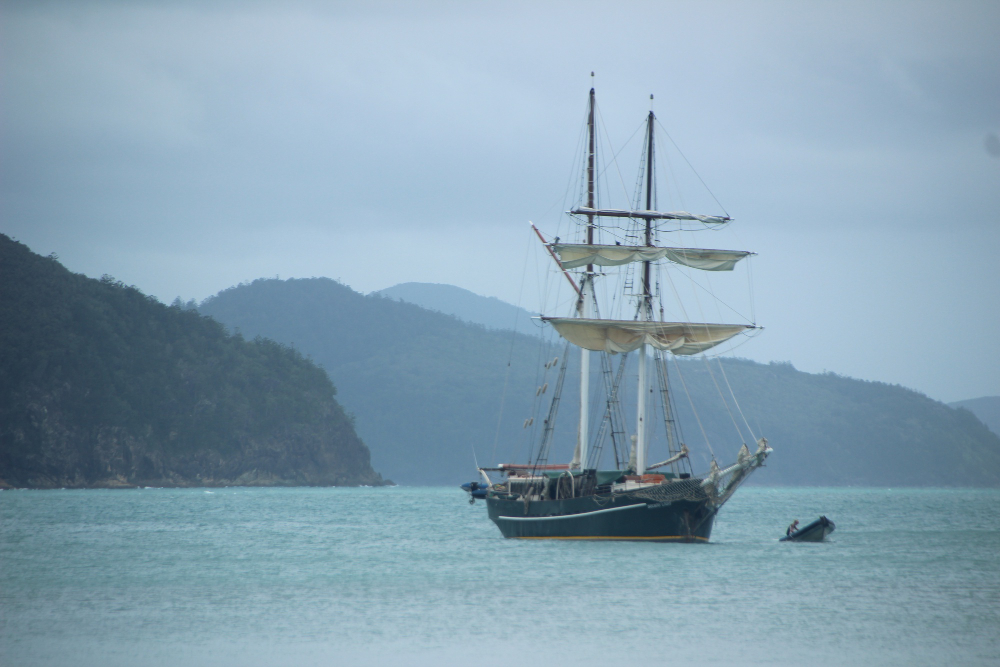
The mechanism is the same one that lifts an aircraft, turned on its side.
A sail set at a shallow angle to the oncoming wind takes air and deflects it, and the reaction to that deflection acts at roughly right angles to the sail rather than in the direction the wind is blowing.
That reaction force can be resolved into two parts: one pushing the vessel sideways, which is large, and one pushing it forward, which is smaller.
The sideways push is by far the bigger of the two, which would simply blow the boat across the water if nothing resisted it.
What resists it is the hull below the waterline, and particularly any deep fin, keel or board, which meets a great deal of resistance moving sideways through water and comparatively little moving forward.
So the boat is pushed sideways by the wind, refuses to go sideways because of the water, and squeezes forward instead — which is the whole trick and is far less intuitive than the bag version.
Like our content? Follow us for more.
Why Not Directly Into the Wind
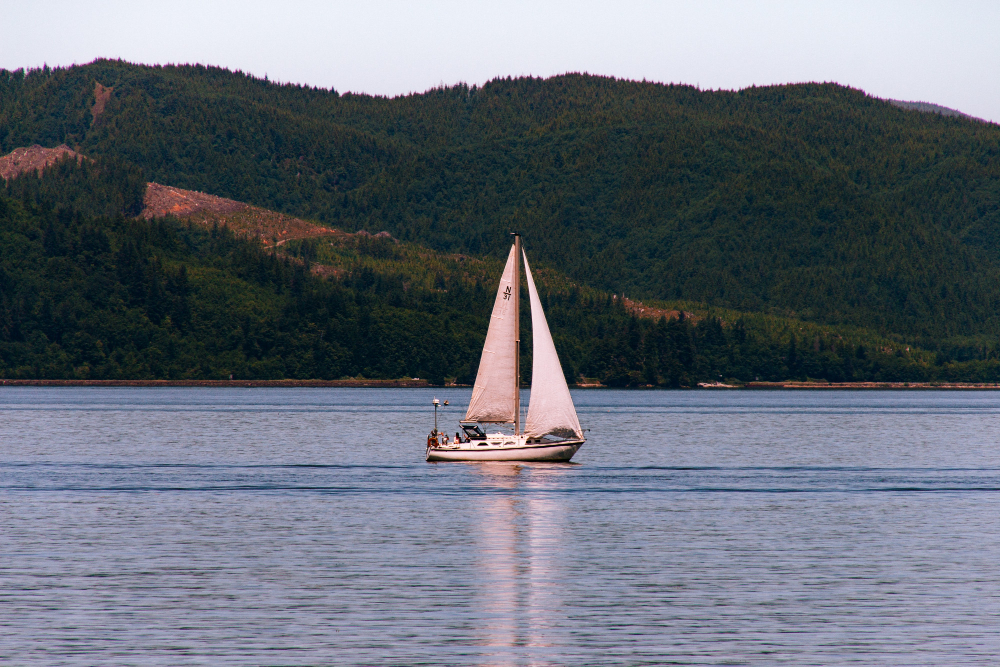
There is a limit, and understanding it explains how sailing vessels actually travel.
As the angle between the sail and the wind narrows, the airflow eventually stops following the sail’s curve and breaks away, at which point the force collapses and the sail flaps.
That sets a minimum angle to the wind at which any vessel can sail, which varies with the rig, the hull and the conditions.
Sailing directly into the wind is therefore impossible, and progress toward it is made by sailing as close as the vessel manages on one side, then turning and doing the same on the other.
That zigzag covers substantially more distance than the straight line, and the better a vessel points toward the wind, the less distance is wasted.
The manoeuvre of turning through the wind is itself a moment of vulnerability, since the vessel loses drive while its bow passes through the dead angle and can be left stopped if the turn is mishandled.
There is a material point worth adding. Sails were woven cloth for most of history, which stretches, absorbs water, rots and grows heavier when wet – so the shape a sail held depended on its condition as much as its cut.
Modern synthetic sailcloth holds its shape far better, which is one reason modern rigs point closer to the wind.
The Two Families of Rig
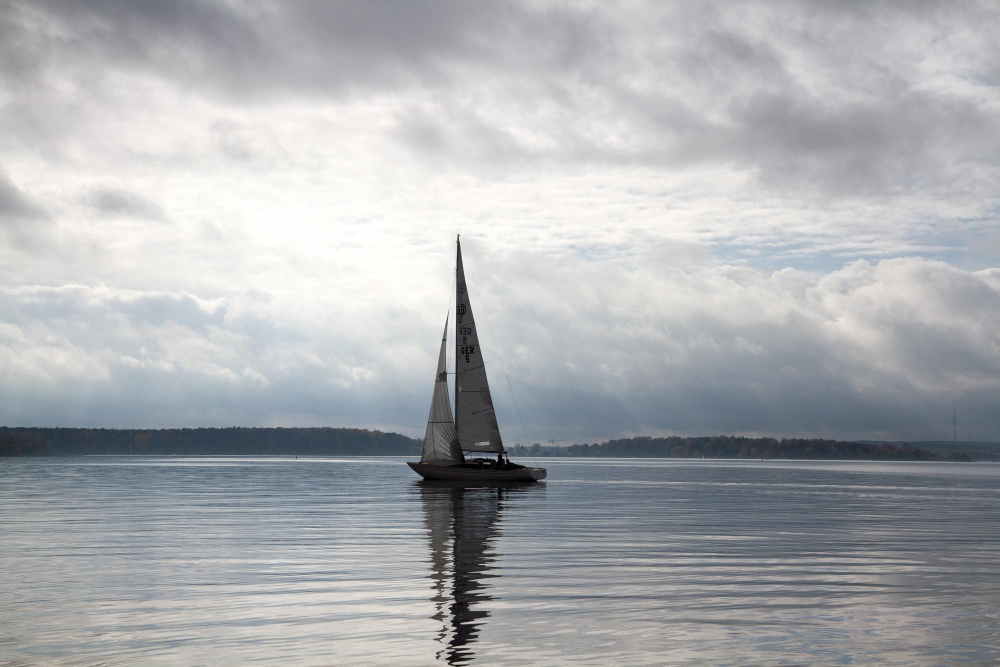
Sailing rigs divide broadly into two kinds, and the division explains an enormous amount of maritime history.
Square sails hang from horizontal spars set across the vessel, and are at their best with the wind behind or on the quarter, driving a vessel downwind with great power and stability.
Fore-and-aft sails are set along the line of the vessel and pivot around a mast or a stay, and are far better at working toward the wind.
Square rigs suited long ocean passages that followed predictable wind systems, where a vessel could sail for weeks with the wind consistently behind and needed to carry large sail area handled by a large crew.
Fore-and-aft rigs suited coastal work, where the wind comes from any direction, courses change constantly, and a small crew has to manage everything.
Large sailing ships frequently combined both, with square sails for power on the main masts and fore-and-aft sails for control and windward ability elsewhere — which is why a big sailing vessel carries such a complicated-looking arrangement.
What the Rigging Is Doing
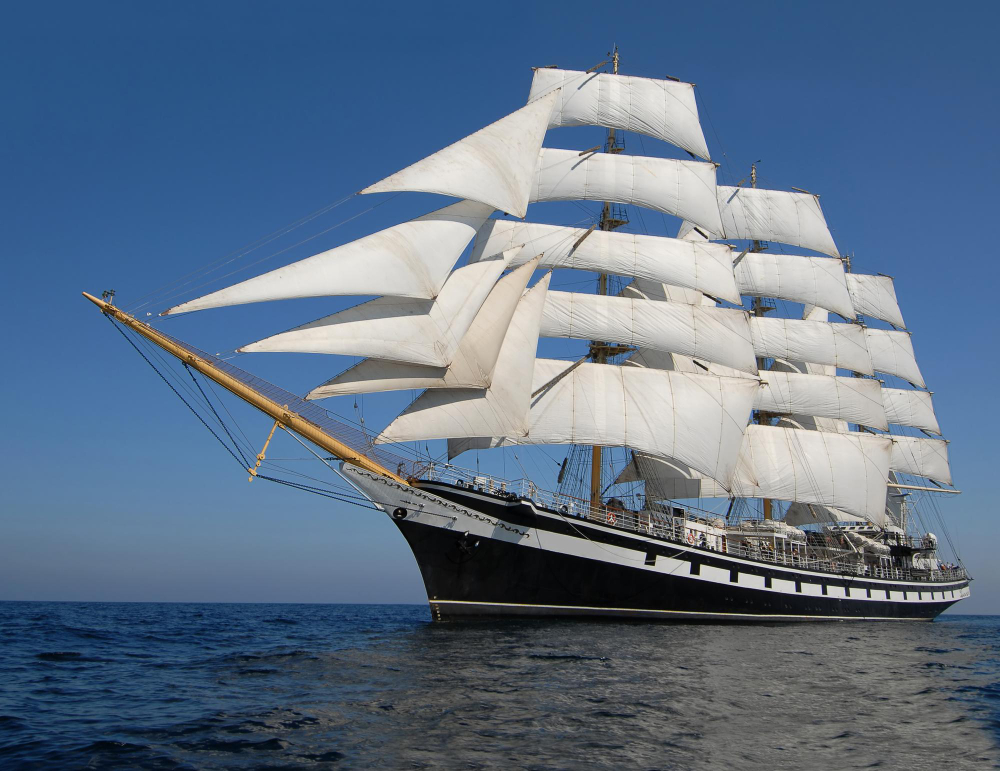
The ropes fall into two categories and confusing them makes a ship look incomprehensible.
Standing rigging is fixed and holds the masts up, running from the mastheads down to the sides, bow and stern, and it is adjusted rarely.
Running rigging moves, and it does two jobs: raising and lowering sails, and controlling their angle and shape once set.
A mast on its own would snap or fall, because it is a long column loaded from the side by the sails; the standing rigging turns it into a braced structure that can take that load.
The running rigging is where the sailing happens, since the same sail in the same wind produces quite different results depending on the angle it is set at and how much its shape is flattened or allowed to bag.
That trimming is continuous work, and it is the difference between a vessel sailing well and one merely sailing.
Why the Shape Matters So Much
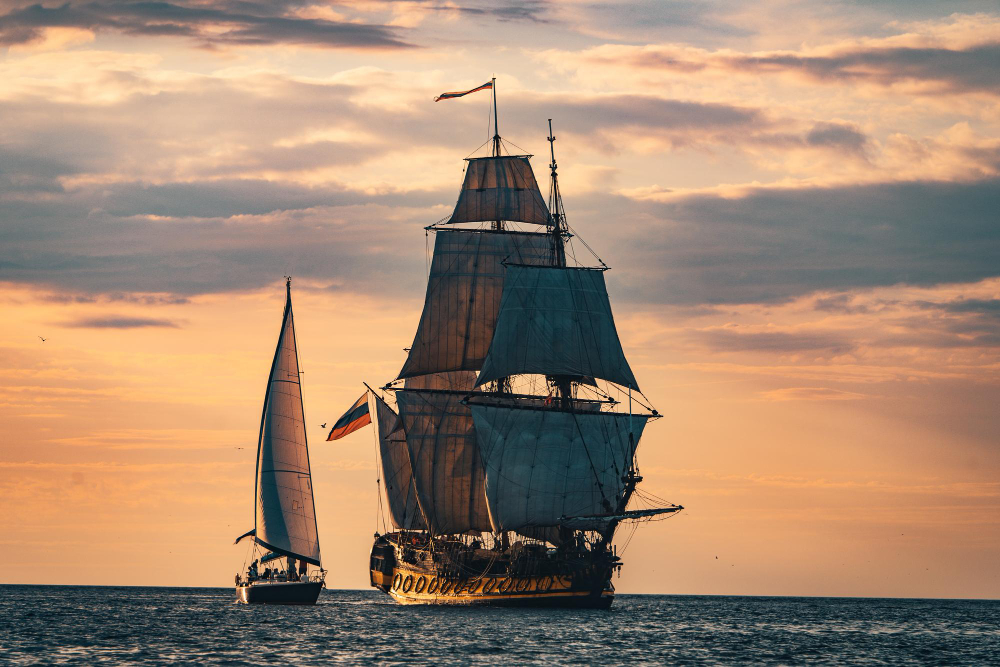
A sail is not a flat sheet, and the curvature is designed.
A sail cut with a curved profile generates more force than a flat one, in the same way a curved wing does, because it deflects air more effectively.
Too much curve produces more force and more sideways push, which heels the vessel over and increases drag, so there is an optimum rather than a maximum.
In strong wind the sail is flattened by tensioning its edges, which reduces the force and keeps the vessel upright; in light wind it is allowed to take more shape.
Reducing sail area entirely — by rolling or folding part of the sail away — is the other response to strong wind, and knowing when to do it early is a mark of experience.
A sail that is too full in strong wind does not drive the boat harder; it lays it over and stalls its progress, which is one of the more counterintuitive facts in sailing.
Why Masts Are Where They Are
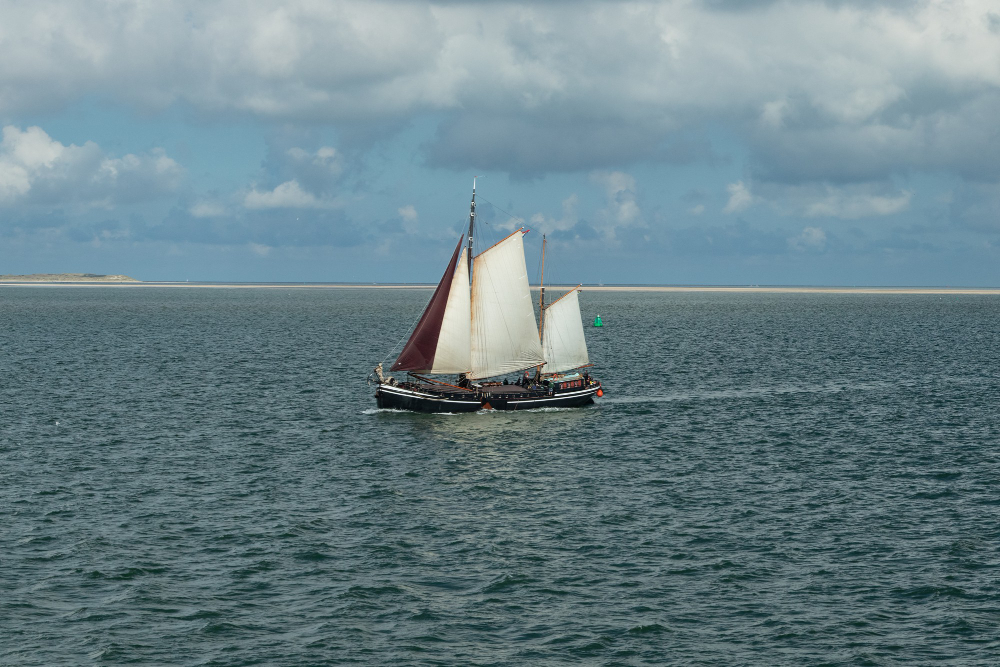
The placement of masts is determined by balance, and getting it wrong makes a vessel unmanageable.
The combined force of the sails acts at a point, and the resistance of the hull acts at another, and the relationship between the two determines how the vessel behaves when left to itself.
If the sail force acts behind the hull’s pivot point, the vessel turns into the wind when the helm is released, which is generally desirable because a vessel that rounds up when unattended is safer than one that bears away.
Too much of that tendency makes the vessel fight the helm constantly and wastes energy dragging a turned rudder through the water.
Too little, or the opposite, makes the vessel bear away from the wind when unattended, which is harder to manage and can be dangerous.
So the mast positions and the sail areas are arranged to give a small, deliberate tendency in the safe direction, and changing the sail plan alters it.
That is why reducing sail in strong wind is not simply about area: taking in the wrong sail moves the balance and can make the vessel handle badly even while the load is reduced.
What Replaced It and What Did Not
The commercial end came quickly and the principle survived intact.
Engine-driven vessels go where they are pointed regardless of the wind, keep a schedule, and need far smaller crews, which ended commercial sail for most purposes within a few decades.
Sail persisted longest in trades where cargo was not urgent and where crews were cheap, and in places where fuel was expensive or unavailable.
What remained afterwards was sailing as a sport, a pastime and a training method, where the object is the sailing itself rather than the cargo.
And the aerodynamics turned out to be portable. The understanding of how a curved surface generates force from moving air fed directly into the development of wings, and modern racing rigs use shapes and materials that came back from aviation.
Which is a reasonable place to finish. The insight that a sail is a wing rather than a bag took a very long time to arrive, made it possible to sail against the wind, and ended up helping to explain how anything flies at all.
And it is worth noticing how long it took. People sailed for thousands of years before the wing account was articulated, working by accumulated practice rather than theory – which is a reminder that knowing how to do something and knowing why it works are different achievements, frequently separated by centuries.
And it is worth noticing how long it took. People sailed for thousands of years before the wing account was articulated, working by accumulated practice rather than theory – which is a reminder that knowing how to do something and knowing why it works are different achievements, frequently separated by centuries.
Like our content? Follow us for more.
