There is a small category of materials that are not assembled from anything, and felt is the oldest of them.
Almost every fabric is made of threads. Spinning turns loose fibres into yarn, and weaving or knitting turns yarn into cloth, which then has to be cut and sewn into a shape.
Felt skips all of it. Loose fibres are made to grip each other directly, with no spinning and no weaving, producing a sheet that is continuous in every direction.
That makes it a material with no weak direction, no cut edges that fray and no seams — and it can be formed into a three-dimensional shape without being cut and joined, which is precisely what a hat needs.
Why the Fibres Lock
The mechanism is a property of the fibre surface.
Animal fibres are covered in microscopic overlapping scales, arranged like tiles on a roof, all pointing in the same direction along the fibre.
Those scales mean a fibre slides easily in one direction and catches when moved the other way, which is a kind of one-way ratchet at a very small scale.
When a mass of such fibres is wetted, warmed and agitated, the individual fibres are pushed back and forth against each other, and each one can only advance — it cannot slide back.
The result is that fibres work their way progressively deeper into the tangle and cannot retreat, so the mass gets tighter and tighter and the whole thing contracts substantially.
Warmth and moisture make the fibres more flexible, and conditions that swell the scales open make them catch more aggressively, which is why traditional felting used hot solutions rather than plain water.
That is also why the process is irreversible. Nothing is bonded chemically; the fibres are simply tangled beyond any possibility of being pulled apart.
Like our content? Follow us for more.
Why This Is the Same as Shrinking a Jumper
The identical process causes a familiar domestic accident.
A knitted woollen garment put through a hot wash with agitation experiences exactly the conditions felt-making requires: heat, moisture and movement.
The fibres in its yarn behave as they would in a felting workshop, migrating and locking, and the whole garment contracts and becomes dense.
That is why a shrunk jumper cannot be stretched back — the change is not a compression that can be undone but a new arrangement of tangled fibres.
It also explains why felting is deliberately induced with the same three conditions and why textiles intended not to felt are treated to smooth or remove the scales.
So the disaster and the craft are the same phenomenon, distinguished only by whether anybody wanted it.
There is a sizing point worth adding. Hats were made in a range of head sizes rather than adjusted to each wearer, and a trade existed in stretching or shrinking one slightly to fit, using the same responsiveness to heat and moisture that formed it.
Shaping the Hat
The forming process explains the shape of the finished object.
The felted material is produced first as a rough cone or hood, substantially larger than the finished hat and still somewhat loose.
It is then worked further, shrinking it down toward the required size, which increases the density as well as reducing the dimensions.
The damp cone is pulled and pressed over a solid wooden block shaped like the head and crown of the intended hat, and is worked down onto it until it takes the form.
The remaining material spreads outward as the brim, and is flattened and set to the required width.
Once dry, the shape is fixed, because the fibres have set in their new arrangement — and stiffening agents are frequently applied to help the finished hat hold its form and resist weather.
The block is the crucial tool. A hat is a copy of a wooden shape, which is why particular styles could be reproduced exactly and why blocks were valuable enough to be inherited.
There is a weight point worth adding. A felt hat is light for its bulk because it is mostly trapped air, which is why a large hat can be worn all day without discomfort and why felt was preferred to heavier alternatives.
Why the Brim Curls
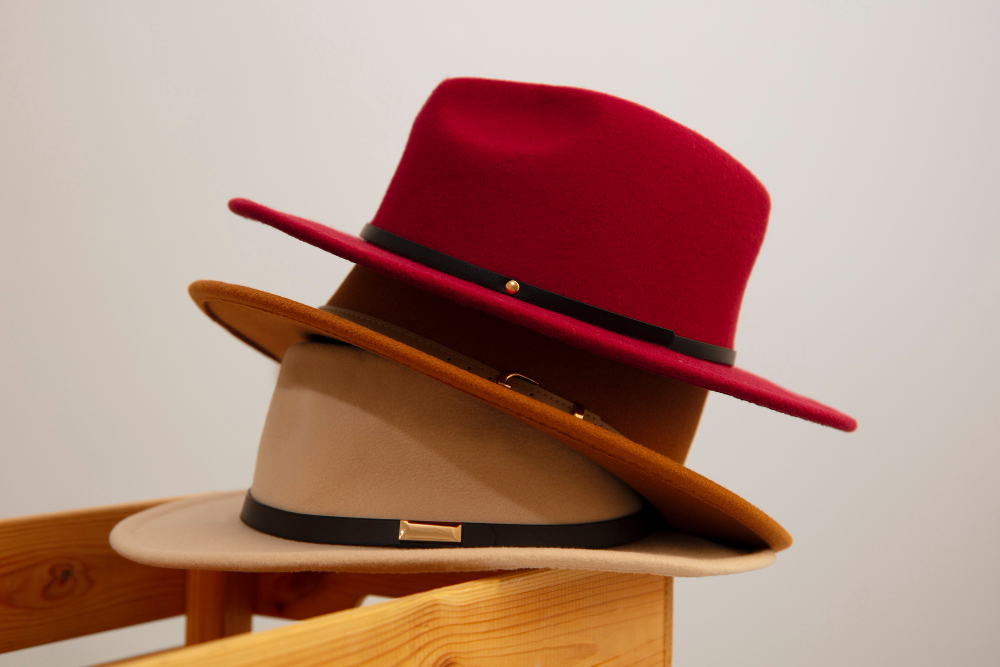
A detail that puzzles people is deliberate.
A flat brim on a felt hat tends to droop under its own weight, particularly when damp, because the material is flexible.
Curving the brim — upward at the edges, or downward at the front — stiffens it in the same way that curving a sheet of paper makes it rigid, since bending it further requires stretching or compressing the material.
That is why so many hat styles have curved brims, and why the curve is set deliberately during shaping and steamed back into place when it relaxes.
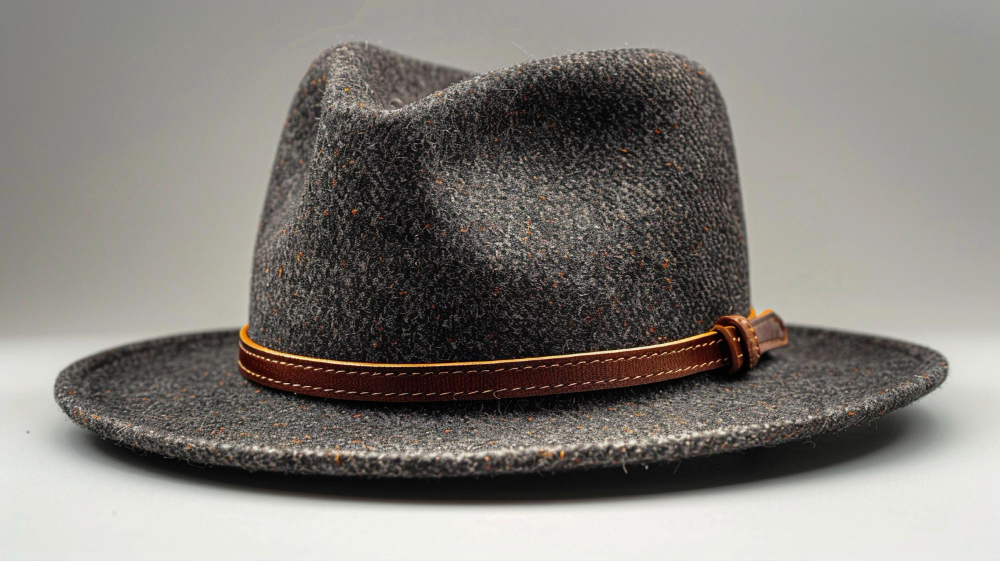
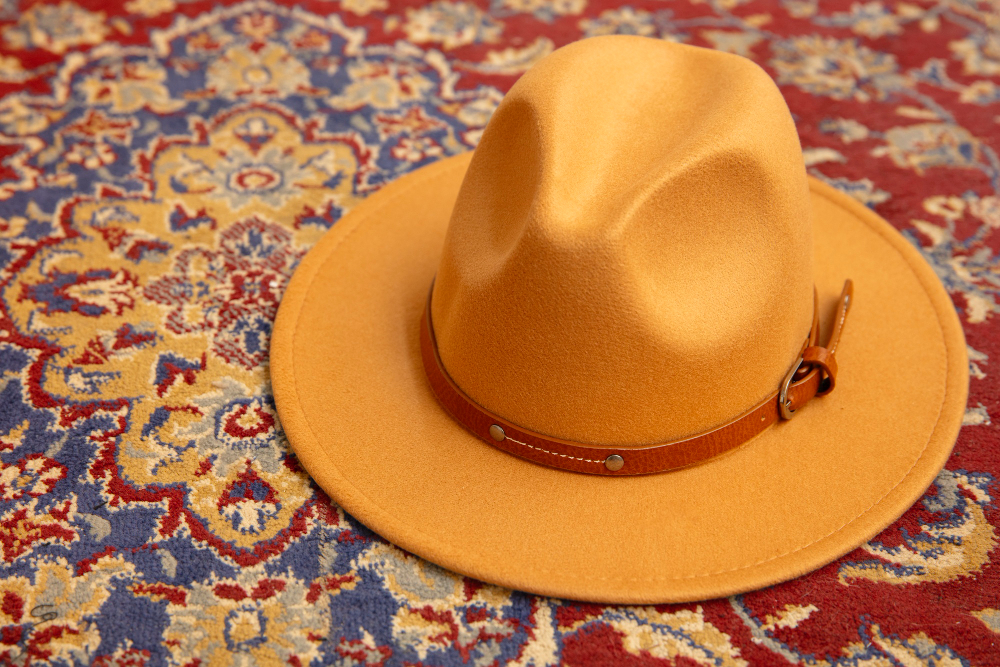
The same principle explains the creases pressed into the crown of many hats: a folded or dented shape is stiffer than a smooth dome and holds its form better.
So the features that look purely stylistic are largely structural, arrived at because they made the hat keep its shape.
What Else Felt Is Good For
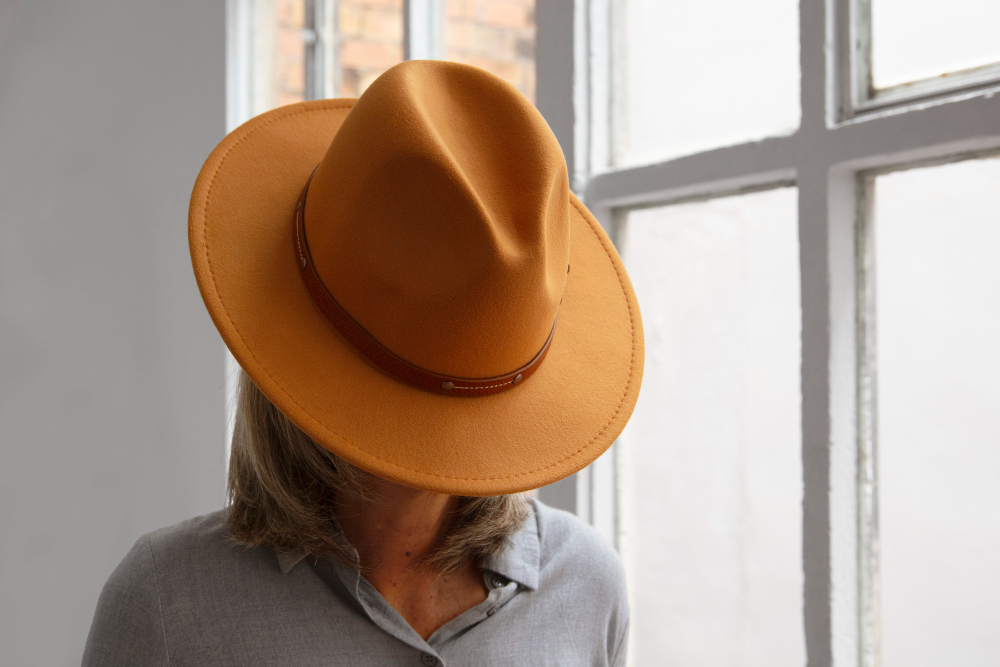
The material had uses well beyond hats, and they share the same reasoning.
Felt has no grain and no cut edges, so it can be cut in any direction and will not fray or unravel, which suits any application where an edge must be left raw.
It is dense and full of trapped air, which makes it an effective insulator against both heat and sound.
It compresses and recovers, which makes it useful as padding, as a gasket and as a damper between moving parts.
It grips, and it does not shed threads, which is why it appears as a protective layer under objects that would otherwise scratch a surface.
And it can be produced in almost any thickness, from a sheet thin enough to be flexible to a slab stiff enough to hold a shape.
Those properties gave it a long industrial life in machinery, where felt pads, washers and dampers were standard components, and many are still made because nothing simpler does the same job.
Why Fur Was Better Than Wool
The material choice had consequences that reached a long way.
Some animal fibres felt far more readily and produce a finer, denser, more water-resistant result than others, and fur fibres from certain animals were regarded as by far the best material for fine hats.
That created enormous demand for particular furs, which drove trade networks, exploration and commercial competition over very long distances for a sustained period.
The trade had substantial and well-documented consequences for the animal populations involved and for the people whose lands supplied them.
Demand eventually fell when fashion shifted to other materials, which changed the economics of that trade abruptly.
Those consequences are a large historical subject in their own right, and this article does not attempt to cover them — but it is worth knowing that the reason was a property of microscopic scales on a fibre.
There is a maintenance point worth adding. Felt responds to steam, which means a hat that has lost its shape can be reshaped by somebody who knows how, and a trade existed in cleaning, reblocking and reshaping hats rather than replacing them.
That trade disappeared with the habit of wearing them.
What Happened to the Hat
The decline of hat-wearing is unusually complete and the causes are debated.
For a long period, an adult outdoors without a hat was unusual, and hats were made, sold, cleaned and reshaped by an extensive trade.
That changed within a generation, and the reasons offered include changing fashion, cars replacing walking, the end of formal dress codes, and changes in how people styled their hair.
No single explanation accounts for it, and the speed of the change is striking regardless of cause.
What survives is the technique. Felt is still made the same way, still shaped on blocks, and the skills persist in a much smaller trade producing hats for people who choose them rather than assume them.
Which is a reasonable thing to consider holding one. There are no seams, no threads and no cut edges anywhere in it — just a very large number of fibres that were pushed together until they could not get apart, and then pressed onto a wooden shape until they agreed to keep it.
Which is an unusual way to make anything. Almost every other material is assembled from parts that were made separately, and this one is produced by persuading a heap of loose fibres to stop being separate at all.
Which is an unusual way to make anything. Almost every other material is assembled from parts that were made separately, and this one is produced by persuading a heap of loose fibres to stop being separate at all.
Like our content? Follow us for more.